Skip to content

You've got six days in Paris, a phone full of screenshots of the same five landmarks, and a phrasebook that hasn't left your bag since you bought it. The problem isn't motivation. It's that every stop on your list comes with a queue, a security check, and a hundred people taking the identical photo, which leaves no room for the thing that builds fluency, a short exchange with someone who lives here.
David, a marketing professional preparing to relocate to Paris for work, became fluent in French in 90 days after starting an intensive course, and he credits everyday, real-world practice for much of that progress. A covered arcade. A market stall. A museum guard with two minutes and a willingness to correct your pronunciation. That's where the language stops being homework and starts being yours.
Our instructors send learners to the eight places below for exactly that reason. Each one comes with a concrete French task attached, so an afternoon out becomes a lesson you can measure. No passport of vocabulary required, no perfect accent expected, and no queue longer than your patience.
Table of Contents
- 1. Passage des Panoramas, the Covered Arcade Where Parisians Still Shop
- 2. Promenade Plantée, the Elevated Garden Built on an Old Railway
- 3. Bibliothèque Forney, the Free Library for Arts and Crafts
- 4. Musée Nissim de Camondo, a Private Mansion Frozen in the 1920s
- 5. The Hammam of the Grand Mosque of Paris, a Quiet Courtyard Ritual
- 6. Musée de la Chasse et de la Nature, an Offbeat Museum in a Renaissance Mansion
- 7. Musée de la Vie romantique, a Quiet House Museum with a Tea Garden
- 8. Maison de Victor Hugo, the Writer's Home on Place des Vosges
- How the eight Paris hidden gems compare for language practice, cost, and booking
- Turn Your Next Paris Walk Into Lasting French Practice
1. Passage des Panoramas, the Covered Arcade Where Parisians Still Shop
The big landmarks give you a security line and a photo everyone else already has. Passage des Panoramas gives you a counter to stand at. Tucked into the 2nd arrondissement, it opened in 1800 and ranks among the oldest covered shopping arcades in Paris, a glass-roofed corridor of mosaic floors and narrow shopfronts holding stamp dealers, bookbinders, small bistros, and tea rooms that locals still use on an ordinary weekday.
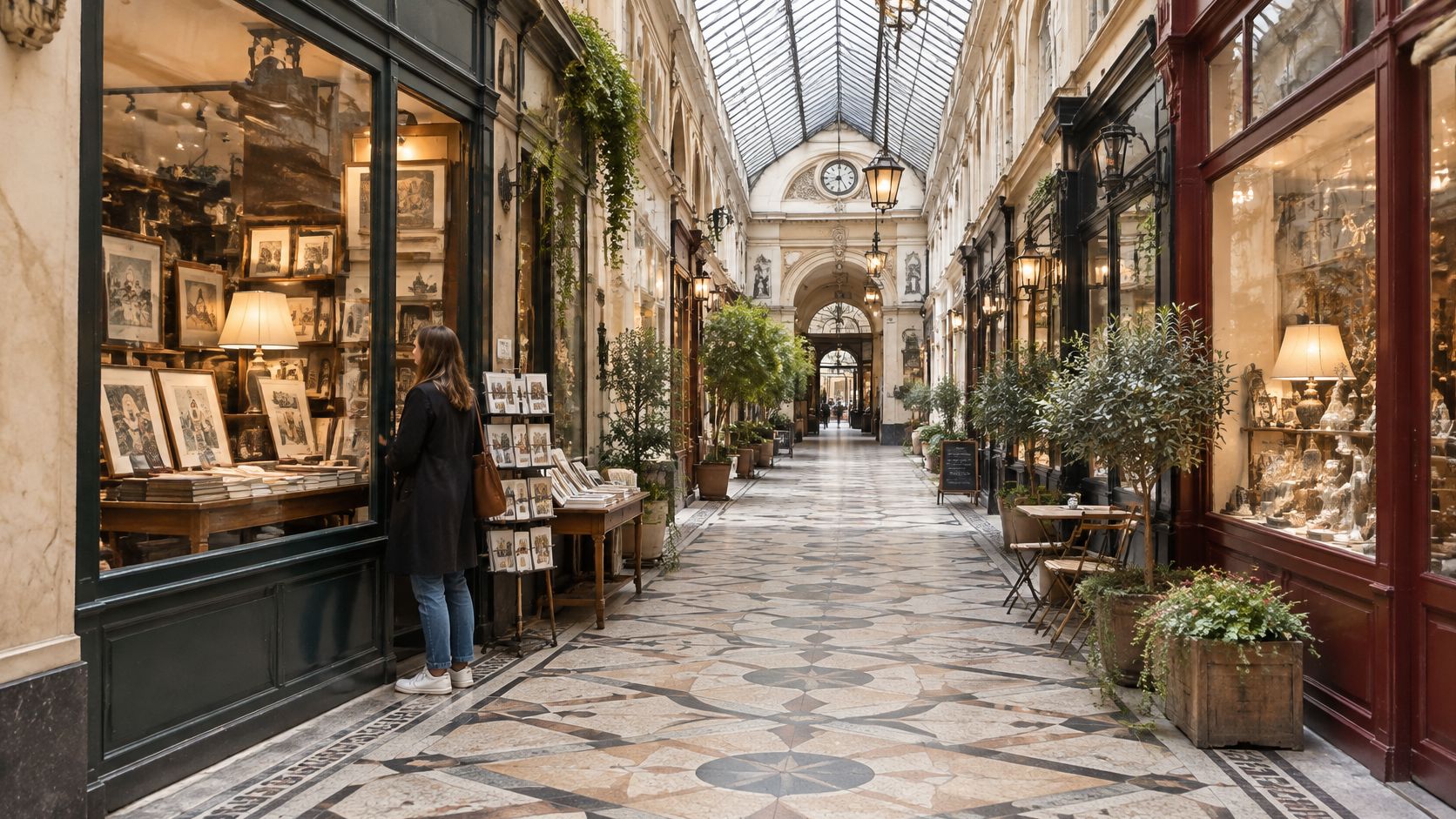
That ordinary weekday is the point. Montmartre now receives roughly 11 million visitors a year, more than the Eiffel Tower, while the hilltop population runs between 12,000 and 30,000 depending on where you draw the boundary, as RFI reported on the neighborhood's overtourism debate. Crowds that size turn the French you came for into background noise. Inside the arcade the pace is different: a shopkeeper with time, a transaction that lasts thirty seconds, no one behind you pushing.
The Task, a Three-Exchange Script
Write three phrases on your phone before you walk in and use all three with one shopkeeper.
- Ask a price. "C'est combien, s'il vous plaît ?" works at a print stall, an antique postcard box, anywhere.
- Ask for a small service. Gift wrapping is "l'emballage cadeau," and asking for it takes a full sentence, which is exactly the practice you want.
- Close and thank. "Merci beaucoup, bonne journée" earns you a real "bonne journée" back, which is the sound of a successful exchange.
If a reply comes too fast, "Plus lentement, s'il vous plaît" resets the pace without apology. Then take a bistro terrace seat and run a full order, drink, bill, and goodbye, entirely in French before you leave. The stakes are a postcard, so a stumble costs nothing and a clean exchange buys you lunch.
What works: A weekday morning, before the lunch service starts. Shopkeepers have time to chat, and most will slow down if you ask them to.
Keep a small notebook and write down anything you heard twice. That becomes your vocabulary list for the evening. If you want to sound less like a visitor while you're at it, our guide to how to be a Parisian covers the small behavioral cues, greetings, and courtesies that decide whether a conversation stays in French.
2. Promenade Plantée, the Elevated Garden Built on an Old Railway
Paris is too busy to absorb anything if you stay in the postcard districts. The Promenade Plantée runs roughly 4.5 kilometers from the Bastille area toward the Bois de Vincennes, laid on a disused railway viaduct and opened in 1993. The archways beneath it, the Viaduc des Arts, hold craft studios you can peer into on the way down.
Paris has done this before at a larger scale, which is why the planting looks less like a park and more like a place nature took back. The Petite Ceinture was a 32-kilometer railway ring around the capital whose passenger service ended in 1934, with some connecting trains running until 1989. Since 2006 the City of Paris and SNCF have progressively rehabilitated sections as walking areas and ecological corridors, with roughly 20 of the 32 kilometers under city management, as the 13th arrondissement's guide to the Petite Ceinture explains. Old rail beds make excellent classrooms. Long, flat, quiet, and full of signs.
Listening Practice With a Finish Line
The route is long enough to finish a full audio lesson without interruption, which is why learners preparing for DELF listening sections use it. Download one episode, not a whole series, and walk the whole thing while it plays. Joggers, families, and café customers supply the ambient French.
Here's a clip of the walk before you commit an afternoon to it.
- Start at Bastille. You walk toward Vincennes on a gentle descent rather than climbing.
- Stop under the arches. Pick one studio and describe the craft out loud in three sentences.
- Rehearse directions. "Tout droit", "à gauche", "au bout de la rue" are the vocabulary of every neighborhood walk you'll take afterward.
Our Paris vacation planning guide pairs this route with the rest of an eastern Paris day if you're building a full itinerary.
3. Bibliothèque Forney, the Free Library for Arts and Crafts
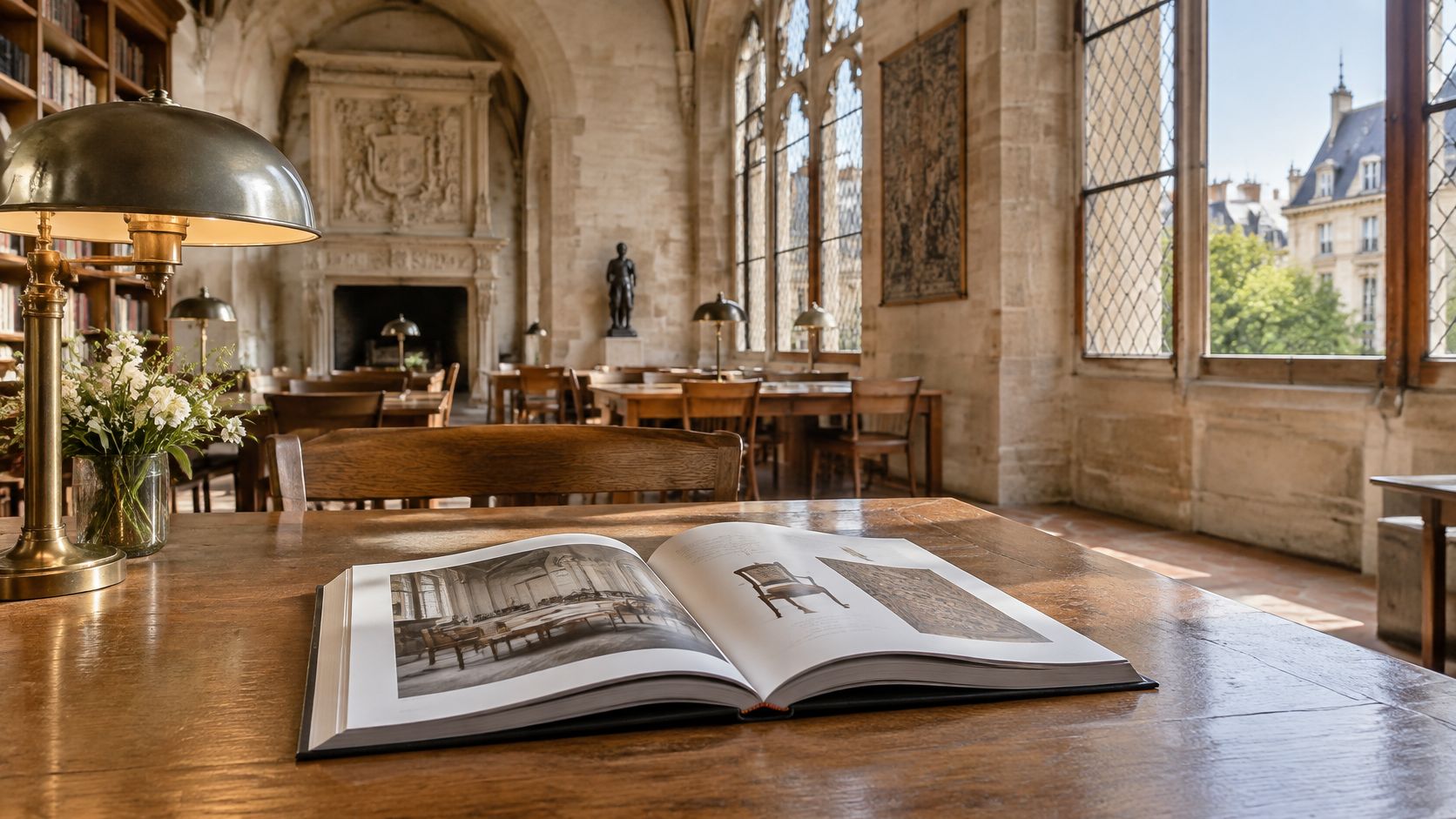
A designer whose French reading still feels slow gets more from two quiet hours here than from another grammar drill. The Bibliothèque Forney sits in the Marais inside the Hôtel de Sens, a public library devoted to decorative arts, graphic design, and craft. Reading rooms and temporary exhibitions are free to enter, and the shelves carry French-language books, catalogues, and periodicals you won't find in translation.
The smaller municipal venues exist for exactly this. Paris runs more museums than a single trip can cover, and a small group of headline institutions absorbs a disproportionate share of visits, which is why the quieter ones stay pleasant places to work. Paris Musées, the city's museum network, recorded 5.3 million admissions in 2023, up 17% year over year, according to France's Ministry of Culture heritage figures. Demand for the quieter venues is real and growing.
How to Read a Design Catalogue Without Drowning
You don't read a French design catalogue cover to cover. You read captions, credits, and short exhibition panels, and you look up nothing until you've finished the page.
- Five terms per panel. Take five unfamiliar words from each exhibition text, no more, and write the French definition rather than the English translation.
- Read one article aloud. Pick a short piece from a periodical and read it out loud. Pronunciation improves faster when your ear hears your own voice.
- Name what you saw. On the way out, say three objects and their materials in French, "une chaise en bois", "un vase en verre".
Give a designer a Tuesday morning here and two hours of panels yields ten working terms, an accurate sense of how French writes about craft, and no fatigue, because the rooms are nearly empty. Check current opening days and access requirements on the official site before you go, since library hours shift with the season.
Clients in creative fields get the most out of this stop when they mix an hour of reading with an hour of conversation practice on the same vocabulary.
4. Musée Nissim de Camondo, a Private Mansion Frozen in the 1920s
A museum visit stops being language practice the moment you can't hear your own voice. The Musée Nissim de Camondo, on rue de Monceau, rarely gets that crowded. It's a 1910s mansion built by the Camondo family and left to the state, with 18th-century French furniture, tapestries, and decorative arts arranged as a home rather than a gallery. Rooms are intimate, sightlines are short, and you can hear the parquet under your own feet.
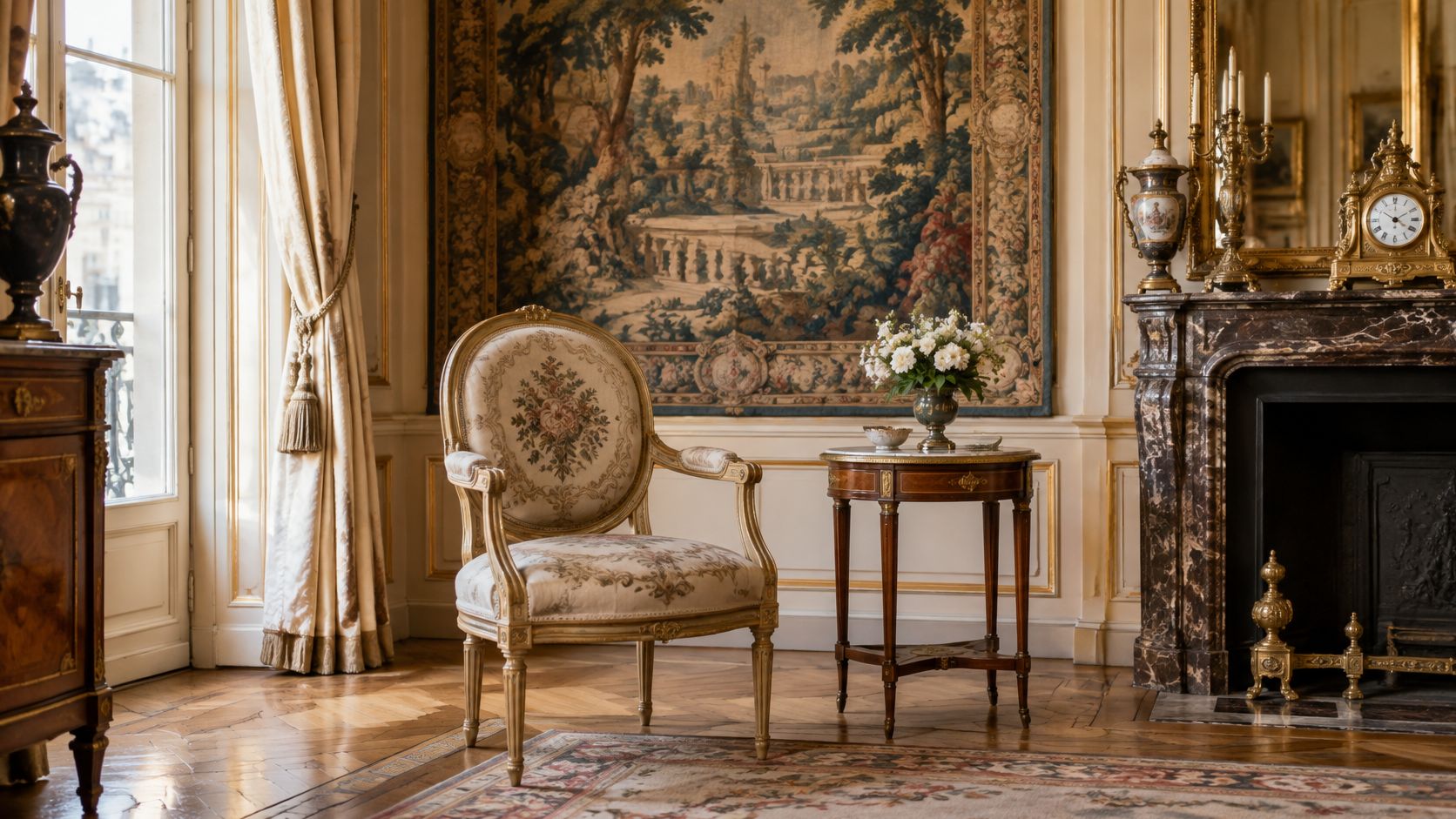
A handful of famous Paris landmarks absorb most of the crowds, while smaller house museums stay far calmer. That difference is practical. In a quiet room you can stand in front of a single commode for five minutes, work through its vocabulary without interruption, and leave with phrases that stick.
Describe Three Objects, Out Loud
The house rewards descriptive language, and it suits learners working toward DELF or DALF level spoken production. A 60 to 90 minute block works best, built as 10 minutes of pre-teaching, 35 to 50 minutes of guided observation, and 15 to 20 minutes of spoken production afterward.
- Pre-teach the frame. "Il s'agit de", "au premier plan", "en bois doré", "tapisserie d'Aubusson".
- Observe with a target. Three objects, three sentences each, written in the room.
- Produce at the end. Sit on a bench outside and describe those three objects from memory, no notes.
Book a timed entry in advance, especially at weekends, and ask for the French-language guided tour if your level allows it. Following a tour in French works like a free listening exam, and guides will repeat a date or a name if you ask. I recommend writing down one unfamiliar word per room rather than chasing every term you hear; the narrower target is what makes the visit stick. Our French travel tips cover similar vocabulary-building routines for other house museums.
5. The Hammam of the Grand Mosque of Paris, a Quiet Courtyard Ritual
Paris has weeks when the city belongs to everyone but you. During the 2024 Olympic fortnight the capital drew a surge of visitors large enough to fill every famous room, according to City of Paris figures on Games attendance. On days like those, an afternoon in a tiled courtyard beats another monument.
The Grand Mosque of Paris, in the 5th arrondissement, is built in a Spanish-Moorish style and houses a traditional hammam plus a courtyard tea room. You can sit with mint tea and pastries under the mosaics, or book the bath and massage. Plan on two restful hours. Sitting still is the activity, and that is the point.
We send beginners here because the script is short and the stakes are low. A tea room forgives a fumbled sentence in a way a pharmacy queue never will.
The Vocabulary Nobody Teaches You
Politeness is the whole task, and the sentences are short enough to memorize on the metro over.
- Greet first. "Bonjour, madame" before any request. Dropping the greeting reads as rude in a space like this.
- Order precisely. "Je voudrais un thé à la menthe, s'il vous plaît, sans sucre" gives the server something to respond to.
- Ask about access. "Est-ce qu'il y a des horaires réservés aux femmes ?" and "Faut-il réserver ?" are questions you'll reuse at every spa, pool, and hammam in France.
Check the official site for hammam hours and gender-specific sessions before you set out. Dress modestly and follow posted guidelines near the prayer areas. Treating the visit as a sightseeing transaction is the fastest way to get a cold reception.
Ask the server one question in French and actually wait for the answer. Tea rooms are forgiving places to fumble a sentence, and you'll get a recommendation worth having.
The payoff is cultural vocabulary a textbook chapter never reaches: ritual, hospitality, and food words in context. And if your companion has no interest in drills, they still get a quiet courtyard and a glass of mint tea out of the deal.
6. Musée de la Chasse et de la Nature, an Offbeat Museum in a Renaissance Mansion
Step into the Marais for a museum visit that starts with an unusual animal or object, then turns into a short French-speaking exercise. The Musée de la Chasse et de la Nature is housed in the Hôtel de Guénégaud, a 17th-century mansion, and brings together art, hunting artifacts, and natural history. Its unexpected displays give you plenty to describe without competing with a blockbuster crowd.
Three Exhibits, Three Sentences
Choose three objects before you begin: one animal, one artifact, and one thing that sparks a reaction. Keeping the task small leaves room to look closely and form a sentence.
- Describe an animal. Mention its size, color, or posture with phrases such as “il est,” “il a,” and “il semble.”
- Explain an object. Say what it is made of and what it was used for. Try the past tense if you can.
- Give your reaction. Start with “Ce qui m'a surpris, c'est…” to move beyond a list of nouns.
The animal displays suit learners building nature vocabulary. With older children, choose an object that raises questions about hunting and discuss your opinions in French. A walk through the Marais afterward makes a natural extension of the visit.
Practical rule: If a wall label appears in both French and English, read the French first. Guess the meaning, then check the English. That small pause turns a label into practice.
Check the museum's schedule before setting out, since it closes on certain days. For more ideas beyond Paris, browse our guide to hidden gems in France.
7. Musée de la Vie romantique, a Quiet House Museum with a Tea Garden
A calm house museum is easier to speak in than a crowded gallery, and this one comes with a garden. The Musée de la Vie romantique, in the 9th arrondissement, occupies the Hôtel Scheffer-Renan, a 19th-century house with a garden and an atmospheric tea room. The collection centers on Romantic-era art and the circle of writers and painters who gathered there.
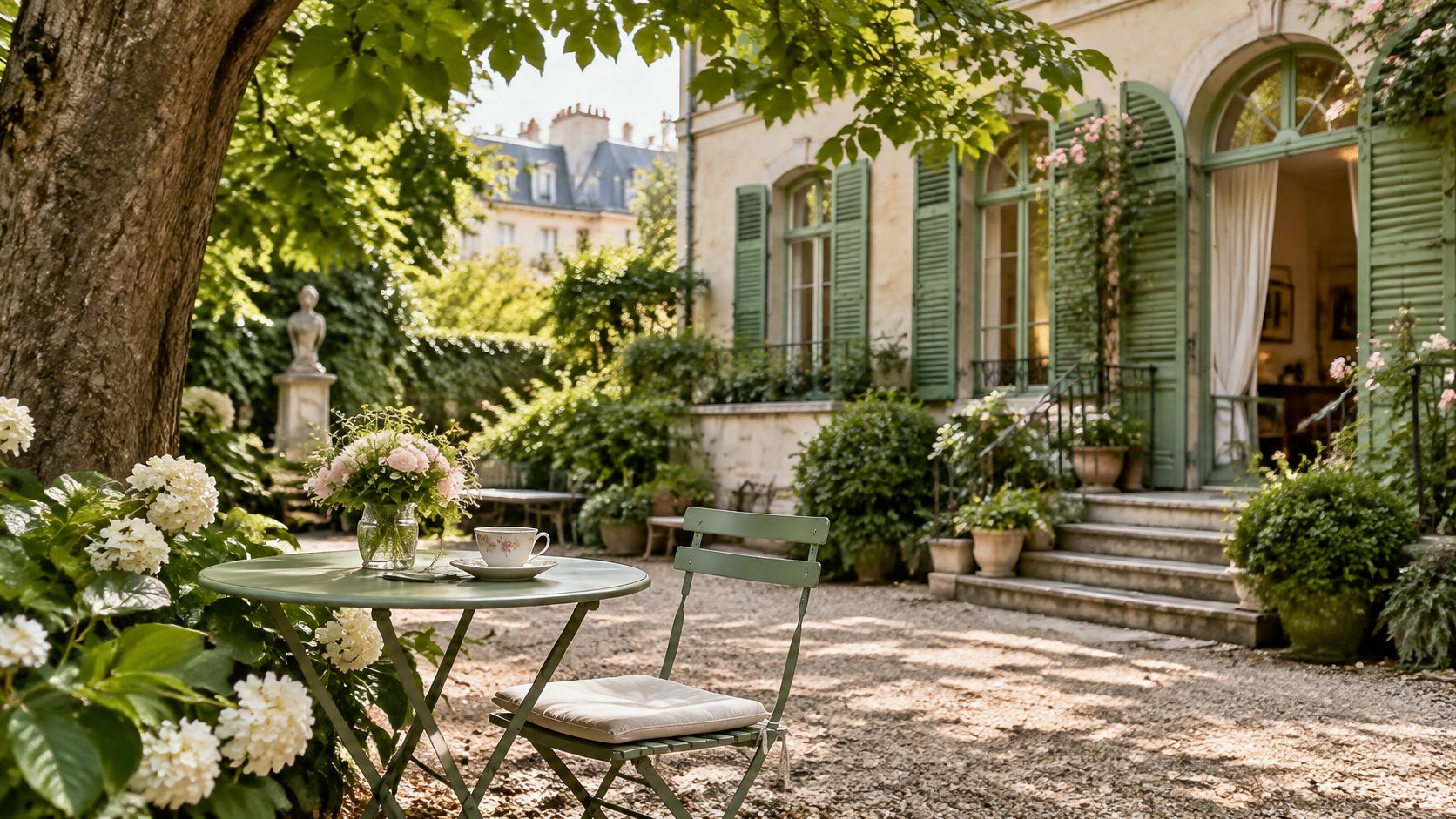
The cost is the easy part. The permanent collection is free, the museum is typically open from 10:00 a.m. to 6:00 p.m., and it closes on Mondays, as Paris tourism's small museum guide notes. Seasonal schedule changes are worth checking before you build a day around it.
It also sits inside a wider free tier that most visitors never use. Paris Musées lists free permanent collections at the Musée Carnavalet, Maison de Victor Hugo, Maison de Balzac, Musée Cognacq-Jay, Musée Cernuschi, Musée Bourdelle, Musée de la Vie Romantique, and Petit Palais, though temporary exhibitions may still require a ticket, per the Paris Musées visitor FAQ. The Catacombs, Musée Galliera, and the Paris Archaeological Crypt generally charge admission.
Read One Panel, Then Close the Notebook
The size of the collection is the advantage. You can finish a room instead of abandoning it.
- One wall text, read twice. Once privately for meaning, once aloud for rhythm. Then summarize it in two sentences without looking.
- Emotion words. "émouvant", "intime", "mélancolique", "apaisant". Romantic-era art is built for adjectives.
- A garden entry. Three sentences in a small notebook, dated, in French. It's the cheapest writing practice in Paris.
The tea room gives you a natural reason to talk, since staff and fellow guests have time to chat over a pot of tea. Order in French even if the waiter answers in English. "Une table pour deux, s'il vous plaît" and a question about the day's teas turn the break into a third exercise. I recommend arriving early enough to claim a garden table, because those seats invite lingering longer than any gallery bench.
8. Maison de Victor Hugo, the Writer's Home on Place des Vosges
Your French reading never moves past textbook passages because you never read anything written for a French reader in a place that matters. The Maison de Victor Hugo, on Place des Vosges, is the house where the writer lived from 1832 to 1848 and is now a museum. The permanent collection is free, with rooms furnished as Hugo would have known them and displays of his drawings and manuscripts.
Pair it with the museum that explains the city he was writing about. The Musée Carnavalet, the history of Paris museum, opened to the public on February 25, 1880 and is the oldest municipal museum operated by the City of Paris, housed in the Hôtel des Ligneris, built between 1548 and 1560, and expanded with the Le Peletier de Saint-Fargeau mansion in 1989. Its collection holds over 618,000 objects from prehistory to the present, and its buildings alone span more than 450 years of Parisian history, as the Musée Carnavalet documents. The two are a short walk apart in the Marais.
Reading Aloud in the Room Where He Wrote
Advanced learners get the most from this stop, because literary French is what DALF and academic work demand.
- Bring one passage. A paragraph of Les Misérables in French, read in the actual house, sounds different than it does on a screen.
- Read it aloud twice. Then close the book and say what happens in it, in your own words, present tense.
- Use the arcades. Place des Vosges has covered walkways and benches. Sit, summarize, and write down two structures you'd reuse in an essay.
Visit the permanent collection first and check temporary exhibitions afterward, since the special shows are where the crowds concentrate. Then read one passage in French on a bench outside and summarize what you understood, not what you think you should have understood. For students working toward certification, that reading-to-summary loop is the same skill the exam tests.
How the eight Paris hidden gems compare for language practice, cost, and booking
Five of the eight stops are free or close to it, and only two ask for a firm reservation. Sort the list by cost first, then by the task each place lets you practice.
| Item | Best for | Cost | Booking |
|---|---|---|---|
| Passage des Panoramas | Practicing everyday shop conversations | Free to enter; purchases optional | No reservation needed |
| Promenade Plantée | Outdoor listening and walking practice | Free | No reservation needed |
| Bibliothèque Forney | Specialized reading and professional vocabulary | Free for most spaces | Check current access rules before visiting |
| Musée Nissim de Camondo | Descriptive vocabulary and guided listening | Paid entry to the permanent collection | Advance timed reservation recommended |
| The Hammam of the Grand Mosque of Paris | Relaxing cultural experience and polite conversation | Tea room is low-cost; hammam is paid | Advance booking recommended for hammam |
| Musée de la Chasse et de la Nature | Nature and animal vocabulary, families, and curious adults | Paid entry to the permanent collection | Check online for timed entry |
| Musée de la Vie romantique | Art vocabulary and relaxed reading practice | Permanent collection free; temporary exhibitions may charge | Check online before visiting |
| Maison de Victor Hugo | Literary French and advanced reading | Free permanent collection; special exhibitions are paid | Check online for timed entry during busy periods |
The hammam and Nissim de Camondo are the two bookings worth handling before a trip. The rest can stay flexible, which leaves room to follow the weather or your energy that day. If the budget allows only one ticket, spend it on the skill you practice least, since describing objects in a furnished room or following a guided visit stretches you further than an easy conversation does.
Turn Your Next Paris Walk Into Lasting French Practice
Choose two or three of these places for your next trip, not all eight. Prepare one French task for each, write down every phrase you hear twice, and give yourself a spoken summary in the evening. That's the whole method, and it works because it turns a city you're visiting into a set of small, repeatable tests with real consequences, a price you have to ask for, a menu you have to read, a guide you have to follow.
Two or three stops is enough for a week. One is enough for an afternoon, and one is more than most visitors manage.
The harder question is what happens after you land. A trip gives you a spike in confidence, and then it fades, because the practice stops when the holiday does. That's where structure helps. If you want the progress to hold, our team can start with a free 20-minute consultation to assess your current level and how you learn best, then build a plan around your goal, whether that's everyday conversation, travel French, or DELF and DALF preparation. Elite French Tutoring has been running fully customized lessons with native instructors since 2012, in person in New York and online worldwide, and the free first call is a short, low-pressure assessment rather than a sales pitch.
Lucas, who wanted to study in France, used DELF preparation online to get there. His route looks like the ones above, a set of small, specific tasks rather than a vague resolution to improve.
The city is already full of rooms worth talking about. All you have to do is prepare three sentences before you walk in. Book the consultation when you're ready, and bring this list with you.