Skip to content


You're standing in a wine shop with dinner guests arriving in three hours, a Sancerre in one hand and a cheaper white with no grape name in the other, and no idea which one will suit oysters. I see that moment constantly. The label isn't hiding information from you. It's speaking French regional logic, and once you read climate and rules together, you can predict the glass before you pay.
Table of Contents
- Quick-Pick Table of French Wine Regions
- How Climate Groups Shape Each Region
- Reading Appellation Tiers on a French Label
- Matching a Region to the Occasion
- Cheaper Alternatives to Famous French Names
- Regional Myths That Mislead Buyers
- Choose Your First Region and Start Tasting
Quick-Pick Table of French Wine Regions
Start here, not with grape names you half remember. I want you to choose from French regions of wine the way I choose for a list, by matching climate to ripeness, grapes to flavour, and appellation to the exact words you'll search for on a shelf or menu.
| Region | Climate | Signature grapes | Typical styles | Appellation examples |
|---|---|---|---|---|
| Champagne | Continental, cool | Chardonnay, Pinot Noir, Pinot Meunier | Traditional-method sparkling | Champagne |
| Alsace | Continental, dry rain shadow | Riesling, Gewürztraminer, Pinot Gris | Dry, aromatic whites | Alsace, Alsace Grand Cru |
| Burgundy | Continental | Chardonnay, Pinot Noir | Mineral whites, silky reds | Chablis, Côte de Nuits |
| Beaujolais | Continental, granitic soils | Gamay | Juicy, fresh reds | Morgon, Fleurie |
| Loire | Atlantic, varied | Sauvignon Blanc, Chenin Blanc, Cabernet Franc | Crisp whites, light reds, sparkling | Sancerre, Vouvray, Saumur-Champigny |
| Bordeaux | Atlantic, maritime | Cabernet Sauvignon, Merlot, Sauvignon Blanc, Sémillon | Structured red blends, dry and sweet whites | Médoc, Saint-Émilion, Pessac-Léognan |
| Northern Rhône | Continental-Mediterranean transition | Syrah, Viognier | Peppery reds, aromatic whites | Côte-Rôtie, Hermitage |
| Southern Rhône and Provence | Mediterranean | Grenache, Mourvèdre, Rolle | Full reds, rosé | Châteauneuf-du-Pape, Côtes de Provence |
| Languedoc-Roussillon | Mediterranean, hot and dry | Carignan, Grenache, Syrah | Value reds, fortified wines | Minervois, Faugères, Banyuls |
| Jura | Continental, mountain | Savagnin, Poulsard, Trousseau | Oxidative whites, vin jaune | Arbois, Château-Chalon |
How I read one row
Grapes tell you what's in the glass. Pinot Noir suggests red fruit and fine tannin, Gamay suggests juicy freshness, Syrah suggests pepper and darker fruit. Climate tells you how ripe and acidic it'll feel. Cool continental Champagne keeps acidity high for sparkling wine, while hot Mediterranean Languedoc-Roussillon builds body and ripeness faster.
Appellation examples are your search terms. Don't ask a merchant for a Loire white. Ask for Sancerre if you want Sauvignon Blanc precision, Vouvray if you want Chenin Blanc, or Saumur-Champigny if you want a Loire red. That specificity gets you the right bottle in one sentence.
Notice Burgundy and Champagne. Both rely heavily on Chardonnay and Pinot Noir, yet I wouldn't swap them at dinner. Champagne turns that fruit into sparkling wine in a cooler, sparkling-focused system. Burgundy makes still mineral whites and silky reds. Same grapes, different climate, soil, and rules, so a different promise.
My shortcut: If you can't name the style, you aren't ready to name the region. Decide crisp, silky, structured, or sparkling first.
You're also missing good wine if your mental map stops at three names. The French Ministry of Agriculture regional overview lists areas including the Loire Valley, Bordeaux, Southwest, Champagne, Burgundy, Beaujolais, Lyonnais, Languedoc, Roussillon, Lorraine, Alsace, Jura, Savoie, Bugey, Rhône Valley, Provence, and Corsica, and it puts France's 2024 production at approximately 3.65 billion liters. Lorraine, Bugey, and Lyonnais rarely appear in short guides, but Loire whites, Rhône reds, and Jura wines absolutely belong on your buying list.
If you're building a broader French table, our guide to popular drinks in France helps you place wine alongside what people order before and after dinner. For wine itself, use this order every time.
- Choose the style you want: Decide acidity, body, bubbles, and sweetness.
- Find the matching row: Use climate and grapes to confirm the style makes sense.
- Search the appellation name: Buy the place name on the label, not a vague regional claim.
How Climate Groups Shape Each Region
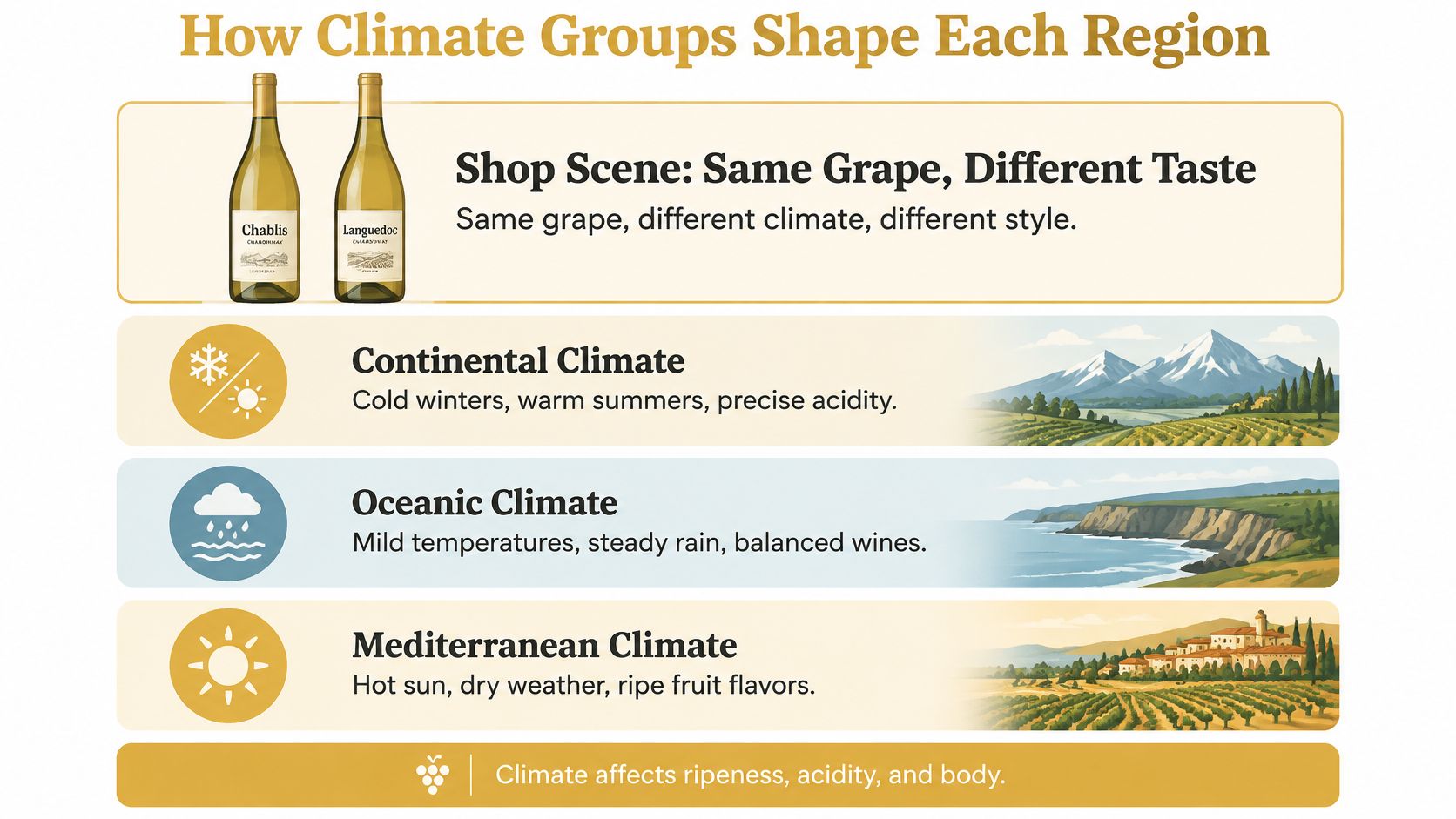
Say you pick up two Chardonnays. One says Chablis, the other comes from the Languedoc. You expect cousins. You get strangers.
The Chablis tastes lean, citrusy, and chalky, with acidity that makes your mouth water. The Languedoc Chardonnay feels rounder and riper, with softer acidity and more stone fruit. Neither producer tricked you. Climate set the ripening speed and acidity before the winemaker made a single cellar choice.
The three climate groups I use
- Continental: Alsace, Champagne, Burgundy, Beaujolais, Savoie, and Jura. Expect sharper seasonal contrast and a strong focus on preserving acidity and achieving ripeness.
- Atlantic: The Loire, Bordeaux and Aquitaine, Charentes-Cognac, and the Southwest. Expect maritime moderation, vintage variation from rain, and styles built around balance.
- Mediterranean: Languedoc-Roussillon, the Rhône and Provence area, and Corsica. Expect heat, drought pressure, riper fruit, and careful work to stop sugar racing ahead.
Those groups come from the French wine industry chapter hosted by HAL Science, which explains that this gradient influences cultivar selection, ripening speed, acidity retention, and disease pressure. That's the buyer's translation. Climate decides which grapes make sense, how fast they sweeten, whether freshness survives, and which vineyard problems the grower fights.
Warming is moving the old predictions
Don't treat a regional reputation as permanent. From 1980-2019, every French wine region experienced rising growing-season temperatures and higher Huglin heat-summation values. For Chardonnay and Cabernet Sauvignon, simulated flowering advanced by roughly 3-9 days, veraison by 6-13 days, and theoretical maturity by 6-16 days, with particularly strong changes in northeastern regions.
Earlier maturity sounds harmless. It isn't always. If harvest timing doesn't adapt, grapes accumulate more sugar, potential alcohol rises, and acidity falls. A region you bought for tension can start giving you weight. A historically marginal site can also ripen more reliably, so warming doesn't make every bottle worse. It makes vintage, exposure, canopy work, rootstock, and harvest date more important.
Projections in that same discussion point to a further increase of approximately 662-771 Huglin-index degree-days and 5.6-22.6 additional hot days relative to 1980-1999. I read that as a shopping instruction. Ask whether a producer picked earlier, farms higher or cooler sites, or changed canopy management. Good merchants can answer.
When someone names a vintage, I ask one question. Did that region's climate push this wine toward freshness or power?
If you want to go deeper before spending serious money, our roundup of the best French wine books is where I'd continue, especially for regional maps. At the shelf, keep it simple. Cool climates usually protect acidity. Warm climates usually deliver ripeness. Buy the tension or power your food needs, then check whether the vintage supports that expectation.
Reading Appellation Tiers on a French Label
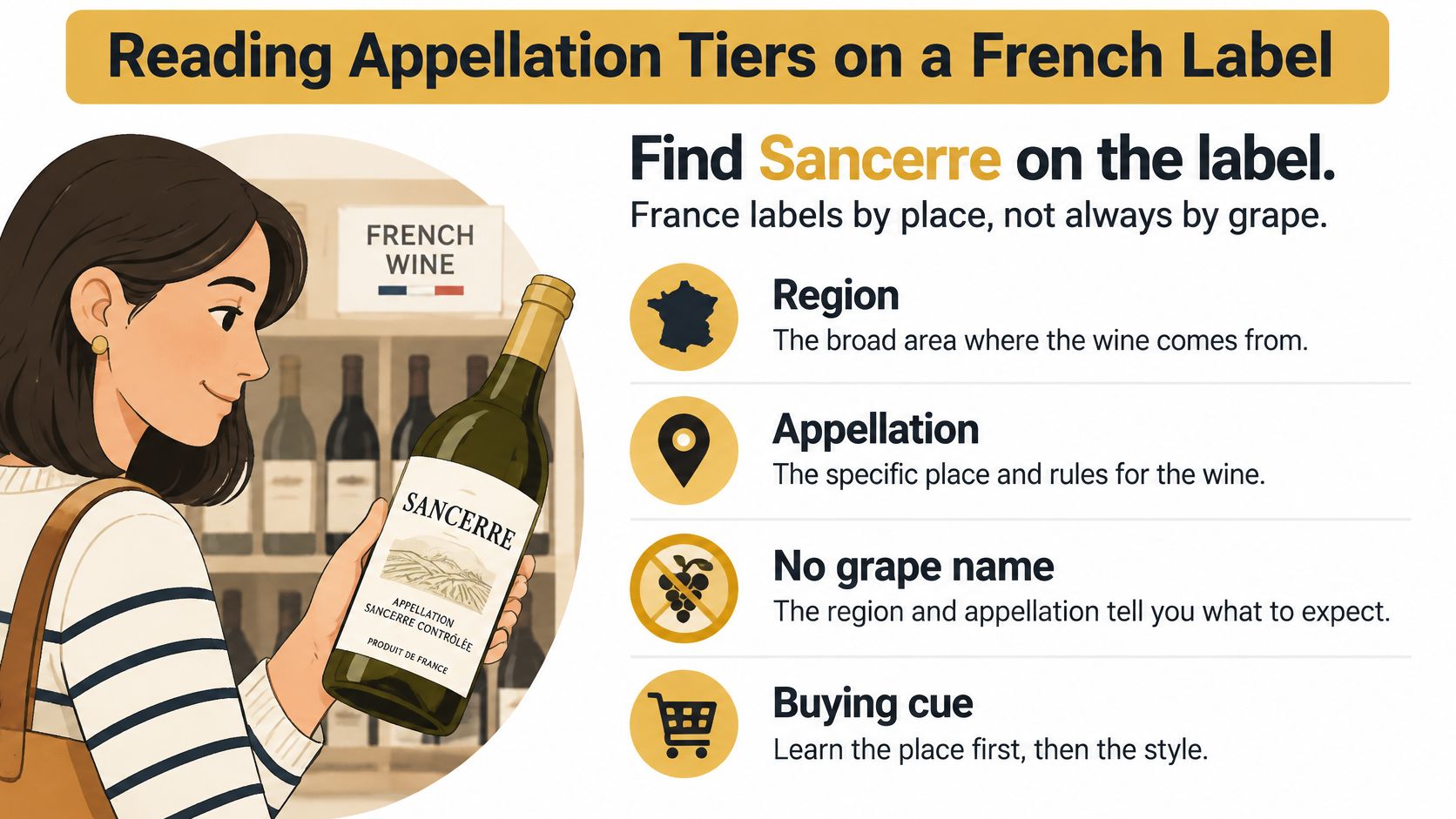
You find Sancerre in large letters and no grape name anywhere. Most shoppers assume the label is incomplete. It isn't. France labels by place first because the place carries the rules.
An appellation tells you where the grapes grew and which production specification applied. If you know Sancerre, you know you're in Loire Sauvignon Blanc territory even when Sauvignon Blanc never appears on the front label. That's why I teach place before variety in France.
What the rules can control
The French wine classification guide from Wine With Seth explains that specifications can regulate the geographic boundary, permitted grape varieties, vineyard practices, maximum yields, minimum alcohol levels, and winemaking methods. Under the European Union protected-designation framework, a PDO wine must use grapes exclusively from its designated area, while a PGI wine must source at least 85% of its grapes from that area.
Those aren't bureaucratic details. Yield limits affect concentration. Permitted grapes define flavour. Methods and ageing shape texture. A narrow appellation reduces a producer's freedom, but it gives you a more repeatable style. A broader designation gives the producer room to experiment, but it gives you a less precise prediction.
| Tier | Origin rule | Grape and method rule | Typical examples |
|---|---|---|---|
| AOP / PDO | Grapes must come exclusively from the designated area | Permitted varieties, yields and methods set by the appellation | Champagne, Chablis, Châteauneuf-du-Pape |
| IGP / PGI | At least 85% of grapes from the designated area | Wider varietal choice, looser rules | Regional IGP wines such as IGP Pays d'Oc |
| Vin de France | No defined geographic origin | No appellation grape list | Blended or experimental bottles |
My five step label check
- Find the region: Loire, Burgundy, Bordeaux, Rhône, or another broad area sets the climate logic.
- Check the tier: AOP signals the tightest origin and production framework, IGP allows more flexibility, and Vin de France removes the defined geographic claim.
- Confirm the permitted grapes: Look on the back label, shelf card, or producer sheet when the front label only names the place.
- Check required ageing: Ageing rules tell you whether to expect youthful fruit, oxidative depth, oak influence, or bottle maturity.
- Compare yield or alcohol rules where stated: Lower yields often support concentration, while minimum alcohol and method rules help separate a precise appellation wine from a looser regional blend.
Cognac shows you how concrete a specification gets. Its rules call for designated white grapes, double distillation in Charentais stills, and at least two years of oak ageing. You aren't buying a romantic place name there. You're buying a production method that every legitimate producer must follow.
Rule of thumb: Treat the appellation as a specification, not a slogan. If you can't say what it permits, you don't yet know what you're buying.
I also want you to stop equating flexibility with poor quality. An IGP Pays d'Oc varietal wine can be exactly right for a Tuesday, and a Vin de France bottle can let a talented producer blend across boundaries. Just don't pay an AOP price for a vague origin claim, and don't expect a flexible wine to reproduce a classic appellation style. Pay for the level of precision you need.
Read the label top to bottom in that order and French bottles stop feeling coded. Region gives climate, appellation gives rules, tier gives strictness, and producer gives interpretation. That's the sequence I use before I look at scores, medals, or shelf talkers.
Matching a Region to the Occasion
Start at your table, not in the wine aisle. I decide what the food needs, then I choose the region whose climate naturally provides it. That order saves you from buying a famous bottle that fights dinner.
For a celebration, I want traditional-method sparkling because fine bubbles, acidity, and a clean finish work before food and with canapés. Champagne is the benchmark. A good Crémant gives you the same basic method through a different regional lens, often with a friendlier bill.
For seafood, I want acidity that cuts salt, oil, and richness without covering delicate fish. Loire Sauvignon Blanc brings citrus and herbal precision. Muscadet brings a lean, saline feel that I love with oysters and grilled fish. If your seafood has a rich sauce, step toward Chenin Blanc rather than reaching for a heavy white.
| Occasion | Region and style | Why it fits |
|---|---|---|
| Celebration | Champagne or Crémant | Traditional-method sparkling |
| Seafood | Loire Sauvignon Blanc or Muscadet | Crisp acidity |
| Roast chicken or charcuterie | Burgundy Pinot Noir or Beaujolais Gamay | Fresh red fruit |
| Grilled meat and stews | Rhône Syrah or Languedoc blends | Structure and warmth |
| Ageing and rich braises | Médoc or Saint-Émilion Bordeaux blend | Long-cellared structure |
The four questions I ask
- How much acidity does the dish need? Fatty, salty, or fried food needs more cut, so I lean Loire, Chablis, or sparkling wine.
- How much body can the food carry? Delicate fish collapses under a full southern red, while beef stew makes a light red taste thin.
- Do you want fruity or savoury? Beaujolais Gamay gives bright fruit for charcuterie, while Northern Rhône Syrah gives pepper and savoury depth for grilled meat.
- Must the bottle carry the moment? A cellared Bordeaux for a rich braise can be the event. A weeknight roast chicken usually needs freshness, not ceremony.
Roast chicken and charcuterie sit in my favourite middle ground. Burgundy Pinot Noir gives silk and red fruit when you want elegance. Beaujolais Gamay, especially Morgon or Fleurie, gives juice and energy when the table has pâté, salami, pickles, and bread. Chill either red lightly if the room is warm. Warm light red tastes clumsy.
For spice or richness that doesn't fit the obvious rows, try my adventurous pair. Alsace Riesling handles aromatic spice, pork, and rich sauces with acidity and perfume. Jura Savagnin brings nutty, oxidative depth that works beautifully with Comté, mushrooms, and cream. Neither is a safe crowd choice for every guest, so pour a small first glass and watch reactions.
If you're planning the meal as carefully as the bottle, our pick for the best French cook book can help you choose dishes with the acidity and richness in mind. Then run my quick test. Name one dish and one mood, find the climate in the first table that matches the freshness or power you need, and buy that region with confidence.
Cheaper Alternatives to Famous French Names
When Champagne, Bordeaux, or Burgundy is out of reach, don't buy the cheapest bottle with a French-sounding name. Buy a style substitute whose grapes, climate, and appellation rules can plausibly deliver the texture you wanted. Price comes second in my process. Structure comes first.
Crémant is the clearest example. It isn't fake Champagne and it isn't merely a cheaper substitute. Producers make it by the traditional method under its own appellation rules, so you still get bottle fermentation, fine bubbles, and autolytic character, but through regional grapes and local rules outside Champagne.
Demand supports that argument. The OIV State of the World Wine Sector in 2025 reports that Crémant de Loire and Crémant d'Alsace gained 8% in export volume and 9.5% in value, while France's total wine exports fell to 12.5 million hectoliters and €11.2 billion, down 2.3% and 3.7% respectively from 2024. Bordeaux exports declined, Burgundy increased in both volume and value, and France remained the leading wine exporter by value in 2025. Shoppers aren't abandoning France. They're moving within it.
| Famous name | Substitute | Style match |
|---|---|---|
| Champagne | Crémant de Bourgogne or Crémant d'Alsace | Traditional-method sparkling |
| Bordeaux red | Languedoc blends | Structured, value red |
| Burgundy Pinot Noir | Beaujolais Gamay | Light, fresh red fruit |
| Dry Burgundy white | Loire Chenin Blanc | Dry white with acidity |
How I judge each swap
For Champagne, Crémant de Bourgogne is my closest stylistic bridge because Burgundy shares Chardonnay and Pinot Noir logic. Crémant d'Alsace feels more aromatic and fruit-led. Choose based on whether you want restraint or perfume.
For a Bordeaux red, a Languedoc blend won't reproduce Médoc tannin or Saint-Émilion exactly, and I won't pretend it will. It can give you structure, dark fruit, warmth, and food-friendly grip for grilled meat at a much easier price. That's a valid substitute for dinner, not for a collector comparison.
For Burgundy Pinot Noir, Beaujolais Gamay gives you light body and fresh red fruit, especially from Morgon when you want more substance. For a dry Burgundy white, Loire Chenin Blanc gives acidity and texture with a different aromatic profile. Both swaps work because the serving role stays similar.
Use this checklist before you congratulate yourself on saving money.
- Pick the style: Bubbles, crisp white, light red, or structured red.
- Pick the appellation: Choose the substitute place name, not a generic regional blend.
- Compare price per bottle: Judge the saving against the famous name only after the style match passes.
Regional Myths That Mislead Buyers
Regional shorthand helps until it starts making your decisions for you. I hear these five myths in shops, and each one sends buyers toward the wrong bottle. Check the display below, then test every claim against a concrete wine you can buy.
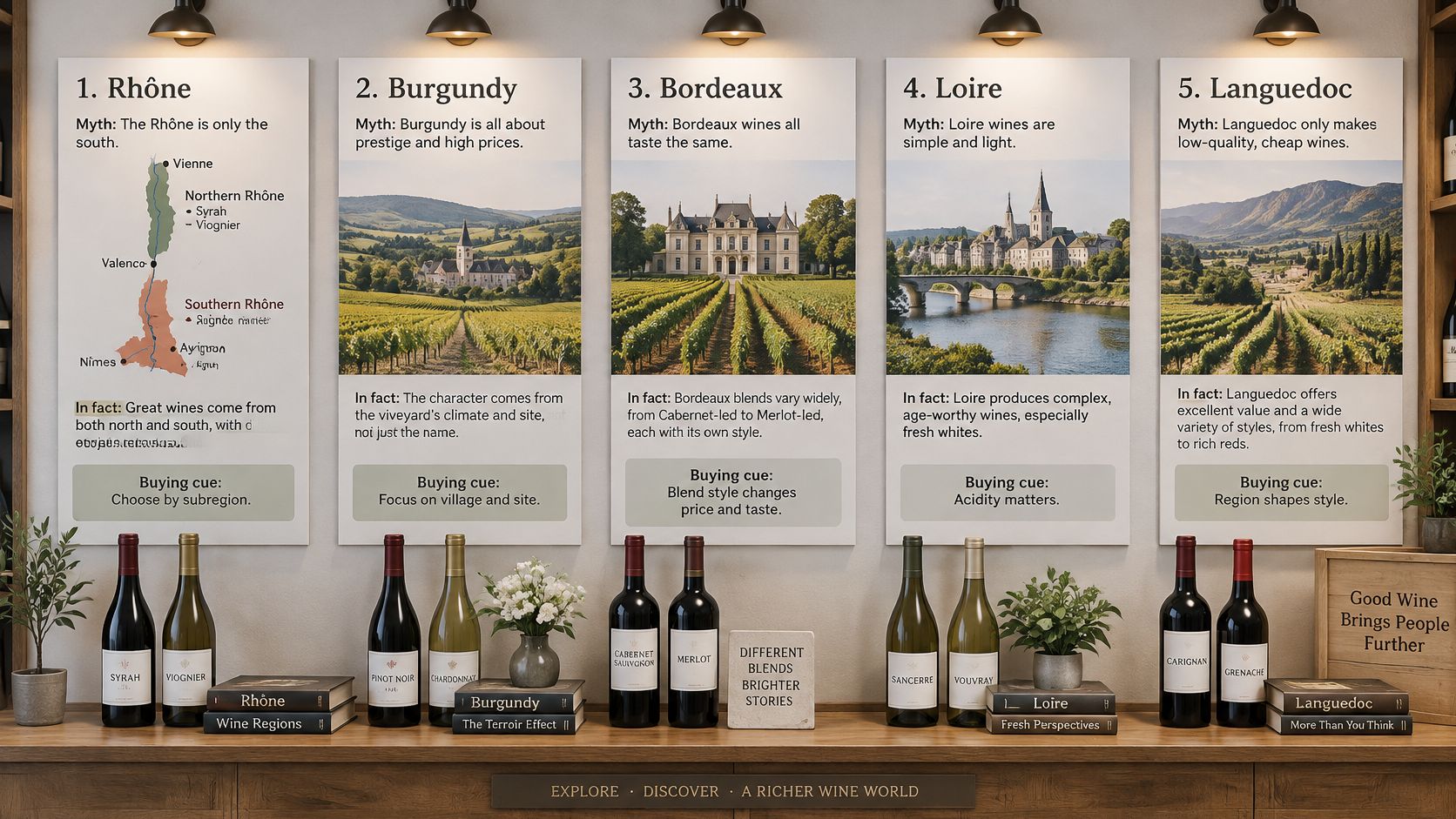
Five corrections before you buy
Myth one, the Rhône means only the south. It doesn't. The north works in a continental-Mediterranean transition and focuses on Syrah and Viognier in places such as Côte-Rôtie and Hermitage. The south leans into Grenache-led blends and rosé. If you buy one expecting the other, you'll misjudge body, spice, and tannin.
Myth two, the Loire is only white. Sancerre and Vouvray earn the attention, but Saumur-Champigny Cabernet Franc gives you a proper Loire red and Crémant de Loire gives you sparkling wine. Loire Chenin Blanc also ranges from dry to sweet. Check the style words on the label instead of assuming every Vouvray tastes the same.
Myth three, Champagne is the only French sparkling wine. Crémant regions produce traditional-method sparkling under separate rules. That distinction matters because a Crémant d'Alsace and a Champagne can both be excellent while offering different fruit, texture, and price.
Myth four, Bordeaux means expensive red. Bordeaux also produces dry whites and the sweet wines of Sauternes from Sémillon and Sauvignon Blanc. If you only shop its red blends, you'll miss some of the region's best value and its strongest dessert pairing.
Watch this short overview after you've read the corrections, and listen for place names rather than grape names.
Myth five, a region's style is fixed. It isn't. Warming changes ripening and acidity, producers adapt harvest dates, and individual sites respond differently. A famous reputation can lag the wines in front of you, so check vintage and producer as well as region.
A region name is a starting point, not a verdict. I trust it only after climate, appellation rules, vintage, and producer point the same way.
Choose Your First Region and Start Tasting
Pick one region from the quick-pick table, one appellation you can explain, and one occasion you have this month. Don't buy a mixed case to study France in theory. Buy a small flight and learn from your own palate.
Your three bottle starter flight
- Loire Sauvignon Blanc: Note citrus, herbs, acidity, and how it changes with goat cheese or fish.
- Burgundy Pinot Noir: Note red fruit, tannin, body, and whether it feels silky or firm.
- Crémant: Compare bubbles, freshness, and finish with what you expect from Champagne.
Write down freshness, body, and acidity for each glass, then name the region you'd buy again and why. That one sentence teaches you more than memorizing a map. Pair the tasting with our guide to French dining etiquette if you're practising for a meal in France, because ordering well includes knowing how to ask, taste, and respond at the table.
French labels also get easier when the words stop being decoration. One of our students, David, a marketing professional preparing to relocate to Paris for work, became fluent in French in 90 days after starting an intensive French course. His goal was work, but the same principle helps in a wine shop. Focused vocabulary, real conversation, and steady feedback turn recognition into confidence.
All of our teachers are native French speakers, and we shape lessons around your goals, whether that's travel, work, or reading a wine list without panic. If you'd like that kind of support, book a complimentary consultation with us to set your level and goals, then start with a short label-reading lesson built around the regions you want to buy.