Skip to content
You're trying to make one decision, but the signals are all mixed up. Your child understands family French at the dinner table and freezes when it's time to write. Your teenager needs help after school dropped French. You're a professional in New York, and you want French that works in meetings, not just on an app.
That confusion is normal. The French language in the US isn't one single learner type, one single accent, or one single reason to study. I work with NYC families, professionals, and exam candidates on this every day, and I start with one rule: don't buy "French lessons" until you know which French you need. If you want a practical lens on cultural fit before choosing lessons, I also point families to this guide on differences between French and American culture.
Table of Contents
- Why French in America Feels Confusing at First
- How Many People Speak French Across the US Today
- From Acadia and Quebec to Louisiana and New England
- Where Americans Actually Encounter French Now
- Benefits of Learning French for School Work and Travel
- How to Choose Your Fastest Path to Confident French
- Your Next Step Toward Speaking French With Confidence
Why French in America Feels Confusing at First
A parent usually calls me with the same frustration. “My child hears French from grandparents, but school says the writing is weak.” That's not a contradiction, it's a placement issue. A heritage speaker, a beginner, and a professional learner need different routes, even if they all say they want “French tutoring.”
The first mistake is treating every learner the same
If you want real progress, stop asking whether someone “speaks French” in a general sense. Ask what they can do comfortably right now, and where they need French to work. A child in a bilingual school needs curriculum alignment. A diplomat needs polished speaking and writing. A heritage teen often needs literacy and confidence more than basic listening.
Practical rule: the fastest path is the one that matches exposure, literacy, and goal, not the one with the flashiest label.
That's why I diagnose before I teach. I look at home exposure, formal writing, pronunciation, and whether the learner needs everyday conversation, exam prep, or school support. The right plan for a family in Queens is often different from the right plan for a manager preparing for a Francophone client call.
Why home-language numbers can mislead buyers
Census language data tells you where demand is concentrated, but it doesn't tell you who is ready for lessons. It also doesn't capture everyone who uses French at school, at work, or in international settings. So if you're choosing tutoring, treat demographics as a market signal, not as a seat count in a classroom.
That's the lens I use with families and professionals. First, identify the learner profile. Then choose the tutoring format that fits the goal. If you do it in that order, you avoid paying for the wrong kind of help.
How Many People Speak French Across the US Today
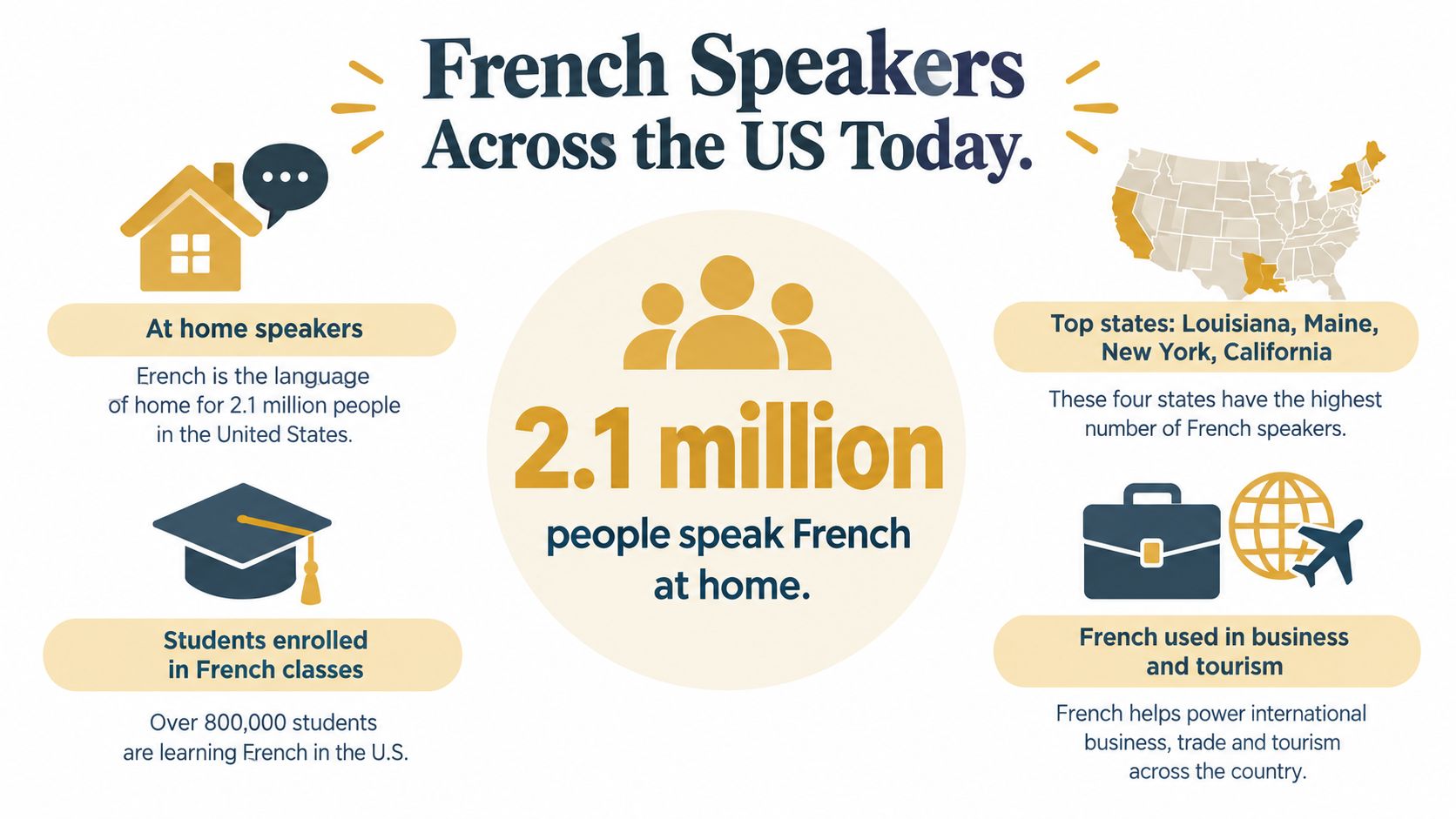
If you are deciding whether French lessons make sense for your family, your school, or your career, start with the market signal. The Census still gives the clearest national picture. The 2010 American Community Survey counted 1,984,824 people who spoke French at home, including French Patois, Cajun, and related varieties, down from 2,097,206 in 2000 and 1,930,404 in 1990. More recent 2020 American Community Survey data reported roughly 1.18 million people age five and older speaking French at home, which placed French as the seventh most commonly spoken language in the country after English, Spanish, Chinese, Tagalog, Vietnamese, and Arabic. Census ACS French language data
What those numbers do and do not prove
Those figures do not mean 1.18 million or 1.98 million people are equally fluent. The Census question measures language spoken at home, so it leaves out many students, professionals, heritage learners, and multilingual Americans who use French at school, at work, or in international settings. It also combines several historically distinct varieties, including standard French, Canadian-influenced French, Cajun French, and French-based Patois. Census language-use overview
That distinction matters if you are buying tutoring. I do not start with a headcount. I start with the learner profile and the job French needs to do. A heritage learner who hears French at home needs a different path from a student preparing for school placement, and both need something different from a professional who has to speak clearly on a client call.
Where demand is strongest
French is especially prominent in Maine and Vermont, where it is the second most spoken language overall after English, and it ranks third in Louisiana, Connecticut, and Rhode Island. The Census also identifies French as the most common non-English language in Maine and Vermont in 2017 to 2021 language-use tables. 2017 to 2021 ACS language-use tables
I use that pattern as buying guidance. In northern New England and Louisiana, French tutoring is often about heritage, family continuity, or school support. In major cities, the same language often serves professional mobility, diplomacy, and international work. Choose the tutoring format that fits the goal.
From Acadia and Quebec to Louisiana and New England
French in the US did not arrive as one tidy story. It came through forced dispersal, relocation, and stubborn preservation. The Acadian communities were expelled by the British in 1755 during the Great Upheaval. Between 1765 and 1780, about 4,000 Acadians settled in Louisiana, and that migration helped shape the Cajun French tradition that still matters in southern Louisiana today. French heritage brief
The full arc is covered in our guide to the history of the French.
Why that history still affects what people buy now
Quebec migration later brought French-speaking workers into textile-mill towns across New England and parts of the upper Midwest. Those moves kept Franco-American communities alive and kept Canadian French varieties in family use across generations. Census-based research also points to the same regional pattern, with Louisiana and Maine standing out in the 2010 data and much of the wider French-speaking population concentrated in the six New England states, northern New York, and southern Louisiana.
If someone in your family says, “We're French,” I do not treat that as one category. It may mean Acadian roots, Cajun home speech, Franco-American heritage, or standard classroom French. Each one calls for different tutoring. A learner trying to preserve family pronunciation needs a different path from a student who has to produce clean written French for school or exams.
Heritage communities are still a commercial signal
A 2011 Census-based profile counted approximately 1.33 million people speaking French at home and another 646,000 speaking French Creole at home. French heritage brief
That matters because it shows a market that is both emotional and practical. French in America is a heritage language, a school subject, and a working tool for diplomacy, migration, international business, and multilingual professional life. If you are choosing tutoring, the history points to the buying signal, family continuity, local identity, or formal French for school and work.
Where Americans Actually Encounter French Now
French shows up in the US in very different places, and each setting demands a different kind of instruction. A middle-schooler at a bilingual school, a Georgetown-style applicant, a New York executive, and a Louisiana heritage speaker do not need the same lesson plan. The right support depends on whether French is a school subject, a family language, a professional tool, or an exam target.
| Setting | Typical Learner | Best Support Focus |
|---|---|---|
| Bilingual or French school | Child or teen in a structured program | Curriculum alignment, homework, grammar, writing |
| Heritage home | Family speaker with uneven literacy | Reading, writing, confidence, dialect awareness |
| University course | Student in French class | Speaking, composition, test prep, continuity |
| Corporate or diplomatic use | Professional needing functional French | Meetings, email, presentation language |
| Travel and relocation | Adult learner | Practical speaking, listening, situation-based fluency |
Standard French is not the same as family French
Many buyers waste money here. The Census language framework groups standard French with related varieties in some reporting structures, while French Creole is separately identified. That means a student who grew up hearing family French may not need beginner conversation from zero, but they may still need formal grammar, writing, and standardized vocabulary. Census language-stats framework
A DELF or DALF candidate usually needs standardized international French. A Louisiana heritage learner may want to keep regional vocabulary and pronunciation intact. A Haitian Creole speaker may need French instruction that respects the related but distinct starting point. If you buy the wrong format, the lessons feel busy but don't move the learner forward.
The decision is about use, not prestige
I tell parents and professionals to choose based on the actual setting. School support should stay close to the syllabus. Heritage support should rebuild literacy without shaming home speech. Professional French should focus on functional outcomes, not textbook perfection.
For one-on-one support, Elite French Tutoring offers private French instruction for children, teens, adults, and professionals, online and in person, with programs aligned to school, business, and exam goals. Use it when the learner needs a custom path instead of a generic group class.
Benefits of Learning French for School Work and Travel
French pays off fastest when it solves a real problem. A student needs better grades and stronger placement. A candidate wants DELF or DALF readiness. A manager needs cleaner communication with clients or colleagues. A family wants travel to feel easier, not like a constant translation exercise. Why learn French

School success needs continuity, not cramming
French helps most when the learner has regular exposure. If a school cuts the class, the student often loses momentum fast. Private tutoring works well here because it keeps grammar, speaking, and writing active even when the classroom rhythm disappears.
I've seen that with teens who were doing fine in French until the school schedule changed. One Manhattan student I worked with had strong listening ability from home exposure but almost no confidence in writing. We rebuilt the basics slowly, corrected the recurring errors, and gave her a structure she could maintain. She stopped treating French as a subject she was “bad at,” and started using it as something she could manage.
Travel, relocation, and career use need a different payoff
Adults don't usually buy French for the romance of the language. They buy it because they need to move, present, negotiate, or function abroad with less friction. That's where private lessons make the most sense, because the content can be built around your actual itinerary, job, or destination.
A busy professional who travels often doesn't need broad academic coverage first. They need speaking practice, listening work, and usable phrases that survive real conversations. The tradeoff is clear, private lessons cost more focus than self-study, but they waste far less time.
Bottom line: buy French for the setting you actually live in, not the version you imagine you should want.
How to Choose Your Fastest Path to Confident French
The fastest path depends on what you're trying to fix. If you want casual exposure, books and apps can help. If you need accountability, group classes can work. If you need school alignment, exam readiness, or professional French, private tutoring wins because it targets the exact gap.
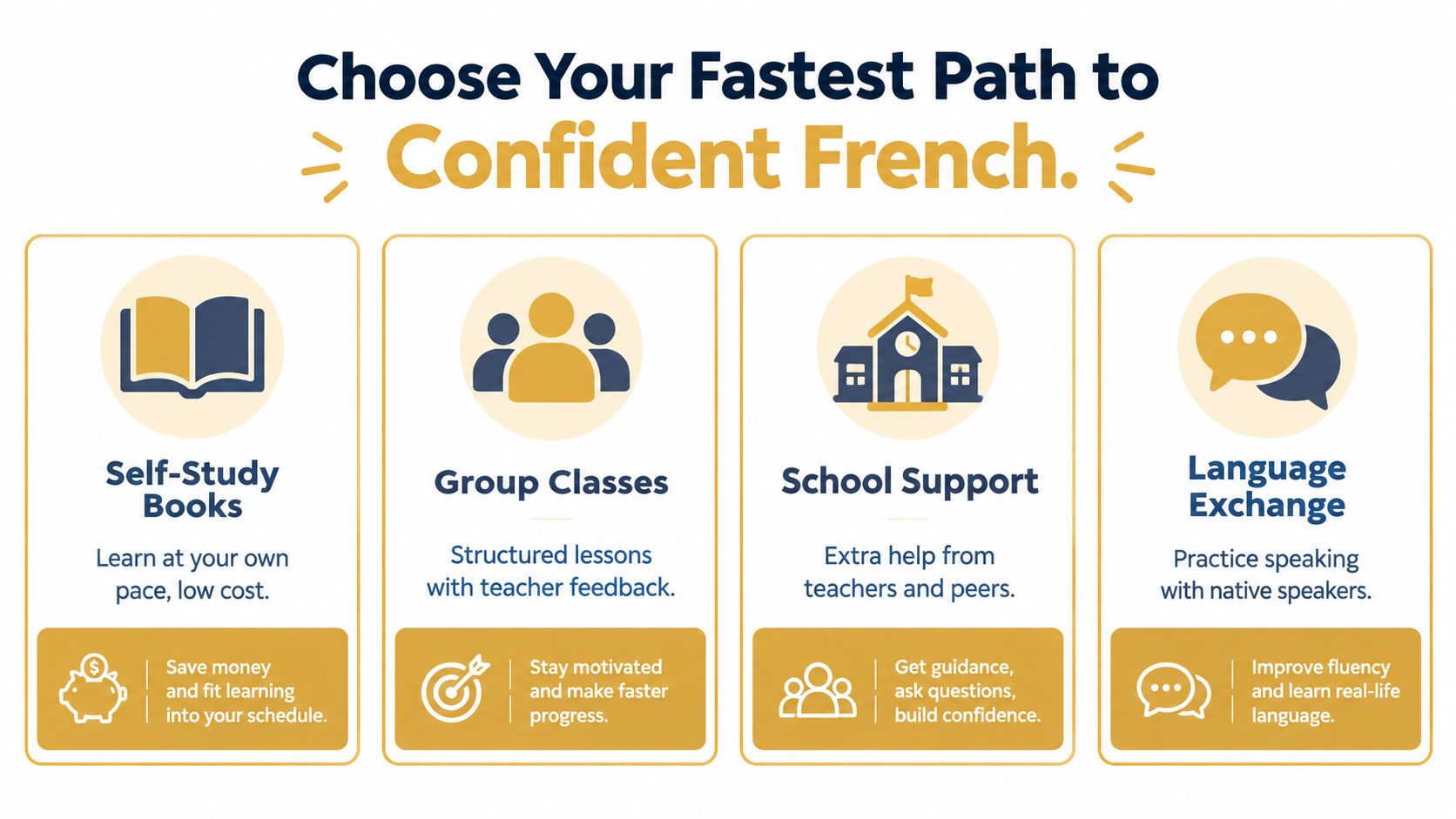
Compare the main options honestly
| Option | Best For | Watch Out |
|---|---|---|
| Self-study books | Independent learners with time and discipline | Slow feedback, easy to drift |
| Group classes | Learners who like structure and peer energy | Pacing may not match your level |
| School support | Students with a fixed curriculum | Can stay too close to homework, not enough speaking |
| Language exchange | Speaking practice with real people | Little correction, uneven quality |
If your goal is DELF or DALF, I would not rely on casual conversation alone. Standardized French needs structure, correction, and a clear map of what the test rewards. If your goal is heritage preservation, the path changes again, because you need a program that respects family language while improving literacy and formal accuracy.
A consultation should diagnose, not sell
A good first call should sort the learner into a real pathway: heritage maintenance, bilingual-school support, adult acquisition, or professional certification. That diagnosis matters more than the headline method. It's also where remote learners save time, because online coaching can be matched to schedule, time zone, and target outcome.
Fastest path rule: if the learner has a deadline, choose the option that gives correction, continuity, and accountability from week one.
Structured French study plan is the kind of page I send to families who want to compare a formal plan against a looser approach. The right choice is the one that fits level, deadline, and amount of outside practice you'll do.
Your Next Step Toward Speaking French With Confidence
If you're a parent, start with one question. Does your child need help keeping up with school, or do they need heritage French support at home? If the answer is school, prioritize curriculum alignment and consistent sessions. If the answer is heritage, focus on writing, vocabulary, and confidence, not just conversation.
If you're a teen or adult targeting DELF or DALF, stop treating all French practice as equal. Build around the exam format, your weak skills, and a regular schedule you can keep. If you're a professional or remote learner, choose a tutor who can fit your calendar and work backward from the situations you face.
I'd begin with a free consultation and bring one concrete goal, one recent writing sample if you have it, and a honest description of your exposure to French. That gives us something useful to diagnose, and it keeps the plan practical from day one. Consistency wins here, not intensity.
If you want to compare lesson options or book a first diagnostic, take the next step now and choose the format that matches your learner profile.