You're staring at a French sentence that should be simple, then the spelling throws you off and the pronunciation feels even less connected. I've seen that moment with countless learners since 2012, and it's usually the point where people start thinking French is random. It isn't. The history of the French language explains a lot of the mismatch between what you read and what you hear, and once you see the pattern, French becomes easier to buy into as a learning project, not just harder to decode.
That matters if you're choosing tutoring, self-study, or exam prep. When you understand where French came from, you can make smarter decisions about what kind of support you need, whether that's conversation practice, school support for a child, or targeted DELF/DALF preparation. If you want a broader case for why learners keep investing in French, this overview on why French language matters is a useful companion.
Table of Contents
- Why French History Matters When You Are Trying to Learn French Today
- Where French Came From and How It Became a Distinct Language
- How French Became the Language of the State
- From Empire to Global Language and Why French Is Still Expanding
- Choosing the Right Way to Learn French Based on Your Goals
- How One Learner Used History to Finally Speak With Confidence
- Your Next Step From History to Fluency
Why French History Matters When You Are Trying to Learn French Today
A student once told me, “I can recognize the words on the page, but I can't hear them in real life.” That reaction is common. French spelling often keeps older forms, while pronunciation has shifted over time, so the gap feels confusing until you see the history behind it.
Why the language feels both familiar and difficult
French keeps a large amount of visible Latin vocabulary, so English speakers often spot familiar words quickly. Then speech begins, and silent letters, nasal vowels, and liaisons make that same sentence feel much harder to follow. History explains why the written form can look steady while the spoken form feels lighter and faster.
I use a simple comparison with learners. French works like a house with old foundations, newer walls, and a fresh coat of paint. The structure still shows the original build, but later centuries changed how the rooms function. That is why history helps with pronunciation, not just cultural background.
Practical rule: if a French word looks “too long” for the sound you hear, do not assume the language is inconsistent. It often preserves an older spelling tradition that once matched speech more closely.
That perspective also helps you choose the right support. A beginner who needs phonetic confidence needs a different lesson format from a professional who wants polished email writing, or a parent looking for school-aligned support. If you are deciding how seriously to invest, why French language matters gives you a useful next step.
Where French Came From and How It Became a Distinct Language
French began as Vulgar Latin after the Roman conquest of Gaul, then slowly separated from Latin through everyday speech, regional usage, and centuries of change. Sediment is a useful way to picture it. One layer is Roman speech, another is local Gaulish influence, and later layers add medieval habits, standardization, and modern policy. The result is not “broken Latin,” but Latin reshaped by place and time.
The earliest surviving text in Old French, the Strasbourg Oaths in 842 CE, marks a major turning point because it shows the language had already moved far enough from Latin to sound distinct. That explains why French still feels related to Latin even when the spelling looks unfamiliar. The family resemblance is real, but it has been remodeled over centuries (WorldData on French history).
What that origin means for learners
French shares a large amount of vocabulary with other Romance languages because they grew from the same Latin base. For English speakers, the connection often comes through French loanwords that entered English later. That is why French can feel familiar in business, travel, law, and food vocabulary before fluency really develops.
French is Latin shaped by centuries of local speech, not a language that appeared fully formed.
That history also explains pronunciation. Spelling often preserves older forms, so the written word may keep clues that the spoken word no longer says out loud. Once learners stop expecting a perfect match between sound and spelling, progress usually gets easier.
For readers who want a clearer historical guide, I also point students toward French history books for learners, because a well-chosen book can make vocabulary patterns and cultural references stick faster.
How French Became the Language of the State
A learner who can read French newspapers but freezes on formal letters is usually running into history, not bad memory. French became the language of state because institutions gave it authority, then kept repeating that standard in offices, courts, and schools.
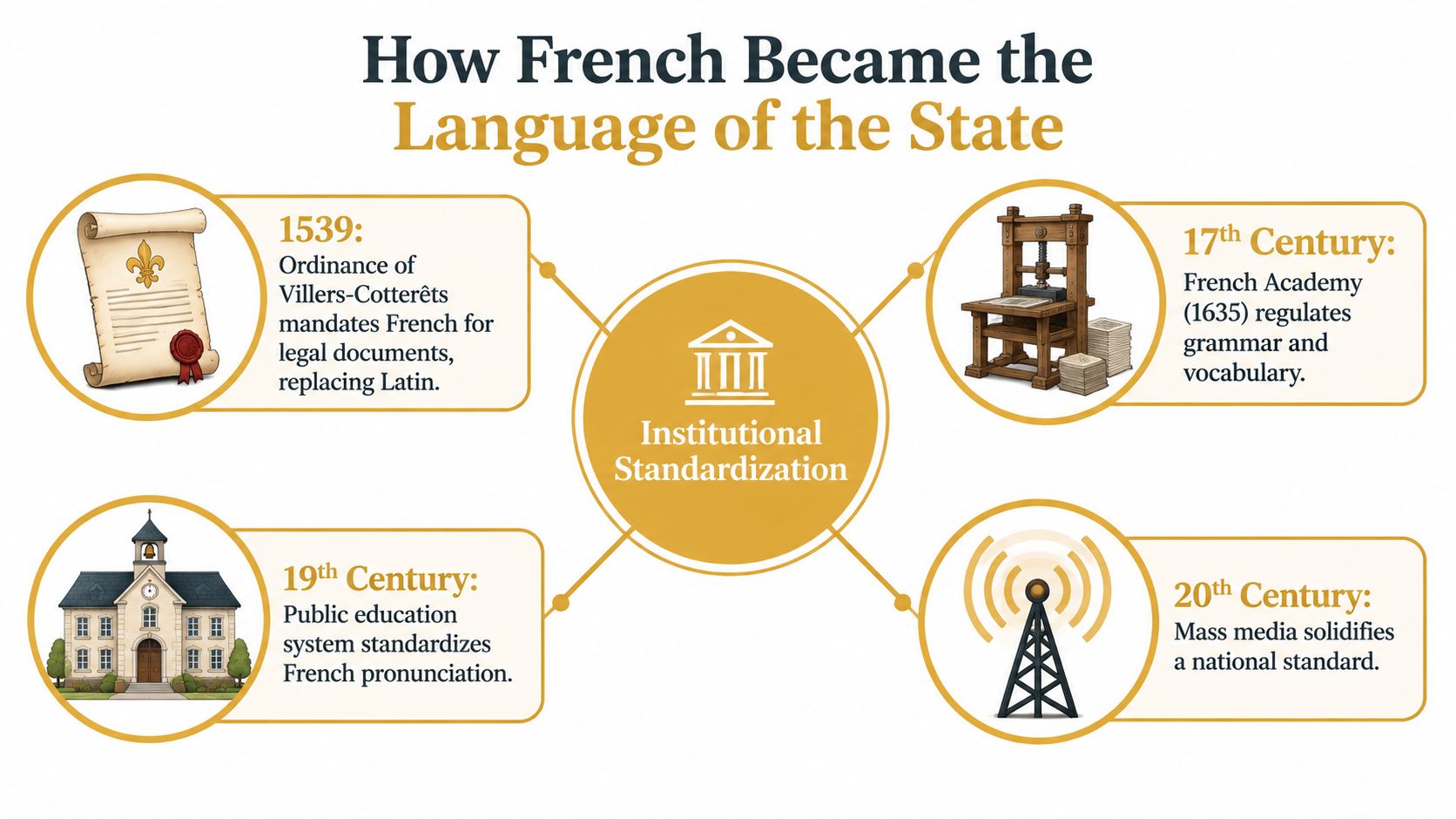
The Ordinance of Villers-Cotterêts in 1539 required French, rather than Latin, for administrative and legal documents in the kingdom, and that pushed French from a regional prestige variety toward a national standard (Duolingo history of French).
That matters because official French still carries this old institutional weight. When you see careful grammar, fixed spelling, and precise register in exams or formal writing, you are seeing the legacy of state standardization. French was shaped not only by speakers, but also by clerks, judges, printers, and later educators.
Why formal French feels so codified
The founding of the Académie française in 1635 further stabilized orthography, grammar, and elite usage. It did not make French simple. It did make a written norm more visible across public administration and high-status writing. For learners, that means formal French rewards precision in a way casual conversation does not always do.
A travel phrase can be forgiving. An application, essay, or official letter is less forgiving.
That difference is why students often say, “I know the words, but I'm not sure which form is correct.” They are meeting a language that was intentionally standardized. French spelling often keeps older forms, while pronunciation moved on, so the page can look more conservative than the spoken language. Once you expect that gap, spelling stops feeling random and starts feeling like a historical map.
Learner takeaway: if you want to write or speak at an official level, you are not just learning vocabulary. You are learning the rules that turned French into a language of administration.
A structured lesson path helps here. A tutor can show you which forms are fixed, which are flexible, and which errors matter most for the setting you care about. For a method comparison, this page on learning French online offers a practical bridge from history to use.
From Empire to Global Language and Why French Is Still Expanding
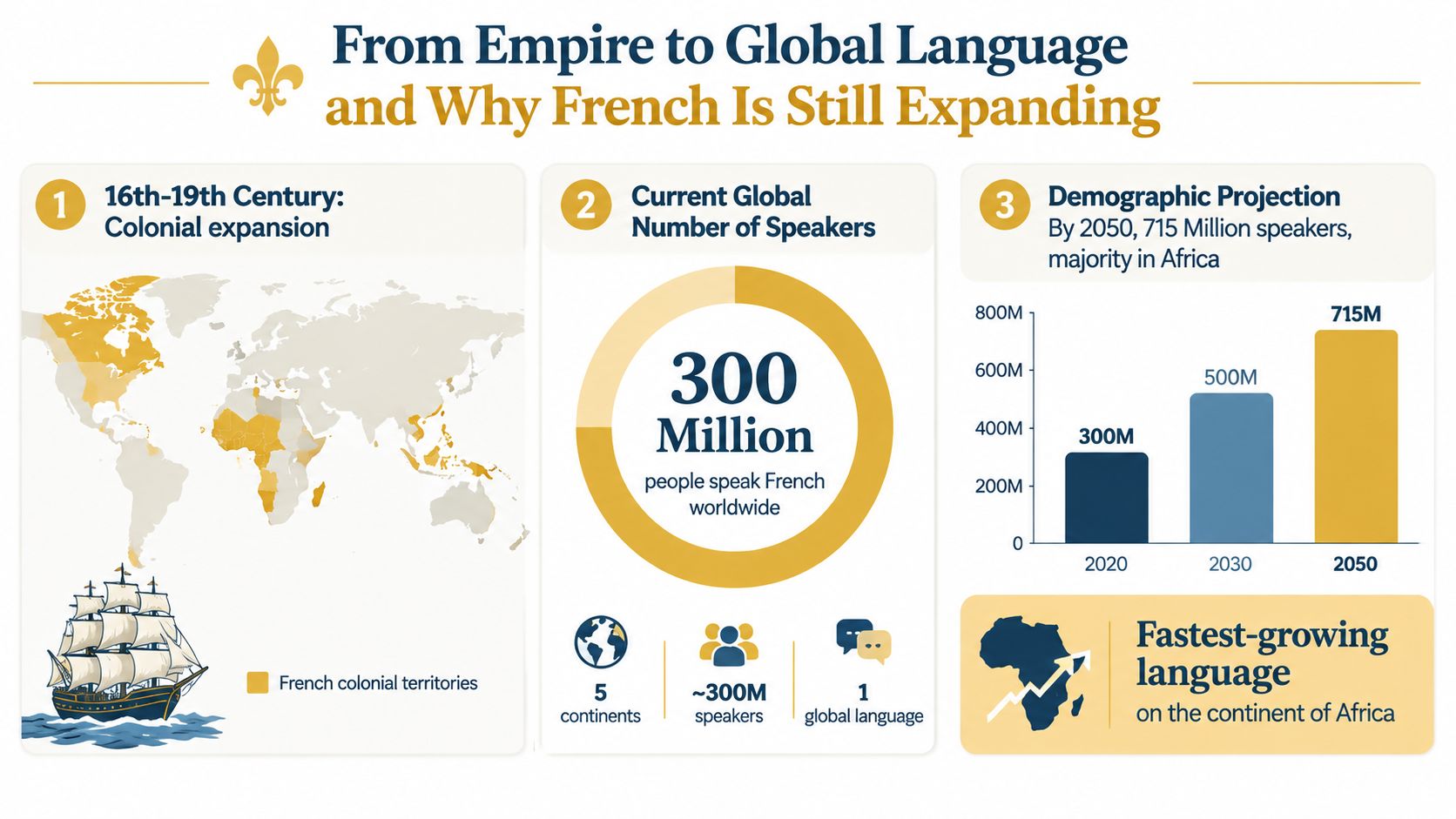
French spread far beyond France through colonial expansion from the 16th to the late 19th century, building a footprint across several continents and shaping where the language is used today. That history still matters, yet the modern story is larger than empire. Learners often picture French as a European subject with a fixed center, but the language now lives in many places at once.
Today, French is an official language in 39 countries and is spoken in 106 countries and territories. The French language page on Wikipedia French language and WorldData both show how broad that reach has become, while recent reporting has also pointed to rapid growth in francophone education systems and changing speaker counts. One analysis explains that newer totals can rise sharply when children in school systems are included, which is why the headline figure depends so much on method and definition.
Why Africa matters to French learners now
That point is where many older histories stop too soon. French is being shaped by education, demographics, and growth across Africa, not just by preserving yesterday's colonial map. One source notes that about 65% of French speakers live in Africa, and that changes the practical value of French for business, migration, education, and diplomacy (Financial Afrik).
For learners, the lesson is simple. French is not only a classroom language tied to Europe. It is a living global language with several centers of use, so the accent, vocabulary, and register you need depend on your goal. If you want the wider professional case, this overview of French in diplomacy connects that spread to real-world influence.
The story isn't decline, it's measurement, demographics, and expansion happening at the same time.
That is why modern French tutoring should reflect global use, not only Parisian norms. A good program helps you understand standard French while preparing you for the accents, registers, and situations you will meet in practice.
Choosing the Right Way to Learn French Based on Your Goals
The right French path depends on what you are trying to do with the language. A parent supporting a child at a bilingual school needs one kind of help, an executive preparing a presentation needs another, and a candidate aiming for certification needs a third. French history explains why these paths differ. The language carries a formal written standard, a global reach, and exam structures that reward precision, so your lesson plan should match the reason you are studying in the first place.
The DELF/DALF system makes that choice easier to see. There are six independent diplomas aligned to CEFR levels, with DELF covering A1, A2, B1, and B2, and DALF covering C1 and C2 (DELF/DALF official site). The diplomas are described as valid for life and independent, so you do not need to pass a lower diploma before taking a higher one (GoDELF). One U.S. exam source also states that as of January 1, 2026, B2 is required for naturalization and B1 is required for a resident card, so level choice is tied to outcomes, not just study effort (AFSF).
Which French Learning Path Fits Your Goal
| Learning Path | Best For | What History Helps You Master | Ideal Format |
|---|---|---|---|
| Adult conversation and travel | Travelers, expats, and adults who want practical fluency | Why pronunciation and spelling do not line up neatly, and which everyday words keep older forms | Private online or in-person lessons with speaking practice |
| Families and K-12 support | Parents at Lycée Français, bilingual schools, or home support needs | Formal grammar, school vocabulary, and the written standard that comes from state history | Curriculum-aligned tutoring, often weekly |
| Corporate and professional communication | Executives, diplomats, and cross-border teams | Register, precision, and the vocabulary of official communication | Flexible private lessons with role-play and writing feedback |
| DELF/DALF exam preparation | Students and adults pursuing certification | The level structure, exam expectations, and why exact usage matters | Targeted exam prep with mock tests and correction |
Online tutoring is described as the largest segment in the France tutoring market, so flexibility matters for busy learners (Deep Market Insights). That helps explain why a custom format often works better than a fixed course.
I also see value in a consultation-based model like Elite French Tutoring, because it starts with your level, your goals, and your schedule before the plan is built. If you want to compare formats before you commit, this guide to online French learning options is a practical place to start.
How One Learner Used History to Finally Speak With Confidence
A client I worked with, a busy parent preparing for French-school support, came in with the complaint I hear often. She could memorize vocabulary lists, but spoken French still felt slippery, and written corrections felt personal instead of useful. Once I showed her how French spelling kept older layers of the language, her mistakes stopped feeling random.

What changed in her lessons
We started with pronunciation, then moved to formal writing, then to school-specific vocabulary. The biggest shift came when she stopped trying to “sound out” every word as if French were phonetic in the English sense. She began to notice spelling patterns that carry meaning, register, and family resemblance.
Personalized tutoring matters for exactly that reason. A native expert can slow the language down, point out what belongs to everyday speech, and show which forms matter for school or exams. For this learner, history became a memory aid, not an academic detour.
Student lesson: when learners understand why French looks the way it does, they stop fighting the language and start recognizing patterns.
She also felt calmer knowing that exam pathways are structured. Because DELF/DALF diplomas are valid for life and independent, as explained by GoDELF, she could think strategically about future goals instead of treating every practice session as the same exercise. That reduced pressure and made each lesson more purposeful.
By the end, she was not just reciting rules. She was speaking with more confidence in parent meetings and reading classroom messages with less hesitation. That difference came from guided support that connected history to real use.
Your Next Step From History to Fluency
A learner opens a French sentence and sees silent letters, unfamiliar accents, and a word that looks only partly familiar. That confusion makes sense once you know the history of the French language. French grew from Latin roots, became more standardized through the state, and spread into many regions and accents. Those shifts explain why spelling and pronunciation do not always match, why formal French can feel so precise, and why one textbook rule does not cover every situation you will hear.
You do not need to memorize a timeline to use that history well. You need pattern recognition. When you understand that French was shaped by institutions, migration, and wide everyday use, your study plan becomes easier to choose, and vocabulary starts to sort itself into families instead of random lists.
The language is also still very active. Wikipedia French language describes French as a global language with a large and growing speaker base, which is one reason it remains a practical choice for school, work, relocation, and long-term communication.
For a learner, that history works like a buying guide. If your goal is conversation, you need practice that trains the ear. If you need school support, you need help with standard forms and writing. If you are preparing for exams, you need a path that matches the test format.
If you want a plan built around your own goal, book a free 20-minute consultation with Elite French Tutoring. We will look at your level, your timeline, and whether you need conversation practice, school support, professional French, or DELF/DALF prep, then map out the path that fits.