Skip to content
You need a French class in Chicago that fits real life, not a brochure. If you've just been asked to join a French-speaking client call next month, or your child needs support that matches a school schedule, the wrong class wastes time fast. Chicago has very different options, from exam centers and credit courses to boutique groups and North Shore immersion schools, so the best fit depends on your goal, budget, location, and weekly availability. I've compared seven strong choices below, with a focus on format, pricing signals, target learner, and what to weigh before you enroll.
Table of Contents
- 1. Elite French Tutoring
- 2. Alliance Française de Chicago
- 3. Language Loop Chicago
- 4. Lycée Français de Chicago Oui Learn French for Adults
- 5. La Petite École de Chicago and L'Institut Bilingue
- 6. French Institute of the North Shore
- 7. City Colleges of Chicago Credit French
- Comparison of 7 French Classes in Chicago
- Your Next Step Toward Confident French in Chicago
1. Elite French Tutoring
If your goal has a date on it, such as a client call in French next month, a DELF exam, or a child falling behind at a bilingual school, private tutoring usually gets you there faster than waiting for the next group term to start. Elite French Tutoring is built around that one-on-one model. Chicago learners work with their tutor online, and in-home sessions are available in New York and Washington, D.C. Elite French Tutoring
The program starts with a diagnosis, not a fixed textbook. A free 20-minute consultation looks at your current level, your objective, and how you like to learn, and the lessons are planned around that. Sessions are personally paced, so a beginner who needs grammar foundations and an advanced speaker preparing for meetings don't follow the same script. The service menu covers adult lessons, French for kids, corporate and business French, DELF/DALF preparation, and tutoring for students at French or bilingual schools, including academic subjects taught in French.
Practical rule: Choose private tutoring when your deadline, schedule, or learning gap is too specific for a shared syllabus.
Online delivery works in your favor in Chicago. You skip the drive across the city or up to the North Shore, and lessons fit around a work calendar or a school week instead of a fixed term. For parents, it means the tutor can work directly on the homework and curriculum a child brings home.
The trade-off is that you won't get the classroom community of a group program, and private lessons cost more per hour than a credit course. If you want in-person teaching in Chicago or a social class setting, combine it with one of the group options below. If you want the most direct route to a specific result, start with private French lessons in Chicago and the free consultation.
2. Alliance Française de Chicago
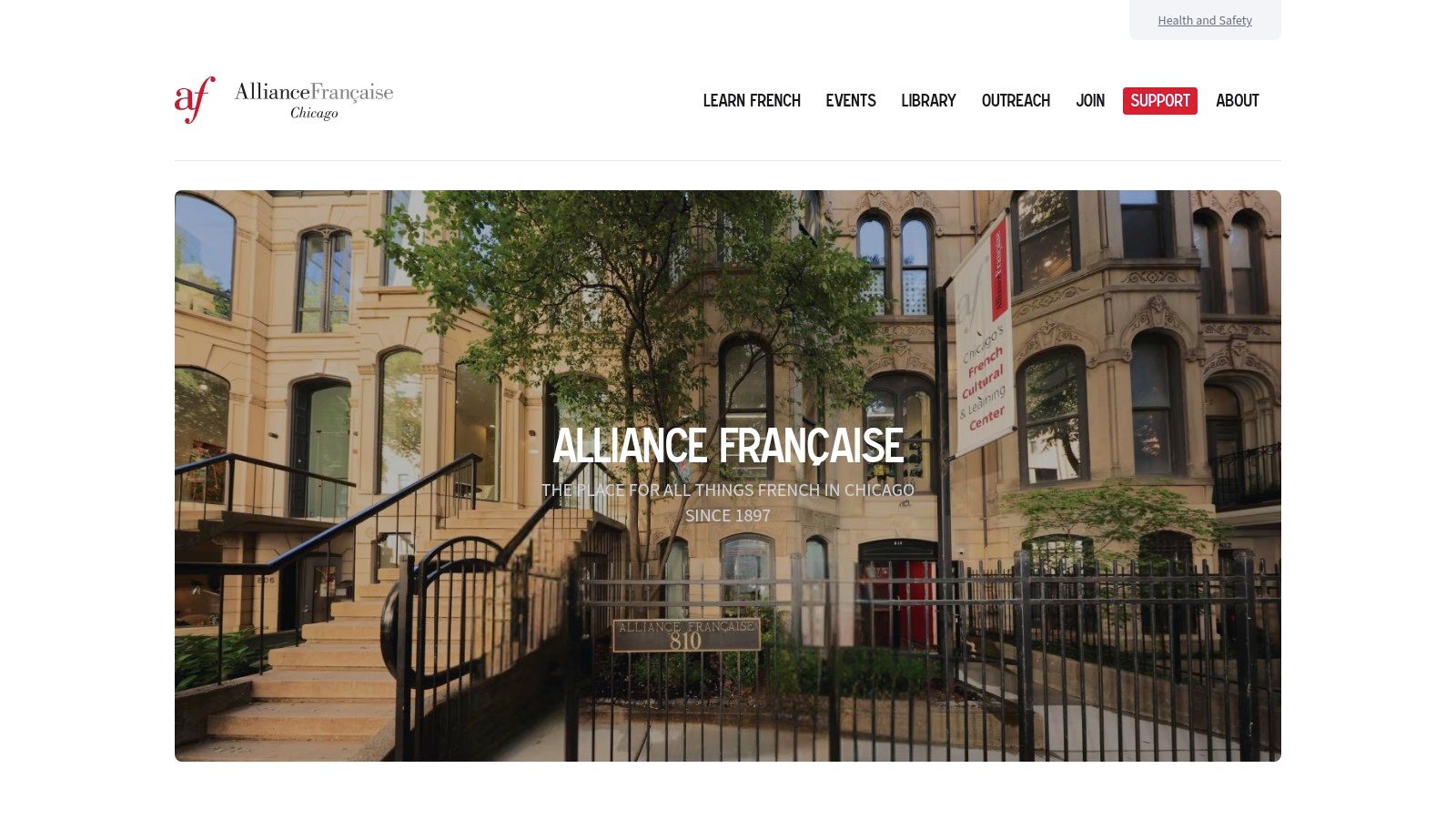
If you want the most established French-learning hub in the city, this is usually the first place I'd look. The institution dates to 1897 and has built a long-running role in Chicago's French-language ecosystem, with early lessons, lectures, and a lending library, plus later cooperation with the Art Institute of Chicago and the University of Chicago. It's also described as the second-oldest and second-largest Alliance Française in the United States, and it belongs to a worldwide network of more than 1,100 organizations. Alliance Française de Chicago
That history matters because the class menu is built for more than casual study. Learners can move through a wide level range from A1 to C2, choose on-site or online sections, and add private lessons, themed workshops, or kids' and teens' classes through Chez Kids Academy. The center also serves as Illinois' official DELF/DALF exam center, which makes it especially useful if you want a place that can support both instruction and certification.
Practical rule: Choose Alliance Française when you want structure, community, and a path that can lead from beginner lessons to formal exam testing without switching providers.
The trade-off is price and popularity. Compared with community college classes, it's usually a more premium option, and strong sections can fill quickly. Textbooks and materials may also add to the true cost. If you want a full-service option and the cultural side matters to you, this is a strong commercial choice. If you only need a light, inexpensive introduction, it may be more than you need. For learners who want private support alongside group study, it pairs well with a one-on-one tutor like the option above.
3. Language Loop Chicago
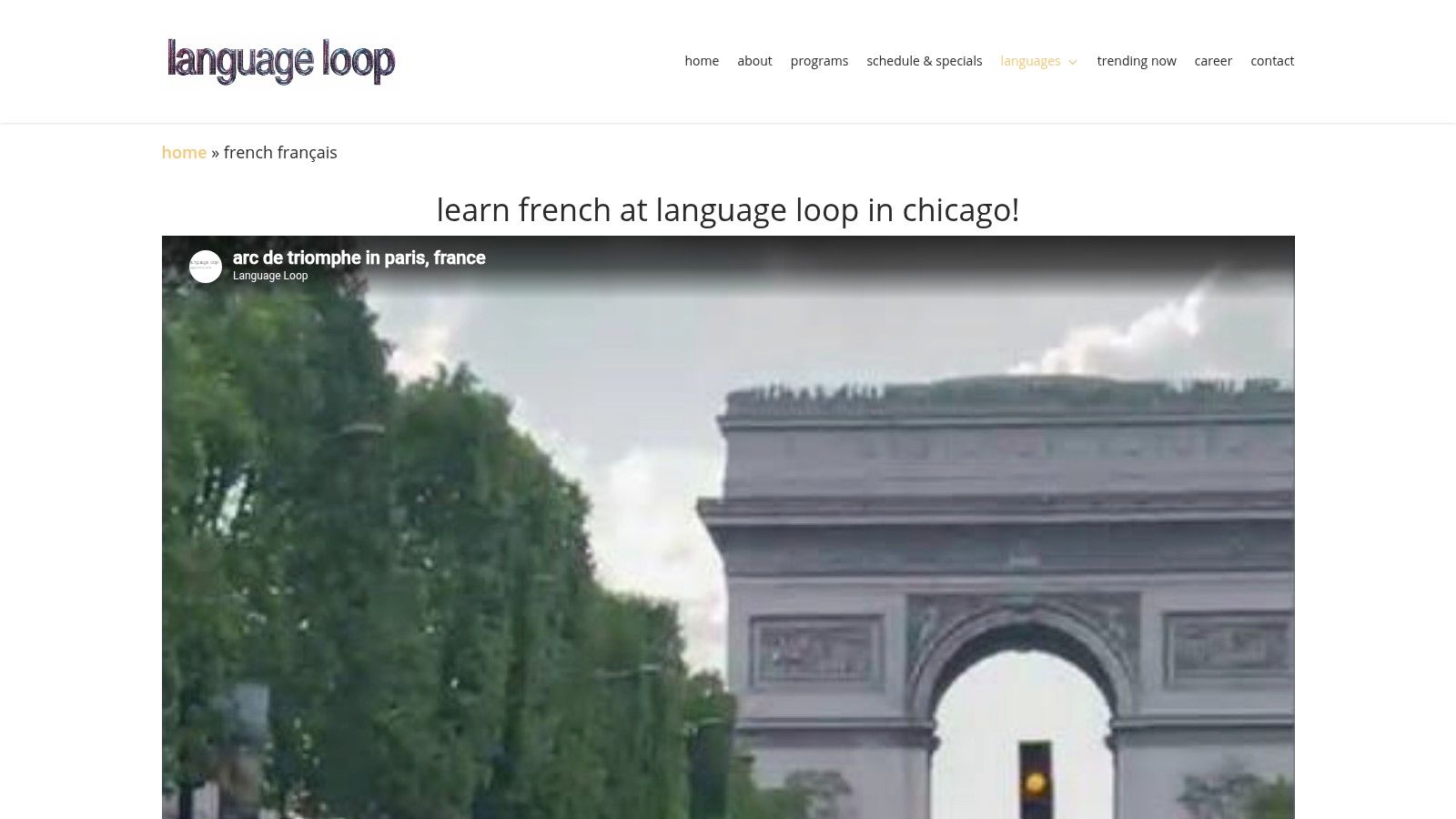
Language Loop is the option I'd point to when speaking practice is the priority. Its group classes are capped at a maximum of five students, and it also offers private, semi-private, and corporate French programs. That small size changes the experience a lot. You get more speaking turns, more correction, and less hiding in the back row.
The school also offers a range of schedules, including 10-week formats, intensives, and short immersions such as “Dive and Survive.” That makes it attractive for busy professionals who need momentum quickly, or for learners who'd rather compress learning into a shorter window than stretch it across a long term. The free level assessment is helpful too, because it reduces the guesswork before you commit.
Best fit and trade-offs
I'd shortlist this provider for a learner who wants speed, attention, and flexibility. The challenge is that boutique schools rarely have the same number of sections as bigger centers, so timing can be tighter. Pricing isn't posted publicly, so you need to ask directly and compare the package against your actual goals.
If your main problem is not motivation but speaking time, a five-person room often beats a larger class.
The school's website is the place to confirm current formats and ask about availability. Start there if you need French for work, travel, or a fast restart and want a small-group setting rather than a lecture-style class.
4. Lycée Français de Chicago Oui Learn French for Adults

This is the most school-like adult French option on the list, and that's the point. Lycée Français de Chicago runs CEFR-based community French classes for adults with placement support, and the instructors include DELF/DALF examiners and IB-certified teachers. If you like the idea of learning inside a French international school environment, this setup has real appeal. Oui Learn French for Adults
The format is straightforward. Adult sessions run in fixed 10-week blocks, with 20 hours total, on Saturdays. That makes it easier to plan around work during the week, and the North Side location can be convenient for learners who already spend time on that side of the city. Childcare during lessons is another practical plus for parents who want consistency without arranging a separate weekend solution.
A good fit here is the adult who wants a stable routine and vetted teachers more than a flexible menu of time slots. A less obvious but important advantage is the school community atmosphere. Some learners stay motivated longer when the setting feels like part of a larger French-language ecosystem, not just a standalone class purchase.
The trade-off is obvious. Weekend-only scheduling will not suit everyone, and you have fewer weekly options than you'd get at a larger language center. Still, if you want a clean, predictable Saturday routine and a serious instructional environment, this is one of the strongest choices in Chicago.
5. La Petite École de Chicago and L'Institut Bilingue
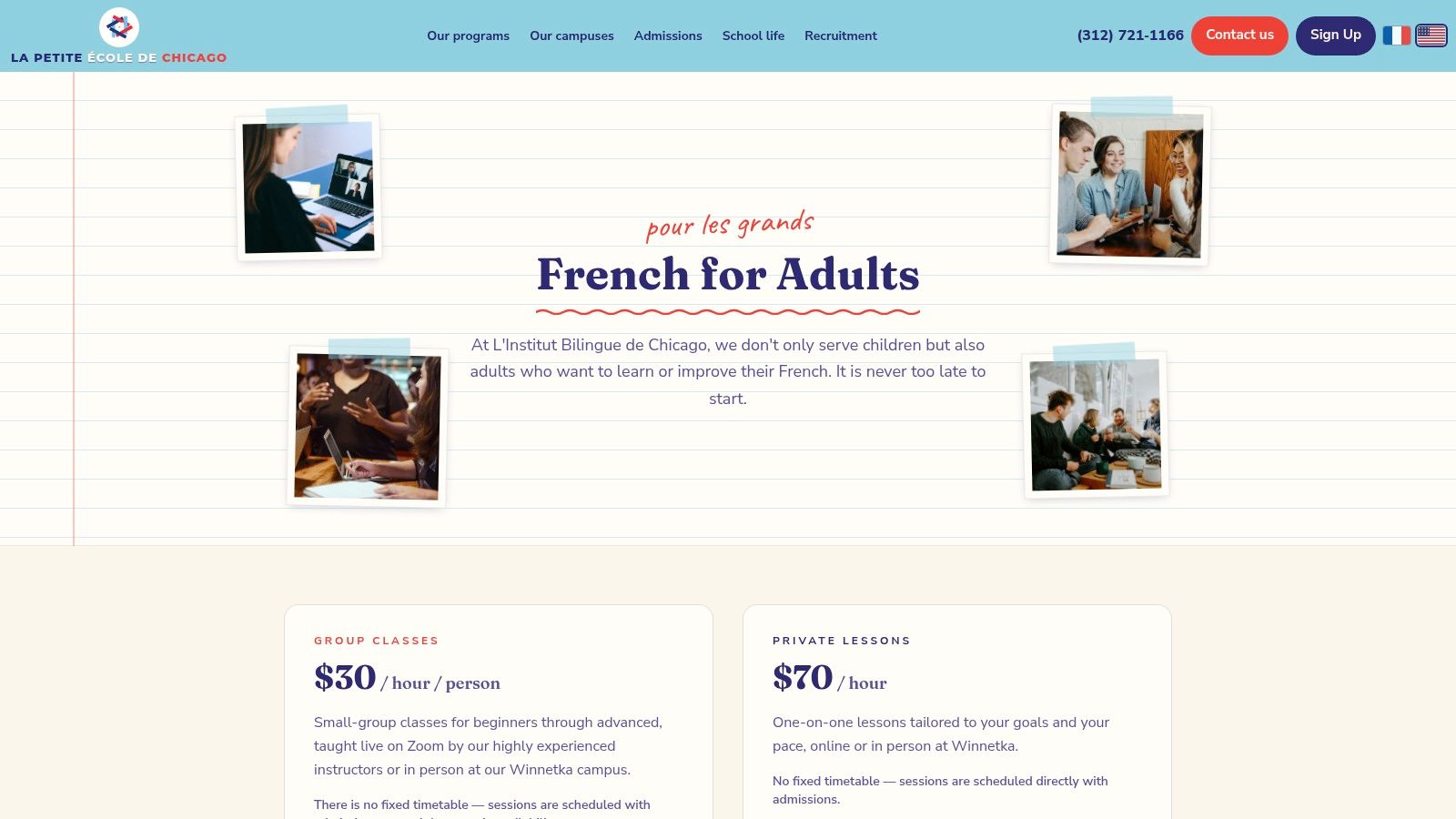
North Shore families and commuters often want a different kind of solution. La Petite École de Chicago, also known as L'Institut Bilingue, is useful because it gives adults small-group classes and private lessons both in person at the Winnetka campus and online. That matters if you want a French program that fits a suburban schedule instead of forcing regular trips into the city.
The pricing is transparent by the hour, which makes budgeting simpler than at schools that hide the numbers until you inquire. Flexible scheduling also helps people who need either a quick private sequence or a low-pressure group format. If you live on the North Shore, the commute savings alone can be a deciding factor.
The biggest limitation is location clarity. Most in-person classes are tied to Winnetka, and Chicago in-person availability is listed as coming soon. That means this is stronger as a North Shore or remote option than as a downtown convenience play.
What to compare before you book
- Private versus group pace: Private lessons work better for a child with uneven school gaps or an adult with a deadline.
- Online versus campus access: Winnetka is ideal if you live nearby, but online may be smarter for a packed week.
- Curriculum fit: Ask whether the teacher can adapt to school support, travel French, or confidence-building conversation.
For families who also need child support, I'd compare the adult options with French classes for kids in Chicago before deciding on a split strategy.
6. French Institute of the North Shore
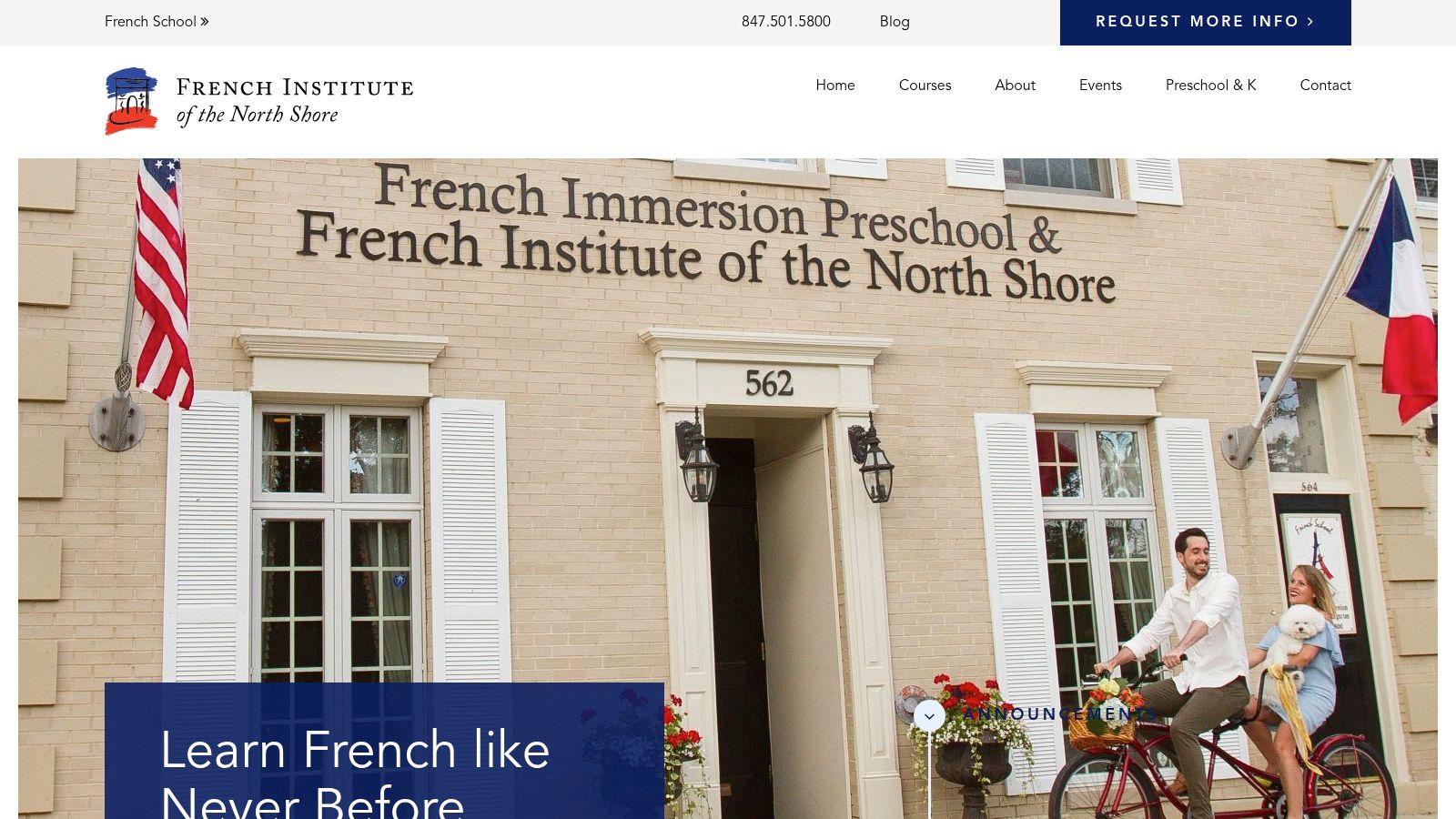
This is the culture-forward choice for North Shore residents who want more than a standard lesson block. The institute uses native-speaking teachers, keeps class sizes small, and combines adult language classes with cultural events such as tastings and literary evenings. It also maintains a client library, which adds to the feeling that you're joining a community rather than just buying hours.
That community atmosphere is the main selling point. Some learners stay more consistent when there's a cultural reason to show up, not only a homework reason. If you enjoy French literature, film, or food, this setting can make the learning process feel more integrated with your interests.
The best local program is often the one you'll actually attend every week.
The practical downside is transparency. Pricing and schedules aren't as easy to compare online, so you need to contact the institute directly. It may also have fewer sections than larger city centers, so if you need a very specific weekday, you may have to be flexible.
I'd recommend it for learners who already know they want a North Shore base and value atmosphere, native-speaker exposure, and cultural programming. If you're price-shopping first and culture second, you may prefer a more openly structured provider.
7. City Colleges of Chicago Credit French
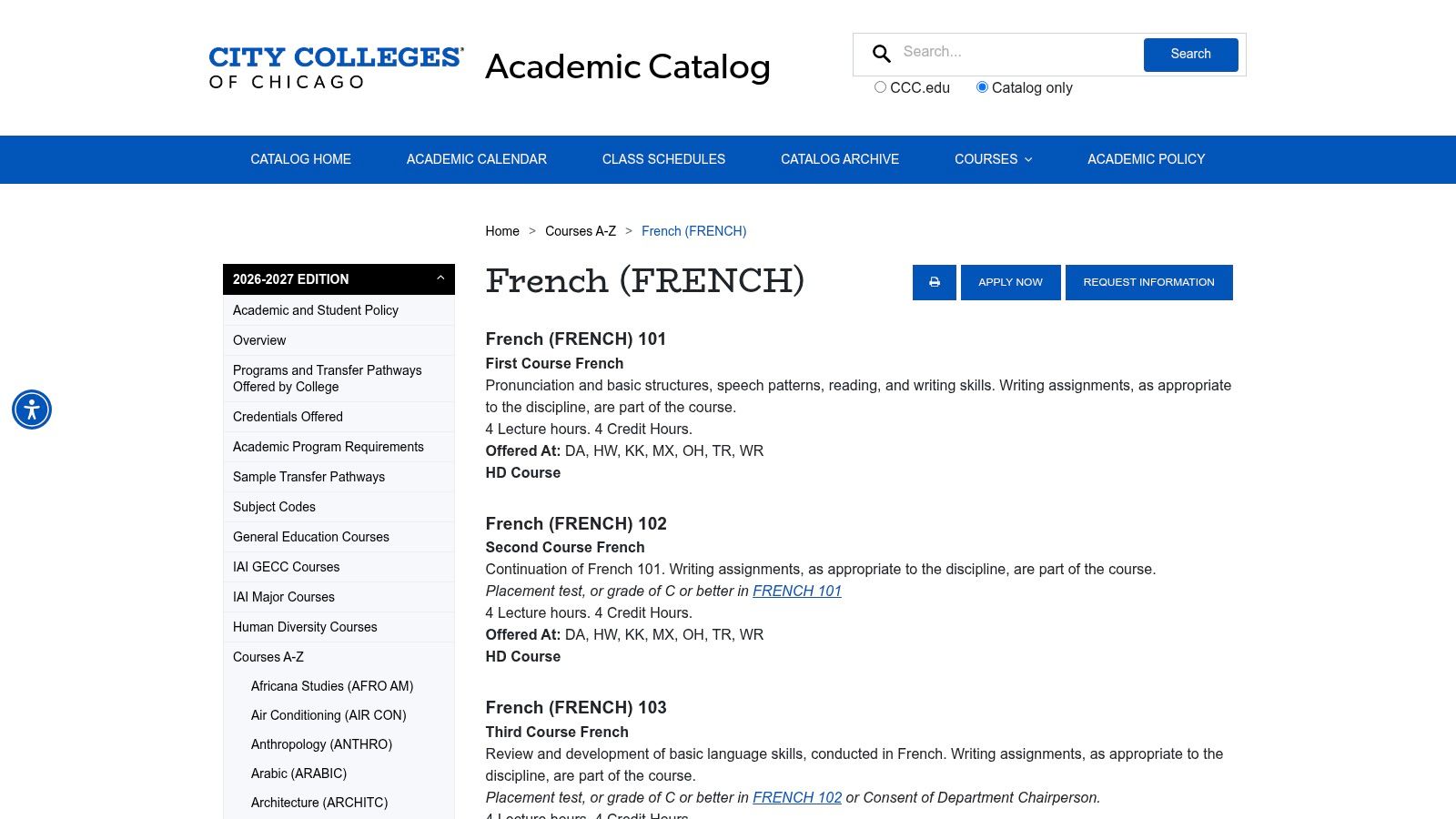
For budget-minded learners who still want structure, City Colleges is one of the most practical choices in town. Its catalog includes credit-bearing French courses such as FRENCH 101 through 104 and conversation classes, with availability spread across multiple campuses. That citywide footprint matters if commuting convenience is part of your decision.
The main advantage is value. You can earn college credit, receive transcripts, and study in a formal academic setting without paying private-school rates. Evening and weekend options also make it easier for working adults to fit French into a larger weekly schedule. If you want an affordable, organized path and don't need a boutique environment, this is a serious contender.
The trade-off is focus. Credit courses are built for academic progression, not necessarily for a fast business-French turnaround or an exam sprint. Course times and campus availability can also vary by term, so planning ahead is important.
This is the option I'd recommend to someone who wants low-cost repetition, transcript value, and a campus-based routine. It's less ideal if you need fast speaking confidence before a trip or a client meeting. If you want to pair academic study with outside coaching, consider the structure of online university-level French classes as a supplement.
Comparison of 7 French Classes in Chicago
| Provider | Implementation complexity 🔄 | Resource requirements ⚡ | Expected outcomes 📊 | Ideal use cases ⭐ | Key advantages 💡 |
|---|---|---|---|---|---|
| Elite French Tutoring | Low, free 20‑minute consultation then a personalized plan | Higher per‑hour cost than group classes; online for Chicago learners | Fast, goal-specific progress in speaking, exams, or school support | Professionals with deadlines, DELF/DALF candidates, bilingual-school kids | Diagnostic-first one-on-one lessons; adult, kids, and corporate programs |
| Alliance Française de Chicago | Moderate, structured CEFR progression with placement | Higher cost; certified instructors; textbooks/materials often extra | High proficiency and DELF/DALF readiness; broad cultural exposure | Structured learners, exam prep, community engagement | Official DELF/DALF center; extensive course catalog; FLE‑certified teachers |
| Language Loop Chicago | Low, flexible boutique processes, quick enrollment options | Moderate–high; very small groups (max 5); pricing by inquiry | Accelerated speaking skills and fluency in short timeframes | Intensive conversation practice, busy professionals, corporate training | Very small class caps; many intensives and immersion options |
| Lycée Français de Chicago – “Oui Learn French” | Low, fixed 10‑week Saturday sessions with placement | Moderate; weekend time commitment; vetted examiner/IB instructors | Consistent progression in a school-like setting; exam-aware instruction | Working adults who prefer weekends; those wanting vetted teachers | Transparent schedule; childcare available; experienced certified staff |
| La Petite École de Chicago / L'Institut Bilingue | Low, flexible scheduling; group starts depend on demand | Moderate; transparent hourly pricing; in‑person Winnetka or online | Personalized progress; continuity for families and adult learners | North Shore residents, remote learners, private-lesson seekers | Clear pricing; flexible private lessons; local campus access |
| French Institute of the North Shore | Low, community-driven scheduling and events | Moderate; native‑speaking instructors; details via inquiry | Cultural enrichment with steady language improvement | Culture-focused learners on the North Shore | Strong cultural programming; client library; native teachers |
| City Colleges of Chicago (credit French) | Moderate, formal registration, term schedules and placement | Low cost; term-based; transferable college credits | Solid academic foundation and transcripted credits | Budget learners seeking college credit or academic pathways | Very affordable; credit-bearing courses; wide citywide access |
Your Next Step Toward Confident French in Chicago
The right choice depends on what you need French to do for you. If you have a specific goal and a deadline, Elite French Tutoring's one-on-one online lessons are the most direct route. If you need exam prep in a classroom, Alliance Française de Chicago is the clearest path because it combines instruction with official DELF/DALF testing. If you want a weekend routine, Lycée Français de Chicago is easier to anchor. If your priority is low cost and credit, City Colleges of Chicago makes the most sense. If you want small-group conversation practice, a boutique school like Language Loop is often the better buy.
For parents, I'd look first at curriculum fit, placement, and whether the teacher can support homework, speaking, and writing separately. For professionals, I'd compare time on task, speaking practice, and schedule flexibility. For North Shore residents, location may matter more than brand recognition, especially if the commute decides whether you keep showing up.
My advice is simple. Shortlist two or three options, compare schedules and total cost, and confirm placement before enrolling. If you want a fully customized plan, you can book a free 20-minute consultation with Elite French Tutoring at elitefrenchtutoring.com to review your level, objectives, and learning style. Lessons for Chicago learners run online, and in-home sessions are available in New York and Washington, D.C.