
You're probably here because your search for French lessons in Los Angeles has turned into a mess. One option looks affordable but vague. Another sounds polished but doesn't make it clear whether classes are in person. A third promises flexibility, but you can't tell how much structure you'll get once you pay.
That confusion is normal. In Los Angeles, the hard part often isn't deciding to learn French. It's figuring out which lesson format will fit your schedule, your goal, and your tolerance for inconsistency. I've seen motivated learners waste months in the wrong setup because they chose based on a headline rate or a nice-looking website instead of how the program works day to day.
The people who make steady progress usually do one thing well: they buy for fit and continuity, not just convenience in the moment.
Table of Contents
Finding Your Way in the LA French Learning Maze
Los Angeles is not a simple market for French learners. It's wide, decentralized, and full of mixed signals. You might find a program that looks local, then realize the venue changes. You might find a tutor with open slots, then discover there's no real curriculum behind the sessions.
That's why so many searches for French lessons in Los Angeles are really searches for reliability.
A major issue right now is schedule and location volatility. Coucou Los Angeles states that it “no longer have[s] a permanent location” as of March 2026 and now relies on live online classes plus selected in-person workshops and conversation events, which makes stable in-person access harder to judge in advance on its Los Angeles class page. For a city built around commute time, parking, and neighborhood convenience, that matters more than many learners expect.
Why this feels harder in Los Angeles
In practice, most learners are trying to solve three problems at once:
Consistency: Can I keep the same routine for months, not just for a trial week?
Proximity: Is this workable from my home, office, or school route?
Instructional fit: Will the lessons match my level and purpose, or am I just joining whatever has space?
Los Angeles has had a long-standing demand for French learning across classes and cultural programming. Alliance Française de Los Angeles describes itself as the city's main French language and cultural center on its official website. That tells me something important as an instructor: French study in LA has never been just a casual hobby market. It has deep ties to schools, culture, family language maintenance, travel, and professional goals.
Practical rule: Don't choose a French program in LA until you know where you'll study, how often you'll meet, and who is responsible for keeping your momentum on track.
Private tutoring has also had staying power here. Strommen notes that it has been matching students with private French tutors in Los Angeles since 2006, and it also describes 8-week class cycles and online lessons via Zoom or Google Meet on its Los Angeles French classes page. That kind of longevity suggests the market isn't experimental. People in LA keep buying French lessons because they need ongoing support in different formats.
If you're evaluating options and want a clearer picture of private support, it helps to compare what providers offer in French tutoring in Los Angeles instead of relying on directory listings alone.
A Comparison of French Lesson Formats in Los Angeles
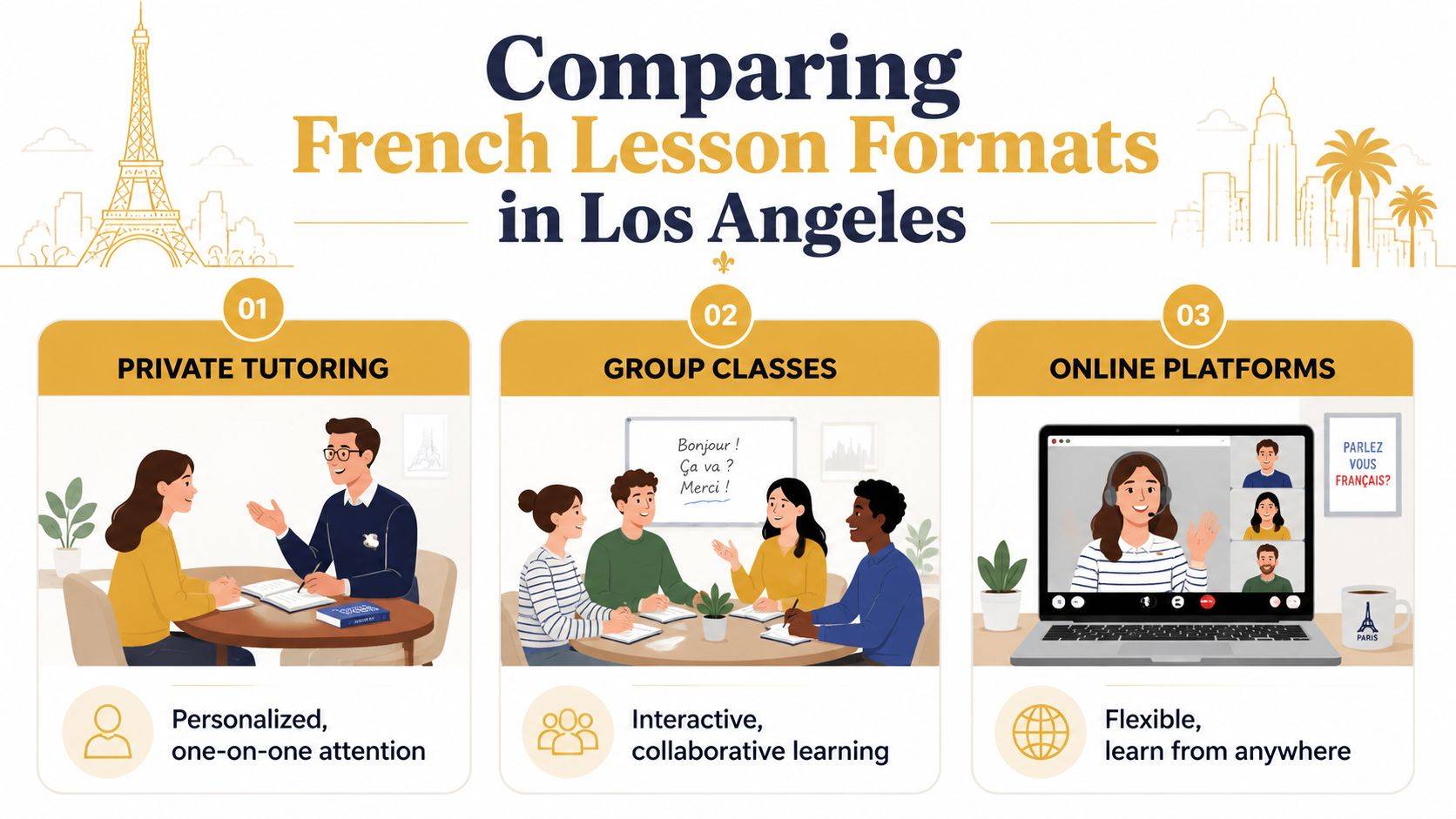
Choosing between private tutoring, group classes, and online platforms isn't about which one sounds most distinguished. It's about which one makes progress easiest for your situation.
Some learners need speed. Some need accountability. Some need the lowest-friction schedule possible. Those are different buying decisions.
What each format does well
Private tutoring works best when the learner has a specific target. That might be business French, school support, oral fluency, or exam prep. The big advantage is customization. The tutor can adjust pacing, homework, correction style, and vocabulary focus in real time.
Group classes work well for adults who want structure and social energy. They're often a good fit for learners who benefit from routine and enjoy hearing other students speak. Alliance Française de Los Angeles, for example, offers separate beginner, intermediate, advanced, and proficient tracks, which reflects the practical value of teaching by level rather than mixing everyone into one room.
Online platforms win on access. If your work hours shift, your commute is unpredictable, or you travel often, online lessons can remove enough friction for you to stick with French. In many cases, that matters more than whether the lesson happens in a physical classroom.
French Lesson Formats in LA At a Glance
| Feature | Private Tutoring (e.g., Elite French Tutoring) | Group Classes (e.g., Alliance Française) | Online Platforms (e.g., Superprof) |
|---|---|---|---|
| Pacing | Set around the learner | Fixed by the group | Varies by tutor or platform |
| Curriculum | Customized to goal and level | Standardized by course track | Often depends on the individual tutor |
| Accountability | High when sessions are scheduled consistently | Moderate, built around course calendar | Uneven unless the tutor imposes structure |
| Best for | Professionals, students, children, exam candidates, targeted goals | Social learners, general progression, cultural immersion | Busy adults, remote learners, flexible scheduling |
| Scheduling | Flexible if the tutor is stable and organized | Usually fixed | Usually flexible |
| Feedback quality | Deep and specific | Limited by group time | Varies widely |
| Cost visibility | Often less transparent up front, but easier to assess by outcome | Usually clearer per term or cycle | Easy to compare at surface level, harder to compare by value |
| Risk | Overpaying for weak personalization | Moving too slowly for urgent goals | Inconsistent teaching quality and continuity |
Los Angeles learners who need remote flexibility but still want structure should compare dedicated programs with broader marketplaces. A useful starting point is this guide to online French lessons, especially if you're weighing convenience against curriculum quality.
What usually goes wrong
The biggest mistake I see is choosing by format before choosing by outcome.
If you need rapid oral improvement for relocation, a pleasant once-a-week group class may feel productive without moving fast enough. If your child needs support tied to school content, a conversation-only tutor may be likable but ineffective. If you're self-directed and disciplined, a flexible online setup can be ideal. If you need external accountability, it can lose momentum.
“The right lesson format is the one you'll still be following three months from now, with clear progress you can actually describe.”
Another common issue is mismatch between lesson density and goal urgency. In Los Angeles, French instruction is often organized by CEFR bands from A1 to C2, and some accelerated formats compress 24 hours into 4 weeks for learners who need faster gains, as shown on this Los Angeles French classes overview. That matters. A maintenance goal can live in a slower rhythm. Relocation, placement, or DELF/DALF preparation usually can't.
Matching the Right Lessons to Your Learner Profile
The right French lessons in Los Angeles depend less on your age than on your use case. Two adults at the same level may need completely different programs. One wants travel conversation. The other needs to present to French-speaking clients. They shouldn't buy the same product.

Adults learning for work or relocation
If you're learning French for your career, generic conversation lessons usually aren't enough. You need targeted speaking practice, high-frequency structures, and vocabulary tied to your field. A lawyer, executive, academic, and healthcare professional all need different language.
What works:
Scenario-based sessions: meetings, introductions, negotiations, networking, presentations
Correction with restraint: enough feedback to sharpen you, not so much that you stop speaking
Role-specific vocabulary: not “advanced French” in theory, but the French you'll use
What doesn't work is spending week after week discussing restaurant orders and vacation plans when your real pressure point is professional communication.
Children, teens, and heritage learners
For school-aged learners, the lesson has to connect to the environment where French is already showing up. If a student attends an immersion program or bilingual school, support needs to strengthen reading, writing, classroom comprehension, and subject-specific vocabulary.
The instructional principle here is simple. Comprehensible input and targeted vocabulary matter more than endless open-ended conversation.
CAL notes that French heritage language schools in the United States are designed to support community language maintenance and cultural identity, and the Census data cited there reports 1.33 million people spoke French at home and 646,000 spoke French Creole at home in the U.S. on this French heritage language schools brief. In real tutoring terms, that means heritage and school-aligned learners often need input comprehensibility, literacy transfer, and purpose-built vocabulary more than casual speaking practice.
A strong lesson plan for this group often includes:
School text support: reading assigned passages, decoding instructions, preparing for written tasks
Vocabulary by domain: science, social studies, math, literature, not just daily life topics
Writing scaffolds: sentence frames, transition words, verb support, revision feedback
If you're an adult learner trying to choose a tutor with this level of precision in mind, this guide on how to find the right French tutor as an adult learner is useful because it focuses on fit rather than broad promises.
Exam candidates and goal-driven adult learners
Exam prep is where “friendly conversation practice” fails most obviously. DELF and DALF candidates need format familiarity, timing control, correction strategy, and repeated work inside the exam's task types. The same principle applies to adults targeting a specific CEFR level.
I usually recommend that learners ask three questions before buying:
Is the program level-specific? A1 through C2 isn't just labeling. It changes what you study and how fast you can absorb it.
Does the lesson cadence match the deadline? Weekly maintenance won't rescue a short preparation window.
Will I get corrective feedback tied to the actual task? Fluency matters, but task performance matters too.
If your goal has a deadline, your French lessons need a calendar, not just a conversation partner.
Casual adult learners have more flexibility. They can do well in group classes if they enjoy the pace, or in private lessons if they want faster progress and more speaking time. The main thing is honesty about the goal. If you say “travel French” but you aim for confident sustained conversation, buy accordingly.
A Look Inside Our Proven Lesson Structure
A productive French lesson is never just chat. It has an intention, a sequence, and a reason for each activity.
What a strong lesson includes
The strongest private programs start by diagnosing the learner properly. That means current level, real objective, time horizon, scheduling reality, and learning style. Without that step, the tutor is guessing.
At Elite French Tutoring, programs begin with a free consultation and then move into customized instruction built around the learner's profile, with methodology described on its French tutoring methodology page. That's one example of what buyers should look for in a dedicated service rather than a loose tutor marketplace.
A solid lesson usually includes a mix of these elements:
Warm-up speaking tied to prior material: not random small talk, but retrieval practice
Focused instruction: grammar, structure, pronunciation, or vocabulary that serves a real use case
Application: guided speaking, role play, listening, reading, or writing tied to the learner's goal
Correction and consolidation: clear feedback plus next-step practice so errors don't repeat
What doesn't work is spending the full hour reacting casually to whatever topic appears. Students may enjoy that format, but enjoyment alone doesn't produce reliable gains.
What I watch for: If a learner leaves a session knowing exactly what improved, exactly what needs work, and exactly what to practice next, the lesson was built well.
A real student story
One student came in with a common Los Angeles problem: a demanding work schedule, uneven availability, and a high-stakes communication goal. He didn't need academic French. He needed to sound competent and calm in front of a French-speaking audience.
We stripped the program down to what mattered. Presentation language. Transition phrases. Industry vocabulary. Pronunciation work on high-visibility lines. Repetition under pressure.
What worked wasn't volume for its own sake. It was specificity. The sessions kept returning to the exact communicative situations he'd face, so each lesson reinforced performance instead of drifting into broad language study.
That's the difference I care about most as an instructor. A lesson should produce skill you can use outside the lesson.
Decoding the True Cost of French Lessons in LA
If you search French tutors in Los Angeles, the first thing you'll notice is price dispersion. Rates can look similar on the surface while the actual service behind them is completely different.
That's why sticker price is a weak buying tool.
Why the hourly rate can mislead you
Superprof reports 649 tutors in Los Angeles, an average price of $33/hour, and 97% offering the first hour free on its Los Angeles French tutors page. Useful? Yes. Sufficient? No.
Those numbers tell you there's supply and that comparison shopping is easy. They do not tell you whether the tutor can teach a child in immersion school, prepare someone for DELF, support a corporate learner, or build a coherent multi-month plan.
The hidden risk is false economy. A lower rate can still be expensive if progress stalls, sessions drift, or you have to start over with someone else.
What you're actually paying for
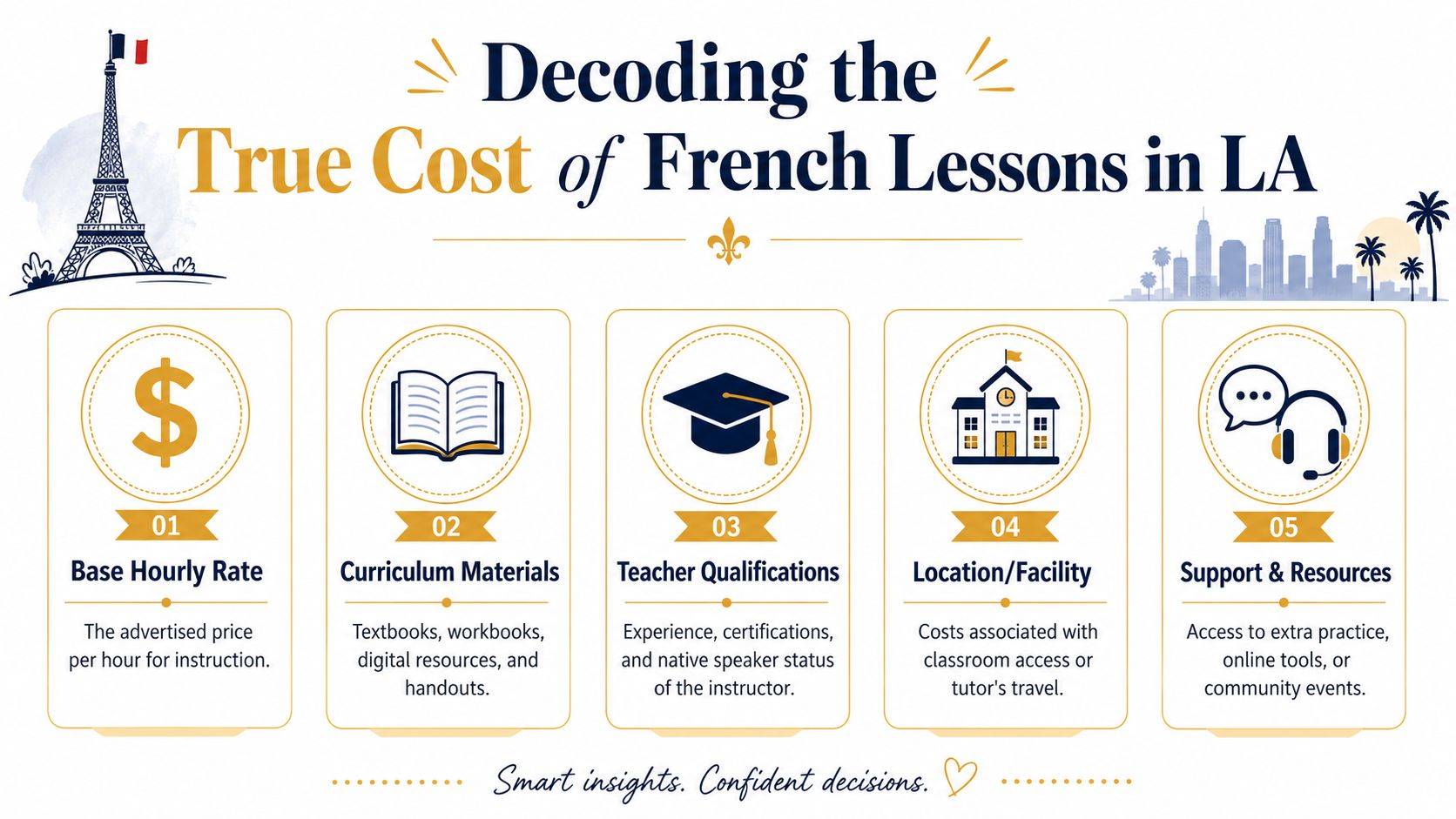
When I evaluate value, I look at five factors:
Instructor fit: Can this person teach your exact use case, not just “French” in general?
Preparation quality: Are lessons planned, or improvised on the spot?
Curriculum alignment: Does the material match your school, exam, profession, or target level?
Scheduling stability: Can you maintain momentum without constant rescheduling or venue uncertainty?
Support outside the session: Are you getting useful notes, practice direction, and continuity?
A group class can be a smart buy when your goal is broad progression and you're comfortable moving at a shared pace. Private tutoring often costs more per session, but it can be better value when the goal is narrow, urgent, or high consequence. A marketplace tutor may be enough for casual practice, but buyers should expect to do more of the vetting work themselves.
Cheap French lessons are only a bargain if they get you where you're trying to go.
If you're a parent, exam candidate, or professional, don't ask only, “What does it cost per hour?” Ask, “What problem is this solving, and how efficiently?”
FAQs About Learning French in Los Angeles
A few final questions usually determine whether someone books lessons or keeps browsing.
Common Questions About Learning French
| Question | Answer |
|---|---|
| Should I choose in-person or online French lessons in Los Angeles? | Choose the format you can sustain consistently. In-person can feel more immersive for some learners, but online often wins if traffic, parking, or schedule changes would otherwise break your routine. |
| Are group classes enough for serious progress? | They can be, if your goal is general improvement and you're happy with shared pacing. They're less ideal when you need school support, exam prep, or job-specific French. |
| What qualifications matter most in a French tutor? | Look for teaching experience with your type of goal, not just fluency. A native speaker can still be a poor fit if they can't sequence lessons, explain errors, or adapt materials to your needs. |
| How long does it take to become conversational? | It depends on your starting point, lesson frequency, and what you mean by conversational. A travel learner and a professional presenter are aiming at different outcomes, so the timeline should be judged against the task, not a generic benchmark. |
| Is private tutoring worth the extra cost? | It often is when you need customization, faster pacing, or accountability. It's less necessary if you're a casual learner who enjoys a slower, social classroom environment. |
| What's the biggest mistake buyers make? | Choosing based on hourly price or convenience alone. The better question is whether the lessons match your goal and can continue reliably over time. |
| Can children and teens use the same type of French tutor as adults? | Sometimes, but not always. School-aged learners often need curriculum-aligned support, reading and writing reinforcement, and age-appropriate materials. |
| How do I know if a tutor is a good fit after the first lesson? | You should be able to tell what the tutor noticed about your level, what they plan to focus on, and how they'll structure the next phase. If the session felt pleasant but directionless, that's a warning sign. |
If you're comparing French lessons in Los Angeles right now, narrow your shortlist by one criterion first: which option gives you the clearest path to consistent progress. Then look at format, schedule, and price.
If you want to make the decision easier, compare a few lesson options side by side and book a consultation only with providers that can clearly explain their structure, continuity, and fit for your goal. That one step saves a lot of wasted time.