

When looking for French lessons in Miami, you're probably not doing it for fun browsing. You have a real reason. Maybe your child needs support for a bilingual program. Maybe you work with francophone clients and you're tired of smiling through conversations you can't fully join. Maybe you're planning a move and need French that works in real life, not textbook French.
I've guided families, professionals, and adult learners through this decision for years, and I'll give you the blunt version. The right choice is rarely “the best school.” It's the right lesson format for your goal, schedule, and pressure level. A parent preparing for a school conference needs a different plan than a Brickell executive, and both need something different from an adult learning for travel or relocation.
Table of Contents
From Zero to Confident A Miami Professional's French Journey
Tailoring Your Learning Path Kids, Adults, and Professionals
Finding Your Pourquoi for Learning French in Miami
A lot of people start in the wrong place. They compare tutors before they define the job the tutor needs to do.
In Miami, that mistake is expensive. I've seen parents book generic conversation lessons for children who required school-aligned support. I've seen professionals join casual group classes when they needed industry vocabulary, meeting practice, and correction on tone. I've also seen motivated adults waste months because they said they wanted to “learn French” when their objective was much narrower and much more useful.

Your goal should be specific enough to teach
If you're standing at a networking event in Miami and losing confidence because you can't keep up with a French conversation, your target isn't “be fluent.” It's something like: hold introductions, ask follow-up questions, explain your work, and manage small talk without freezing.
If you're a parent at a bilingual school conference, your goal may be very different. You may need homework support, reading reinforcement, oral confidence, or preparation for school expectations. If you're relocating or preparing for certification, your target becomes even more concrete.
Practical rule: If your goal can't shape the lesson plan, it's too vague.
I tell students to choose one primary reason from this short list:
School support: Your child needs curriculum-aligned help, pronunciation work, reading practice, or confidence speaking in class.
Professional communication: You need French for meetings, client calls, presentations, hospitality, real estate, legal settings, or executive travel.
Relocation or exam preparation: You need structure, accountability, and progress tied to a recognized level or testing path.
Social and lifestyle fluency: You want to speak comfortably at dinners, while traveling, or with family and friends.
If you need help naming that reason clearly, this guide on why adults and families choose to learn French is a useful starting point.
The wrong goal creates the wrong program
A broad promise sounds appealing. It usually leads to slow progress.
The best French lessons in Miami are built backward from the outcome. If your priority is business communication, your tutor should be correcting phrasing, register, and response speed. If your child needs academic support, lessons should follow what's happening in school. If you need conversation fast, speaking should start immediately.
That's why I push people to define their pourquoi first. Once you do that, your options become much easier to judge.
In-Person vs Online French Lessons in Miami
Miami learners often ask the wrong question here too. They ask which format is better. The useful question is which format you'll sustain.
What Miami learners actually need
You need a format that fits your week, not your fantasy week. If you live in Miami proper, commute across neighborhoods, juggle school pickups, or travel for work, convenience matters more than people like to admit.
The local market gives you plenty of options. One Miami tutoring directory lists 215 private French tutors, an average lesson cost of $30 per hour, and says 97% offer a first lesson free, which shows broad supply and active price competition in the local French tutoring market according to Superprof's Miami French tutor listings.
That sounds great, but variety creates a second problem. When there are many choices, people start shopping by convenience alone. Don't do that. Shop by fit.
A useful place to compare remote options is this roundup of online French lesson formats and how they differ.
A practical comparison
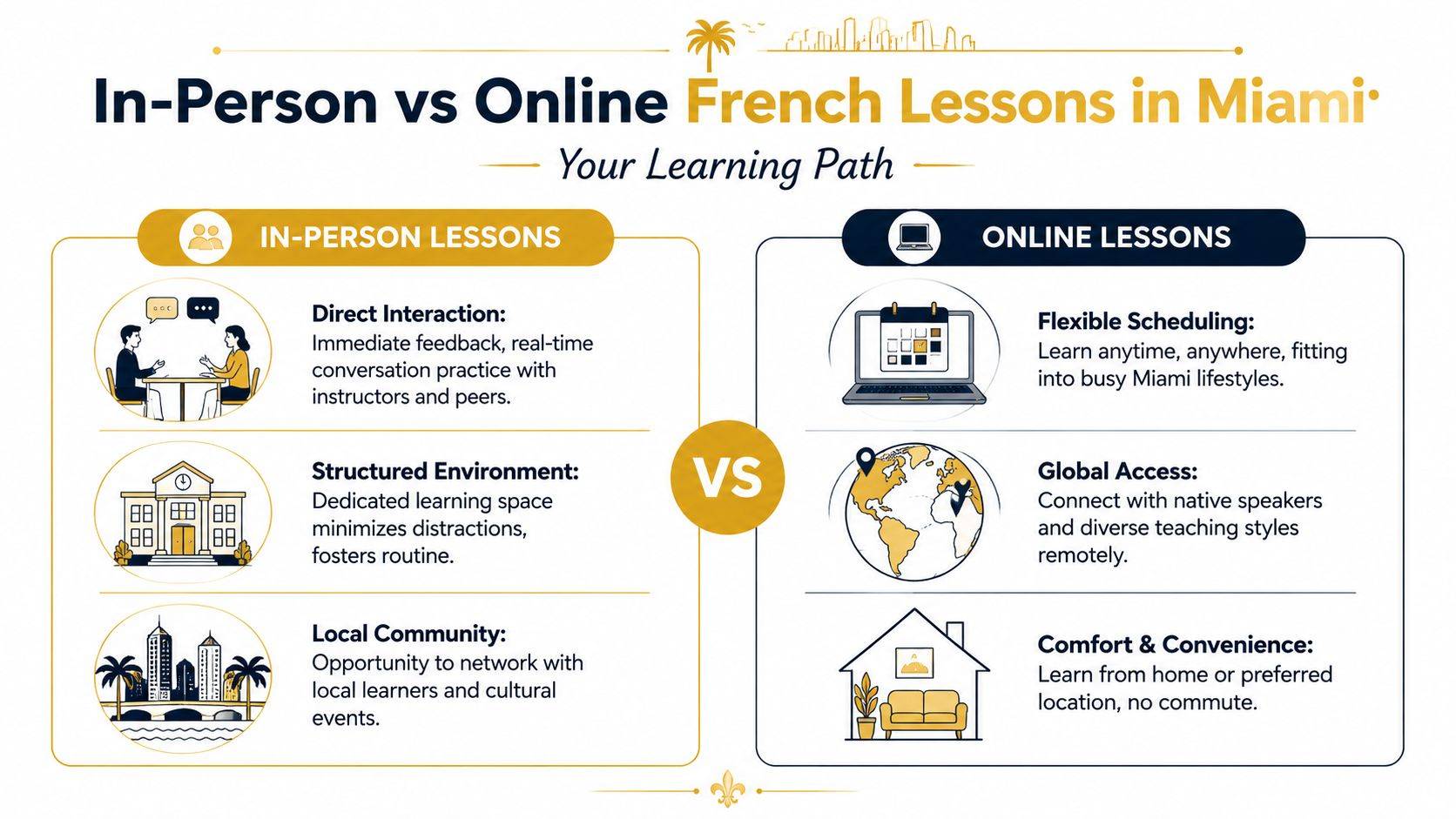
In-person lessons can be excellent when you need a strong routine, a physical learning environment, and face-to-face accountability. They're especially useful for younger children, learners who focus better outside the home, and adults who know they'll cancel virtual sessions too easily.
Online lessons win for flexibility. They also widen your access. You're not limited to whoever happens to teach near your neighborhood or office.
Here's the side-by-side view I'd give a client.
| Feature | In-Person Lessons | Online Lessons |
|---|---|---|
| Routine | Strong for learners who need a set location and fewer home distractions | Strong for learners who need flexibility around work, school, or travel |
| Commute | Requires travel time and planning | No commute, easier to fit into busy weeks |
| Tutor access | Limited by geography and local availability | Wider access to specialized instructors |
| Energy and presence | Good for learners who respond to physical classroom energy | Good for focused one-to-one work and efficient scheduling |
| Family logistics | Can be helpful for younger students if location is convenient | Easier for parents managing packed calendars |
| Consistency | Works well if you can protect the time block | Often easier to maintain week after week |
Here's my opinion. Most busy adults in Miami do better online unless they are unusually disciplined about transit and scheduling. Most children can do well in either format, but only if the lessons are interactive and age-appropriate.
If you keep canceling because getting there is hard, the format is wrong, even if the teacher is good.
Choose in-person when physical presence will increase commitment. Choose online when flexibility will increase consistency. Consistency beats romance every time.
Decoding Credentials What Makes a Great French Tutor
A polished website tells you almost nothing. A French accent alone tells you even less.
Fluency alone isn't enough
I've met many fluent speakers who could not teach beginners, support a child in a bilingual curriculum, or correct an adult professional with any precision. Teaching French and speaking French are not the same skill.
You want someone who can hear what you're doing wrong, explain it clearly, and adjust their method fast. That matters even more if you're paying for private lessons.
Miami does have formal French-learning infrastructure beyond private tutoring. Alliance Française Miami Metro operates multiple Miami-area locations, offers learning options for kids and adults in person or online, and functions as an official testing center for DELF, DALF, and TEF exams. That matters if certification is part of your plan, because exam preparation needs more structure than casual conversation practice.
The checklist I'd use myself
If I were hiring a tutor for my own family, I'd screen for these points first:
Teaching ability: Ask how they correct mistakes. Good tutors don't just interrupt. They decide what to fix immediately, what to revisit later, and how to keep momentum.
Goal match: A tutor for travel conversation may be a poor choice for DELF prep, school support, or business French.
Methodology: Ask what happens in the first few lessons. If the answer is vague, that's a warning sign.
Material quality: Serious instructors use structured materials, not random worksheets and improvised chats.
Pronunciation coaching: Early correction matters. Bad sound habits become stubborn quickly.
I also care a lot about whether the tutor can explain their approach in plain English. If they can't describe how they teach, they probably teach by instinct alone. That's risky.
A great tutor doesn't just make you comfortable. They make you capable.
For adults comparing private options, this guide on how to evaluate a French tutor before you commit asks the right questions.
Here's one more hard truth. “Fun” is not a teaching method. Lessons should be engaging, yes. But your tutor should also track what you can understand, what you can say spontaneously, and where your recurring mistakes are showing up. If that tracking never happens, progress will feel fuzzy because it is.
From Zero to Confident A Miami Professional's French Journey
A Miami real estate professional once came to us with a problem I see all the time. She had strong market knowledge, strong client instincts, and zero confidence in French. She was meeting buyers from France and Quebec, but every property visit became harder than it needed to be. She couldn't guide naturally, clarify details quickly, or build rapport in the way she wanted.
I'll call her Isabel.
What changed for Isabel
Isabel did one thing right from the beginning. She didn't say, “I want to be fluent.” She said, “I need to handle tours, answer common client questions, and manage basic negotiation language.” That gave us something concrete to build around.
Her program focused on role-play. We practiced property descriptions, neighborhood language, scheduling, pricing discussions, and polite ways to redirect or clarify when she didn't understand. We also worked on listening under pressure, because client interactions move fast.
She committed to frequent lessons and daily exposure between sessions. That matters. Language-learning guidance notes that retention improves with daily practice, and that an intensive rhythm of three to four tutoring sessions per week plus daily immersion can produce conversational ability in roughly three to four months, as explained in this French learning cadence guide.
Why her plan worked
Isabel improved because her lessons were narrow, repetitive in the right way, and tied directly to her work. We weren't chasing every tense and every exception. We were building response speed in situations she faced.
About four months in, she called after conducting a client interaction largely in French. She wasn't perfect. She didn't need to be. She was understandable, calm, and useful. That changed the tone of the relationship immediately.
That kind of success story isn't magic. It comes from a few plain decisions:
Choose a deadline-driven goal: “Speak better” is weak. “Handle property tours” is teachable.
Practice under realistic conditions: Role-play beats passive review.
Increase frequency: Short, regular contact with the language works better than occasional marathon sessions.
Use the language the same day: If new vocabulary never leaves the notebook, it won't stick.
The fastest progress I see comes from students who stop collecting French and start using it.
If you're a professional in Miami, take that seriously. You do not need an academic plan unless your goal is academic. You need a targeted communication plan.
Tailoring Your Learning Path Kids, Adults, and Professionals
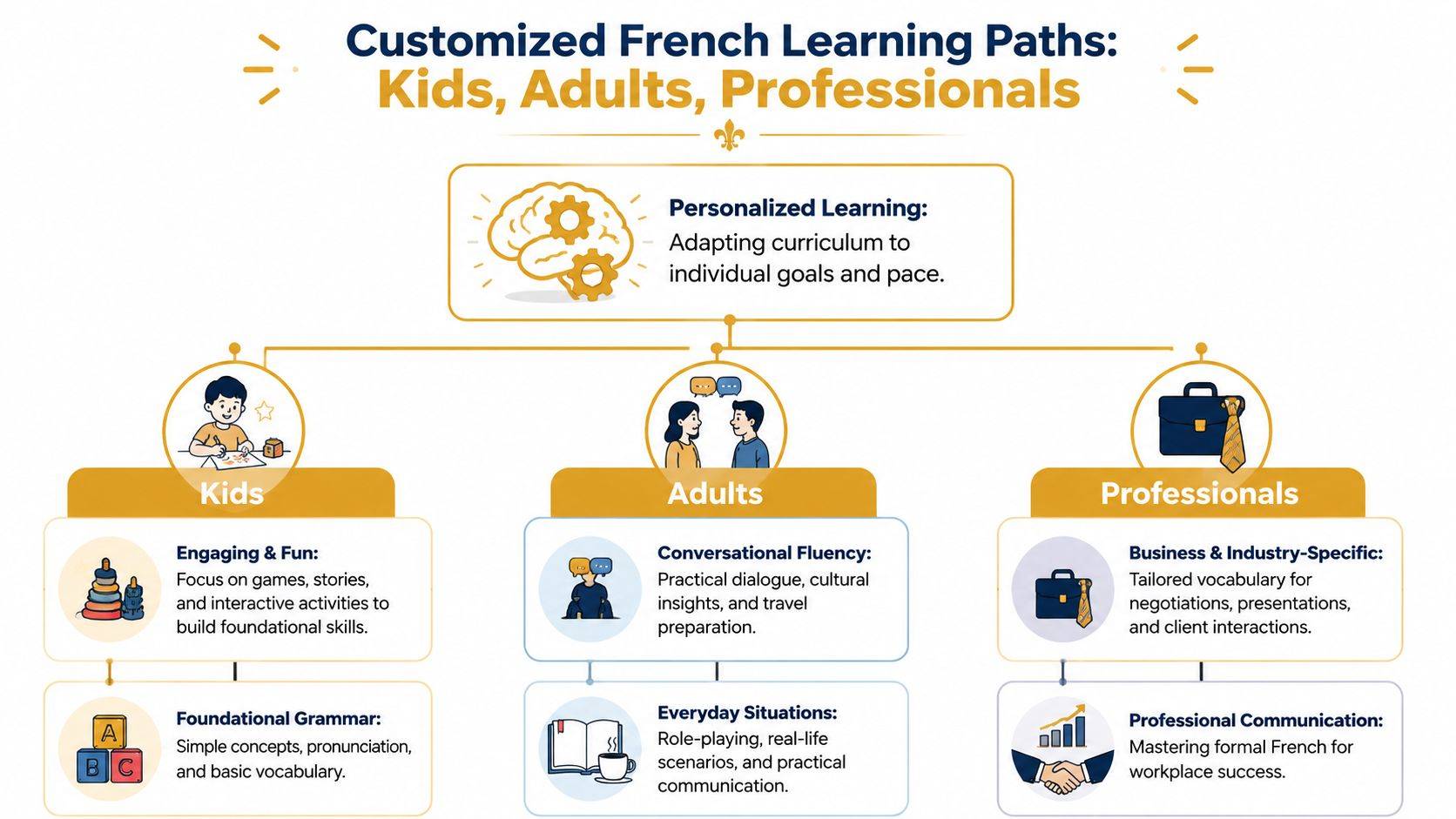
The biggest mistake schools and tutors make is selling one curriculum to three completely different audiences. Kids, adults, and professionals do not need the same French.
Kids need alignment, not random enrichment
For children, especially those in bilingual or academically demanding programs, support should match what happens in school. Random vocabulary lists won't solve reading gaps, oral hesitation, or grammar confusion tied to classroom expectations.
Sustained, curriculum-aligned instruction matters. District French immersion evaluations found that students in Grades 3 to 8 showed consistent positive gains across core subjects, with math advantages ranging from 14 to 39 percentage points, according to this French immersion executive summary. I wouldn't misuse that finding as a promise for tutoring, but it strongly supports a structured approach rather than occasional, disconnected exposure.
A strong child plan usually includes:
School alignment: Homework support, reading practice, dictation, oral preparation, and reinforcement of current class topics.
Age-appropriate engagement: Games, storytelling, visuals, and active speaking. Children need structure, but they also need movement and variety.
Consistent correction: Gentle, clear feedback on pronunciation and grammar before mistakes harden.
Families comparing options for younger learners can start with these French classes for kids and teens.
Adults need usable French
Adult learners often overestimate how much grammar explanation they need and underestimate how much guided speaking they need.
If your goal is travel, social confidence, or everyday communication, your program should focus on high-frequency phrases, listening practice, response building, and confidence speaking without overediting yourself. Adults do benefit from grammar, but only when it serves actual communication.
I'd structure an adult conversational path around three priorities:
Immediate speaking
Start with introductions, preferences, questions, and practical exchanges.Listening tolerance
Learn to keep going when you don't catch every word.Useful repetition
Reuse the same language in new contexts until it becomes available under pressure.
Professionals need precision
Professionals need the most customized path of all. A generic intermediate class won't prepare a lawyer for client meetings, a hospitality leader for guest interaction, or an executive for a cross-border presentation.
For this audience, I look for five things in a program:
| Need | What the lesson should include |
|---|---|
| Industry vocabulary | Terms and phrases tied to your actual field |
| Formal register | How to sound appropriate, not just understandable |
| Scenario training | Meetings, calls, presentations, follow-ups, negotiations |
| Correction strategy | Fast, targeted feedback on errors that affect credibility |
| Cultural communication | Tone, pacing, and expectations in francophone contexts |
One provider that offers customized private online and in-person French instruction, along with a free consultation, is Elite French Tutoring. That model fits learners who need a customized plan rather than a fixed general course.
The right French lessons in Miami should reflect your actual life. If they don't, you'll either get bored, feel lost, or plateau early.
How to Trial a Lesson and Book with Confidence
By the time you reach the trial lesson, most of the decision has already happened. You know your goal. You know your preferred format. You know what kind of teacher you need.
Now you're checking fit.
What to ask in a trial lesson
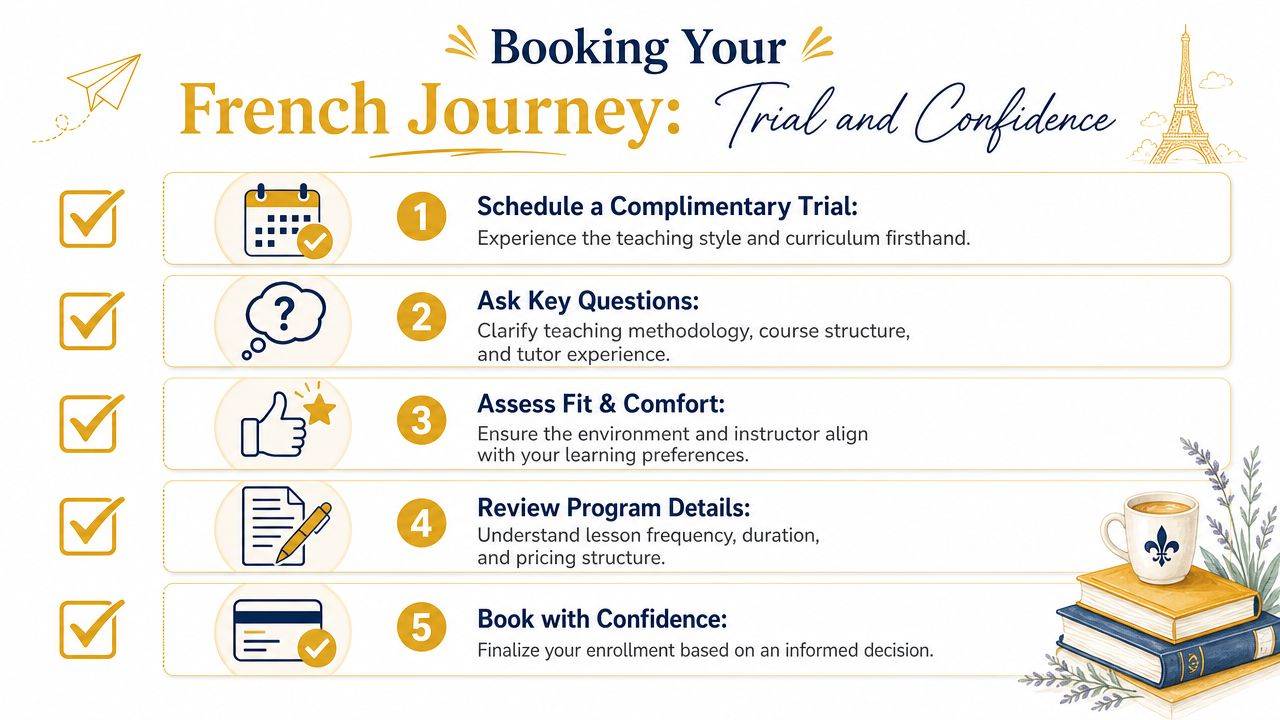
Don't treat a trial like a free sample. Treat it like an interview.
Neutral adult-program information from Alliance Française Miami Metro shows that French study is commonly structured by CEFR levels A1 to B2 and offered in interactive formats, including online classes once or twice a week over six weeks, as shown on their adult French class page. That gives you a useful benchmark. Any tutor or school you consider should be able to explain level, pacing, and structure just as clearly.
Ask these questions directly:
How will you place me or my child? You want more than “beginner” or “intermediate.”
What will the first month look like? Good teachers can answer this quickly.
How do you correct mistakes? The answer reveals a lot about teaching quality.
What materials will we use? Serious programs have a system.
How do you track progress? If progress is only based on vibes, move on.
If the tutor can't explain the roadmap, don't expect the student to feel secure following it.
How to make the final call
A trial lesson should leave you with a clear impression in three areas.
First, clarity. Did the teacher understand your goal and respond with a real plan?
Second, chemistry. Did you or your child feel comfortable enough to participate? Comfort matters, but it can't be the only criterion.
Third, structure. Was there a sense of pacing, correction, and direction?
Here's the booking checklist I recommend:
Define your objective in one sentence
Keep it concrete and tied to use.Confirm the recommended frequency
The right plan should fit your calendar and your urgency.Review cancellation and scheduling expectations
Convenience is part of value.Ask what happens between lessons
Good programs support momentum outside the live session.Book the option you can sustain
Ambitious plans fail when they ignore real life.
If you're actively comparing French lessons in Miami, the smartest next step is simple. Book a trial or consultation with the provider that best matches your goal, then judge them on clarity, fit, and structure rather than marketing.
If you want a practical next step, compare a few lesson options and book one trial this week. That single conversation will tell you more than hours of scrolling.