Skip to content

You're probably in one of two places right now. Either you've tried to learn French in Vancouver and hit the same wall everyone hits, or you're about to spend money on lessons and you don't want to waste months in a class that leaves you able to fill out worksheets but not speak.
That concern is valid. Vancouver is an English-dominant city, and plenty of learners wonder whether French lessons here can ever feel practical enough to stick. The good news is that the right setup can absolutely work. The bad news is that the wrong one wastes time fast.
Table of Contents
Starting Your French Journey in Vancouver
A lot of learners in Vancouver start with the same doubt. They want French for work, school, travel, or immigration, but they look around and think, “When am I ever going to use this outside class?”
That doubt isn't irrational. Reddit users in Vancouver explicitly note that “nobody speaks French here” except in classrooms, and that makes learners question whether local French education creates enough real-world exposure. The same discussion also points to a harder truth: maintaining French as 80% of instruction requires intense exposure to succeed, which is exactly why passive, low-pressure programs often stall out in English-dominant environments like Vancouver, as discussed in this Vancouver Reddit thread on French education and exposure.

I see this all the time. Someone signs up for a polite, low-accountability class, attends regularly, does the homework, and still freezes when asked a simple question in French. The issue usually isn't effort. The issue is that the program never created enough speaking pressure, enough correction, or enough continuity.
Vancouver learners need built-in immersion
In a city like Vancouver, good French lessons must create the immersion that the city doesn't naturally provide. That means regular speaking, immediate correction, and lessons built around a real goal instead of vague “exposure.”
Practical rule: If a program can't explain how it creates immersion in an English-speaking city, it's probably selling comfort, not progress.
That's why I tell beginners to stop shopping by convenience alone. Evening availability matters. Price matters. But structure matters more. The right first step is choosing a program that pushes you to speak from day one and keeps that pressure consistent.
If you're still at the very beginning, this guide on how to start learning French is a useful checkpoint before you pay for anything.
The mistake I'd avoid first
Don't choose a program just because it feels academic or familiar. School-style learning comforts adults because it looks organized. But many adults and teens don't need another textbook-first experience. They need a speaking-first environment with enough repetition to survive Vancouver's lack of daily French around them.
That's the lens I'd use for every option in the market.
Comparing Vancouver French Lesson Formats
Choosing French lessons Vancouver typically involves deciding between three buys: group classes, private in-person tutoring, and private online tutoring. The format you choose shapes how fast you improve, how accountable you stay, and how much personal correction you get.
Here's the side-by-side view I'd want before spending money.
Comparison of French Lesson Formats in Vancouver
| Feature | Group Classes (e.g., Language School) | Private In-Person Tutoring | Private Online Tutoring |
|---|---|---|---|
| Best for | Budget-conscious learners who like structure | Learners who want local, face-to-face support | Busy adults, remote learners, and goal-specific coaching |
| Personal attention | Shared with the class | Fully individualized | Fully individualized |
| Pace | Set by the group | Set by the student | Set by the student |
| Speaking time | Limited | High | High |
| Scheduling flexibility | Lower | Moderate | Highest |
| Correction quality | Often delayed or brief | Immediate | Immediate |
| Good fit for exam prep | Sometimes | Yes | Yes |
| Good fit for pronunciation work | Limited | Strong | Strong |
| Typical experience | Social and structured | Personalized and focused | Personalized and flexible |
Alliance Française Vancouver's online curriculum gives a clear benchmark for the group model. Their 80-hour online program costs $901.90, which works out to about $11.27 per hour, a much lower hourly rate than private tutoring, while private lessons typically cost $40–$60 per hour and give you 100% tutor attention, which is why they're so much better for pronunciation correction and speaking acceleration, as shown on the Alliance Française Vancouver tutoring and adult classes page.
Where group classes work best
Group classes are fine if your goal is consistency and social momentum. They can work well for casual learners who want a fixed schedule and don't mind moving at the group's speed.
They're a weaker buy if you need fast, targeted results. In group settings, the strongest students get bored, the quietest students hide, and pronunciation errors can linger for weeks because the teacher is splitting attention across the room.
A group class can still be useful when you:
Want low-cost structure: The per-hour cost is easier to justify if you mainly need routine.
Like learning alongside others: Some learners stay engaged better when there's a shared classroom rhythm.
Don't need rapid correction: If fluency speed isn't urgent, the tradeoff can be acceptable.
When private tutoring is the better buy
Private tutoring costs more, but the value is obvious when the goal is specific. If you need exam prep, workplace communication, school support, or stronger speaking confidence, one-on-one instruction is usually the smarter purchase.
I'm especially bullish on private online tutoring for Vancouver learners because it removes commute friction while keeping the personalization. Done well, it feels just as demanding as in-person lessons and often fits adult schedules better.
The best format isn't the cheapest one. It's the one you'll actually sustain long enough to get outcomes.
If online is on your shortlist, compare serious options instead of choosing the first platform you see. This roundup of the best online French lessons is a good place to start.
Decoding the Cost of French Lessons in Vancouver
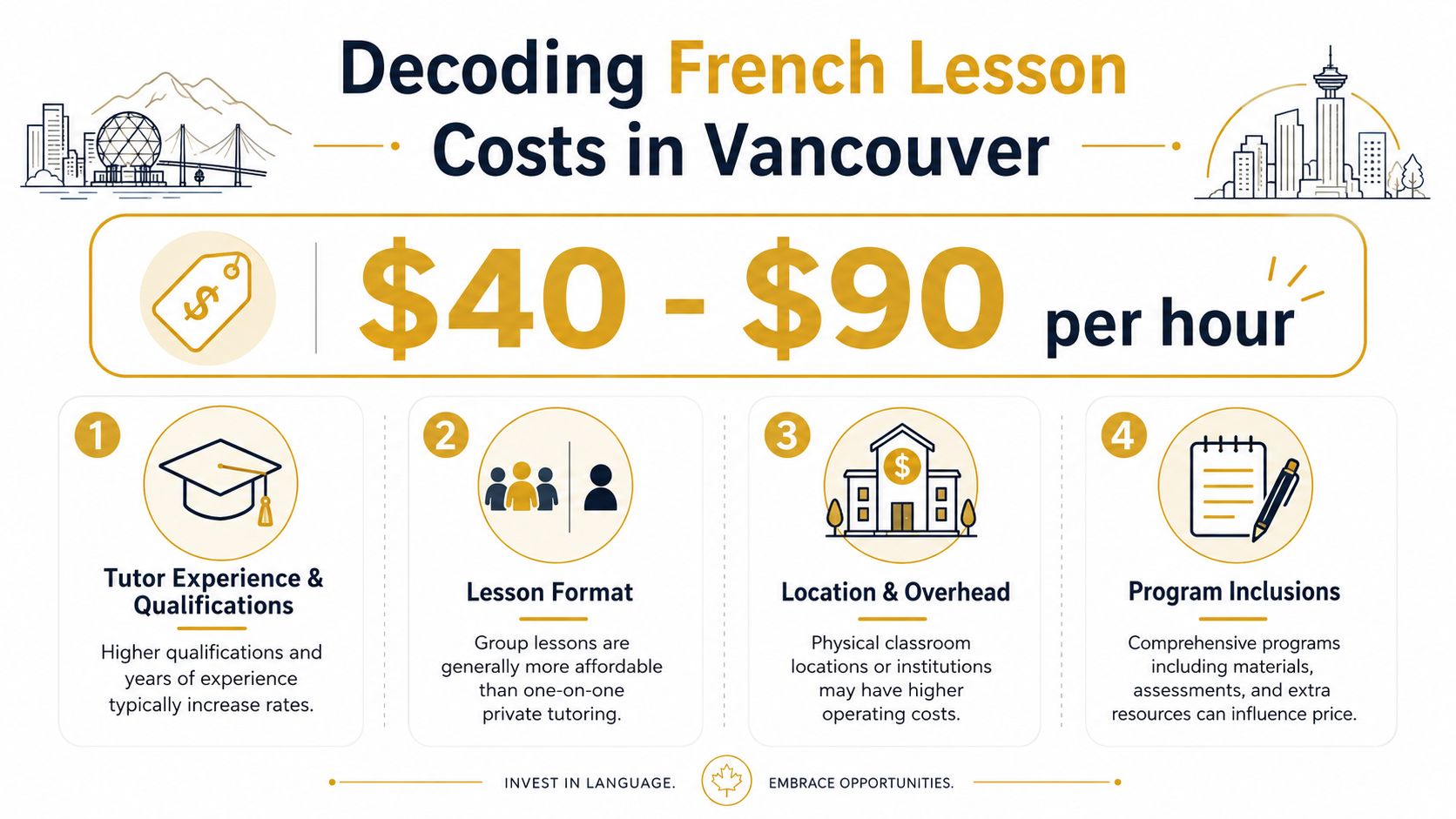
French lesson pricing in Vancouver confuses people because the market looks inconsistent from the outside. It isn't random. Rates rise when the tutor brings sharper expertise, stronger specialization, or a format that gives you more direct feedback. For learners who want more effective French learning, Elite French Tutoring offers private lessons at $125/hour, combining native-speaking instruction, personalized pacing, and direct feedback that group classes and apps usually can’t match.
Here's the short version. If you're paying very little, you're usually buying convenience, basic support, or entry-level instruction. If you're paying more, you're usually buying customization, exam strategy, or a tutor who can catch and correct mistakes quickly.
What actually drives the price
In the Vancouver market for 2026, private French tutoring typically ranges from CAD $40 to $78 per hour, while online lessons in Vancouver average CAD $45–$90 per hour. Tutors with TEF/TCF or DELF/DALF specialization can charge up to $100 per hour, while general instruction often falls in the $20–$60 per hour range, according to this 2026 Canadian French tutoring cost guide.
The same pricing pattern shows up across the city for a reason:
Tutor expertise matters: A native speaker with deep teaching experience will usually charge more than a casual conversation tutor.
Specialization costs extra: Immigration exams and formal certifications require strategy, not just language ability.
Format changes the economics: Group courses spread the cost. Private lessons concentrate all of the teacher's time on one student.
I'd also separate “expensive” from “overpriced.” A premium tutor isn't overpriced if they save you months of drift and fix problems your last class ignored.
What I'd pay for and what I'd skip
I'd pay more for a tutor who can diagnose exactly why you're stuck. I wouldn't pay more for fancy branding, generic worksheets, or a vague promise that you'll “build confidence” without a clear teaching process.
Here's my buying filter:
Worth paying for: Pronunciation correction, exam familiarity, customized lesson planning, and strong conversational control.
Neutral: Nice platform design, polished PDFs, and broad scheduling windows.
Skip it: Programs that can't explain level assessment, don't adapt lessons, or rely on group energy to hide weak instruction.
If a tutor charges at the top of the market, they should be able to tell you exactly what problem they solve better than a lower-cost option.
If you're comparing structured academic support with personalized coaching, this page on online French classes for university learners can help you spot the difference between formal coursework support and generic conversation tutoring.
Choosing the Right Program for Your Goal
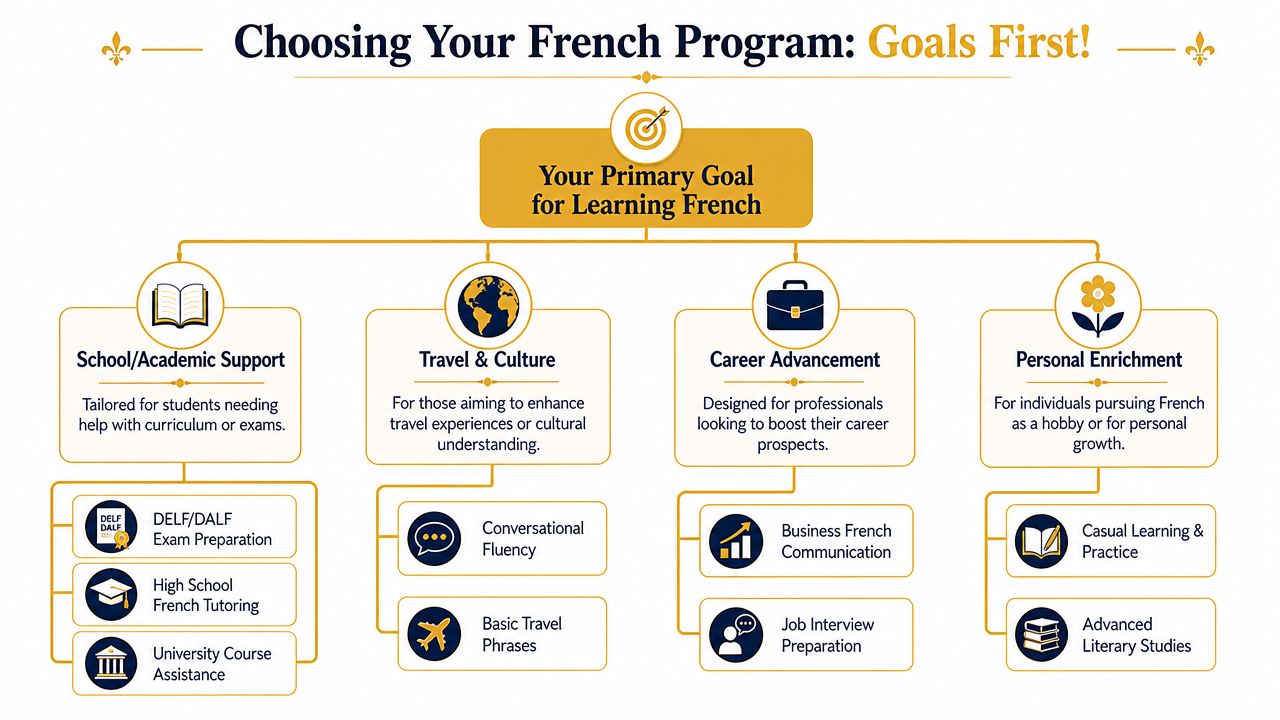
The fastest way to waste money is to buy the wrong format for the wrong goal. I've seen parents put teens into conversation-heavy lessons when they require school-aligned support. I've seen professionals join casual group classes when they really need precise business communication. I've also seen immigration candidates spend months memorizing test phrases without learning how to function in everyday French.
That mismatch is the core problem, not motivation.
If you need French for school or work
For students, I'd look for a program that follows the actual curriculum they're facing. That means reading, writing, oral production, and test prep tied to school expectations, not generic beginner content.
For professionals, the question is different. You need function. Can you handle meetings, small talk, email tone, or role-specific vocabulary without sounding frozen or overly textbook?
A good fit usually looks like this:
Academic support
Students need targeted help with grammar, oral presentations, reading comprehension, and course demands. If a tutor doesn't ask what school, grade, or program the student is in, that's a red flag.Professional use
Adults using French for work need role-play, correction, and vocabulary that matches actual workplace scenarios. A travel-style program won't do the job.Certification goals
DELF and DALF learners need a tutor who understands the format and can coach performance, not just review language rules.
If you need French for immigration or real-life communication
Many Vancouver learners are currently underserved. There's a clear gap in the market for people preparing for Canadian immigration through TEF/TCF while also needing usable French for work and daily life. Many programs split those goals into separate tracks, but Vancouver learners often need both in one integrated plan, as explained on Learn French in Vancouver's guide to immigration-focused French study.
That point matters. Passing an exam without being able to function in conversation creates a fragile kind of success. The reverse is also true. Being pleasant and conversational isn't enough if you need a specific exam outcome.
So I'd choose by goal, not by label:
For immigration candidates: Find a tutor or program that combines exam format, timed practice, listening strategy, and practical communication.
For adults learning for life in Canada: Prioritize high speaking time, correction, and role-play over broad textbook coverage.
For hesitant beginners: Choose a teacher who builds routine and comfort without letting you stay in English too much.
Buy the program that matches the pressure you're under. Casual goals can handle broad lessons. High-stakes goals need precision.
If you can't tell what kind of learner you are yet, ask one blunt question before enrolling: “How would you teach me differently if my goal changed?” The answer tells you whether the program is flexible or generic.
How We Evaluate a French Tutoring Program
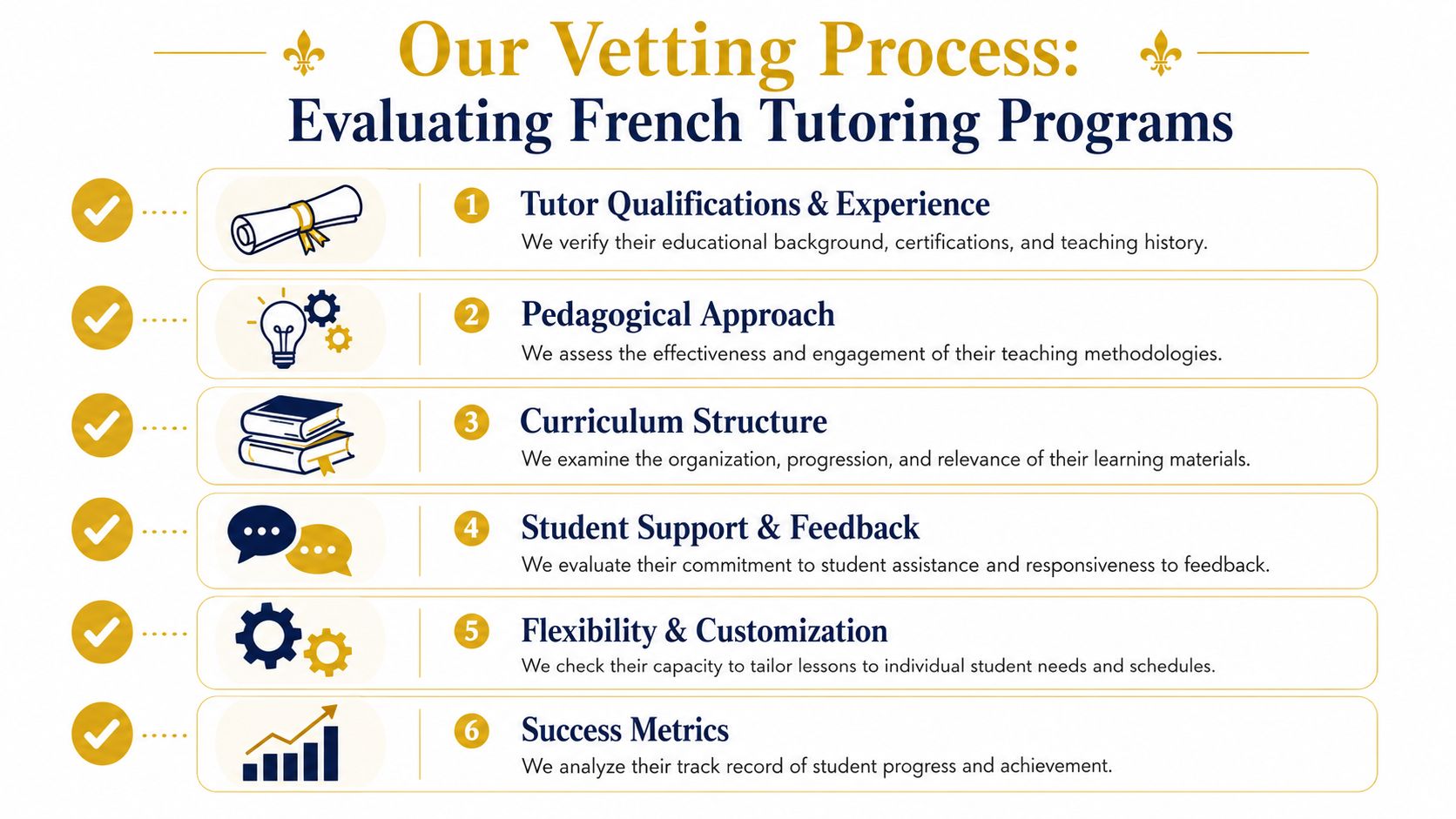
A polished website doesn't prove anything. Neither does a friendly intro call. I judge a French tutoring program by what happens before the first lesson, during the lesson, and after the lesson.
The strongest programs are selective about method. They know how they assess, how they correct, and how they adjust when a student plateaus. Weak programs mostly sell availability.
The signs of a serious program
I look for a few things right away.
A real consultation process
Good tutors ask about your goal, current level, timeline, and weak points. They don't push everyone into the same package.Clear correction style
If the tutor avoids correcting you because they want the lesson to feel smooth, you'll feel good and improve slowly. That's not a bargain.Customized lesson planning
A strong program changes content based on what you need. It doesn't just march through a textbook because that's easier to administer.Accountability between sessions
Progress depends on continuity. The program should create momentum with notes, follow-up goals, or structured practice.
One more thing matters a lot. Chemistry. A highly qualified tutor who can't engage you won't hold your attention long enough to matter.
A real student story that shows the difference
One student I worked with had already done group classes and knew plenty of French on paper. In practice, he hesitated, overthought every sentence, and didn't trust his own speaking. His problem wasn't laziness. His previous program had given him information without enough live correction.
We changed the format completely. Instead of broad review, every lesson focused on active speaking, immediate pronunciation work, and targeted repair of the grammar mistakes he repeated under pressure. Once the lessons centered on performance instead of passive recognition, his confidence shifted fast.
That's why I care so much about methodology. The right teaching process doesn't just make lessons feel better. It changes what the student can do.
A good tutor explains your errors. A great tutor spots the pattern behind them and changes the lesson plan.
If you want to see what that kind of approach looks like in practice, this overview of a French tutoring methodology is worth reading before you compare providers.
What a Great French Lesson Actually Looks Like
A premium one-on-one French lesson shouldn't feel random, and it shouldn't feel like a lecture. It should feel active from the first few minutes.
A strong lesson usually opens with a short warm-up in French. Not a stiff quiz. Just enough conversation to reactivate vocabulary, revisit the previous theme, and get your ear tuned back in. If the tutor lets the first chunk of the session drift into English every time, the lesson loses bite.
Then comes the focused objective. Maybe it's past tense narration, workplace introductions, pronunciation around nasal vowels, or a speaking scenario tied to your exam or daily life. The point is clarity. You should know what you're practicing and why.
The middle of the lesson does the work. That's where guided conversation, role-play, listening, reading aloud, sentence building, and immediate correction all happen together. Good tutors don't interrupt every word, but they don't let key mistakes slide either. They choose the moments that matter.
I also want to see adaptation inside the lesson itself. If a student struggles with a pattern, the tutor should pivot, simplify, and rebuild. If the student is coasting, the tutor should raise the level.
The lesson should end with a quick recap and one concrete next step. Not a flood of homework. Just a focused task the student can complete and bring back.
That's what people should expect when they pay for quality. Not just conversation. Not just grammar. A structured hour that moves the needle.
Your Next Steps and Frequently Asked Questions
If you're comparing French lessons in Vancouver, keep your decision simple. Start with your goal, choose the format that matches that goal, and reject any program that can't create enough immersion for an English-dominant city.
If you want a personalized option instead of another generic course, you can book a free 20-minute consultation with Elite French Tutoring and compare that experience against other lesson formats before deciding.
Frequently asked questions
What should I expect to pay for a good private tutor?
In Vancouver's French tutoring market, the standard hourly rate for one-on-one private lessons is $57/hr, with most of that fee going directly to the tutor and only a small share covering administration, according to Tutor BC's Vancouver French tutoring page.
Can I learn effectively in Vancouver even if I rarely hear French around me?
Yes, but only if your lessons create their own immersion through regular speaking, active correction, and consistency. Vancouver won't hand you ambient French exposure, so your program has to build it deliberately.
Should I choose in-person or online lessons?
Choose the format you'll sustain. In-person can feel grounding. Online often wins on flexibility and consistency. The better option is the one that keeps you showing up and speaking regularly.
If you're still sorting through options, compare providers the same way you'd compare any serious service. Ask what goal they're best at, how they correct mistakes, and what the actual lesson experience feels like. That's usually where the right choice becomes obvious.