Skip to content


Your French is good. You know it is. You've held your own in Paris cafés, read Le Monde without a dictionary, maybe helped your child with a French essay last week. Then the job posting opens, and it asks for a language profile with a letter next to reading, writing, and oral interaction, and you close the tab and promise yourself you'll deal with it later.
That pause is where most strong candidates lose the job. In government hiring, French isn't a nice line on a CV. It's a gate with a fixed level, a fixed format, and a fixed moment in the process. Clear the gate and your qualifications finally get read. Fail it and nobody ever finds out how good your French is.
The government jobs that require French aren't one category either. Some test you mid-interview, some test you after you're otherwise qualified, and some let you start below standard and train you up. We've built this roundup around those gates rather than around job titles, so you can see where French is tested, what rating or credential proves you're ready, and what to do in the weeks before.
Table of Contents
- 1. U.S. Foreign Service Officer (Department of State)
- 2. Intelligence and Defense Linguist (French)
- 3. Federal or State Court Interpreter (French)
- 4. United Nations Interpreter or Translator (French)
- 5. Peace Corps Volunteer (Francophone Africa Placement)
- 6. New York City Public School French Teacher
- 7. NYC Health + Hospitals Medical Interpreter (French)
- 8. Canadian Federal Public Service Officer (Bilingual Position)
- How the Top Government Roles Compare on French Requirements and Proof
- Choosing Your Path and Proving Your French
1. U.S. Foreign Service Officer (Department of State)
The interview everyone prepares for isn't the one that eliminates them. Candidates rehearse answers about foreign policy, then meet a language measurement with a number attached and discover their French doesn't map onto it.
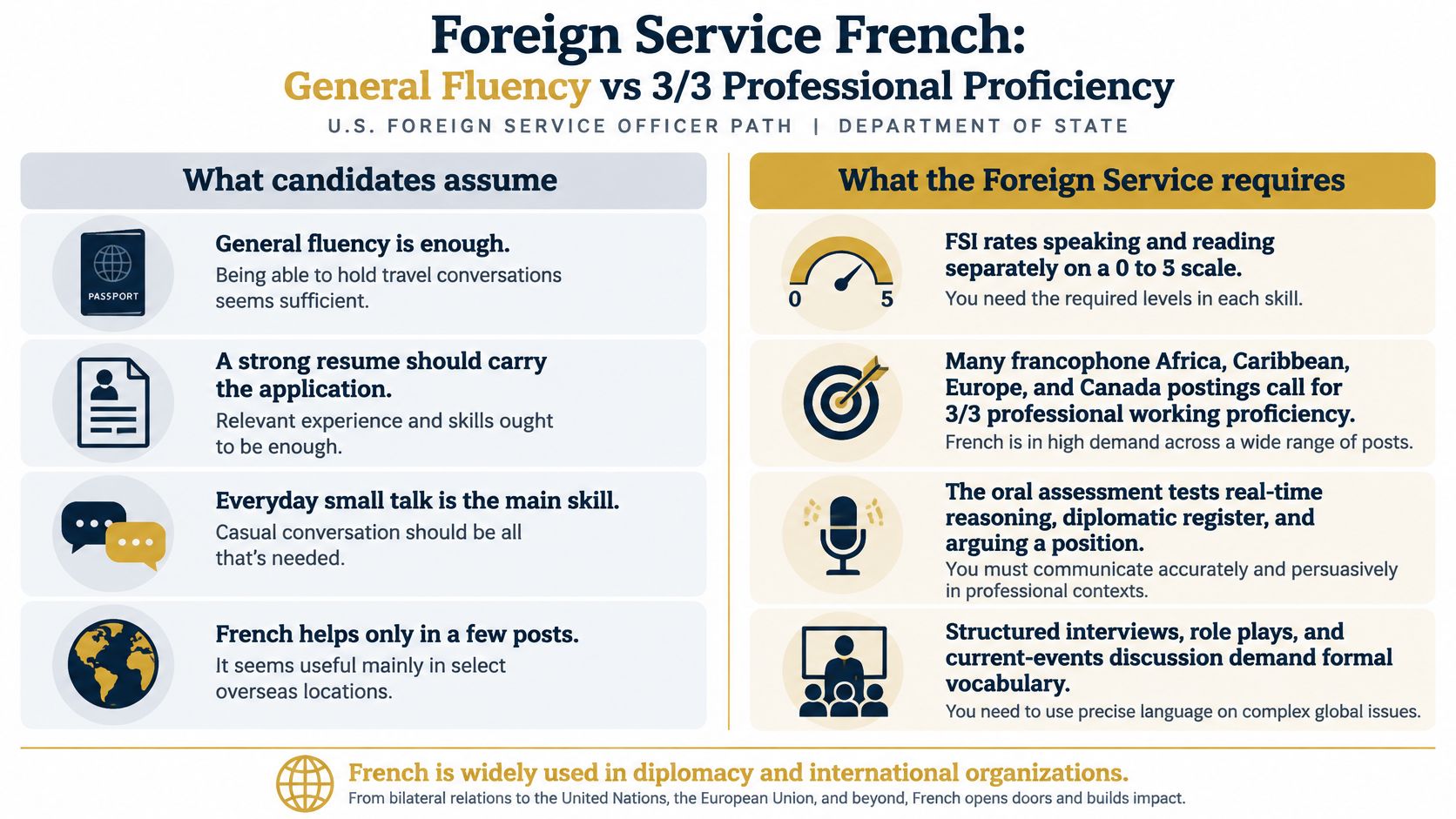
Foreign Service Officers represent the United States at embassies and consulates. Many posts in francophone Africa, the Caribbean, parts of Europe, and Canada expect working French from the first week, not after a year of on-the-job practice. The State Department's Foreign Service Institute rates speaking and reading on a 0 to 5 scale, and posts that designate French typically want professional working proficiency, usually written as 3/3.
The distance between 3/3 and the French you speak socially is register and precision, not vocabulary size. Here's the distinction worth understanding before you book anything.
What the oral assessment actually measures
It measures reasoning in real time. You're asked to analyze a situation, defend a position, and adjust when the examiner pushes back, all in French, with no script and no warning. A candidate who has never argued a policy question aloud in French tends to freeze at exactly the wrong moment.
Three things move the needle fastest:
- Build a policy vocabulary bank. Read one French article a week on trade, migration, or security and write a five-line summary from memory.
- Record yourself answering structured questions. Listen for filler words, dropped subjunctives, and drifting tenses. Accent matters far less than people assume.
- Rehearse disagreement. Concession phrases carry diplomatic French, and most learners reach the test without them.
A worked example: a candidate reaches 3/3 through private coaching, walks into the oral assessment having practiced arguing a trade dispute aloud, and clears it on the first attempt. The same person six months earlier would have described their French as "pretty good" and failed the same test.
If you want a structured runway, our French for diplomats course drills negotiation register, formal correspondence, and oral assessment simulations.
Practical rule: schedule a baseline assessment three months before you apply, not three days before the test.
2. Intelligence and Defense Linguist (French)
Your French is strong and your current job never touches it. Defense and intelligence linguist roles are the shortest route from that skill to daily use.
Agencies across the U.S. Department of Defense and the wider intelligence community need analysts who read, translate, and interpret French for national security reporting. A large share of the source material originates in West and Central Africa and the Maghreb, where French is the working language of ministries, newspapers, and armed groups alike.
The first gate is a dedicated language test, and it's harder than the job description suggests. Lead-in matters here, because the format is not a conversation.

What the test rewards
- Comprehension under speed. You'll hear fast, informal regional French, not studio recordings.
- Accurate summarization. Word-for-word translating scores as a failure. Analysts need the actor, the point, and the implication in three lines.
- Domain vocabulary. Security, economics, and regional politics carry the load.
A worked example makes it concrete. Say a batch of French-language regional reporting lands on a Tuesday morning. Your job is to skim it, pick the two items that matter to a policy audience, and write an English summary that doesn't overstate the source. That's the skill the test simulates, and it's a different skill from ordering dinner in Lyon.
Requirements vary by agency, so "French linguist" isn't one job spec. Some postings test translation formally, some test listening and summarization, some screen for a security clearance before they test language at all. Read each posting to see which gate comes first, because preparing for the wrong one wastes months.
Candidates who want documented proof of level before applying often sit a recognized exam, and our French language certification preparation covers the DELF, DALF, and TCF formats.
3. Federal or State Court Interpreter (French)
Here's the trap nobody explains at the start. The federal court interpreter certification program covers Spanish. French interpreters usually enter the courtroom through state court systems or work as qualified interpreters on a case-by-case basis, which means the credential you need depends on the court standing in front of you.
The work itself doesn't vary. You render French speech into English and English into French in hearings where the record and due process depend on accuracy. Consecutive interpreting during a witness examination, simultaneous whispering at counsel table, sight translation of documents: all three show up, sometimes in the same morning.
Where the actual gate sits
- Credential check. Ask which interpreter qualifications the court accepts for French before your first assignment, and get the answer in writing.
- Skills test. Many state systems run their own written and oral exams, and the oral component is usually pass or fail on the day.
- Ethics agreement. You'll sign and be held to a code of conduct covering confidentiality, conflicts of interest, and the limits of your role.
A worked example: a French-speaking defendant is arraigned, and the interpreter has to render the judge's advisement precisely enough that the plea is knowing and voluntary. A summarized version isn't a translation. It's a defect on the record, and it can reopen a case later.
Vocabulary is where preparation pays off fastest. Build flashcard decks by case type (criminal, family, immigration, civil) rather than alphabetically, and practice sight translation of documents against a timer. Our French legal terminology training is organized around that case-type structure for exactly this reason.
Ask before you accept the assignment: which qualification does this court accept for French, and who signs off on it?
4. United Nations Interpreter or Translator (French)
French is one of the United Nations' six official languages and one of its principal working languages, as the UN's official languages page sets out. That status is operational, not ceremonial.
The organization keeps a standing corps of language professionals: interpreters, translators, editors, verbatim reporters, terminologists, reference assistants, copy preparers, and proofreaders. The same page notes that several hundred of these professionals work within its Department for General Assembly and Conference Management across New York, Geneva, Vienna, and Nairobi, with more attached to regional commissions in Addis Ababa, Bangkok, Beirut, and Santiago. That's a global map of workplaces where French is a hiring requirement rather than a bonus.
The gate is a competitive language examination, and it filters on speed and precision at once. Simultaneous interpreting from French into English at conference pace, translating a dense policy text against a deadline, knowing when "cessez-le-feu" maps cleanly onto "ceasefire" and when the context demands a narrower term.
What separates a strong bilingual candidate from a passing one
- Formal register. Diplomatic French has its own formulas, and they're expected, not optional.
- Endurance. Conference interpreting tests stamina as much as accuracy.
- Subject range. Human rights, international law, peacekeeping mandates, and budget language all come up.
Practice with recorded UN speeches in French, and work in both directions rather than only into English. A worked example: an interpreter supports a Security Council session conducted in French, and one ambiguous rendering of a mandate's scope sends delegations into a side conversation. Precision isn't perfectionism in this job. It's the deliverable.
Watch for examination announcements and start preparing months out. The candidates who pass rarely decide in a fortnight.
5. Peace Corps Volunteer (Francophone Africa Placement)
You don't need to arrive fluent, and that's both the good news and the risk. Placements in francophone countries put French at the center of daily life, and pre-service training assumes you're starting from a low base in at least one language.
Volunteers work on education, health, and economic development projects, using French with local partners, schools, and government counterparts. The agency provides language training during pre-service training. What that training can't do is compress two years of classroom French into ten weeks for someone who has never held a real conversation.

What actually helps before you go
- Start now, even at A2. Arriving with a working base means training polishes rather than builds, and you contribute sooner.
- Practice everyday registers. Food, family, transport, illness, and community life come up daily. Policy vocabulary doesn't.
- Ask about local languages early. Daily speech in the community may run on a local language while French handles offices and schools.
A worked example: a volunteer sits with a local health committee and explains a prevention message in French, then repeats the key points in the local language with a counterpart's help. The French is what gets the meeting started. The relationship is what makes it land.
Keep a vocabulary notebook organized by project area (health, education, agriculture) rather than by grammar topic. You'll reach for it more often, and it maps onto what your community asks you.
Volunteers who arrive with conversational French spend their first months building trust. Volunteers who arrive without it spend those months building sentences.
6. New York City Public School French Teacher
If you're reading this for your child rather than for yourself, the hiring gate matters less than the classroom gate. New York City public schools hire French teachers who hold New York State certification, and many schools need teachers who can carry students across beginner, intermediate, and advanced levels in the same building.
The teachers who move students fastest build speaking practice into every unit instead of bolting it on before an exam. That's a pedagogy choice, and parents can see it in the homework within a month.
What to ask before you enroll or hire a tutor
- How often does my child speak? Weekly conversation circles beat daily grammar worksheets for retention.
- Is there a proficiency target? Ask whether instruction maps to CEFR levels and whether DELF or DALF preparation is available when the student is ready.
- What does progress look like? A shared checklist aligned to CEFR levels beats a vague "doing fine" at parent conferences.
A worked example: a middle school teacher runs conversation circles every Friday, and by spring the students who whispered in September are arguing about films in French. That fluency doesn't come from a textbook unit on the passé composé. It comes from low-stakes repetition with a person who answers back.
For students heading toward certification, timed listening and writing tasks belong in the weekly routine months before exam season, not in a panic block the week before. And if a child needs more individual practice than a class of thirty allows, small-group or private sessions fill the gap. Start with a short level assessment rather than a guess about which class to join.
7. NYC Health + Hospitals Medical Interpreter (French)
A misheard dosage isn't a vocabulary slip. It's a safety event. That's the frame medical interpreters work inside, and it's why screening for these roles tests accuracy under pressure rather than conversational ease.
NYC Health + Hospitals serves a large and diverse patient population, and French interpreters work across emergency, primary care, and specialty settings. Consent conversations, discharge instructions, medication counseling, and difficult news all pass through you.
Where the hiring test bites
- Medical glossary depth. Body systems, medications, procedures, and a plain-language version of each.
- Sight translation. Prescription labels and discharge forms, read aloud accurately and at pace.
- Confidentiality rules. HIPAA and hospital-specific policy, tested before you touch a live case.
The work looks like this in practice.
A worked example: a patient is discharged after surgery with four new medications and a wound-care routine. You interpret the instructions, then check comprehension by asking the patient to repeat the schedule back in their own words. Interpreting the words is half the job. Confirming the message landed is the other half, and it's the half that gets tested.
Build your glossary by specialty, starting with cardiology, pediatrics, and emergency care, and practice explaining complex terms in simple French. Our French for medical professionals course follows that specialty-by-specialty structure.
8. Canadian Federal Public Service Officer (Bilingual Position)
A, B, C. Three letters that decide whether an application moves, and most candidates meet them for the first time on the posting itself.
Canada runs one of the largest bilingual workforces anywhere. In fiscal year 2022–23, 105,547 federal positions, or 41.4% of all positions, were designated bilingual, according to the Treasury Board Secretariat's official languages report to Parliament. Those aren't translation jobs. They're policy, service delivery, administration, and executive roles where French is a condition of the position.
Reading the posting correctly
Bilingual positions set a separate level for reading, writing, and oral interaction, and the Public Service Commission explains why language requirements for candidates hinge on whether an appointment is imperative or non-imperative. Imperative means you meet the standard on hiring day. Non-imperative may allow training after appointment, generally within two years. That single word answers the question candidates ask us most: do I need fluent French before I apply?
The levels are tested skill by skill. The Public Service Commission's guidance on bilingual positions in the federal public service sets out that reading, writing, and oral interaction are assessed separately on an A, B, C scale, and that results stay valid for five years. A strong speaking level never substitutes for a required writing level.
Where the bar goes up
Supervisory and policy leadership work raises the oral requirement sharply. In 2023, 66% of bilingual supervisory positions required Level C oral interaction, per the Treasury Board Secretariat's official languages annual report. Level C is where candidates with comfortable conversational French start losing ground.
There's a compensation detail worth knowing too. Eligible non-executive employees in bilingual positions receive an annual bilingualism bonus of $800, tied to documented Second Language Evaluation results for that specific position rather than to how often you happen to speak French at work.
Prepare for the format, not the feeling. Mock interviews on public-policy topics and timed formal memos in French do more for a Level C result than another year of conversation class.
A worked example: a policy analyst writes briefing notes in formal French for a federal program and answers citizen questions in both languages. The writing gate, not the speaking gate, is usually what delays that promotion.
How the Top Government Roles Compare on French Requirements and Proof
| Item | Typical Employer | French Proof Required | Best For |
|---|---|---|---|
| U.S. Foreign Service Officer (Department of State) | U.S. Department of State | FSI speaking and reading scores; many postings require 3/3 | Diplomacy and international postings |
| Intelligence and Defense Linguist (French) | U.S. Department of Defense or intelligence agencies | Agency language tests in listening, reading, and translation; security clearance required | French speakers interested in national security analysis |
| Federal or State Court Interpreter (French) | State courts or federal settings on a qualified, case-by-case basis | State-specific qualifications; interpreting and legal-language skills | Interpreters focused on legal proceedings |
| United Nations Interpreter or Translator (French) | United Nations departments and agencies | Competitive language examinations; advanced interpreting or translation skills | Language professionals pursuing international work |
| Peace Corps Volunteer (Francophone Africa Placement) | U.S. Peace Corps | No fluency requirement to start; language training provided | Applicants seeking service and language immersion |
| New York City Public School French Teacher | New York City public schools | New York State teacher certification in French | Certified teachers who want to teach school-age students |
| NYC Health + Hospitals Medical Interpreter (French) | NYC Health + Hospitals | Strong medical French and English; recognized interpreter certification often preferred | Interpreters interested in patient care |
| Canadian Federal Public Service Officer (Bilingual Position) | Government of Canada | Second Language Evaluation in reading, writing, and oral interaction | Professionals seeking bilingual federal public service roles |
Choosing Your Path and Proving Your French
Match your current level to the gate before you spend money on anything. A B1 speaker with eight weeks and an oral assessment ahead needs a very different program from a C1 speaker who writes well and freezes when a supervisor pushes back. Buying forty hours of general conversation when the test is timed formal writing is the most common expensive mistake in this whole category.
Here's how I'd sequence it.
- Name the gate. Pull the exact language profile from the posting (an FSI 3/3, A/B/C levels across three skills, a state court qualification, a competitive UN examination) and write it down where you'll see it.
- Get a baseline. Sit a short assessment that tests reading, writing, and speaking separately. Candidates often overrate their writing and underrate their listening.
- Build to the format. If the gate is oral interaction at Level C, practice mock interviews on policy topics against a clock. If it's written correspondence, write formal memos weekly and get them corrected.
The pattern repeats across every role above. The bilingualism bonus and the level system reward people who prepare for a specific test, not people who have spoken French for years. Format knowledge is worth as much as vocabulary, and it's far quicker to acquire.
We work with candidates at exactly this stage, and every engagement at Elite French Tutoring begins with a free 20-minute consultation where we evaluate your objectives, current level, and learning style, then build the program around the test or interview in front of you. Our teachers are native French speakers, and our programs cover professional communication, DELF and DALF preparation, and the diplomacy, legal, and medical registers these roles test. David, a marketing professional preparing to relocate to Paris for work, became fluent in 90 days after starting an intensive course with us.
If you'd rather start with a small diagnostic step than a large commitment, that instinct is right. Book the free consultation, bring the job posting with you, and we'll tell you how far your French sits from the level that posting specifies.