Skip to content


You're at the kitchen table in your city apartment, comparing schools while your child finishes homework. The nearest suitable lycée is an hour away by bus, and boarding suddenly looks less extravagant than exhausting daily travel. But you're also wondering whether living at school would finally make your child comfortable studying in French.
I'd separate those decisions immediately. Choose boarding for the school, the living arrangements and your child's readiness. Choose language support for the French your child needs. French boarding schools can make sense for a family without being a complete solution to language difficulties.
Table of Contents
- Which French Boarding School Fits Your Family
- How Families Apply and What Schools Check
- Budgeting Tuition, Board and Hidden Fees
- What the Evidence Says About Academic Results
- Daily Life, Routines and the First Year
- Prepare Your Child's French Before You Apply
Which French Boarding School Fits Your Family
French boarding isn't just a choice between prestigious private campuses. In its account of the 2019–2020 academic year, The Local reports approximately 166,000 pupils in 1,529 public boarding schools, roughly 3.5% of all pupils, alongside about 50,000 pupils in roughly 600 private boarding schools. Public establishments therefore account for most resident pupils and facilities, not a marginal alternative to private education.
The history helps explain the institutional feel. According to the Encyclopedia.com history of the lycée, state lycées were created in 1802 and initially operated as closed residential institutions with strict, military-style discipline. That heritage helps explain the formal routines families associate with traditional boarding, although you should judge a modern school by its current rules rather than its history.
French boarding school formats at a glance
Treat these categories as starting points for a shortlist, not quality rankings. An international curriculum and a French national curriculum can lead to very different classroom experiences, even when both schools offer boarding.
| Format | Typical students | Admission route | Key trade-off |
|---|---|---|---|
| Public internat | Pupils living far from suitable schools or needing structured support | Student and parent both volunteer, followed by the establishment's admission process | Accounts for the majority of resident pupils nationally; confirm local provision |
| Internat d'excellence | Selected students, including those from disadvantaged backgrounds | Selective admission offer | Intensive academics; demonstrated gains have concentrated among strong starters |
| Private boarding school | Families seeking a private establishment with boarding | Application, followed by the school's enrollment and security charges | Around 600 schools hosting about 50,000 boarders; examine the individual school |
| International boarding school | Families relocating from abroad | Application timed months ahead, with language entry thresholds | Compare tuition plus housing and verify language-transition support |
I'd begin with curriculum continuity, then look at residential fit. Ask which qualification your child is working toward, which language teachers use in each subject, and how the school handles a student who understands conversation but struggles with written assignments.
Don't assume an international school supplies intensive French support just because it's in France. Equally, don't rule out a public internat because it lacks the presentation of an international admissions office.
A practical boarding decision checklist
Give each condition an honest yes or no:
- Distance: Home is far enough from a suitable school that the commute would undermine daily life.
- Evening structure: Your child would benefit from supervised study and a predictable routine.
- Language readiness: Their French is at or near the school's documented requirement, with a realistic support plan.
- Financial room: Your budget covers the full annual commitment, including initial charges and travel.
- Application readiness: You've allowed a planning window of at least four months, while checking the actual deadline with each school.
- Willing participation: Your child agrees to boarding, and you agree too, particularly when considering a public internat.
If most boxes are ticked and no warning sign applies, boarding deserves a serious look. If your child's French is weak and nobody can explain how they'll receive help, pause. Also pause if your main goal is fluency rather than schooling, or if a strong day school is within easy reach.
A day school with intensive French tutoring may be the more proportionate choice. You can also compare French bilingual schools or keep a closer school while arranging online lessons.
My decision rule: Don't pay for a residential solution when the problem is a language gap.
How Families Apply and What Schools Check
Check eligibility before preparing an elaborate application. A family can spend considerable effort gathering records only to discover that the program's teaching language, boarding arrangements or deadline makes it unsuitable.
The application process is easier to manage when you separate school selection, language eligibility and paperwork.
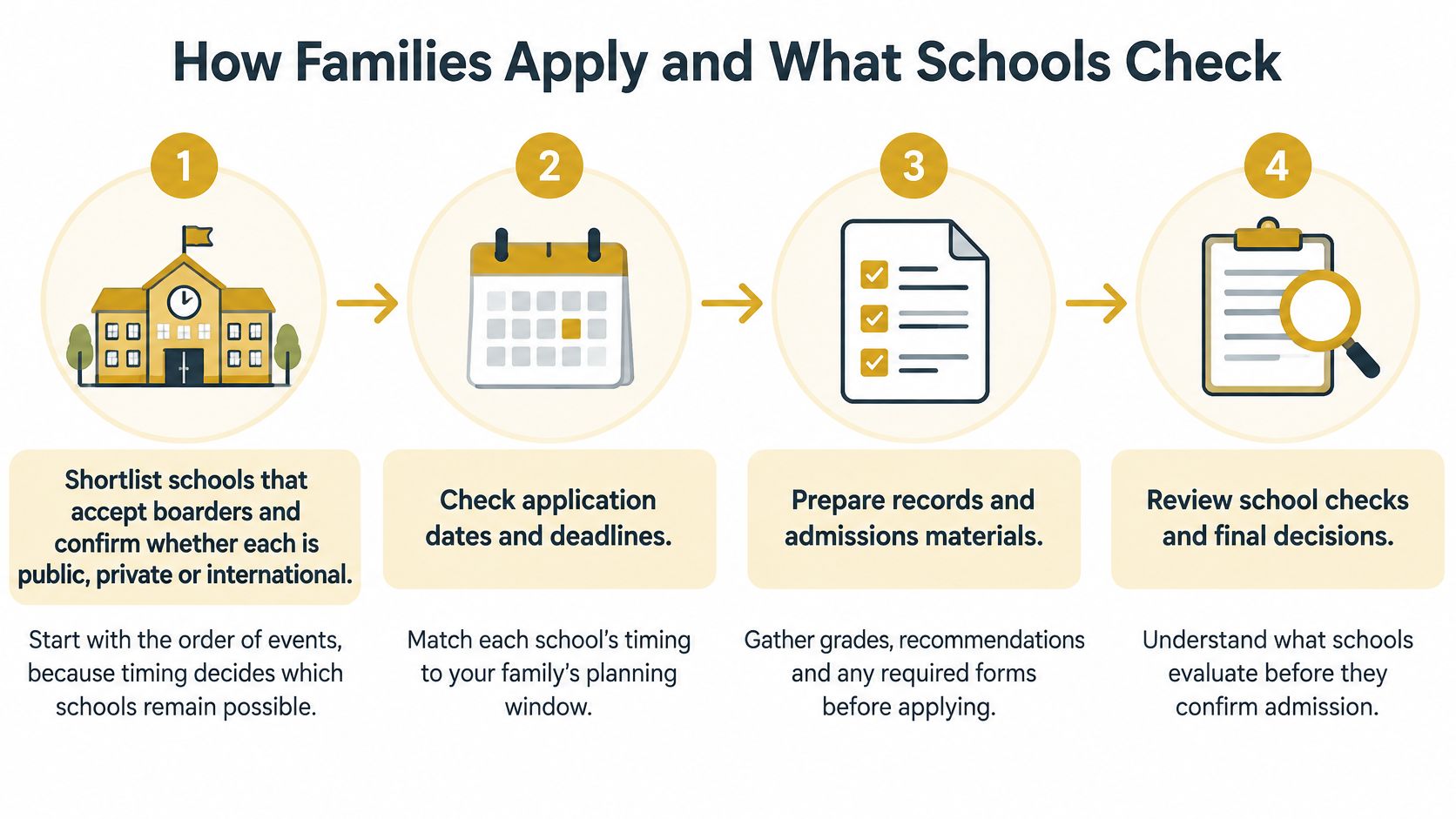
Apply in the right order
Shortlist schools that accept boarders. Confirm whether each establishment is public, private or international, then check that the curriculum suits your child's next educational step.
Check the language threshold immediately. NDIHS admissions guidance specifies a B1+ minimum for its English-language program and says visa students must apply no later than four months before the academic year begins. That language threshold belongs to the stated program, so don't treat it as a national French-language requirement.
Gather the application and academic records. Obtain the completed form, prior school reports and any requested transcripts so admissions staff can assess academic continuity.
Request teacher recommendations early. Give teachers the target school's instructions, rather than asking for a generic letter that may omit what admissions staff need.
Submit against the school's actual deadline. Confirm timing directly for grade-10 applications and public-internat places; don't assume the visa-student rule applies to every applicant.
Prepare for an interview if requested. Your child should be ready to explain their school interests, why they want to board and how they manage work independently.
Confirm practical arrangements before accepting. Resolve housing coverage, visa requirements and transport, including what happens when the boarding house closes.
NDIHS identifies the completed application, prior records and teacher recommendations as primary elements of grade-10 review, with interviews and transcripts potentially considered. A polished interview won't replace missing academic documentation.
Match the application to your situation
| Applicant situation | Timing to confirm | Language check |
|---|---|---|
| Visa student applying to NDIHS | The school's published advance deadline | Requirement for the chosen program |
| Grade-10 applicant | Confirm the relevant intake deadline directly | Ask which language evidence admissions accepts |
| Public-internat applicant | Confirm the establishment's application calendar | Check readiness for the intended curriculum |
| Student preparing a French qualification | Coordinate preparation with the application window | Confirm whether certification is required or simply useful |
Public boarding also requires willing participation from both student and parent, as explained in the French public-service boarding guidance. Treat your child's agreement as a real conversation, not another signature.
Keep a single application folder containing school reports, transcripts, recommendations, identity documents, language evidence and deadline confirmations. If certification is relevant, review the DELF Junior exam before choosing preparation, but ask admissions whether the qualification answers its actual requirement.
Budgeting Tuition, Board and Hidden Fees
A headline annual fee isn't a complete boarding budget. I'd ask for a written cost breakdown before paying an application charge, particularly if you're comparing weekly boarding with full-time residence.
The Ermitage school-fee schedule lists annual room-and-board-inclusive fees of €26,900 for 6e–4e, €26,950 for 3e–2nde and €28,500 for 1ère–terminale, plus €300 application, €600 enrollment and €150 security charges. Adding those listed initial charges to the lowest annual fee produces a €27,950 first-year subtotal before extras.
Annual boarding costs by school type
These are comparison figures, not current quotations. The international-school examples are historical, and the Sourdun figures are estimated institutional costs, not a parent fee schedule.
| School | Level or arrangement | Annual cost (EUR) | What it includes |
|---|---|---|---|
| Ermitage | Collège grades 6e–4e | 26,900 | Room and board; application 300, enrollment 600 and security 150 are additional |
| Ermitage | Grades 3e–2nde | 26,950 | Room and board |
| Ermitage | Lycée grades 1ère–terminale | 28,500 | Room and board |
| International school | Grade 10, five-day weekly boarding | 28,680 | Tuition plus housing, 2024–25 |
| International school | Grade 12, full-time boarding | 38,550 | Tuition plus housing, 2024–25 |
| Sourdun internat d'excellence | Boarder versus non-boarder | 21,600 versus 10,700 | Estimated institutional costs; gap mostly housing and residential services |
The international examples illustrate why boarding nights matter as much as the headline total. However, the underlying international schedule isn't identified here, so obtain a named school's written quotation rather than treating those examples as a purchasable offer.
Likewise, don't use the Sourdun comparison to estimate your public-internat bill. Confirm the basis of any institutional cost estimate separately from the charges families pay.
Build a budget you can compare
Ask each admissions office to separate:
- Tuition: Classroom teaching, compulsory academic charges and any examination costs.
- Residential provision: Accommodation, meals, evening supervision and weekend coverage.
- Travel: Journeys home, station or airport transfers, and transport during closures.
- Academic support: Language tuition, subject help and any compulsory diploma preparation.
- Initial payments: Application charges, enrollment fees, security payments and deposits, with refund terms in writing.
Keep compulsory and optional items in separate columns. A cheaper school can become the more expensive choice if essential language support or frequent travel sits outside its advertised fee.
A weekly boarding place isn't a full-time home. Ask who is responsible for your child on every night the residence is closed.
Before committing, confirm boarding nights, deposits, enrollment charges, and whether French or DELF preparation is mandatory. Ask public establishments directly about their charges and any available bursaries or scholarships; don't build your family budget around assumed assistance.
What the Evidence Says About Academic Results
The strongest reason to be cautious about academic promises comes from Sourdun. In the randomized evaluation described by J-PAL, the highest-performing third of admitted students improved mathematics scores by 0.72 standard deviations after two years, while researchers found no improvement in French skills for any group.
That is a meaningful academic success for a specific group of students. It isn't evidence that every child will improve across subjects, or that residential immersion automatically fixes French-language difficulties.

Read the result as a parent
Boarding is like a gym membership. The building provides access and structure, but the training plan still has to suit the person using it.
For a student already equipped to tackle demanding work, supervised study and an intensive environment can be useful. For a child who cannot understand the assignment, additional time sitting with that assignment doesn't address the underlying obstacle.
I wouldn't generalize this selective program's results to every public internat or private campus. Nor would I dismiss the value of residential supervision because it isn't a language intervention. Convenient, well-organized care and improved subject attainment are different benefits, and families should know which one they're buying.
Ask for an academic support plan
Put these questions to the school before accepting its offer:
- Baseline assessment: How will you assess my child's French reading, writing, listening and classroom comprehension?
- Support during lessons: What help runs alongside the academic program, and who coordinates it with subject teachers?
- Measurable progress: What specific language goal will you set for the first year, and how will you review it?
Listen for concrete answers, such as a writing sample, an identified teacher and scheduled progress discussions. A promise that your child will pick it up through immersion isn't a support plan.
For non-native speakers, distinguish everyday conversation from academic performance. A child might make friends easily yet struggle to summarize a history text, interpret a science question or construct a written argument.
Prestige, rankings and attractive facilities shouldn't replace answers about assessment and teaching. I'd choose the school that can explain how it will help your particular child over the one that relies on its reputation.
Daily Life, Routines and the First Year
The difficult moment may arrive after the excitement of moving in. Your child can like the school and still find shared bedrooms, fixed study periods and separation from home exhausting.
The Sourdun evaluation summary describes lower student well-being initially after entry into the intensive residential environment, with that adjustment effect diminishing by the second year. That finding doesn't mean families should tolerate distress indefinitely. It means emotional adjustment deserves deliberate attention.
Follow a typical first term
Consider a hypothetical student arriving from a bilingual day school. They're used to understanding lessons, but not to organizing their whole evening around a boarding timetable.
The day might include a morning routine, lessons, meals, sport, free time and supervised evening study. Ask to see the actual timetable, including device access, lights-out rules and how students obtain help during study hall.
During the first weeks, this student may spend so much effort following instructions and negotiating friendships that homework takes longer than expected. The useful response is to identify the friction: unfamiliar vocabulary, poor organization, lack of sleep or a subject-specific gap.
A useful check-in: Ask your child to describe an ordinary evening from the end of lessons to bedtime. Specific details tell you more than asking whether everything is fine.
Weekend and holiday arrangements need equal attention. Ask when students must leave, whether belongings can remain in rooms and who handles unexpected travel changes.
Put people around the transition
Agree on a named adult your child can approach at school and a regular time to call home. Give a tutor the actual assignments so support can focus on French literacy, academic vocabulary and study routines rather than unrelated exercises.
Watch for changes that persist:
- Sleep problems: Repeated exhaustion or difficulty settling at night.
- Study avoidance: Skipping supervised work or concealing unfinished assignments.
- Social withdrawal: Pulling away from friends or losing interest in activities.
- Academic decline: A sudden drop in work quality or grades.
At a six-month family review, I'd look for practical independence: knowing where to get help, understanding the timetable and managing assignments more reliably. That's a review point, not a guaranteed adjustment deadline.
Request a school meeting sooner if distress persists or functioning deteriorates. Families coordinating the wider move can also use our study abroad in France guidance to organize the educational side of the transition.
Prepare Your Child's French Before You Apply
Before paying an application fee, put the target school's entry requirements beside an honest assessment of your child's current French. Don't rely on a good classroom grade alone. Ask whether your child can read instructions independently, explain their reasoning aloud and produce the kind of written work the school expects.
I'd use actual school materials for that conversation. A sample assignment and a recent piece of writing will reveal more useful preparation priorities than a broad goal such as becoming fluent.
Give preparation a defined purpose
Lucas wanted to study in France and used online DELF preparation to achieve his goal. His story illustrates a sensible sequence: identify the destination, choose relevant preparation and work toward that objective.
It doesn't establish that every boarding applicant needs DELF certification. Your child's plan should follow the school's requirements and their own gaps, whether those concern examination tasks, academic writing or understanding lessons.
At Elite French Tutoring, all our teachers are native French speakers. We offer a complimentary 10–20 minute call in which our experts assess the student's French level. Families still abroad can take online lessons from anywhere in the world, at times suited to the learner.
Make this month useful
You don't need to settle the whole boarding decision immediately. You do need enough information to avoid applying to a school that cannot meet your child's needs.
- Gather the requirements: Obtain the intended program's language criteria, application deadline and support arrangements.
- Record the starting point: Keep a recent writing sample and note which classroom tasks your child can complete independently.
- Arrange an assessment: Book the consultation before the application window closes, leaving time to act on the result.
For a calm next step, explore our French support for school and book the complimentary consultation. Bring the target school's requirements and your child's recent work, so we can help you identify the level and support they need before you commit to boarding.