French became the main language of diplomacy in the 17th century, then English overtook it after World War II. Even so, French still carries institutional force today, because it is one of the six official UN languages and one of the two UN working languages.
You can feel that tension in a briefing room fast. A delegate switches into French, the room gets sharper, and if your comprehension lags by even a few words, you lose nuance, timing, and sometimes influence.
Table of Contents
- Why French Still Matters for Modern Diplomacy
- Where Institutions Still Run on French
- What Makes Diplomatic French Different
- Training by Institution and Setting
- A Realistic Learning Roadmap for Diplomats
- Private Lessons vs Group Workshops
- Sample Timeline and Next Steps
Why French Still Matters for Modern Diplomacy
The hardest diplomatic moments usually don't announce themselves. You're in a multilateral meeting, the pace is quick, and a polite phrase suddenly carries a legal or political edge that a casual learner would miss. That's where french for diplomats stops being a nice-to-have and becomes a working skill.
French took over from Latin as the main diplomatic language in the 17th century and kept that dominance until English overtook it after World War II. The transition wasn't abrupt in practice. Historical summaries also point to the Treaty of Versailles in 1919 as an early signal of change because it was drafted in both English and French, which mattered in later diplomatic standard-setting. French still matters because it never left the institutional core of diplomacy. It remains one of the six official UN languages and, alongside English, one of the two working languages used in official meetings and peacekeeping contexts (French language history and UN status).
What that means in practice
Diplomatic French is not about sounding elegant. It's about reading the room, catching register shifts, and knowing when a formulaic phrase is doing more work than a long explanation. That's why a general conversation class rarely gets you ready for embassy notes, ministerial briefings, or committee exchanges.
Practical rule: if the room uses French to negotiate, your training has to cover more than fluency. It has to cover precision, protocol, and speed.
For a useful historical overview of why French kept its diplomatic status, see this discussion of why French became the international language of diplomacy. The point isn't nostalgia. It's career relevance. If you want to operate comfortably in multilateral settings, French still gives you access, credibility, and room to manoeuvre.
Where Institutions Still Run on French
French matters most where institutions still treat it as a working language, not a decorative extra. That changes how you train, because you are not preparing for abstract conversation. You are preparing for rooms where French decides whether you keep up or fall behind. The clearest answer is institutional reach. French remains commercially useful for professional training precisely because so many bodies still operate in it.
French is listed as an official language of 36 international organizations, including the African Union, European Union, NATO, OECD, UN, and WTO (official-language list and institutional reach). Another academic summary cited in the same source says that among 13 major international organizations, French is official in 10, while English appears in 12. That gap is exactly why French still functions as a strategic working language for diplomats, international civil servants, and multilateral negotiators.
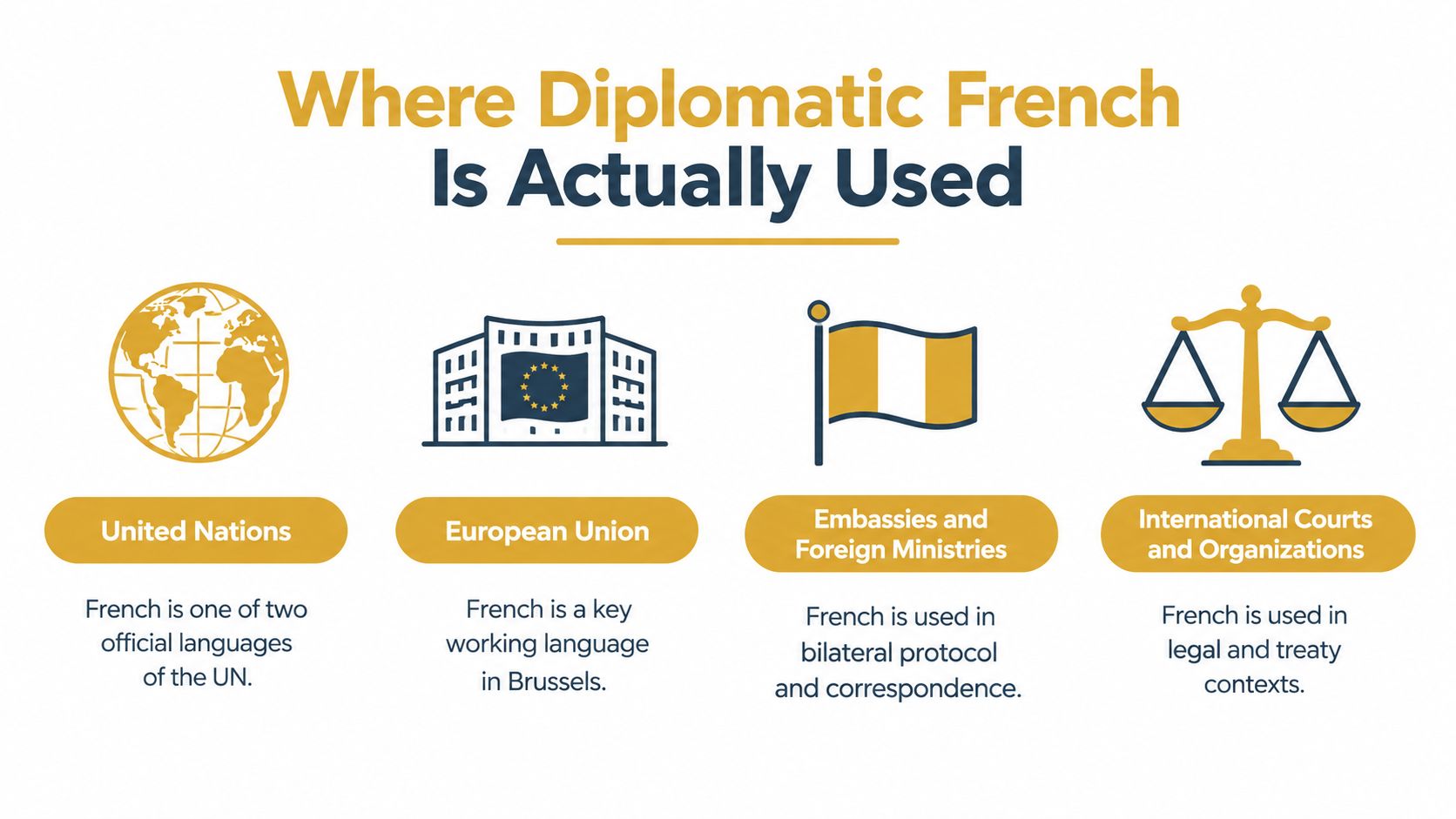
Four settings that change your vocabulary
An EU committee exchange is not the same as a UN plenary. An embassy protocol meeting is not the same as a ministry briefing. The content may sound official in each case, but the pressure points are different, and so is the French you need.
- United Nations: French stays visible in formal meetings, peacekeeping, and written coordination, so listening and writing both need to be tight.
- European Union: the challenge is fast committee language, institutional shorthand, and tracking procedural detail without drifting.
- Embassies and foreign ministries: bilateral correspondence, reception language, and protocol phrasing matter more than broad casual fluency.
- International courts and organizations: legal and treaty language pushes precision even further, so ambiguity becomes a liability.
French in diplomacy is rarely about speaking more. It is about saying less, with the exact meaning the institution expects.
General classroom material can sound polished and still fail in a real mission room. The institutional footprint of French is why specialized training keeps its value.
What Makes Diplomatic French Different
Diplomatic French sounds formal, but formality alone doesn't make it usable. What matters is precision, protocol sensitivity, and low ambiguity, because a small lexical choice can tilt a sentence toward legal caution, political softness, or outright friction. In real work, people don't judge your French by how ornate it sounds. They judge whether it survives a negotiation room, a draft note, or a brief to a senior official.
The register is professional, not conversational
Training programmes aimed at international relations explicitly focus on spoken and written precision, expanding domain vocabulary, and mastering the conventions used in international relations. One official programme says participants improve expression through role-playing and practical exercises so they can communicate more easily in diplomatic and institutional contexts (professional diplomatic training approach). That's the right model, because diplomats need to perform under pressure, not just answer textbook prompts.
The biggest mistake I see is assuming that polished everyday French will transfer automatically. It doesn't. Diplomatic French depends on formulaic speech acts, careful hedging, and institutional vocabulary that keep messages clear without sounding blunt.
What tends to matter most
- Protocol-sensitive wording: greetings, acknowledgements, and closings can signal respect or carelessness.
- Institutional vocabulary: the words used in ministries, missions, and multilateral bodies often differ from classroom French.
- Drafting discipline: a sentence that sounds fine in conversation can become risky in a note verbale or internal brief.
- Listening for implication: in diplomacy, what isn't said can matter as much as what is said.
For a practical companion to this issue, see French telephone etiquette, because the same caution and register control show up in calls, messages, and follow-ups.
If a phrase can be read two ways, someone in the room will read it the wrong way.
That's why the strongest programmes push repetition, correction, and scenario work. They're not polishing accent alone, they're building a professional reflex for precision under time pressure.
Training by Institution and Setting
A diplomat posted to Brussels, a ministry officer drafting briefings, and an embassy team preparing a reception all use French differently. The training has to match the setting, because the work is in the tasks, not the label on the course. Generic diplomatic French often misses that difference.
The best comparison is practical. Some programmes are built for diplomats, journalists, civil servants, and embassy staff, while others focus on public administration, protocol, reports, minutes, and formal speaking (institution-focused course overview). That split matters, because committee work, bilateral exchanges, and internal drafting all demand a different balance of speed, precision, and formality.
| Setting | What French has to do | What to prioritise | What often gets missed |
|---|---|---|---|
| EU institutions | Keep pace in committees and negotiation-heavy exchanges | Fast comprehension, committee vocabulary, concise intervention style | French that is correct but too slow for live exchanges |
| UN settings | Handle formal plenary language and written coordination | Written precision, institutional phrasing, meeting language | Spoken agility under time pressure |
| Embassies | Support protocol, hosting, and bilateral conversation | Politeness formulas, reception language, flexible speaking | Role-specific vocabulary for visits and events |
| National ministries | Manage briefings, reports, and administrative communication | Briefing language, report writing, internal clarity | The gap between oral and written register |
Entry level is the other issue. The Alliance Française programme cited above, for example, expects A2 to B1 on entry, which leaves a real gap for beginners who need a bridge before a specialised track. A direct jump into diplomatic jargon usually wastes time.
For that reason, a French immersion program can work as a bridge before specialised diplomatic content. Near-beginners need a staged path, not a course that assumes they can already follow institutional French under pressure.
A Realistic Learning Roadmap for Diplomats
A realistic roadmap starts from the level you can sustain under pressure, not the level you wish you had. Diplomatic training often relies on CEFR-style benchmarks rather than vague “business fluent” claims, because a shared standard helps with hiring, placement, and internal readiness. One concrete example is the French professional certificate in International Relations and Diplomacy at B1 level offered through United Nations Vienna language training, which shows how operational language use is measured in practice (UN Vienna language-training page).
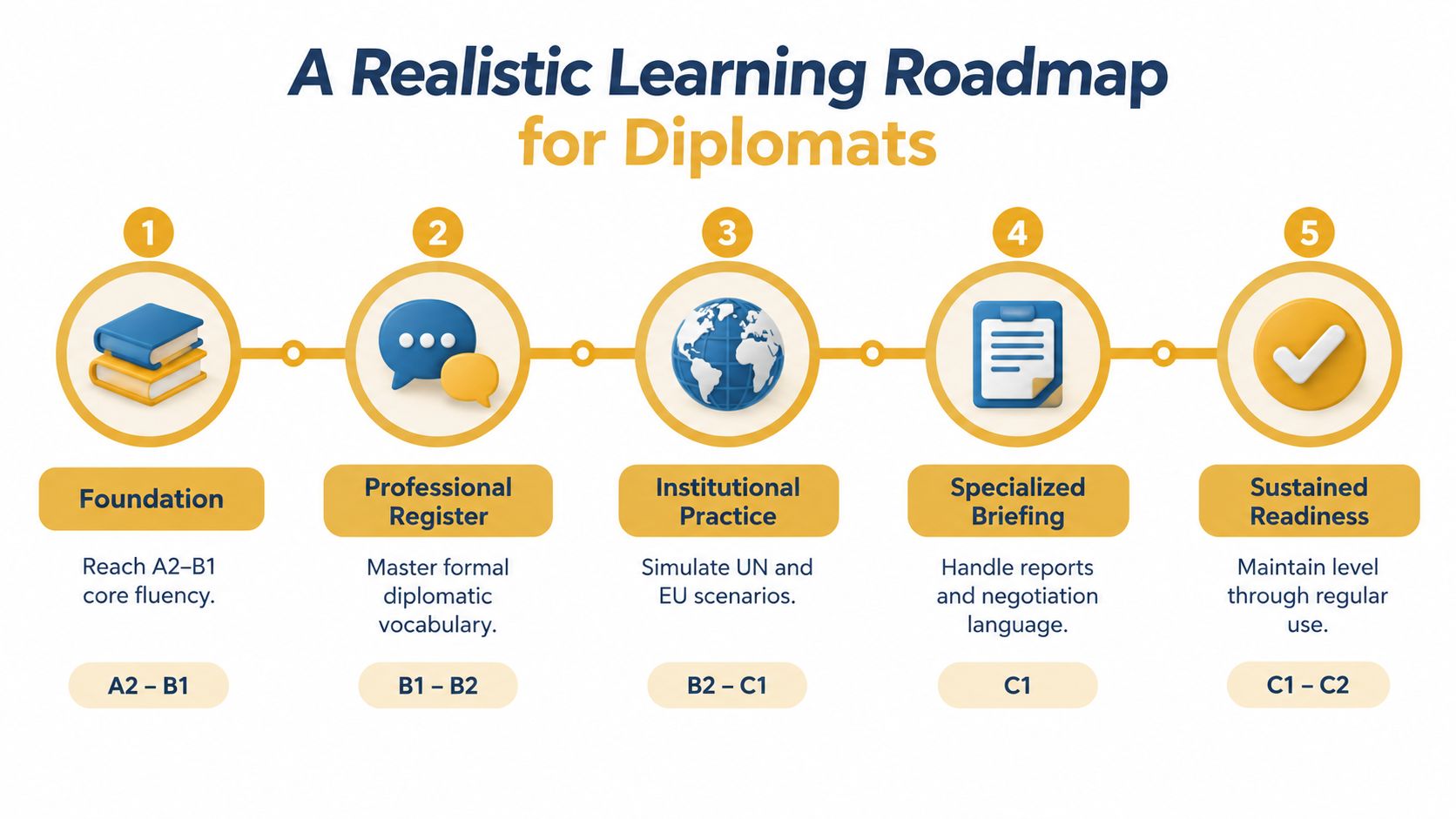
A workable sequence
- Foundation. Build the grammar, core verbs, and listening habits you can retrieve in a meeting, even when the room moves quickly.
- Professional register. Learn the hedging and courtesy forms that make French sound institutional, such as il conviendrait de instead of the blunter il faut.
- Institutional practice. Rehearse UN and EU-style exchanges, short interventions, and note-taking so the language feels familiar under time pressure.
- Specialised briefing. Draft brief reports, read speaking notes, and handle negotiation language tied to your file, not just general diplomacy.
- Sustained readiness. Keep the level active with regular use, because diplomatic French dulls fast if you only study it passively.
B1 is a useful benchmark, but it is still intermediate. If you need to draft notes verbales, brief ministers, or negotiate texts, you need more than exam-pass competence. You need register control, protocol terms, and the vocabulary that keeps your meaning stable when others push back.
A practical target helps here. At the foundation stage, you should be able to follow a short briefing without losing the thread. At the institutional stage, you should handle a committee exchange without searching for every formula. By the time you reach specialised briefing, you should be producing clean written material that another official can use without rewriting it from scratch.
A certificate can confirm readiness. It cannot replace scenario practice.
Private Lessons vs Group Workshops
In diplomatic work, the format you choose can save time or waste it. Deadlines, postings, and role-specific pressure mean the wrong setup can leave you with useful vocabulary but poor recall under fire. The choice usually comes down to precision, speed, or peer interaction.
How the two models behave in real use
Private lessons give tighter correction. That matters for a posting, an exam, or any role where a small phrasing error can blur the message. Group workshops help when you need exposure to different speaking styles, yet they still move at the pace of the room, not the pace of your mission.
The government-backed Diploma in French for International Relations was created at the request of the French Ministry of Europe and Foreign Affairs and the International Organization of La Francophonie, so it is tied to professional diplomatic use rather than a generic French certificate (official diploma information). France's foreign ministry language-training centre also offers instruction in Paris and Nantes, with a mix of regular group classes and private lessons before posting, and it teaches 13 foreign languages with about 40 language teachers (foreign ministry training model).
| Format | Best for | Trade-off |
|---|---|---|
| Private lessons | Fast correction, mission-specific vocabulary, and discreet preparation | Less exposure to multiple voices and spontaneous peer interaction |
| Group workshops | Role-play, committee-style interaction, and shared practice | Less individual correction and slower adaptation to your exact needs |
If you want a structured service option, private French instruction for professional communication fits diplomats who need targeted correction and clear feedback. It is one route among several, and the right choice depends on whether you need individual precision or broader group exposure.
Sample Timeline and Next Steps
A useful plan starts with the next assignment, not an abstract goal. For diplomats and internationally mobile professionals, the work should be sequenced so each lesson serves a clear purpose. I usually structure it as a cycle that begins with vocabulary and ends with performance under pressure.
A sample lesson flow
Start with foundational diplomatic vocabulary and protocol basics, then move into meeting language, formal email drafting, and short oral briefings. Add negotiation language once those pieces are stable, along with the phrases that let you handle disagreement without sounding abrupt. The final stage should be realistic practice, where you speak, summarise, and correct yourself in real time.
For learners working toward a benchmark, the clearest target is the B1 professional certificate standard used in UN Vienna language training. That does not mean the target stays fixed forever. It gives you a measurable checkpoint, and it helps you decide whether you need more work on register, speed, or precision.
What to measure
- Listening accuracy: can you follow a formal exchange without losing the main point?
- Written control: can you draft short institutional messages with the right tone?
- Protocol safety: do your greetings, closings, and transitions fit the setting?
- Recovery speed: when you miss a phrase, can you recover without derailing the message?
Re-test yourself against these four measures every six weeks. Diplomatic register decays faster than general fluency, especially when your day job shifts back to English or another working language.
Whichever format you choose, anchor the plan to a posting date or certification deadline so every session has a target.