Skip to content


You've finished another grammar unit, and you can recognize the passé composé on screen. Then a colleague asks what you did last weekend, and you freeze while trying to choose an auxiliary and arrange the sentence. The problem isn't necessarily that you need more rules. You need practice retrieving the right forms while someone is waiting for your answer.
I would judge an online French grammar course by that moment, not by the size of its lesson library. A worthwhile course should help you produce French, correct what goes wrong, and use the correction again without a prompt. Here's how to choose a format that makes that possible without paying for support you don't need.
Table of Contents
- Online French Grammar Course Formats Side by Side
- What Each Grammar Level Covers and Why It Matters
- How Feedback Decides Whether Grammar Sticks
- Choosing a Course for Your Learner Group
- How Custom Tutoring Compares with Packaged Courses
- What DELF Prep Requires and How Long It Takes
- Book a Free Placement Call Before You Commit
Online French Grammar Course Formats Side by Side
Your first language and school background affect what deserves lesson time. A learner who already understands grammatical gender may need different explanations from someone encountering it for the first time. The Organisation internationale de la Francophonie's overview of French worldwide describes a geographically distributed learning community, a useful reminder that a course shouldn't assume everyone shares the same educational starting point.
An online French grammar course is a structured set of lessons that teaches verb, agreement, and sentence forms and checks whether you can produce them, delivered through self-paced study, live groups, private tutoring, or exam preparation.
Online French grammar course formats compared
| Format | Best for | Feedback | Speaking practice | Main trade-off |
|---|---|---|---|---|
| Self-paced grammar platform | Disciplined learners who review rules on a fixed habit | Automatic, right or wrong | Little or none | Errors can persist unnoticed |
| Live group class | Learners who want a fixed schedule and classmates | Tutor during class, shared attention | Moderate, shared time | Pace is set for the whole group |
| Private online tutoring | Adults with specific goals, professionals, families with children | Immediate and specific to your errors | High, most of the session | Higher commitment per hour |
| Exam-prep course | DELF or DALF candidates with a test date | Scored practice tasks against exam criteria | Timed writing and speaking tasks | Narrow focus; all language skills need coverage |
Match the format to the bottleneck
Choose self-paced study when you need orderly revision and can reliably notice your own mistakes. It's less suitable as your only resource when your written exercises look strong but spontaneous answers fall apart.
A group class adds accountability and unfamiliar conversation partners. The compromise is attention: your teacher must balance your agreement errors against everyone else's needs. Private tutoring makes more sense when a particular weakness is blocking a work task, school assignment, or upcoming conversation.
Practical rule: Buy the format that addresses your weakest performance, not the format you find easiest to complete.
Use the French class structure guide to consider how lesson activities fit together, rather than comparing course labels alone.
Before choosing a row, ask yourself:
- What's my goal? Name an actual task, such as answering clients or supporting school French.
- What's my deadline? Separate an approaching assessment from an open-ended interest.
- How much do I speak each week? Count original answers, not repetition after a recording.
If speaking is the missing activity, another exercise subscription won't fill that gap by itself.
What Each Grammar Level Covers and Why It Matters
Grammar focus and production task by CEFR level
| CEFR level | Core grammar focus | Production task that proves it |
|---|---|---|
| A1 | Gender, articles, present tense, basic negation | Describe your home and daily routine in five sentences |
| A2 | Passé composé with auxiliary choice, early imparfait | Narrate what you did last weekend |
| B1 | Subjunctive after common triggers, object pronoun order | Write a short personal email to a colleague |
| B2 | Conditional, relative clauses, agreement in longer sentences | Argue a point and narrate past events in order |
| C1 | Register, nuanced mood choice, formal written tone | Draft a formal request or report for work or study |
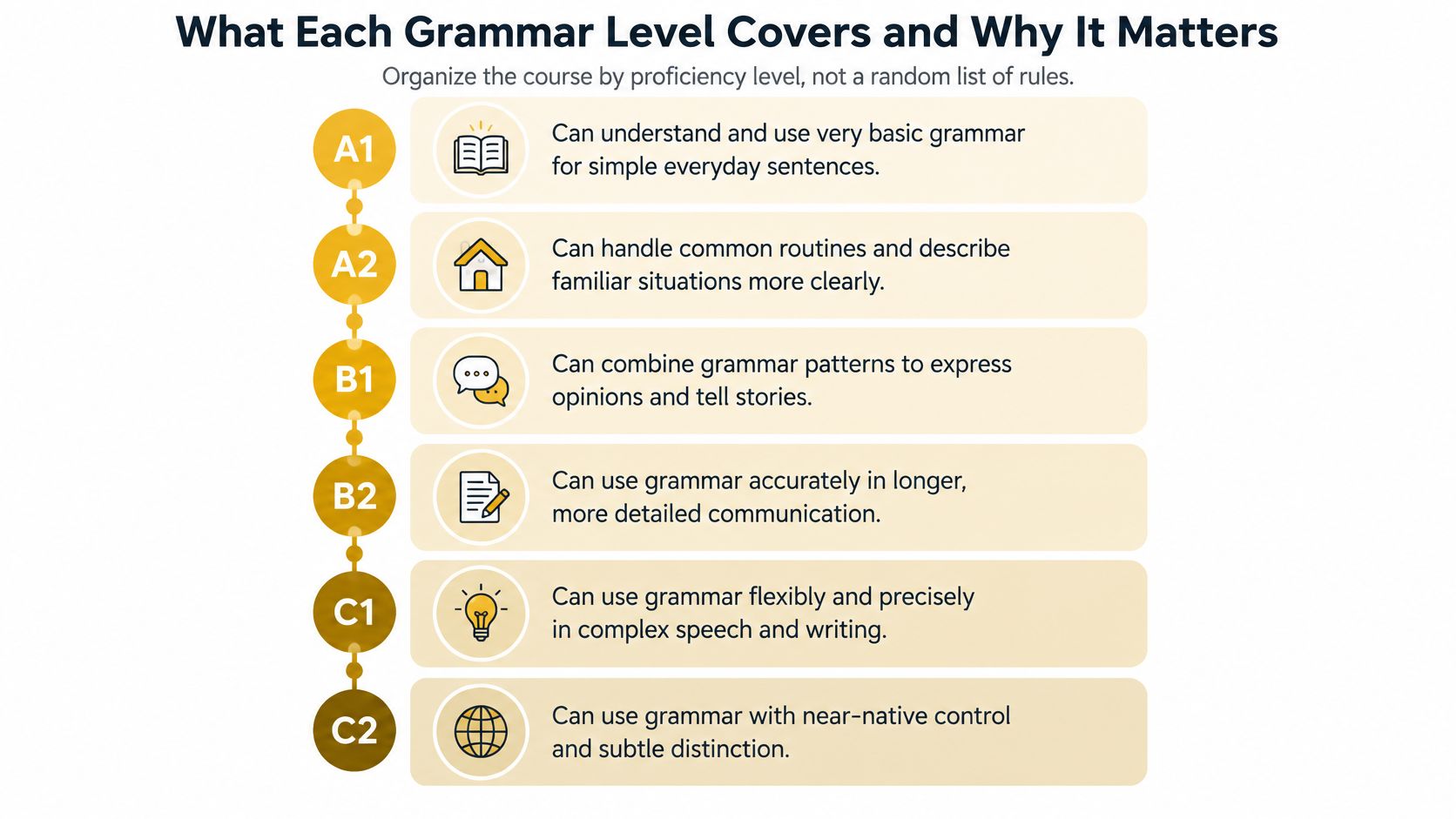
Treat these as practical course-selection targets, not an official rule-by-rule examination syllabus. The Council of Europe's CEFR descriptors establish proficiency levels from A1 through C2, while language-specific descriptions connect proficiency with the forms learners need.
A course title such as intermediate grammar tells you little unless the provider explains what you'll produce. The table gives you something concrete to inspect in a sample lesson: is the learner selecting an answer, or composing a message that requires several grammatical decisions?
The full proficiency ladder helps put those course targets in context.
Test performance rather than familiarity
Start with a short, unaided writing sample and a spoken response. A useful diagnostic examines both accuracy and the complexity you can handle: producing a correct present-tense sentence isn't the same challenge as maintaining agreement across a longer explanation.
Try writing a brief account of yesterday without translation software. If auxiliary choice or basic sentence construction repeatedly stops you, revisit the relevant beginner material before buying an advanced course. That exercise identifies a weakness, but it doesn't establish your overall CEFR level on its own.
A strong syllabus then selects the grammar your goal requires. A professional drafting requests may need work on politeness and conditional forms, while a learner telling personal stories may need clearer control of past-time relationships.
Look for comparable reassessment
Progress checks should use new tasks of similar difficulty, not the same exercise with familiar answers. If your starting task is a personal email, the reassessment might be another email with a different recipient and purpose.
Keep the original and revised samples. They make progress visible in a way that a completion badge doesn't: fewer recurring errors, more independent sentence construction, and less reliance on prompts. Our guide to French proficiency and CEFR levels can help you interpret level labels before selecting a course.
I wouldn't pay extra for a large advanced library if the course never checks whether you can use its beginner material independently.
How Feedback Decides Whether Grammar Sticks
Many grammar courses mark an answer wrong, display the correct version, and move on. That tells you what the answer was. It doesn't establish whether you understood the problem or could repair it yourself.
The Cambridge-published comparison of implicit and explicit corrective feedback found an advantage for explicit feedback on delayed imitation and grammaticality-judgment posttests. That supports looking beyond immediate quiz scores when judging a course's correction method.
What useful correction looks like
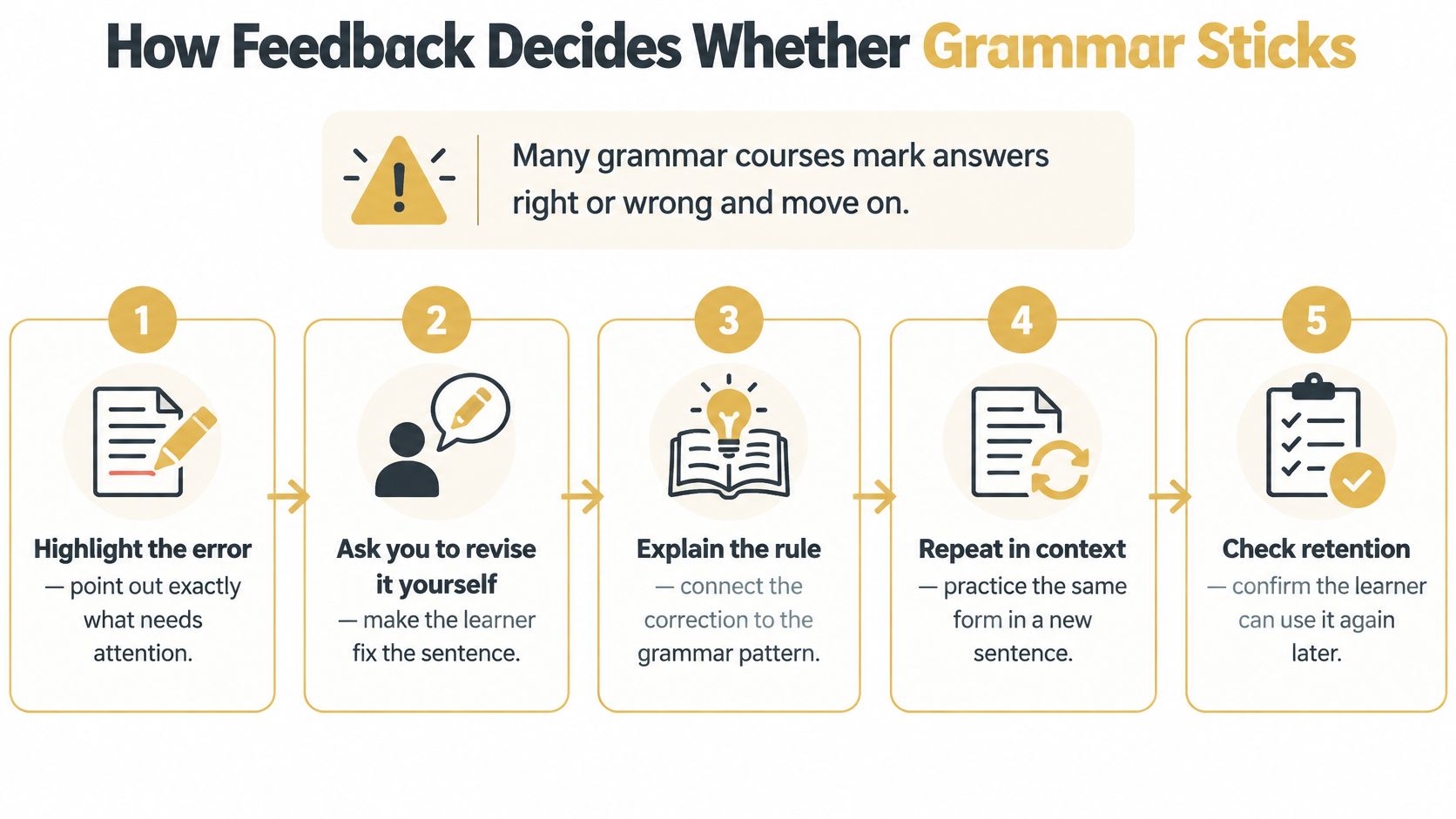
A tutor or well-designed lesson should take you through an active repair process:
- Highlight the error. Identify the word or relationship that needs attention without rewriting everything.
- Ask you to revise it. Give you a chance to retrieve the rule yourself.
- Offer a focused clue. Point to auxiliary choice, agreement, pronoun position, or mood rather than delivering an unrelated lecture.
- Require the corrected version. Have you say or write the complete sentence again.
- Recycle the form. Introduce a different situation that requires the same grammatical decision.
The important distinction is who does the work. If the teacher supplies every correction and you only nod, the teacher has demonstrated accuracy. You haven't yet demonstrated independent control.
This visual summarizes the correction-and-retention cycle.
Consider auxiliary selection in a past-tense account. A useful response directs your attention to the verb and intended construction, lets you repair the sentence, and then asks you to describe a different event. For agreement, the teacher should help you identify which noun controls the article or adjective, rather than treating each wrong ending as an unrelated mistake.
Keep terminology in its place
The 2025 study of 124 French learners published in the Journal of Multilingual and Multicultural Development associated performance with form-focused instruction, rule discovery, multilingual strategies, and everyday language use, while belief in grammatical terminology was negatively associated with performance. These are associations, not proof that grammatical vocabulary causes weaker results.
Use terminology when it makes correction shorter and clearer. Don't let a lesson turn into a test of whether you can define a subordinate clause while still struggling to finish a request.
Our French tutoring methodology explains how instruction and practice fit together. When comparing alternatives, look for evidence of a correction process rather than accepting personalized feedback as a sufficient description.
Can you use the corrected form in an unfamiliar task a week later, without the original sentence in front of you?
That's the benchmark I'd use to decide whether to renew.
Choosing a Course for Your Learner Group
Choose the task before choosing the textbook. A child completing a school assignment, an adult organizing travel, and a professional writing to a client may need overlapping grammar, but they shouldn't spend their lessons doing identical activities.
Use these priorities to narrow your shortlist:
- Adults learning for travel or conversation: Favor manageable recurring sessions with practical exchanges, follow-up questions, and opportunities to repair your own answers. A lecture-heavy course can leave too little time to speak.
- Children and teens: Look for task-based or game-style activities with clear language objectives. Parents should receive progress information connected to school expectations, not merely a report that the child participated.
- DELF or DALF candidates: Select the intended qualification level and require exam-shaped practice. A general conversation class isn't automatically an exam-preparation course.
- Professionals: Bring the situations you need to handle, such as clarifying a deadline, softening a disagreement, or drafting a formal email.
- Families at bilingual schools: Align support with current classroom material so tutoring addresses the language needed to understand and complete schoolwork.
For remote learners, the lesson task matters more than the appearance of the video classroom.

Give grammatical gender individual attention
If your first language handles noun gender differently, a masculine-or-feminine explanation may not be enough. Learn nouns with their articles, rehearse them in useful phrases, and extend those phrases with adjectives so you practice the agreement relationship.
The 2025 Australian university study listed by Monash University found that students generally regarded grammatical-gender innovations as useful but complicated, while teachers differed in attitudes and practices. That makes clear guidance especially important when a course introduces professions, inclusive forms, or contemporary usage.
A good teacher distinguishes exam conventions, everyday usage, and institutional preferences. Inclusive writing forms aren't a single universal standard, so confirm expectations with your school or employer before using them in assessed or official writing.
Before enrolling, check whether the course starts at your demonstrated level, assigns tasks that match your goal, and explains exceptions candidly. If it promises a universal shortcut for gender or tense choice, inspect the sample lesson carefully.
How Custom Tutoring Compares with Packaged Courses
Emma had never studied a foreign language seriously before and mastered French in just 6 months with Elite French Tutoring. That's an individual success story, not a standard completion promise. Her account doesn't establish a formal starting CEFR level or a certification result, so it shouldn't be used to predict your exam timeline.
The purchasing decision is more practical: do you need an orderly path through material, or a teacher who can change the path when your own French reveals a problem?
This comparison illustrates the distinction between a fixed course and individualized instruction.

Packaged course versus custom private tutoring
| Criterion | Packaged online course | Custom private tutoring |
|---|---|---|
| Starting point | Fixed unit where the course begins | Level and goals assessed before the first lesson |
| Syllabus | Set in advance for all learners | Adjusted to your progress each session |
| Feedback | Automated or delayed | Immediate and tied to your own sentences |
| Speaking practice | Limited, mostly written | Most of each lesson in French |
| Fixing a real work or school error | Only if the course covers it | Addressed in the next session |
When a packaged course is enough
I would start with a packaged course if you work independently, want systematic review, and already have somewhere to use French. A clear syllabus can remove the effort of deciding what to study next.
Custom tutoring is more useful when the material must follow your job, your child's schoolwork, or an assessment deadline. Our instruction adapts as learners improve, and private lessons take place in French, with slight exceptions for beginners. That makes explanation a means to further practice rather than the whole lesson.
The accompanying video offers another way to explore the tutoring option.
Compare the cost of usable study time
A subscription can be economical when you consistently use it. Divide the total fee by the study hours you realistically expect to complete, not by unlimited access advertised on the sales page.
For tutoring, separate live instruction from independent practice. Then examine what the live fee buys: diagnosis, preparation, correction, and focused speaking time. Don't treat an unsupervised exercise hour as equivalent to an hour of individual attention.
Budget check: A cheaper course isn't better value if it leaves the problem you're paying to solve untouched.
Use the qualification study-hour benchmarks below to test the scale of your plan. Bring your budget and available study time to the placement call, and confirm exact fees before committing.
What DELF Prep Requires and How Long It Takes
DELF B2 scoring and timing by component
The France Éducation international DELF B2 candidate manual sets the component requirements and overall pass rules shown here.
| Component | Points | Time and output |
|---|---|---|
| Listening | 25 | 30 minutes |
| Reading | 25 | 60 minutes |
| Writing | 25 | 60 minutes, text of at least 250 words |
| Speaking | 25 | 30 minutes preparation, up to 20 minutes exam |
| Overall pass | At least 50 of 100 | At least 5 of 25 in every component |
A component score below the stated minimum is eliminatory, even when the overall total reaches the pass threshold. That's why a grammar-only course is a risky substitute for balanced preparation: strong written accuracy can't compensate for an inadequately prepared listening or speaking component.
The Institut français Canada's DELF and DALF overview describes six independent diplomas, DELF A1, A2, B1, and B2, followed by DALF C1 and C2, certifying reading, writing, speaking, and listening; the diplomas are valid for life. Choose the intended diploma rather than assuming any French certificate course prepares you for the same assessment.
Turn study hours into a workable calendar
The Institut français of Finland's exam guidance lists approximately 60 study hours before DELF A1 and at least 750 before DALF C1; using its A1 benchmark, a hypothetical schedule of two instructor-led hours weekly would take roughly 30 weeks to accumulate that amount of instruction alone. These are planning benchmarks, not guaranteed routes to a pass.
Your current level matters more than a package name. An existing learner may need targeted preparation, while someone starting from scratch needs broader language development before exam technique becomes the priority.
Check what preparation includes
A credible certification plan should provide:
- Timed writing: Complete responses under exam conditions, followed by corrections you actively apply.
- Oral interaction: Practice answering follow-up questions and developing an argument without reading a script.
- Balanced assessment: Diagnose listening and reading alongside productive skills.
- Clear hour accounting: Separate live lessons, homework, independent revision, and practice tests.
For a B2 target, compare your needs with our DELF B2 exam-preparation guide. Before buying a package, make sure the proposed calendar leaves room to correct weaknesses revealed by practice, rather than ending immediately after the last new topic.
Book a Free Placement Call Before You Commit
A placement conversation should help you choose a format, not pressure you into a package. We offer a complimentary 10–20 minute call in which our experts assess your French level and discuss what you want to accomplish.
Bring your goal, your realistic weekly availability, and a short piece of unaided writing. For a child, include current school material; for work, bring a nonconfidential example of the communication you need to handle.
Use the call to clarify:
- Format: Which option suits my level and available time?
- Correction: What happens after I make an error?
- Workload: Which activities happen in lessons, and which happen independently?
- Materials: What will I use between sessions?
- Progress: What will demonstrate that I'm improving?
Our tutors are fluent in English and can explain difficult grammar points when beginners need clarification. Lessons are available in person in New York, with online learning available worldwide at times suited to the learner.
Choose the row in the format comparison that best matches your immediate problem, then book a free placement call with Elite French Tutoring to discuss whether it's the right fit before committing to lessons.