Skip to content


Which French pharma giants operate in the U.S., and which have the local teams you need? Finding a French parent company is easy. Determining whether its American business conducts research, manufactures medicines, supports patients, or commercializes a specialized portfolio takes more digging.
I recommend comparing French pharmaceutical companies in the U.S. by function, not name recognition. A large global employer won't necessarily suit an ophthalmology researcher, and a recognizable skin-care brand won't necessarily connect you to its parent company's pharmaceutical team.
These seven companies offer different starting points for job seekers, clinicians, researchers, and business partners. Our work helping professionals prepare for corporate communication shapes the practical lens: identify the American organization first, then understand how you'll interact with colleagues in France.
Use the comparison table to narrow your shortlist, then visit each company's U.S. resources. Pay particular attention to the distinction between local commercial presence, research activity, and manufacturing capability. They aren't interchangeable, and choosing the right contact starts with knowing which one you need.
Table of Contents
- 1. Sanofi
- 2. Ipsen
- 3. Servier
- 4. Pierre Fabre Laboratories
- 5. LFB
- 6. Théa Pharma
- 7. Biocodex
- French Pharmaceutical Companies in the US at a Glance
- Working With French Pharma in the U.S. Your Next Steps
1. Sanofi
Sanofi is my first recommendation for professionals seeking a broad U.S. pharmaceutical footprint. Its American organization spans research, manufacturing, commercial operations, specialty-care medicines, vaccines, and general medicines.
Sanofi reported approximately 13,000 U.S.-based employees in 2025, according to its U.S. manufacturing and supply overview. That makes it a useful starting point for candidates comparing scientific, industrial, and business career paths rather than looking for one narrow specialty.
Best for breadth of opportunity
The Sanofi U.S. website provides routes into immunology, neurology, oncology, rare blood disorders, rare diseases, and vaccines, alongside product and patient-support resources. Start with your therapeutic area, then identify the relevant business and location.
- For job seekers: Search by function and site, not just the corporate name. Manufacturing quality and commercial market access require very different experience.
- For healthcare professionals: Use the specific medicine's U.S. prescribing and support materials.
- For partners: Establish whether your proposal belongs with research, procurement, manufacturing, or a therapeutic-area team.
The trade-off is navigation. Sanofi's breadth makes it attractive, but it also makes a general corporate inquiry less useful than a targeted approach.
Practical rule: A global portfolio isn't a U.S. product catalog. Verify the American indication, access route, and responsible team before making plans.
If employment is your priority, our guide to French companies hiring in the U.S. can help you broaden your search beyond a single employer.
2. Ipsen
Choose Ipsen when therapeutic specialization matters more than corporate breadth. Its focus on oncology, rare disease, and neuroscience gives clinicians, scientific candidates, and prospective partners a clearer starting point than a general pharmaceutical directory.
The Ipsen U.S. website brings together American resources for patients, caregivers, healthcare professionals, research, patient support, and careers. Its rare-disease information includes liver, growth, and ultra-rare bone conditions, making it particularly relevant when your work concerns specialized care.
A focused commercial and scientific fit
I'd shortlist Ipsen for a medical-affairs candidate with relevant disease-area experience or a partner whose service addresses specialist treatment delivery. I wouldn't make it the first stop for someone seeking consumer-health products or broad primary-care exposure.
Its main advantage is clarity: you can compare your expertise against a defined therapeutic focus. Its limitation is the same concentration, which leaves fewer reasons to engage if your work falls outside those areas.
- Clinical fit: Match the condition and indication before exploring support resources.
- Career fit: Explain your relevant scientific or commercial experience rather than relying on general enthusiasm for French business.
- Partnership fit: Identify a concrete need within the U.S. organization.
Treatment access still depends on prescribing, indication, and U.S. distribution. Patient-support information isn't a promise of eligibility or coverage.
For cross-border preparation, our overview of the French language in the U.S. provides context. Treat language preparation as a complement to technical qualifications, not a substitute for them.
3. Servier
A researcher seeking a French group with a locally anchored American scientific organization should put Servier high on the shortlist. Its U.S. business focuses primarily on oncology, with an expanding neurology presence and Boston-based headquarters and Seaport research activity described through Servier Pharmaceuticals.
The American operation is commercially significant, too. Servier's annual report for fiscal 2024/2025 records U.S. revenue of €1.496 billion, representing 21.8% of group revenue.
Best for targeted oncology and research connections
I recommend Servier for professionals interested in targeted therapies, difficult-to-treat cancers, and the relationship between local research and commercialization. Its concentrated U.S. portfolio makes it easier to frame a relevant conversation than approaching a diversified group without a clear therapeutic angle.
The advantage: a French parent group combined with identifiable American research and commercial infrastructure. The trade-off: fewer therapeutic directions than a broad multinational such as Sanofi.
For a business-development discussion, distinguish among an approved medicine, an investigational asset, and a research collaboration. Each calls for a different proposal and decision-maker.
A pipeline listing is a research signal, not evidence that a treatment is available for routine prescribing.
Clinicians should begin with U.S. medicine information, then investigate trial or expanded-access pathways where relevant. Candidates should connect their experience to a specific function, such as clinical development, translational research, or medical affairs, rather than assuming all oncology roles require the same background.
4. Pierre Fabre Laboratories
Pierre Fabre spans pharmaceuticals and dermo-cosmetics, so identify the relevant business before reaching out. Its U.S. website describes pharmaceutical activity focused on oncology and rare disease. Check the site for current details on U.S. operations and office locations before making contact.
Best for a clearly defined business-unit match
For partners and job seekers, the key question is which U.S. entity and business unit handles the opportunity. Match your proposal or application to the work involved, rather than assuming a consumer-brand contact can direct pharmaceutical inquiries.
I'd recommend Pierre Fabre to professionals whose expertise connects directly to oncology, rare disease, dermatology, or dermo-cosmetics. The group's American pharmaceutical focus is narrower than its overall portfolio.
- Strength: The group combines pharmaceutical expertise with dermatology and skin-care activities.
- Limitation: Its American pharmaceutical focus is narrower than its overall global portfolio.
- Decision point: Confirm the U.S. subsidiary, product category, and responsible contact before tailoring an application or proposal.
For job seekers, use precise language on your résumé. Consumer marketing, clinical development, and pharmaceutical market access call for different experience. For cross-border conversations, our guide to French business culture can help you prepare. Keep your opening message concrete: explain your relevant expertise, the American business you're addressing, and the decision you want to discuss.
5. LFB
For specialized biologics and an industrial U.S. connection, LFB deserves attention. The French group focuses on plasma-derived medicines and recombinant proteins for serious and often rare diseases, rather than a broad consumer-facing portfolio.
The LFB group website describes American activities involving bioproduction, subsidiaries, and plasma collection, with a Framingham, Massachusetts, contact presence. Its U.S. connections make it relevant to manufacturing, quality, supply-chain, and specialized clinical professionals.
Best for biologics and manufacturing partnerships
A practical example is SEVENFACT, used for certain bleeding episodes in people with hemophilia A or B with inhibitors. Product-specific access can involve a separate American licensee or distributor, so the group headquarters won't necessarily be the right commercial contact.
I'd prioritize LFB for a supplier with relevant biologics capabilities or a candidate with plasma-processing, manufacturing, or quality expertise. Its specialization is an advantage when your experience fits, but it isn't a general-purpose pharmaceutical shortlist entry.
Due-diligence distinction: Facility registration and medicine approval answer different questions. Verify both before qualifying a supplier.
An industry compilation of FDA establishment records identifies LFB-related locations in Charlton and Framingham, Massachusetts, alongside French sites, while explaining that establishment registration doesn't approve an individual product.
For clinical work, follow the current U.S. prescribing information and appropriate specialist guidance. For cross-border communication, our French for medical professionals resources offer a relevant preparation route without replacing clinical, regulatory, or technical training.
6. Théa Pharma
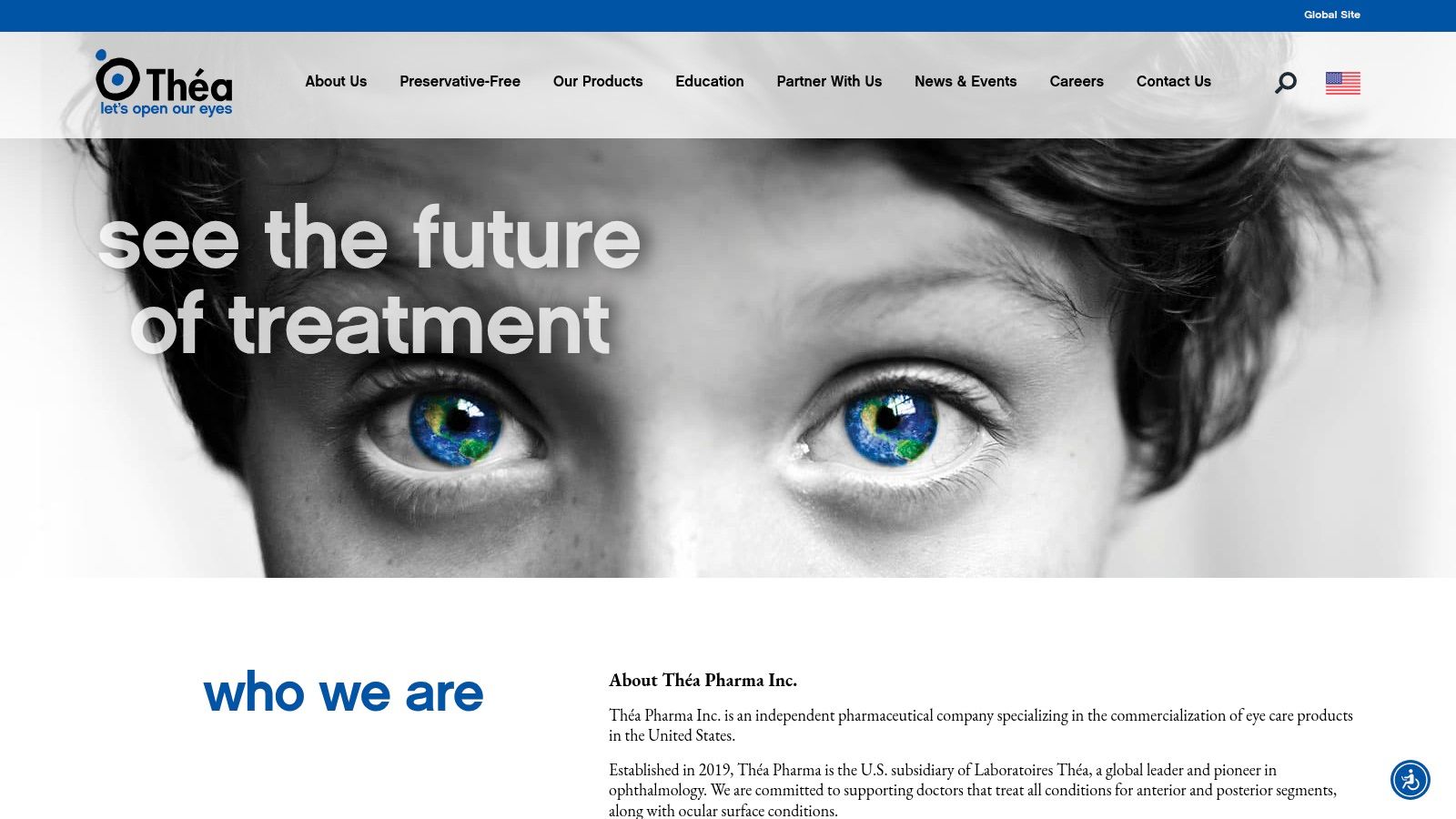
Start with Théa Pharma if your work is specifically in eye care. It's the U.S. subsidiary of French family-owned Laboratoires Théa, and its ophthalmology focus makes it easier to assess than a company whose eye-care activities sit inside a much broader organization.
The Théa Pharma U.S. website provides American product listings, prescribing information, and contact resources, including its Waltham, Massachusetts, office. Its scope includes ocular surface conditions and anterior and posterior eye conditions.
Best for ophthalmology-specific decisions
For clinicians, the useful starting point is the exact product and its U.S. labeling. For commercial candidates or service providers, the better question is how your experience supports ophthalmology practices, eye-care professionals, or the company's American product organization.
- Why shortlist it: A dedicated specialty focus and U.S.-specific product resources.
- Why pass: It won't suit someone seeking broad exposure across unrelated therapeutic areas.
- What to verify: Whether the product is a prescription medicine or another eye-care offering, and which American team handles the inquiry.
I recommend Théa over a general pharmaceutical search when you already know ophthalmology is your destination. That narrower focus helps you write a more relevant application or partnership proposal.
Don't assume an eye-care product available in France has the same American availability, formulation, or labeling. Use U.S. materials for U.S. decisions, and involve the treating clinician when considering prescription treatment.
A local office establishes a contact point. It doesn't, by itself, establish that the company manufactures a particular product domestically.
7. Biocodex
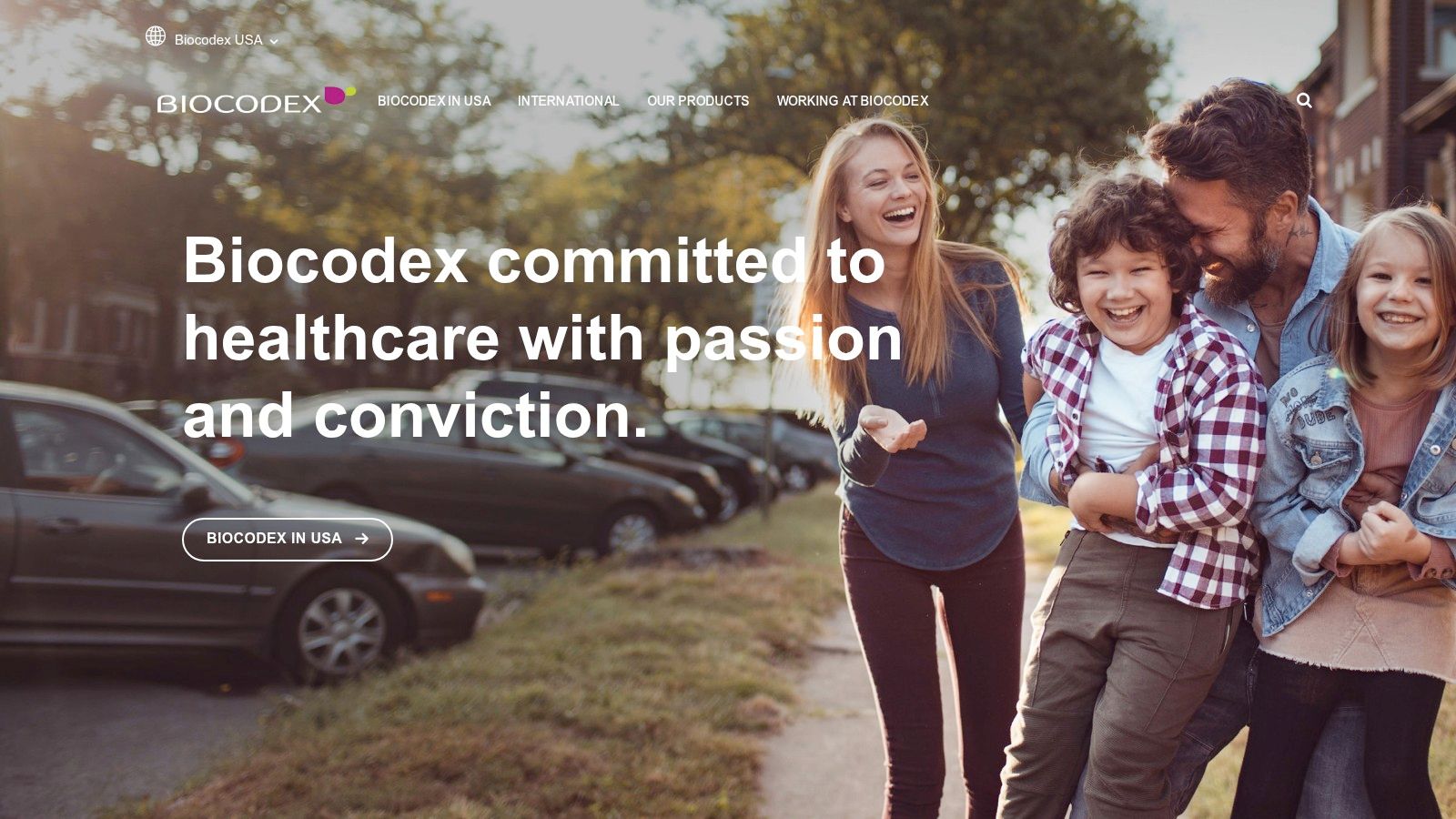
Biocodex suits professionals who can distinguish prescription pharmaceuticals from consumer-health products and want to work within that mixed portfolio. The independent, family-owned French company has an American subsidiary in Bedminster, New Jersey.
Its U.S. website provides local company, product, and contact information, with separate business activities covering prescription medicines and dietary supplements or natural health products. The group's expertise includes microbiota, women's health, and orphan diseases.
Best for product-category precision
I'd shortlist Biocodex for candidates and partners interested in microbiota-related work or specialized medicines, but I'd first establish which American business unit matches the opportunity. A consumer-health proposal and a prescription-medicine proposal require different evidence, contacts, and commercial assumptions.
Its strength is a distinct portfolio with an accessible local organization. Its limitation is that a smaller, specialized American business won't offer the same range of functions or therapeutic options as a large diversified multinational.
For a clinician, the critical distinction is the individual product's status and intended use. A dietary supplement shouldn't be evaluated or discussed as though it were an approved prescription treatment.
For commercial planning, don't assume a single purchasing route across the portfolio. Identify whether the relevant buyer is a pharmacy, retailer, distributor, healthcare organization, or another business customer.
Likewise, investigate price and insurance coverage at the product level rather than treating them as company-wide characteristics. Your most productive first inquiry names the product category, your professional role, and the specific American contact or resource you need.
French Pharmaceutical Companies in the US at a Glance
| Company | U.S. Location(s) | Therapeutic Focus | Best For |
|---|---|---|---|
| Sanofi | Broad U.S. operations | Specialty care, vaccines, general medicines | Broad U.S. footprint and diverse therapeutic areas |
| Ipsen | U.S. commercial presence | Oncology, rare disease, neuroscience | Focused research into rare disease and neuroscience |
| Servier | Boston, Massachusetts | Oncology, neurology | Targeted therapies and U.S.-based research |
| Pierre Fabre Laboratories | Secaucus, New Jersey | Oncology, rare disease; broader group includes dermatology | Exploring pharmaceutical and dermo-cosmetics businesses |
| LFB | Framingham, Massachusetts; U.S. operations | Plasma-derived medicines, recombinant proteins, rare diseases | Biologic medicines and U.S. manufacturing activity |
| Théa Pharma | Waltham, Massachusetts | Ophthalmology and eye care | U.S.-specific eye-care products and information |
| Biocodex | Bedminster, New Jersey | Microbiota, women's health, orphan diseases | A mix of prescription medicines and consumer health products |
Working With French Pharma in the U.S. Your Next Steps
Match your objective to the company before investing time in outreach. I'd start with Sanofi for breadth, Ipsen or Servier for focused specialty opportunities, Pierre Fabre for a clearly identified pharmaceutical or dermatology business, LFB for specialized biologics, Théa for ophthalmology, and Biocodex for microbiota-related or mixed pharmaceutical and consumer-health work.
Use the comparison table to narrow your options, then make each company's U.S. website your first research stop. Global corporate materials provide context, but American product resources, office details, and job descriptions are more useful for an immediate U.S. decision.
- Career: Choose a function and location, then tailor your application to the actual role.
- Clinical: Confirm the medicine, U.S. indication, prescribing information, and support pathway.
- Research: Separate approved products from investigational programs and identify the relevant scientific contact.
- Partnership: Name the service you provide and the American team that would use it.
Language preparation belongs alongside that work, not in place of it. Don't assume a U.S. role requires French; use the job description and expected cross-border responsibilities to decide whether it's a practical priority.
Alex's experience offers a useful example. A senior project manager at a global tech firm, he was promoted to lead cross-border operations in Europe and used our corporate French classes to support his international work. His story isn't a pharmaceutical case study, but it illustrates a relevant decision: prepare for the conversations your responsibilities will require.
Our professional courses can be private, online, or in person, with customized learning built around the learner's objectives. That lets you focus preparation on professional communication rather than studying without a clear use case.
If you're aiming at a French company in the U.S. market, Elite French Tutoring's corporate French lessons can help you communicate with confidence. Book a free 20-minute consultation to assess your current level, discuss your cross-border responsibilities, and identify a practical starting point.