Skip to content

You've found the perfect role in Paris, opened the application portal, and stopped at one phrase: « lettre de motivation exigée ». Your English cover letter is ready, but translating it line by line will usually produce the wrong document. French recruiters screen for structure, register, evidence, and cultural signals before they decide whether your experience deserves a closer look.
A strong French cover letter is compact, formal, and deliberately organized. It uses the objet line, follows the Vous–Moi–Nous logic, keeps every pronoun in the formal vous register, and ends with a precise request for an interview. French hiring guidance converges on a one-page A4 format, with 3–4 paragraphs, clear contact details, and the job posting reference easy to find, as explained in this French cover letter format guide.
I'll walk you through the version I use with applicants who need a letter ready to send, not a collection of translated phrases. We'll build the seven blocks, tailor each paragraph to the annonce, and finish with the proofread ritual that catches the mistakes recruiters notice immediately.
Table of Contents
- Staring at a Blank Lettre de Motivation
- The Anatomy of a French Cover Letter
- Formal vs Informal French at a Glance
- How Camille Landed Her Paris Offer
- Tailoring the Letter to Each Posting
- Cultural Traps That Quietly Sink Applications
- Proofread, Send, and What to Do Next
Staring at a Blank Lettre de Motivation
The blank page feels difficult because you're trying to solve several problems at once. You need to write in French, sound professional without sounding inflated, explain your motivation, and show evidence that matches the posting. Meanwhile, the announcement may give you only a few lines and a firm instruction to submit a CV plus a lettre de motivation.
English-speaking applicants often begin by translating their usual letter. That approach carries over the wrong habits: a broad opening about being excited, a résumé summary in paragraph form, an American-style greeting, and a friendly sign-off. The result may be grammatically correct while still feeling culturally misplaced.
My rule: Don't translate your English cover letter. Rebuild its logic for a French reader.
A practical French application has seven blocks:
- Your contact details
- The employer's details
- The city and date
- The objet line
- The formal salutation
- The Vous–Moi–Nous body
- The closing formula and signature
The most important shift is conceptual. The letter isn't a second CV, and it isn't a personal essay. It's a short argument that connects the employer's need, your proof, and the value you could create together.
The Vous–Moi–Nous structure makes that argument easy to follow. “Vous” shows that you've understood the company and the role. “Moi” gives concrete evidence, ideally with measurable outcomes where your background supports them. “Nous” explains how your contribution could serve the team and naturally leads to a request for an interview.
You'll also need to treat the letter as a French writing exercise. Agreement errors, missing accents, an inappropriate tu, or a casual ending can weaken an otherwise impressive application. Read it aloud, check every name and title, and ask whether each sentence sounds like formal professional French rather than an English sentence wearing French vocabulary.
The Anatomy of a French Cover Letter
A French cover letter should feel orderly before it feels persuasive. Recruiters need to identify who you are, which role you're applying for, and why your background fits without searching through decorative prose.
Build the document from the top down
Place your name, address, phone number, and email at the top. Add the recipient's name, title, company, and address on the opposite side, followed by the city and date aligned to the right. If the recruiter's name is available, use it. If it isn't, « Madame, Monsieur, » remains the safest formal salutation.
The objet line is essential:
Objet : Candidature au poste de [intitulé du poste], référence [numéro]
Repeat the exact job title and reference number from the announcement. This helps the reader classify the application quickly and signals that you've followed the instructions.
Your first paragraph is the Vous section. Name the company, mention a specific aspect of its work, and identify the position. Avoid empty praise such as « Votre entreprise est très intéressante ». Write something tied to the posting, such as:
« Votre développement de solutions de mobilité durable correspond directement à mon expérience en analyse de projets urbains, et je souhaite vous proposer ma candidature au poste de chargée de projet. »
The second paragraph is Moi. Select the evidence that answers the employer's stated needs. If your experience supports quantified results, include them. Don't write « Je suis rigoureuse et motivée » when you can describe the project, responsibility, action, and outcome that demonstrate those qualities.
The third paragraph is Nous. Explain what you'd contribute and connect it to the team's work. Then request a conversation:
« Je serais heureuse de pouvoir vous présenter plus précisément mon parcours et d'échanger sur la manière dont je pourrais contribuer à vos prochains projets. »
End with a formal politeness formula:
« Je vous remercie de l'attention portée à ma candidature. »
Then use the traditional closing:
« Je vous prie d'agréer, Madame, Monsieur, l'expression de mes salutations distinguées. »
Keep the entire document to one A4 page, as recommended by France-focused application guidance. Use a readable 11–12 point font, restrained spacing, and enough white space to make the page easy to scan. For additional practice with professional phrasing, our French business writing lessons can help you work on tone as well as grammar.
Seven blocks of a French cover letter
| Block | Purpose | Sample Phrase |
|---|---|---|
| Contact details | Make it easy to reach you | Nom, téléphone, adresse e-mail |
| Employer details | Identify the recipient correctly | À l'attention de Madame Dupont |
| City and date | Establish the document's formal setting | New York, le 9 septembre 2026 |
| Objet line | State the role and reference clearly | Objet : Candidature au poste de chargé de mission |
| Salutation | Set the appropriate register | Madame, Monsieur, |
| Vous–Moi–Nous body | Connect need, evidence, and shared value | Votre besoin, mon expérience, notre collaboration |
| Closing and signature | End with formal courtesy and a next step | Je vous prie d'agréer… |
Formal vs Informal French at a Glance
The safest decision is simple: use vous throughout a French cover letter. That rule applies to large corporations, public institutions, traditional firms, and startups. A relaxed office culture doesn't automatically authorize tu in an application.
The distinction matters because French professional register appears in more than the pronoun. It affects possessives, verb forms, requests, greetings, and the closing. A letter can contain excellent vocabulary and still look careless if it shifts between vous and tu or ends with a sign-off suited to an informal email.
| Element | Formal, vous | Informal, tu |
|---|---|---|
| Salutation | Madame, Monsieur, | Salut, |
| Subject pronoun | vous | tu |
| Possessive adjective | vos besoins, votre équipe | tes besoins, ton équipe |
| Polite request | Je souhaiterais échanger avec vous. | J'aimerais discuter avec toi. |
| Past narration | J'ai coordonné le projet. | J'ai coordonné le projet. |
| Conditional request | Je pourrais contribuer à… | Je pourrais t'aider à… |
| Sign-off | Salutations distinguées | Cordialement or À bientôt |
The past-tense contrast deserves a clarification. Imparfait describes an ongoing background or habitual action, while passé composé presents a completed action. In a cover letter, « Je gérais une équipe » describes an ongoing responsibility, whereas « J'ai réorganisé le processus » highlights a completed result. Use the tense that matches the evidence, not the one that sounds most polished.
The conditionnel présent is particularly useful for polite intentions: « Je souhaiterais vous rencontrer » or « Je pourrais mettre mon expérience au service de votre équipe. » It sounds measured and professional without weakening your candidacy.
Informal French in a lettre de motivation doesn't read as friendly. It reads as a failure to recognize the situation.
There's one narrow exception. You may use tu if you're writing directly to a founder or contact you already know personally and that person has clearly established that register. Even then, check the company's conventions and the posting. For everyone else, follow French language rules and professional etiquette rather than trying to sound casually modern.
How Camille Landed Her Paris Offer
Camille was a junior consultant at a Lyon firm who had applied to twelve Paris consultancies over six months without receiving a single interview callback. Her original letter wasn't disastrous French. It was an English-style letter translated into French.
She opened with generic enthusiasm, listed her degree, described herself as rigoureuse and motivée, and ended with « Cordialement ». Nothing connected her experience to the specific firms or positions. The letter sounded polished at sentence level but gave recruiters little reason to continue.
Our tutoring team rebuilt the document around the posting. We replaced the generic introduction with a first sentence anchored to the role's stated consulting needs. We removed the vague list of strengths and inserted two quantified results from a client project, choosing evidence that demonstrated analysis, organization, and client communication rather than merely naming those qualities.
The body then followed the Vous–Moi–Nous sequence. Camille showed that she understood the firm's work, proved her fit through relevant results, and explained how her experience could support the team's projects. We also tightened the politeness formula and replaced the casual closing with a formal request for a conversation.
The outcome was specific. She received a callback from McKinsey Paris and received an offer three weeks later. Those details come from Camille's application story, not from a general hiring statistic.
The lesson wasn't that she suddenly learned a new set of impressive words. She changed the cultural framing and increased the evidence density of the letter. If you're preparing for a role in France, the same principle applies to your French work application preparation: make the recruiter's needs visible, then prove your relevance.
Tailoring the Letter to Each Posting
A reusable template is useful only as a skeleton. French recruiters notice recycled sentences quickly, especially when the letter praises a company without referring to the role, sector, or team. Keep the formatting and basic sequence, but rewrite the substance for every annonce.
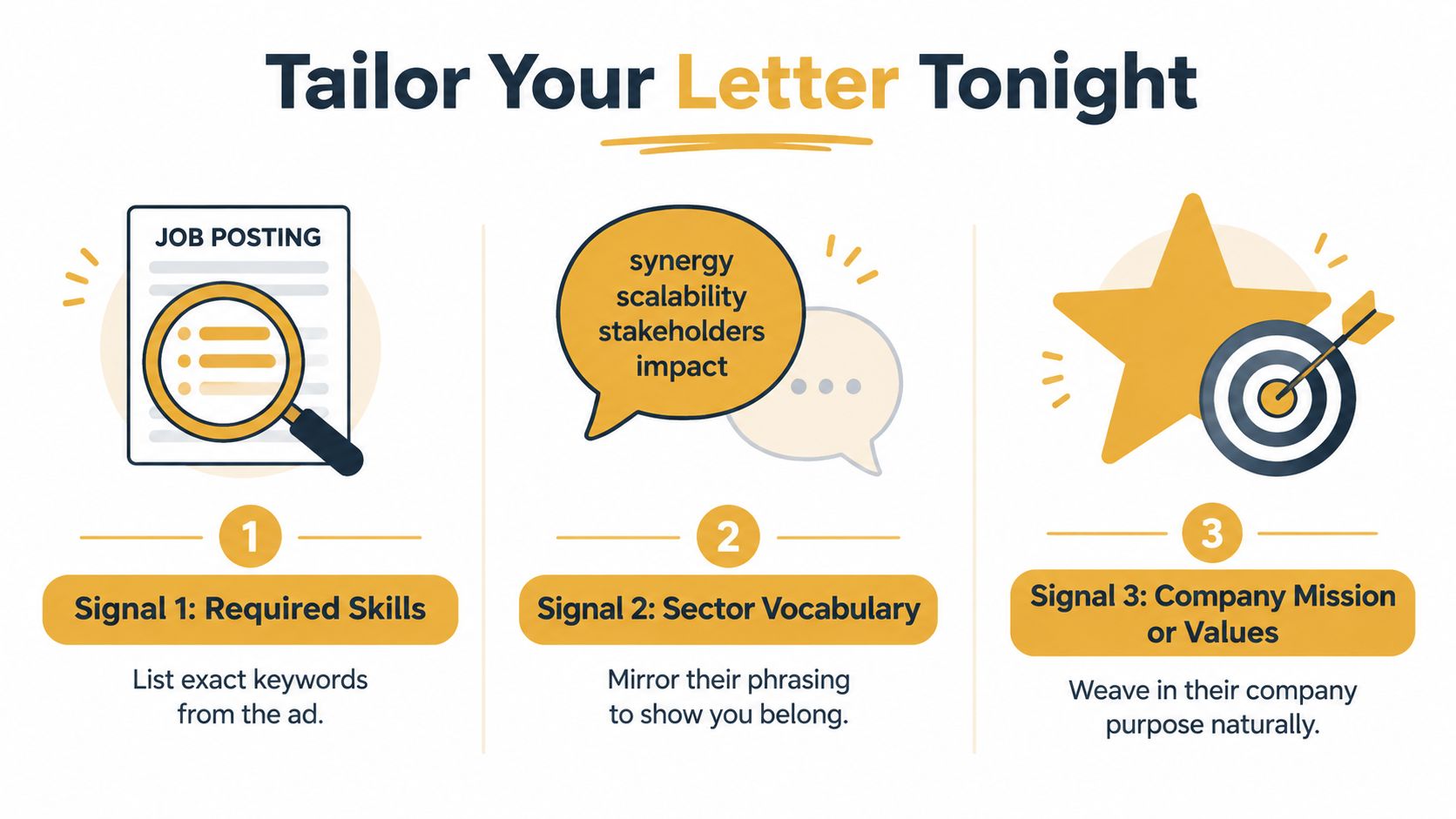
Start with three signals.
Find the signals in the annonce
Required skills are the first filter. Highlight terms such as gestion de projet, analyse de données, relation client, or maîtrise de la suite Office. Don't copy a skill you can't support. Choose the ones that connect to your experience.
Sector vocabulary tells you how the company describes its work. A technology company may use terms such as produit, déploiement, or expérience utilisateur, while a consulting firm may emphasize mission, client, and recommandation. Mirror relevant language naturally, without stuffing keywords into every sentence.
Company mission and values reveal the employer's priorities. Look for expressions such as autonomie, esprit d'analyse, and sens du relationnel, then identify an experience that demonstrates the quality through action.
Map each signal to the right paragraph
The Vous paragraph should reflect the company's stated mission or current need. Instead of « Votre entreprise est leader dans son domaine », write « Votre volonté de développer des solutions accessibles aux PME rejoint mon expérience auprès de clients en phase de transformation numérique. »
The Moi paragraph needs one strong proof point that matches a requirement. Replace « Je possède un excellent sens de l'organisation » with « Lors de mon dernier projet, j'ai coordonné les contributions de plusieurs interlocuteurs et livré les recommandations dans le délai prévu. » Add a number only when it is true, relevant, and available in your own records.
The Nous paragraph should name the team, project, or outcome you want to support. « Je souhaiterais contribuer à vos missions d'accompagnement des entreprises industrielles » is stronger than « Je pense être un bon élément pour votre entreprise. »
Use this quick editing test:
- Delete: sentences that could appear in any company's letter.
- Keep: evidence that directly answers a requirement.
- Replace: adjectives with actions and outcomes.
- Check: every paragraph has a clear relationship to the posting.
The letter should feel written for one reader and one role. A template can save time, but only after you've rewritten the Vous–Moi–Nous content.
Cultural Traps That Quietly Sink Applications
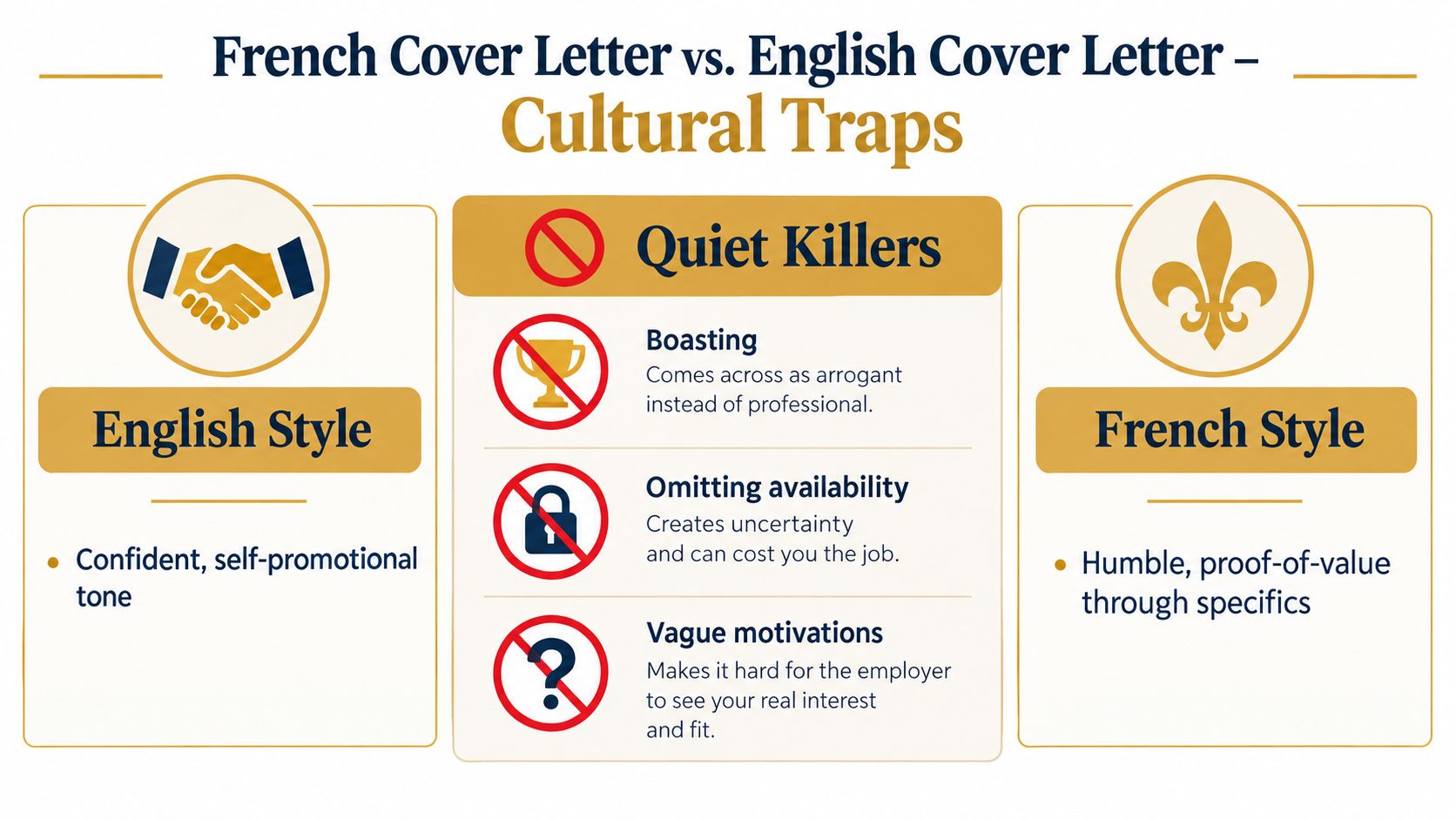
A French cover letter isn't an English cover letter with French vocabulary substituted into the same paragraphs. The document carries expectations about hierarchy, courtesy, precision, and restraint. Strong international candidates often lose credibility through small signals that have nothing to do with their technical ability.
Five rewrites that change the impression
1. Addressing the brand instead of the person
Current: « Votre mission est inspirante et votre marque me passionne. »
Better: « La mission décrite dans votre annonce, notamment l'accompagnement des clients internationaux, correspond à l'expérience que j'ai développée dans ce contexte. »
The recruiter is a human reader, not the company's advertising voice. Speak to the work and the person evaluating your application.
2. Using an English register
Current: « Dear Hiring Manager, »
Better: « Madame, Monsieur, »
Even when the recipient's gender isn't clear, use the formal French salutation. Don't import an English greeting because the company operates internationally.
3. Listing duties without proof
Current: « J'étais responsable du suivi des clients et de la préparation des rapports. »
Better: « J'ai assuré le suivi des clients et préparé les rapports nécessaires au pilotage des missions, en mettant l'accent sur les informations directement utiles à la prise de décision. »
The second version still describes responsibilities, but it explains their purpose. Add a verified result when you have one.
4. Ending like an American email
Current: « Sincerely, » or « Cordialement, »
Better: « Je vous prie d'agréer, Madame, Monsieur, l'expression de mes salutations distinguées. »
The long formula may feel excessive to English speakers, but it belongs to the formal mechanics of a French application.
5. Omitting the objet
Current: no subject line.
Better: « Objet : Candidature au poste de responsable marketing, référence [numéro] »
The French business culture guide explains why formality and context matter in professional communication. In an application, the objet helps the recruiter identify the exact role and posting immediately.
French recruiters often assess politeness mechanics, evidence, and structural discipline before they assess style.
Proofread, Send, and What to Do Next
Your final review should be mechanical, not emotional. Don't reread the letter only to decide whether it sounds enthusiastic. Check whether every formal requirement is present and whether any small error could make the document look copied or careless.
Run the final document check
Use this carry checklist before exporting the file:
- Title: Name the file with your full name and the role, such as
Nom_Prenom_Lettre_Motivation_Intitule.pdf. - Accent: Write lettre de motivation correctly, with é, not lettre de motivation written with a missing accent in a title or filename.
- Length: Keep the letter to one A4 page, following the format recommended by France Travail-oriented guidance.
- Typography: Use single spacing and a readable 12-point Times New Roman or Arial format, with margins between 2 and 2.5 cm.
- Contact block: Check your phone number, email address, city, and date.
- Names: Verify the recruiter's name, company name, department, and job title letter by letter.
- Objet: Include the exact role and posting reference when one appears in the announcement.
- Register: Confirm every direct address uses vous, votre, or vos.
- Signature: Leave the signature block at the bottom of the page.
Read the French aloud. Listen for past-tense slips, awkward word order, repeated phrases, and sentences that sound translated. Also search specifically for Madame, Monsieur, because an Americanized greeting can survive a general spell-check.
Send a clean application
Export the final document as a PDF only unless the employer requests another format. In the email subject, repeat the job title and reference. Keep the message brief:
« Madame, Monsieur,
Veuillez trouver ci-joints mon CV et ma lettre de motivation pour le poste de [intitulé], référence [numéro]. Je reste à votre disposition pour tout complément d'information.
Je vous prie d'agréer, Madame, Monsieur, mes salutations distinguées.
Nom Prénom »
Attach the CV and letter with clear filenames. Open the PDF after exporting it to confirm that accents, line breaks, and the signature display correctly. If you want another pair of eyes, Elite French Tutoring offers a free consultation with native-speaking tutors who can review your draft and discuss your professional French goals.
Before sending, ask yourself:
- Does the first paragraph prove that I read this specific posting?
- Does the middle show evidence instead of repeating my CV?
- Does the final paragraph connect my contribution to the team?
- Is the register consistently formal?
- Could a recruiter identify the role and reference immediately?
A precise letter won't replace relevant experience, but a structurally careless one can hide it. Finish the document with the same discipline you want the employer to associate with your work.
Book a free consultation with a native-speaking French tutor if you'd like focused feedback on your lettre de motivation, formal register, and interview language before you apply. You'll leave with a clearer draft and a practical plan for presenting your experience in French.