

Internships in France are paid only after the placement crosses more than two consecutive months, or 44 days at 7 hours a day, or 309 hours in the same academic year. Once that threshold is crossed, the 2026 minimum is €4.50 per hour, paid monthly as a gratification, not a salary.
That's the answer most families need before anyone signs a convention de stage. If your offer is shorter, the host can legally leave it unpaid. If it's longer, the money is no longer a courtesy, it's a statutory floor that the host organization must respect.
You're probably looking at an offer letter right now and trying to work out whether the host can call it “experience” and pay nothing. Don't guess. In France, the hours and the calendar decide the answer, and the paperwork has to match the legal test.
Table of Contents
- The Short Answer to Whether Internships Are Paid in France
- How the Two-Month Threshold Actually Works
- The 2026 Minimum Stipend Rate and How It Is Calculated
- A Real Student Story of Negotiating a Paid Offer
- Taxes, Social Charges, and the Convention de Stage
- How French Internship Pay Compares With Other Countries
- Practical Steps Before You Sign and How to Negotiate
The Short Answer to Whether Internships Are Paid in France
Yes, but only after the legal threshold is crossed. A French internship, or stage, is not automatically paid from day one. The host organization must pay a mandatory gratification once the placement lasts more than 2 consecutive months, or 44 days at 7 hours, or 309 hours in the same academic year under the French education rules and official guidance from Service-Public.fr. French internship payment rules
That detail matters because too many students hear a vague “internships are paid in France” and assume every offer comes with money. It doesn't. Short placements can be unpaid, but once the threshold is crossed, payment stops being optional. The convention de stage is where that obligation should appear in black and white.
Practical rule: if the placement will last beyond the threshold, I want the stipend clause in the agreement before anyone signs.
The 2026 minimum is €4.50 per hour, and official guidance says the gratification is paid monthly, not in one lump sum at the end of the internship. It is a legal floor, not a negotiated perk. 2026 internship stipend guidance
That's the key distinction. France is not a universal paid-internship market. It's a paid-after-threshold system. Short internships can be unpaid, longer internships trigger a mandatory monthly payment, and the contract paperwork has to reflect that reality.
How the Two-Month Threshold Actually Works
The legal test is broader than people think. You don't just ask, “Is it more than two months?” You ask whether the internship exceeds more than 2 consecutive months, 44 working days at 7 hours per day, or 309 hours in the same academic year. Crossing any one of those triggers mandatory gratification. Threshold test explained
The three ways the law counts time
| Trigger | Limit | What it counts | Outcome if exceeded |
|---|---|---|---|
| Consecutive time | More than 2 months | Calendar time with the same host organization | Gratification becomes mandatory |
| Day count | More than 44 days at 7 hours per day | Presence days converted into legal days | Gratification becomes mandatory |
| Hour count | 309 hours in the same academic year | Cumulative hours, including non-continuous placements | Gratification becomes mandatory |
Families often get tripped up at this point. A part-time internship can still cross the line if it runs long enough in hours. Two short placements with the same host can also become a problem if the total presence is high enough within the school year. The law is built on cumulative presence, not just on the label pasted on the calendar. Internal guide on summer internships in France
Consecutive months are counted as calendar time in the same host organization. That means you don't get to reset the clock by saying the intern only worked three days a week. If the convention covers enough calendar time, the gratification floor kicks in.
I tell students to track the hours from the first day, not the last. If the host organization miscalculates the threshold, the whole payment discussion becomes messier than it needed to be.
The clean rule is simple. Before you talk about amount, title, or bonus perks, confirm whether the placement crosses the threshold. If it does, the host owes the gratification. If it doesn't, payment can be absent without breaking the law.
The 2026 Minimum Stipend Rate and How It Is Calculated
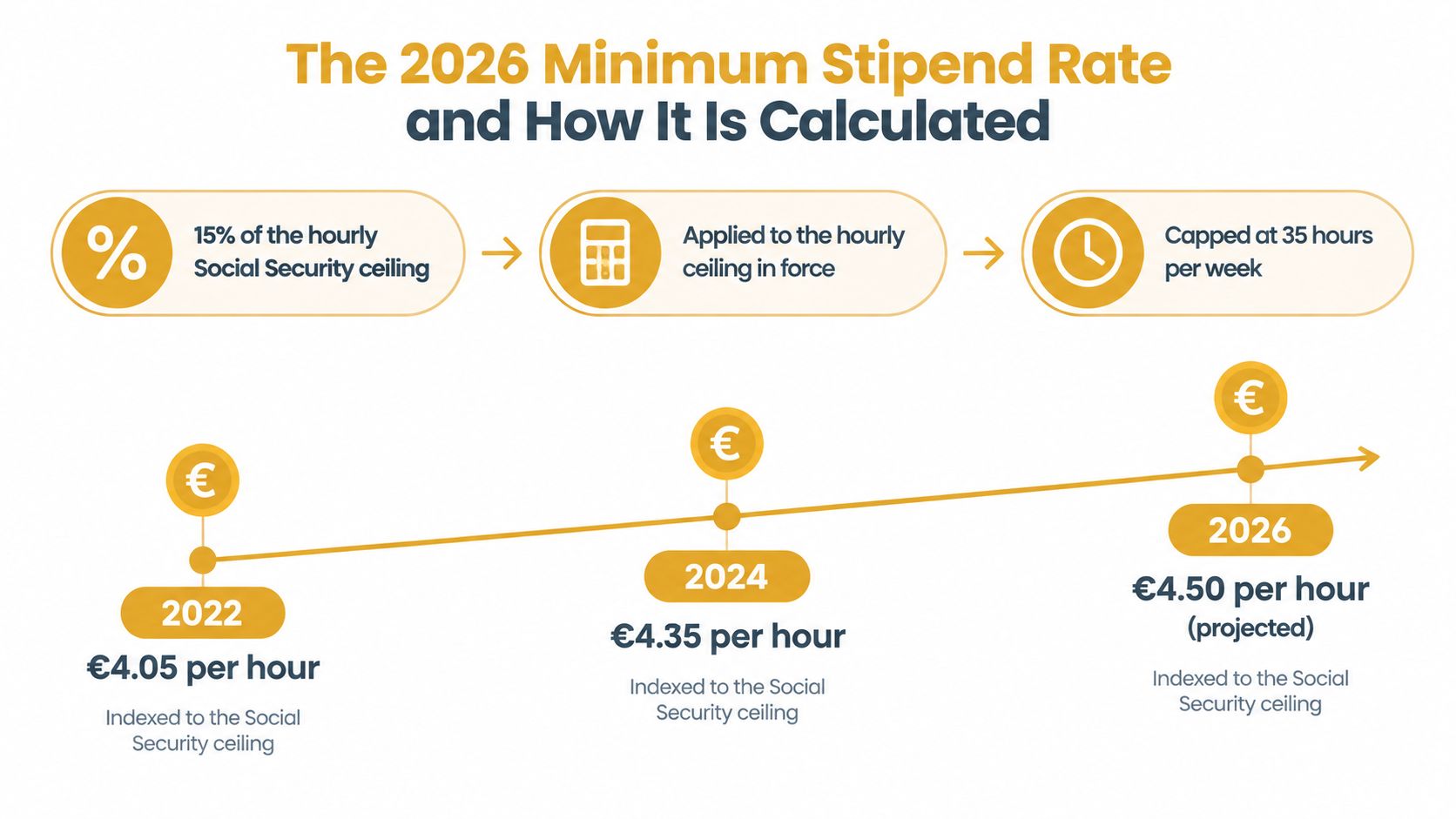
The formula is fixed. The minimum gratification equals 15% of the hourly Social Security ceiling, and the ceiling is what moves. Official guidance shows the floor rising from €4.05 per hour to €4.35 per hour in 2024, then to €4.50 per hour in 2026 as the ceiling increased again. Service-Public internship pay update
For the history behind that formula, the Social Security ceiling publications matter because the internship floor is always tied to that benchmark. For the 2026 update, the Ministry guidance confirms the same logic. Business France internship guidance
What that means in practice
A full-time internship capped at 35 hours per week works out to roughly €600 per month on a standard month-length basis, according to Business France's guidance. That number is a check on the offer, not a salary target. If the draft agreement is wildly below it, the host has not priced the internship correctly.
The structure matters more than the label. A gratification follows a national formula, not a market whim, so the amount changes whenever the Social Security ceiling changes. In 2026, the ceiling behind the floor produces €4.50 per hour at the minimum, and the rule is still the same 15% calculation applied to that ceiling.
Many sectors pay above the floor. Banking, consulting, and tech often do. That is a commercial choice, not a legal one. If the offer sits close to the minimum and the internship is full-time, ask whether the host sees the placement as serious work or as cheap staffing.
The gratification is also treated differently from ordinary pay on the social side. Up to the statutory minimum, it benefits from the social-charge exemption described in official guidance. That exemption is one reason the legal floor stays below employee wages.
A Real Student Story of Negotiating a Paid Offer
Camille, a 22-year-old master's student in Lyon, got the email every student likes and dreads at the same time. A Paris marketing agency offered her a 10-week internship, but the message said nothing about a stipend. She read it once, then read it again, because the duration alone already told her the answer was not negotiable.
Ten weeks is well beyond the French threshold. On a normal full-time schedule, that means the gratification is mandatory. Camille didn't argue about the firm's culture or wait for HR to “clarify later.” She asked for the convention de stage, pointed to Article L124-6 of the Code de l'éducation, and requested the payment clause before she moved forward.
What she noticed in the first draft
- No stipend clause: the offer described the role but skipped the payment line.
- No school signature: the agreement had not yet become a proper tripartite convention.
- Loose wording: the agency talked about “experience” instead of legal internship terms.
Camille then asked for €5.20 per hour, using sector norms as her reference point. The agency came back with €5.00 per hour, and she accepted because the revised offer finally acknowledged the legal obligation and the payment structure. The signed tripartite agreement followed, and the placement started on proper footing.
Students lose leverage when they wait until week one to ask basic legal questions. If the agreement is vague, the host is telling you to trust them instead of the paper.
The red flags are always the same. Vague wording. No school signature. Talk of cash “later.” A host that wants a student to start first and sort out the paperwork second is not being efficient, it's being careless. Camille handled it the right way, and that's the model I want parents and students to copy.
Taxes, Social Charges, and the Convention de Stage
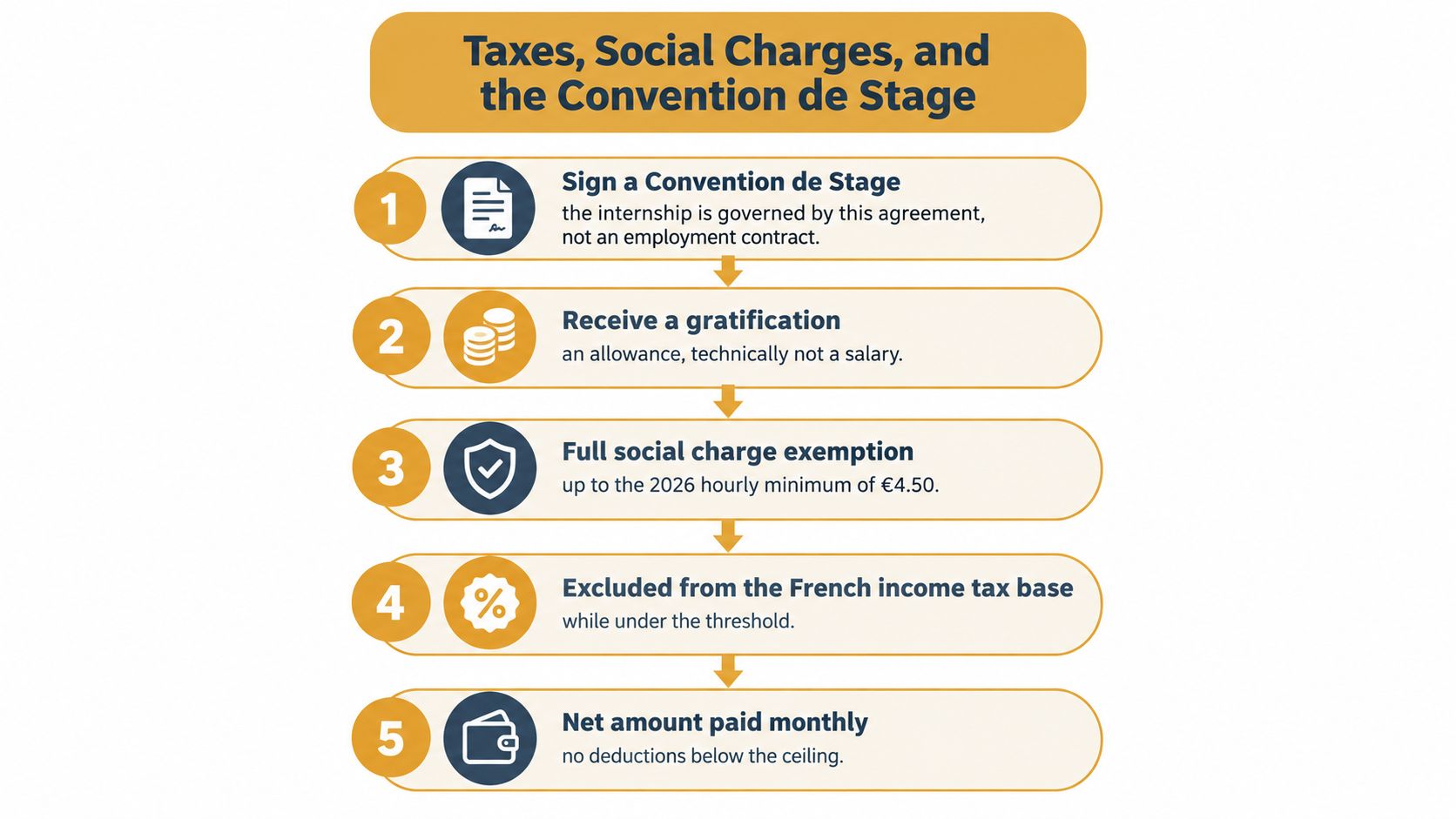
A French internship runs on a convention de stage, not an employment contract. The school, the host organization, and the student all sign it before day one. If that paper is missing, the placement is legally weak, and the student has far less protection than they assume. Study-abroad internship rules
The convention must set out the duration, weekly hours, the educational supervisor, the internship tutor, and the payment clause if the placement crosses the threshold. If the document is sloppy, the internship usually is too.
What the money is, and what it is not
The gratification is not a salary. That matters because the treatment is different. Up to the legal minimum, it is exempt from income tax, and the employer is covered by the exonération de cotisations sociales on the portion up to 15% of the hourly social-security ceiling. That is the clean rule in practice, not folklore. Business France internship guidance
For a host organization, the line is simple. Stay at the minimum, and the payment sits inside the exemption. Go above it, and the excess is treated like payroll for the part that exceeds the exempt threshold. That is the point employers must budget for. A host that pays more is not doing anything wrong, it just has to handle the extra charge correctly.
Interns should keep three documents: the attestation de stage, the gratification statement that looks like a payroll slip, and the administrative fiche the host or school provides. Those papers matter when you apply for another internship, explain your status to a landlord, or prove the placement was completed properly.
Use the contract, not assumptions. If the convention de stage is clean, the payment rhythm is monthly, and the legal minimum is respected, the arrangement is on solid ground.
How French Internship Pay Compares With Other Countries
France sits in an interesting middle ground. It is far more structured than places where unpaid internships are still the default, but it is not a high-wage internship market either. The French rule is the time threshold plus the statutory floor, and that combination is what makes it predictable for students and parents.
| Country | Monthly Pay (EUR eq.) | Mandatory After | Key Document |
|---|---|---|---|
| France | Around the legal floor at full-time minimum | More than 2 months, 44 days, or 309 hours | Convention de stage |
| United Kingdom | Often unpaid by default in many placements | Depends on role and legal worker status | Internship agreement or contract |
| Germany | Varies by sector and internship type | Depends on the type of internship | Contract or internship agreement |
| Spain | Varies by program and host | Depends on program rules | Training agreement |
| Italy | Varies by region | Depends on regional framework | Training agreement |
| Netherlands | Often around €350 to €500 per month in many internships | Depends on arrangement and sector rules | Internship agreement |
| Switzerland | Often CHF 400 to CHF 2,000 per month depending on field | Depends on canton and sector | Internship agreement |
| United States | Often unpaid in many cases | Depends on legal test and program structure | Internship offer or training form |
If you're comparing offers for an international student, France tends to feel more predictable than the UK or the US because the rule turns on the written threshold, not on vague employer preference. If you're coming from a co-op system, that precision is often a relief. Internships for American students in France
The big difference is not the headline amount. It's the legal architecture. France forces the host to answer a very specific question, “Does this placement cross the threshold?” That makes budgeting and planning cleaner for both sides.
For families, that matters more than the theoretical ideal of a “paid internship.” A placement can be modestly paid and still legally compliant. A short placement can be unpaid and still perfectly lawful. The French system is built around that distinction.
Practical Steps Before You Sign and How to Negotiate
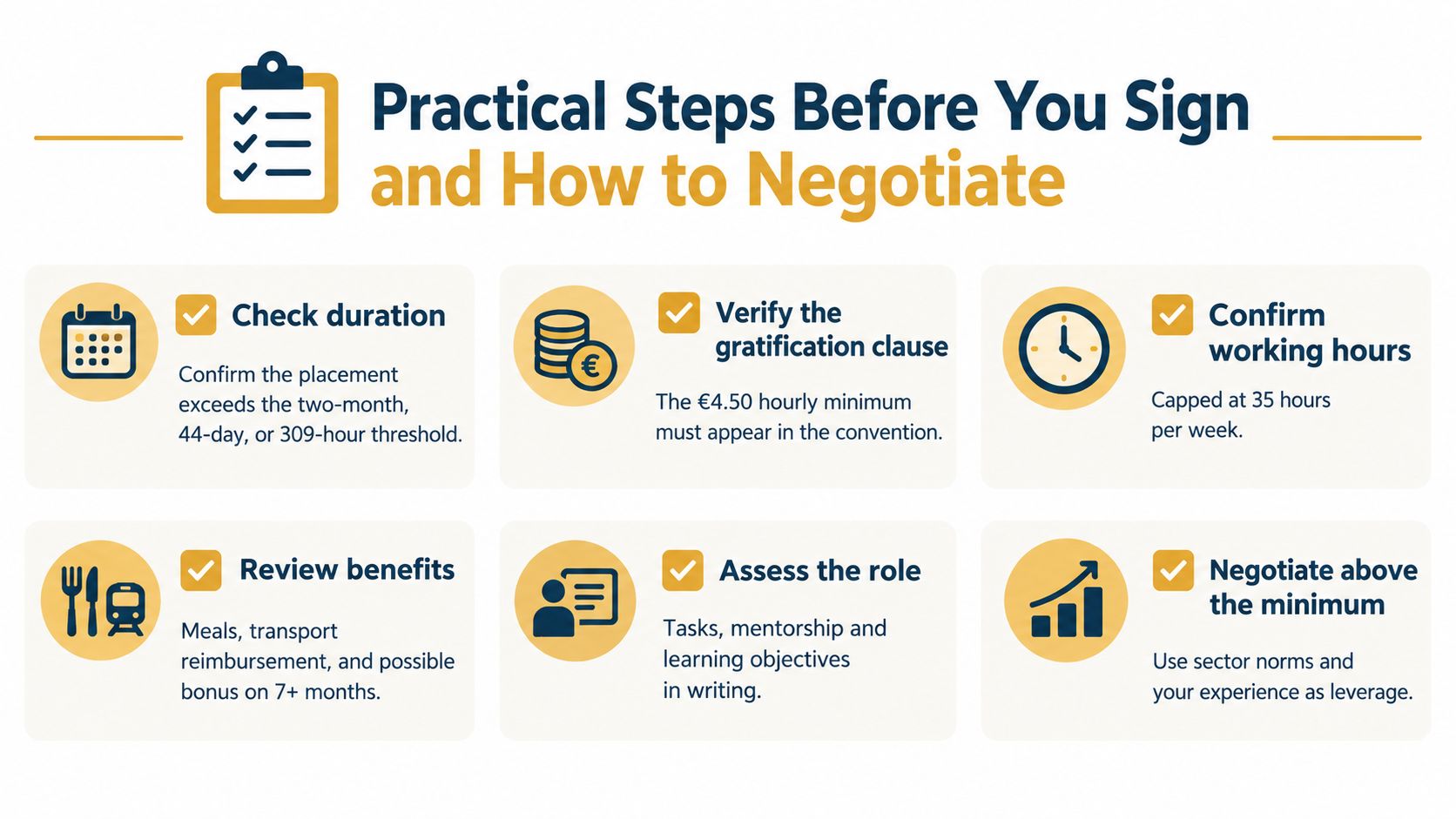
Before you sign, check the threshold first. If the placement exceeds two months, 44 days, or 309 hours, the gratification becomes mandatory. If the host is acting like that detail is optional, they either don't know the law or hope you don't.
What I tell students to verify
- Check duration: confirm whether the placement crosses the legal trigger.
- Verify the gratification clause: the convention should state the hourly minimum and the payment rhythm.
- Confirm working hours: the weekly schedule should stay capped at 35 hours unless the host has a different lawful framework.
- Review benefits: ask about meal vouchers, transport reimbursement, and any extra support.
- Assess the role: the tasks, mentorship, and learning goals should be written clearly.
- Negotiate above the minimum: if the sector pays more, ask for more.
If the internship is long enough to require payment, calculate the monthly amount before you sign. A full-time offer that falls below the statutory floor is a problem, not a bargain. If the host says benefits like transport or meals are “included,” ask for that in writing too.
You should also confirm the employer will issue the end-of-placement certificate required by Article L.124-9. That document matters more than many students realize. It closes the file cleanly and proves the internship happened under the proper framework.
One practical option is to have a French tutor or advisor review the convention before signature. Elite French Tutoring offers a free consultation and can be one place to sanity-check the French in the agreement before you commit. That's especially useful if the document mixes legal language with weak French and you don't want to miss a clause that changes the money.
If you're about to sign an internship agreement, don't let polite wording hide a bad deal. Review the threshold, verify the payment line, and get the convention checked before anyone sends the final version.