

You've probably already noticed the frustrating part of planning internships in France for American students. The hard part usually isn't finding a company you like. It's finding a placement that your school, the French host, and the visa system will all accept without turning your spring or summer into a paperwork pileup.
That's why I give students blunt advice early. Stop treating France like a casual internship market. Treat it like a regulated academic placement system. If you make that mental shift first, your decisions get easier, faster, and a lot less expensive.
France can be an excellent internship destination. It has an established internship culture built into higher education, with some two million French students serving as interns as part of their education according to Frontiers: The Interdisciplinary Journal of Study Abroad. That scale matters. You're not stepping into an improvised summer-job culture. You're entering a country where internships are standardized, school-linked, and document-heavy by design.
Table of Contents
- Why Your French Internship Is Really a Paperwork Project
- The Visa and Convention de Stage Framework
- Where American Students Actually Find These Placements
- Applications That French Employers Actually Open
- Pay, Housing, and the Real Budget Math
- A Real Student Story and What Made It Work
- Your Month-by-Month Plan and Next Step
Why Your French Internship Is Really a Paperwork Project
Most American students have the same moment of panic. They find a host in Paris, Lyon, or Toulouse, the conversation goes well, and then the company asks for the convention de stage. Not a resume tweak. Not a portfolio. The agreement.
That's the point where students realize the French internship system isn't built like a U.S. internship search. In France, the paperwork comes first because the placement is supposed to sit inside an educational framework, not float as an informal work arrangement.
The decision that changes everything
The first issue I want students to settle is duration. The 90-day split reshapes the entire plan. France's official guidance for student trainees says internships up to 90 days use a short-stay route, while anything longer requires a long-stay visa equivalent to a residence permit, with validation after arrival. The same guidance also notes that the internship agreement should be requested about two months before the start date. Read the official overview at France-Visas for student trainees.
If you miss that split, you waste time applying to placements that don't match your visa reality.
Why French hosts care more about compliance than charm
French employers usually won't treat you like a free-floating candidate who can just “start and sort it out later.” They want the placement tied to a course of study, documented properly, and signed by the right parties. That's normal in France.
Three situations usually force students to get organized early:
- Longer placements: Once the internship runs beyond the short-stay window, your visa path changes and the admin load jumps.
- Compensated placements: If the host plans to pay you, they'll usually want the compliance side locked down before they commit.
- Credit-linked placements: If your U.S. degree program requires credit, your academic approval becomes part of the deal, not an afterthought.
Practical rule: If a French employer asks whether you already have a convention de stage pathway through your U.S. university, that's not bureaucracy for its own sake. They're testing whether you're actually placeable.
What students waste time on
They spend weeks polishing cold emails before confirming whether their home university will sign a French internship agreement. That's backwards. I'd rather see a decent application with a confirmed academic signer than a perfect application with no legal structure behind it.
The smart order is simple. Confirm your school can support the internship. Decide whether your timing puts you under or over the visa threshold. Then approach hosts that fit that framework.
The Visa and Convention de Stage Framework
If you want internships in France for American students to go smoothly, you need to know which document corresponds to which opportunity. Most confusion comes from students mixing up tourist entry, student status, and internship authorization.
France's own public guidance makes the core rule clear. For American students, internships are generally governed by a formal training agreement and visa rules tied to duration. Non-EU students already enrolled at a French institution can generally intern under student status, while Americans coming specifically for an internship typically need a long-stay internship visa if the placement lasts more than 90 days. The internship also has to be tied to a training course, and in many cases labor-authority approval is part of the process before the visa is issued, as outlined by France's public service guidance on trainee visas.
The three documents that matter
The framework is easier once you strip it down.
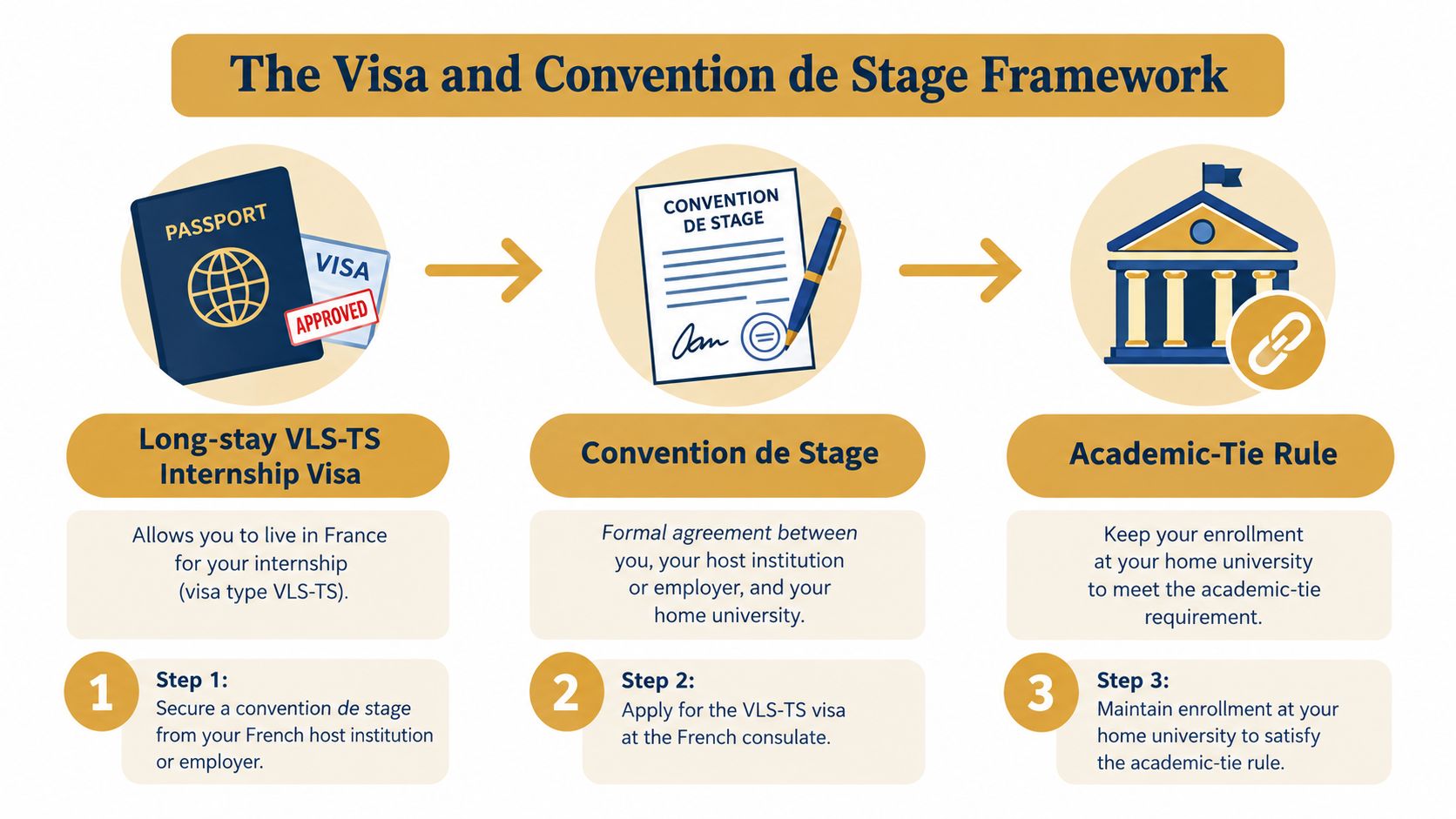
Your academic link
You need a real connection to a training course. In practice, that usually means you're enrolled at a U.S. college or university and the internship fits your degree path.The convention de stage
This is the tripartite agreement between you, your school, and the French host. Without it, many placements don't move.The correct visa path
Short stay and long stay are not interchangeable. If the internship length pushes you into the long-stay category, act like it early.
What the convention actually does
France requires a tripartite internship agreement, and the internship must be integrated into your academic program and occur during the validity of your visa or residence permit, as explained in this overview of student internships in France. That single rule knocks out a lot of informal arrangements students try to create on their own.
Your host wants this document because it defines the training purpose, the supervision structure, and the legal basis for having you there. Your school wants it because it ties the placement to academic oversight. You need it because it's the bridge between the host and your immigration path.
A good convention package usually includes more than signatures. Expect the host to ask for insurance details, a role description, and a named supervisor.
My recommendation on timing
I tell students to build backward from departure, not forward from excitement.
- First move: confirm your school will sign a convention de stage
- Second move: choose placements that match your duration
- Third move: book your consular process early if you'll need a long-stay route
If you want a broader comparison between internship status and other employment pathways, our guide to work visas in France helps clarify where internships sit in the larger system.
If a host company says, “We can take you once your university signs the convention,” that usually means the placement is viable. If they say, “Can you just come as a tourist and help out?” walk away.
Where American Students Actually Find These Placements
Students often ask me for the single best website for internships in France for American students. That's the wrong question. The better question is which search lane fits your major, your French level, and your paperwork tolerance.
Some channels are much more forgiving than others. Some are faster. Some are worth pursuing only if you already have strong French and a university ready to cooperate.
The four search lanes I actually recommend
Campus-led programs are the cleanest option for most undergraduates. If your university has a French partner school, a study-abroad office with internship placements, or a provider relationship, use that first. These programs usually understand the convention de stage and can often coordinate it for you.
Corporate channels make sense for students in business, engineering, luxury, marketing, and data-adjacent fields. Large French employers and structured portals can be excellent, but they often expect sharper French and less hand-holding.
Government and public-sector listings are attractive on paper because the roles are prestigious and usually well organized. They're also selective and slower.
Nonprofit, research, startup, and think tank routes tend to suit students who want shorter, highly targeted experience and are willing to do more outreach themselves.
For students comparing study pathways before they even start applying, our overview of study abroad in France options is a useful place to narrow the field.
Internship Search Channels for American Students in France
| Channel | Typical Lead Time | French Level | Pay Status | Convention Handling |
|---|---|---|---|---|
| Campus-led program | Earlier planning is better | Often flexible | Mixed | Usually the strongest support |
| Corporate channel | Longer lead time is common | Often higher | More likely to be compensated | Usually expects you to arrive with a workable convention path |
| Government or public-sector route | Long and competitive | Often strong French helps | Can be funded or structured | Usually formal, but slow |
| Nonprofit, research, or startup route | Can work for shorter timelines | Varies by role | Mixed, often modest | Depends heavily on the host |
My blunt take on each option
Campus programs aren't glamorous, but they save students from preventable mistakes. If your goal is to land and complete a legal internship, they're often the highest-probability route.
Corporate applications attract students because the brand names look great. Fair enough. But if your French is weak and your school is slow with documents, that route becomes a time sink fast.
Startup and nonprofit placements can be terrific if you're flexible on pay and title. They're often more open to American applicants, especially when the host values English-language work, but you still need the structure behind the placement.
Applications That French Employers Actually Open
French employers don't want your sprawling American campus resume. They want a clean file that looks local, reads quickly, and proves you understand the role you're applying for.
I see the same mistake every season. A student sends a two-page U.S. resume full of coursework bullets, club committees, and vague soft skills. A French recruiter scans it, doesn't see a coherent fit, and moves on.
The three documents you need to get right
| Document | Purpose | Length | Key Rule |
|---|---|---|---|
| CV | Shows your profile fast | One page | Keep it concise and structured |
| Cover letter | Proves fit for one employer | Short, tailored | Write for that company, not for everyone |
| Convention de stage | Confirms the placement can legally happen | As required by the institutions | It must align with your academic setup |
Your Formation section should foreground your degree, university, relevant academic focus, and any study-abroad or language context that supports the placement.
Your Expérience professionnelle section should be selective. Don't dump every campus role you've had. Choose experience that translates into the employer's world.
What makes an application feel French instead of imported
A strong application usually does three things well:
- It uses the right categories: French recruiters expect a familiar structure, not a U.S. career-center template pasted into another market.
- It names language levels clearly: Use the CEFR scale rather than “fluent,” “proficient,” or “conversational.”
- It mirrors the employer's vocabulary: Read the company's recent French-facing posts, site language, and job wording. Then echo the terms naturally.
If you need help shaping the written side, this guide to a French cover letter is worth reviewing before you send anything.
The rejection trigger I wish students would stop creating
Don't ask a French employer for a work permit when you're pursuing an internship. That tells them you don't understand the category you're applying under.
Send only after you can answer this in one sentence: “My university can support the internship through a convention de stage, and I'm applying under the correct internship framework for the placement length.”
My pre-send checklist
- One-page CV: no academic bloat
- Targeted letter: one company, one role, one clear reason
- Language labels: CEFR, not vague adjectives
- Convention path confirmed: before you start promising availability
- Short self-introduction practiced: a tight spoken summary matters in interviews
Pay, Housing, and the Real Budget Math
A lot of French internship plans collapse. Not because the student can't get accepted, but because the financial setup never made sense.
The key legal rule is simple. In France, internship compensation becomes mandatory only after the placement exceeds 2 consecutive months, treated as 44 working days at 7 hours per day or 308 hours of presence in the same academic year, according to the French government's internship compensation guidance. Below that threshold, a host can pay you, but it isn't legally required to.
The number students need to know
The statutory minimum internship compensation is set at 15% of the hourly Social Security ceiling, and the official government source states that the minimum is €4.50 per hour from 1 January 2026 after the hourly ceiling rises to €30, as listed by Service-Public on internship compensation.
Here's the visual most students need before they say yes to a placement.
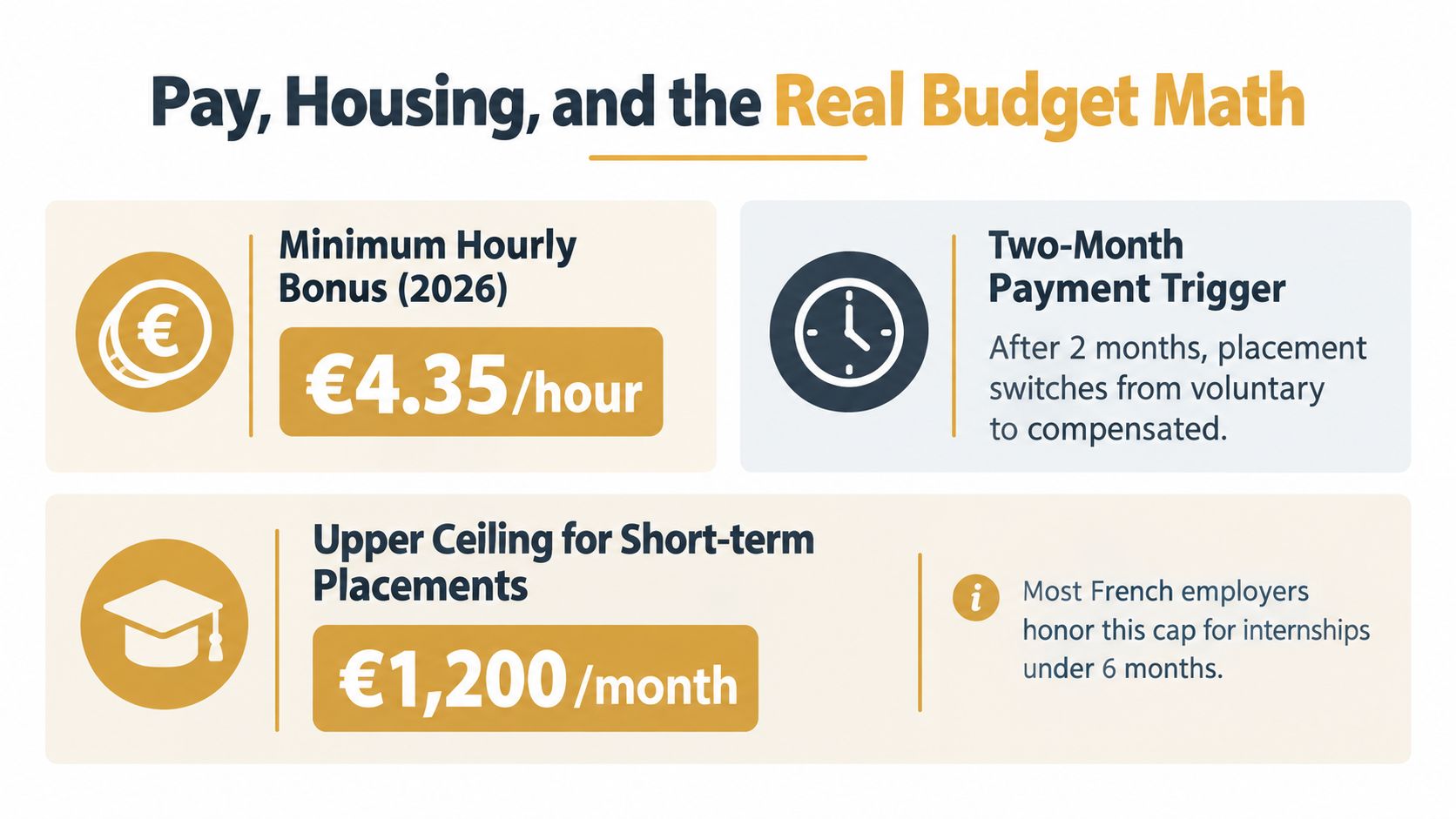
Now pair that with housing. French student guidance for 2026 notes that compensation is required only after more than 2 consecutive months, and the 2026 minimum bonus is €4.50 gross per hour, roughly €630 to €660 per month on a standard 35-hour week. The same guidance shows average student rent around EUR 850 to EUR 1,300 in Paris versus EUR 500 to EUR 800 in smaller cities. See the cost discussion from Sorbonne Université's international welcome desk.
What that means in plain English
If you take a minimally compensated internship in Paris, your housing may outrun your stipend by itself.
If you take a similar internship in a smaller city, the budget can become far more manageable. That's why I push students to compare city economics before they fall in love with a brand name or arrondissement.
The next resource is useful if you're weighing internship pathways against broader work opportunities in France.
A quick explainer helps here:
The budget decision I recommend
Use this simple filter before you accept any placement:
- If the internship is unpaid and in Paris: proceed only if you already have solid housing support or savings.
- If the internship is minimally paid and outside Paris: it may be viable, especially if your housing setup is smart.
- If the host is vague about compensation and paperwork: assume the planning will get worse, not better.
Students obsess over stipend amount and ignore rent. That's backward. Housing strategy decides feasibility more often than internship pay does.
A Real Student Story and What Made It Work
One of my students, Maya, was a junior at the University of Michigan when she decided she wanted a placement in Lyon. She wasn't chasing a glamorous Paris logo. She wanted work she could use for graduate study and a senior thesis.
She landed a spring placement at a mid-sized biotech consultancy in Lyon, working with a market research team. The outcome mattered. She co-authored a market scan that later became part of her senior thesis, and the company told her they'd welcome her back after a master's degree if she wanted to return in a more advanced role.
What she got right
Maya locked down her convention de stage path early. That was the biggest win. While other students were still asking whether France would “count” an internship, she had already confirmed who at her university could approve the placement.
She also started French tutoring the previous summer. That didn't make her perfect. It made her usable. She could handle interview questions, office small talk, and written follow-up without sounding lost.
The trade-offs she accepted
She chose Lyon over Paris because she wanted a city where the numbers felt less punishing. She also chose a four-month placement because it fit her academic and personal goals better than stretching the experience longer just to say she stayed longer.
“I wish I'd stopped assuming the company would explain the French system to me. They expected me to show up already understanding it.”
That's the lesson. The students who do well aren't always the most fluent or the most connected. They're the ones who sort out structure early, then use language prep to become credible in interviews and day-to-day work.
Your Month-by-Month Plan and Next Step
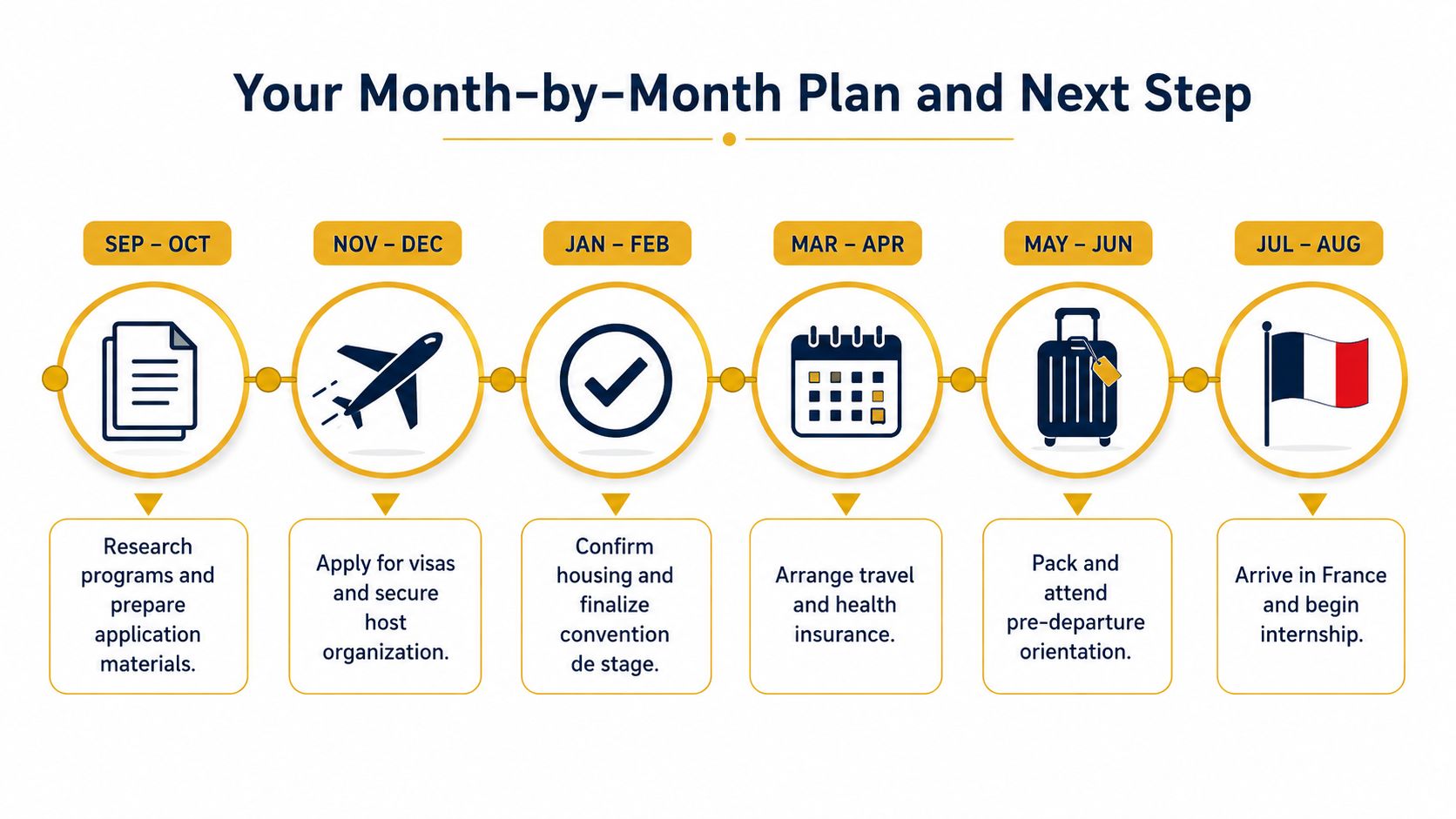
Students do best when they stop treating the internship as one giant project and start treating it as a calendar. Every month should produce something concrete. If a month passes and nothing got decided, the timeline is already slipping.
Here's the planning rhythm I'd use for most students targeting the following year.
Fall and early winter
September and October should be for advisor meetings, school approval questions, and program shortlists. If your university can't or won't support a convention de stage, you need to know that immediately.
November is decision month. Pick your lane. Campus-led program, direct placement, corporate applications, or a hybrid study-and-internship route.
December and January are for documents and French. Build the CV, tailor the cover letter format to the French market, and start serious speaking practice if interviews will happen in French.
Late winter and spring
February is when I want the first application batch out. It's also when students needing a consular process should be moving on appointments and document gathering.
March is interview month for many applicants. Practice a short introduction, role-specific vocabulary, and standard motivation questions until they sound natural.
April and May belong to housing strategy, stipend evaluation, and administrative cleanup. If your passport timing or school signatures are shaky, fix them then.
Summer before departure
June is when loose ends become problems. Chase final approvals, collect formal documents, and stop assuming anyone else is tracking your deadlines.
July should be calm. If it isn't, something started too late. Confirm insurance, re-read your role description, and make sure your arrival plan is realistic.
August is logistics. Arrival details, banking, local transport, and settling in.
My advice: rate your current French level honestly. Can you introduce yourself professionally, describe your coursework, explain why you want the placement, and ask for clarification in a meeting? If not, that gap is fixable, but only if you start early.
For students who want targeted speaking prep before interviews or before arriving at a French workplace, one option is Elite French Tutoring, which offers private online and in-person French lessons built around specific goals such as professional communication, study abroad preparation, and confidence in real conversations.
If you're comparing programs, deciding between Paris and a smaller city, or trying to figure out whether your French is strong enough for interviews, start with the option that reduces risk first. Then build upward. A legal, affordable, well-matched internship will help your career a lot more than a prestigious placement that falls apart in the paperwork stage.