You've got a French poetry book on your nightstand, a bookmarking tab open, and the same question I hear from students all the time: which one will help you read better French instead of just looking impressive on a shelf? The good news is that the best French poetry books can do both, but the right choice depends on your goal. Some editions are built for first contact with the canon, some are better for close reading, and some are ideal when you want to build vocabulary without getting lost in literary history. I've chosen the books below the way I would for a serious student, a busy adult learner, or a reader who wants a smarter purchase, not just a famous name. For context, French poetry is still a live market, with Livres Hebdo's 2025 ranking of the 50 best-selling poetry collections showing contemporary demand at the top, including François Cheng, Hélène Dorion, Rupi Kaur, and Christian Bobin (Livres Hebdo). Here's a quick comparison of our top picks:
Table of Contents
- 1. The Penguin Book of French Poetry, 1820–1950
- 2. The Yale Anthology of Twentieth-Century French Poetry
- 3. Charles Baudelaire, Flowers of Evil and Other Works
- 4. Arthur Rimbaud, A Season in Hell and Illuminations
- 5. Guillaume Apollinaire, Zone Selected Poems
- 6. Paul Valéry, The Idea of Perfection
- 7. Paul Éluard, Selected Poems
- Top 7 French Poetry Books Comparison
- Turn Reading into Fluency
1. The Penguin Book of French Poetry, 1820–1950
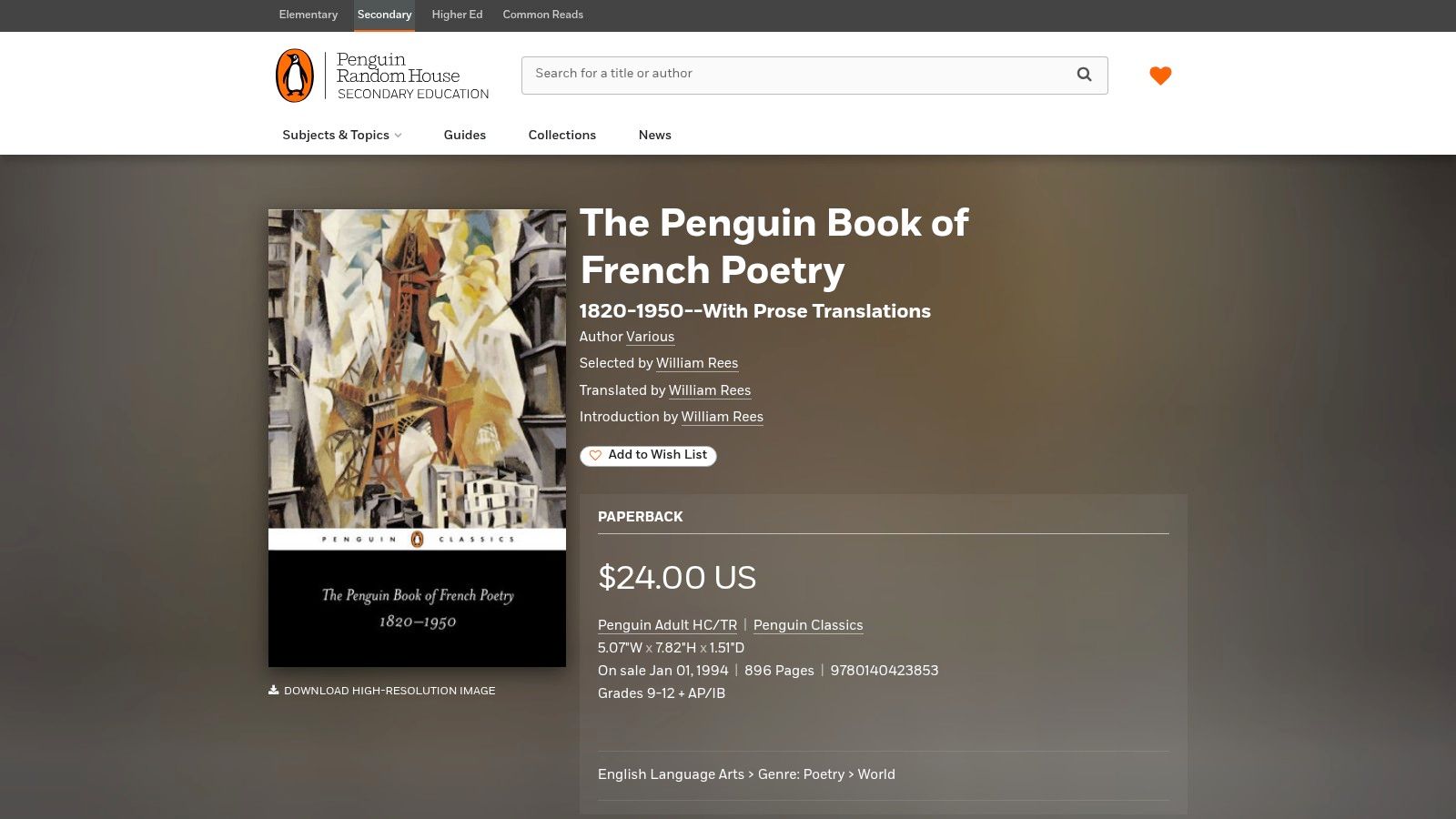
If you want one book that behaves like a map, this is the safest purchase. The Penguin Book of French Poetry, 1820–1950 gives you a broad route through Romanticism, Symbolism, Cubism, and Surrealism, with names students need to know, including Hugo, Baudelaire, Verlaine, Rimbaud, and Breton. I like it for learners who want breadth before they commit to a single poet, because it reduces the panic that comes from opening French verse and not knowing where you are.
The format matters here. Penguin's page describes a 896-page anthology with facing-page French and English prose translations, and it's also listed with Grades 9–12, AP/IB alignment, which tells you exactly where it sits pedagogically. The prose translations aren't as musical as verse translations, but they're easier to follow when you're building comprehension and trying to see sentence structure clearly. For a learner who wants a survey text rather than a collector's edition, that trade-off is usually worth it.
Practical rule: use this book for recognition, not perfection. Read the French first, mark what you understand, then check the English to confirm syntax and image.
A good way to use it is to read one poet at a time and keep a vocabulary notebook for recurring patterns, especially verbs, prepositions, and descriptive phrases. If you want a structured path through the book, our online French literature courses pair very well with an anthology like this, because you can turn a broad overview into guided reading instead of random browsing. That's the main advantage of a volume like this, it gives you a serious literary spine without forcing you into a narrow specialization too early.
2. The Yale Anthology of Twentieth-Century French Poetry
The Yale anthology is the book I reach for when a student is ready to stop asking, “What is French poetry?” and start asking, “How did modern French poetry change?” Its scope is broader than a standard classroom reader, and the emphasis on twentieth-century work makes it especially useful for learners who want to move beyond the canonical nineteenth-century sequence. The anthology's value is not just its size, but its editorial seriousness, with facing-page translations, contextual essays, and biographical notes that help readers track movements, voices, and influences.
What makes this one especially strong for study is its international and Francophone reach. The collection includes 100+ poets, and the editorial design gives more room to women poets and modern voices than older anthologies usually do. That matters if your goal is not just to memorize famous names, but to understand how French-language poetry expands across geography and identity. For advanced learners, that wider scope makes reading feel less like a museum visit and more like a living conversation.
Who should buy it
It works best for university students, independent advanced learners, and readers who want an anthology they can live with for years. Because the translations were commissioned for the book, the results feel consistent across the volume, which is a genuine advantage when you're comparing diction and tone from one poet to another.
The downside is physical and practical. It's a substantial academic book, so it's less portable than a slim selected poems edition, and Yale's site can be inconsistent about availability. Still, if you want one anthology that rewards repeated reading, this is a strong buy. For comparison shoppers, it's the kind of volume you keep returning to when a single poet suddenly becomes your focus.
3. Charles Baudelaire, Flowers of Evil and Other Works
Baudelaire is where many serious students begin to feel the difference between reading French and hearing it. The Dover dual-language edition of Flowers of Evil and Other Works is a smart choice if you want to work slowly and closely through a single iconic text instead of scanning an anthology. The parallel layout gives you the French on one side and the English on the other, which makes it ideal for line-by-line reading, vocabulary extraction, and rhythm awareness.
I like this volume for learners who need a book that can function as both literature and study tool. Dover's dual-language series is known for being affordable and practical, and that matters when you're likely to annotate heavily or revisit the same poem several times. The lack of elaborate scholarly apparatus can help here. You're not distracted by too much commentary, so you stay with the text itself.
For students working on pronunciation, this edition is especially useful when paired with guided oral reading. Our French pronunciation for English speakers work is a natural companion here, because Baudelaire's lines expose exactly where English speakers tend to flatten vowels, stress syllables, or rush through liaison. You do not need to master every poem at once. You need a repeatable method.
What works best with this book
- Vocabulary drilling: isolate recurring words, then reuse them in your own sentences.
- Scansion practice: read aloud and listen for syllable patterns.
- Close reading: compare French and English line by line without rushing.
- Exam prep: use it when you need one strong author rather than a broad survey.
If you want one classic poet that repays careful study, this is a very practical purchase.
4. Arthur Rimbaud, A Season in Hell and Illuminations
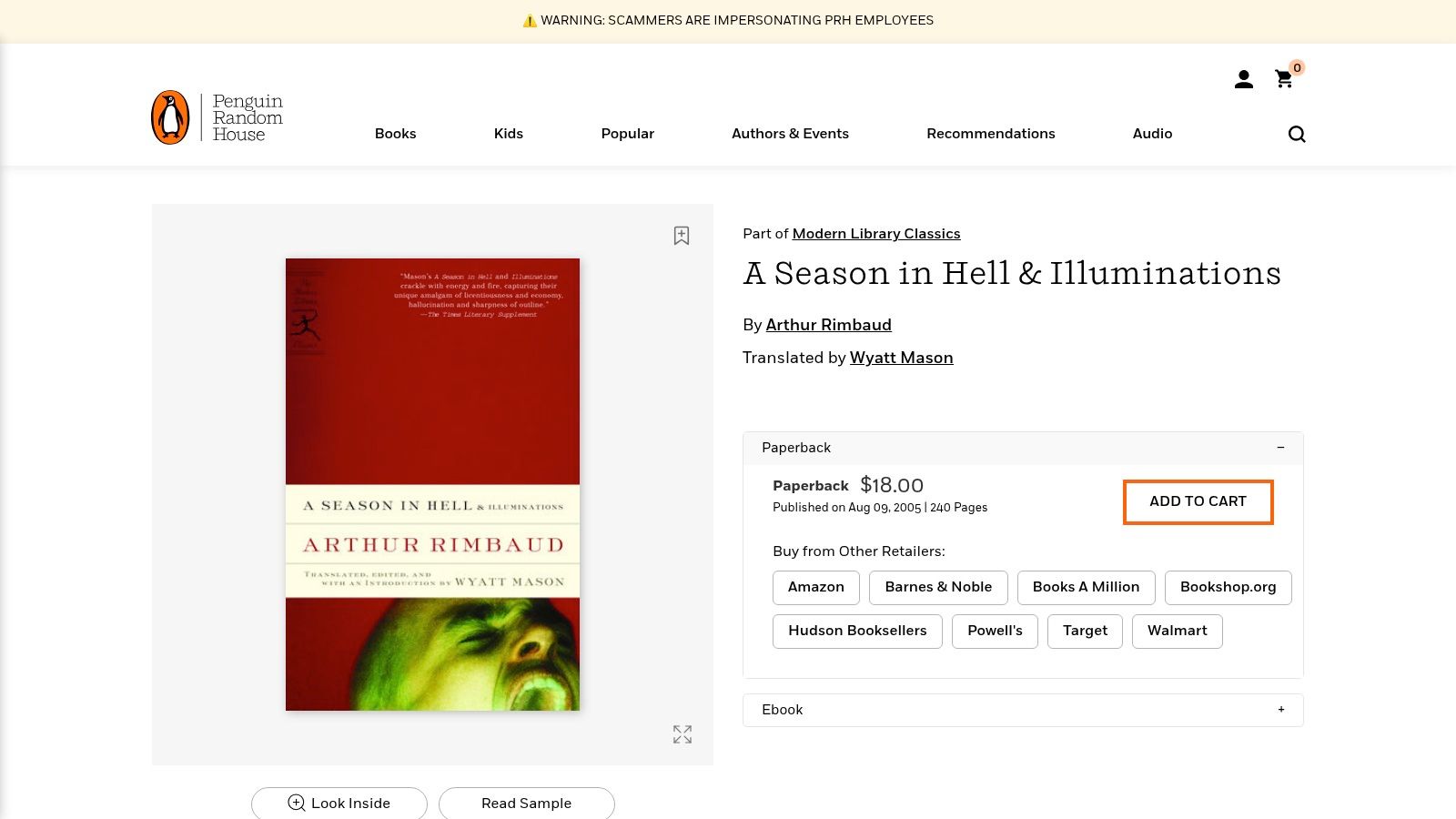
Rimbaud is the poet I recommend when a learner is ready for challenge and wants a book that feels electric rather than polite. The Modern Library edition of A Season in Hell and Illuminations gives you bilingual text, a substantial introduction, maps, and chronology, so the book works as both literature and context. That's especially useful if you're coming to Rimbaud from class discussions or from independent study and need the historical frame to make sense of the rebellion.
This is a strong fit for AP and IB students, but I'd also recommend it to self-directed adults who like understanding why a text mattered. The extras help you track the biography without turning the book into a textbook. For Rimbaud, that balance matters, because the poetry is vivid but often compressed, and readers can feel lost if they don't have some support around the page.
Why learners keep returning to it
The bilingual format encourages comparison without forcing you into a literal-only mindset. That makes it easier to notice how image, syntax, and sound work together. When I've used Rimbaud with students, the breakthrough usually comes when they stop trying to decode every line and start reading for movement, pressure, and emotional shift. His work rewards that approach.
Read Rimbaud for energy first, then for grammar. If you reverse the order, you can miss what makes the poem alive.
You'll also want to hear the language out loud. Our French podcasts for learning French can help keep your ear tuned between reading sessions, especially if you're using the book to strengthen comprehension over time. This edition is not the one I'd hand to a beginner, but for a serious learner, it's one of the best buys on the shelf.
5. Guillaume Apollinaire, Zone Selected Poems
Apollinaire is where French poetry starts to feel modern in a way that many learners immediately enjoy. Zone Selected Poems from NYRB Poets is compact, bilingual, and approachable, which makes it a particularly good bridge from classic verse into experimentation. The fresh translations by Ron Padgett help the poems feel readable without flattening their playfulness, and that's important when you're teaching yourself to handle poems that bend form and image.
I often use Apollinaire with intermediate and advanced learners because he gives you enough complexity to grow, but not so much opacity that you lose confidence. The book includes an introduction and notes, so you can place the poems in context, and the format is friendly for readers who want to carry the book around rather than keep it on a desk. It's also one of the cleaner introductions to calligrammes and the shifting visual energy that made Apollinaire so influential.
What this book does better than larger anthologies
It gives you one poet's voice without the overload of a huge survey. That makes it easier to notice recurring vocabulary, shifts in register, and the difference between literal understanding and poetic effect. The selection is curated, so you are not buying completeness. You're buying a manageable way into modernist French.
My best use for this book is as a bridge text. Read it after you've done some anthology work, or alongside a tutor who can help you unpack the syntax and references. That combination often produces fast progress because the poems feel accessible enough to read aloud, but layered enough to keep you thinking. If your goal is to move from “I can read French” to “I can discuss French literature,” this is a smart pickup.
6. Paul Valéry, The Idea of Perfection
Valéry is for readers who want precision. The Idea of Perfection presents a bilingual selection of poems and prose, which makes it especially useful for advanced students who care about the relationship between thought and form. If Baudelaire teaches you how to read a lyric voice, Valéry teaches you how carefully language can be engineered. I like this book for professionals, academics, and serious learners who want poetry that rewards slow, analytical reading.
The presence of prose is a feature, not a flaw, if your aim is to understand Valéry as a poet-philosopher. You get major lyrics like Le Cimetière marin, but you also get prose that helps explain his craft and intellectual habits. The translation aims to stay attentive to meter and tone, which matters a great deal in a writer whose effect depends on balance and control. This is not a casual beach read, and it shouldn't pretend to be one.
Best use case: read one poem twice, once for meaning and once for structure. Then compare how the prose passages clarify the poem's choices.
If you're studying for a high-level exam, or you're the kind of reader who likes discussing why a line lands the way it does, this volume belongs on your shelf. It's not a complete poems collection, so readers who want only verse may prefer a different format, but I still find it one of the most intellectually satisfying purchases in the category. For readers who want support outside the page, our how to improve French vocabulary page is a natural companion, because Valéry's density rewards deliberate word study.
7. Paul Éluard, Selected Poems
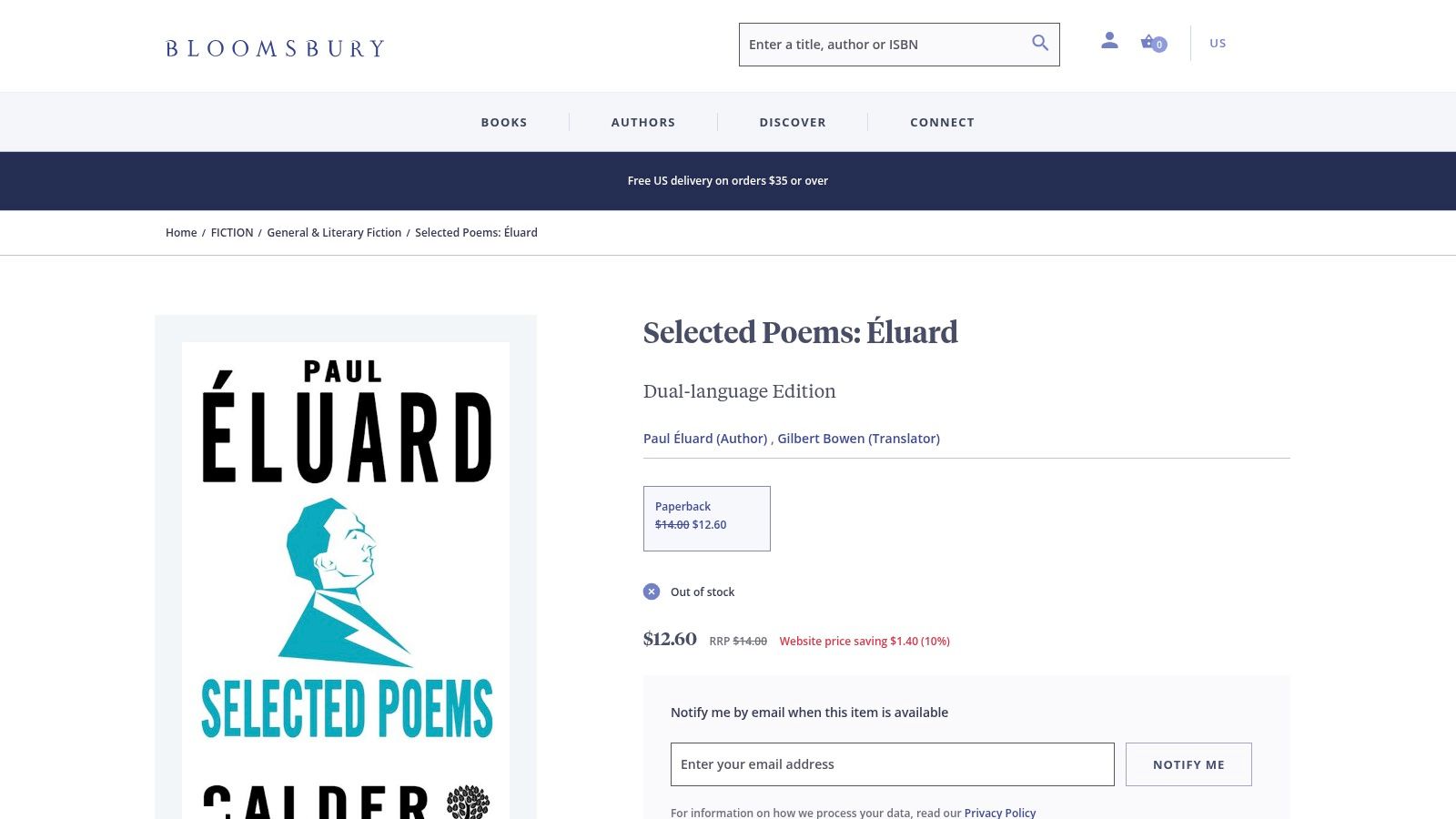
Éluard is one of the easiest poets on this list to recommend for high-intermediate learners because the language is often direct, but the emotional effect stays strong. The Calder Publications and Bloomsbury Selected Poems edition is bilingual, compact at 176 pages, and designed in a way that makes the poems feel usable in a classroom or a private study routine (Bloomsbury). If you want an accessible route into Surrealism, this is a very good place to start.
What I like most about Éluard for learners is that he lets you practice tone without drowning in difficulty. You can work on diction, image, and connotation while still feeling like you are reading a real poet, not an exercise sheet. The love poems and resistance themes also give teachers and tutors a lot to work with, because they open discussion without requiring exhaustive historical setup.
The practical downside is availability. Out-of-stock notices can appear, so you may need to check alternate retailers or place a back-order. Since this is a selected volume rather than a complete collected poems edition, it's best treated as an entry point. That said, entry points matter. A student who finds the right book often stays with poetry far longer than one who starts with something too dense.
For readers balancing study and schedule, this is one of the easiest books to fold into weekly reading habits. Read a poem aloud, underline what you understand, and use the French and English facing pages to confirm meaning. If you want a book that feels less intimidating but still meaningful, Éluard is a very practical buy.
Top 7 French Poetry Books Comparison
| Title | Implementation Complexity 🔄 | Resource Requirements ⚡ | Expected Outcomes ⭐ | Ideal Use Cases 💡 | Key Advantages 📊 |
|---|---|---|---|---|---|
| The Penguin Book of French Poetry, 1820–1950 | 🔄 Moderate, single‑volume anthology, easy course integration | ⚡ Low–Medium, large but cost‑effective per page | ⭐⭐⭐, broad canonical familiarity and survey skills | Curriculum foundations, introductory & AP/IB survey courses | Wide chronological scope; facing‑page translations; excellent value |
| The Yale Anthology of Twentieth‑Century French Poetry | 🔄 High, academic volume with essays and many contributors | ⚡ Medium–High, heavier, sometimes limited availability | ⭐⭐⭐⭐, deep insight into modern/contemporary voices | University courses, advanced learners researching modern poetry | International/Francophone scope; commissioned translations; essays |
| Charles Baudelaire – Flowers of Evil (Dover Dual‑Language) | 🔄 Low, single work, straightforward parallel layout | ⚡ Low, very affordable and consistently in stock | ⭐⭐⭐, strong for close reading, vocabulary, scansion practice | Classroom sets, exam prep, focused close readings | Parallel text ideal for language practice; budget‑friendly |
| Arthur Rimbaud – A Season in Hell & Illuminations (Modern Library) | 🔄 Moderate, bilingual with substantial study aids | ⚡ Medium, focused volume with editorial extras | ⭐⭐⭐⭐, improved contextual understanding and textual analysis | AP/IB students, serious independent learners | Substantial introduction, maps, chronology, critical notes |
| Guillaume Apollinaire – Zone: Selected Poems (NYRB Poets) | 🔄 Low–Moderate, compact selected poems, accessible format | ⚡ Low, compact and user‑friendly | ⭐⭐⭐, approachable entry to modernist experimentation | Intermediate learners, introducing calligrammes and modernism | Fresh translations; approachable selection; includes notes |
| Paul Valéry – The Idea of Perfection: A Bilingual Edition | 🔄 High, philosophically dense, demands close study | ⚡ Medium, aimed at advanced readers and scholars | ⭐⭐⭐⭐, deep analytical insight into craft and meter | Advanced students, academics, professionals studying poetics | Attentive translations to meter/tone; poetry + illuminating prose |
| Paul Éluard – Selected Poems (Calder/Bloomsbury) | 🔄 Low, selected bilingual volume, straightforward use | ⚡ Low, compact, affordable (occasional stock issues) | ⭐⭐⭐, good for tone/diction analysis and surrealist themes | High‑intermediate learners, classroom or private study | Accessible language and imagery; compact introduction to Surrealism |
Turn Reading into Fluency
Choosing one of these books is a strong first step, but the real progress comes from how you use it. I once worked with a student, an architect who loved modernism but felt intimidated by poetry. We started with the Apollinaire NYRB edition from this list, and we used the poems to connect his conversational French with literary analysis. He stopped translating every line in his head, started noticing rhythm and repeated structures, and within months he was discussing the verse with confidence.
That's what the right book can do when it matches the right method. A bilingual anthology can help you build comprehension. A dual-language classic can train your eye. A compact selected poems edition can keep you consistent. The goal isn't to “finish” French poetry. The goal is to use it as a living tool that strengthens your reading, speaking, and confidence at the same time.
If you're not sure which title fits your level, reading style, or study goal, I'd urge you to pair the book with guidance instead of guessing alone. Our team works with adult learners, exam candidates, professionals, and families who want French to feel useful in real life, not just theoretical. Schedule a free 20-minute consultation with us, and we'll help you choose the right path, whether that means a book-led reading plan, private lessons, or a mix of both.