Skip to content
You arrive in a Paris conference room with a strong proposal, solid French grammar, and a clear presentation. The senior director greets you, takes a seat, and waits. Nobody rushes to fill the silence. Your instinct says to launch into an informal brainstorming session, but the room expects a structured argument, a defined agenda, and visible respect for hierarchy.
That moment exposes the central challenge of a French business meeting. Polite greetings matter, but they won't compensate for poor preparation, the wrong level of formality, or a failure to understand how decisions are shaped before people enter the room. The executives who perform well don't memorize an etiquette checklist. They learn to read the company, identify the true decision-makers, and transfer their authority into French.
Table of Contents
- Why Generic Etiquette Fails in the Boardroom
- Securing the Room Before the Meeting Starts
- Adapting Your Register for Modern and Hybrid Teams
- Commanding the Conversation with Precise Phrasing
- Locking in Agreements with the Perfect Follow-Up
- Choosing the Right Coaching for Executive Fluency
Why Generic Etiquette Fails in the Boardroom
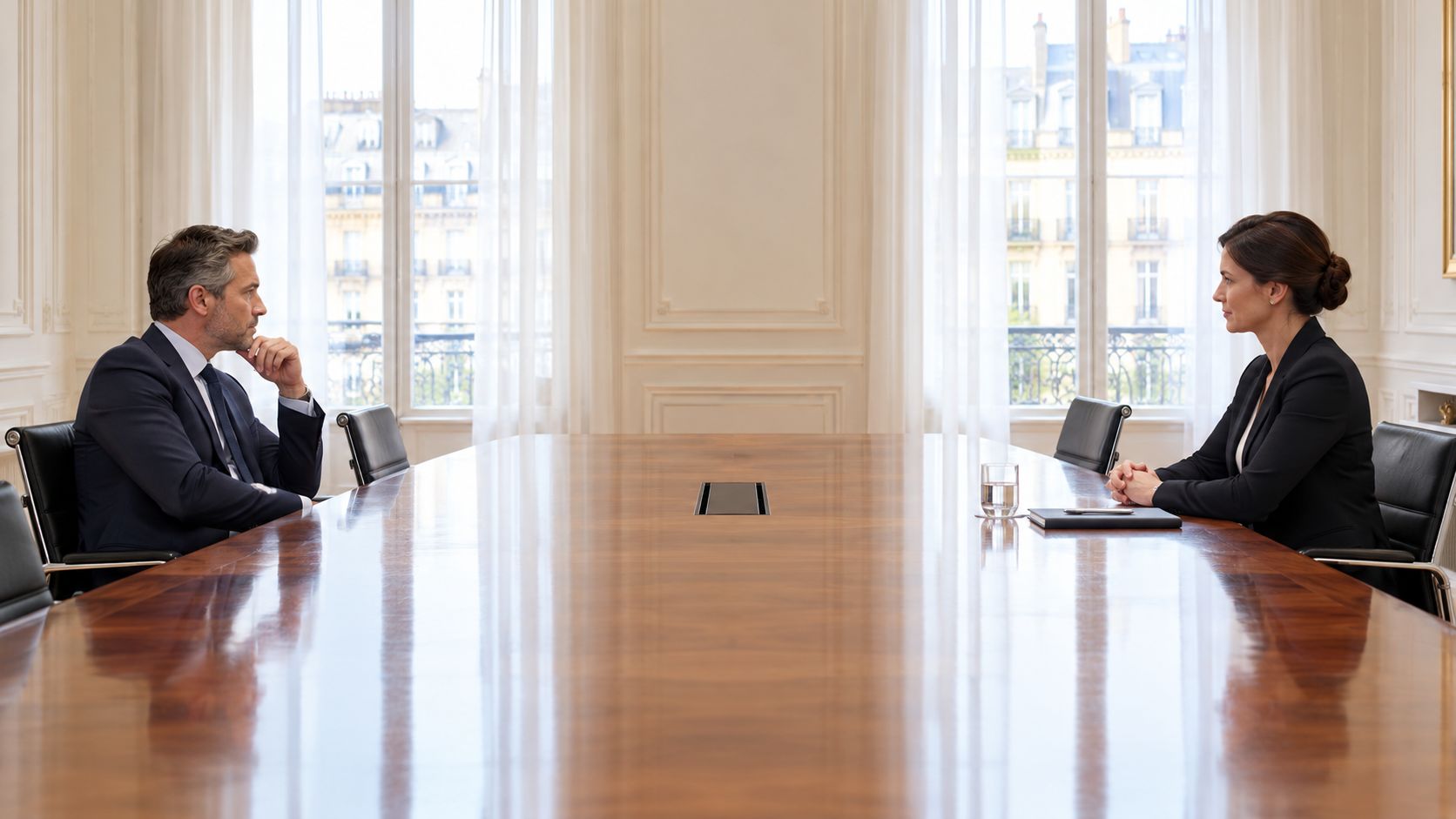
Your proposal is sound, your French is accurate, and the meeting begins with a polished greeting. Then the room goes quiet. In person, the senior director studies your documents. On the hybrid screen, two participants keep their cameras off. You invite open brainstorming, expecting energy and quick agreement, but the discussion becomes cautious and highly analytical.
That gap explains why a French business meeting can expose weaknesses that ordinary language practice misses. A handshake, a formal greeting, and the correct use of vous prevent avoidable errors. They do not, by themselves, help you win support for a complex proposal. French meetings commonly place weight on structure, hierarchy, preparation, and a controlled exchange. French business etiquette guidance also describes the importance of French-language communication, advance arrangements, rank, seating, and greetings.
The decision framework should change with the room. Before speaking, assess three variables: who holds formal authority, who influences the decision, and how much the format limits spontaneous interaction. A Paris startup may welcome a faster exchange. A regulated company may expect a carefully argued position. A cross-border video call may require more explicit turn-taking because silence and hesitation are harder to interpret online.
The boardroom rewards preparation, not performance
Intellectual disagreement does not necessarily mean the meeting is failing. French participants may test the logic of a recommendation, challenge assumptions, and examine details before they accept its implications. Treating every objection as resistance encourages defensive answers and weakens your position.
Arrive with:
- A defined objective: State whether you need validation, clarification, approval, or a decision on a specific point.
- A structured argument: Set out the background, recommendation, reasoning, and consequences of each option.
- A reading of hierarchy: Identify who chairs the meeting, who owns the decision, and whose view will shape the outcome.
- A controlled tone: Sound confident without appearing rushed, overly familiar, or aggressively sales-driven.
In a hybrid meeting, make the decision path visible. Name the issue, give participants time to assess it, and ask for a response from the relevant decision-maker rather than demanding instant consensus. That approach respects hierarchy while keeping remote participants involved.
Boardroom rule: In a formal French meeting, framing the decision often matters more than speaking continuously.
Language coaching should rehearse authority under pressure, not only pronunciation. Practise presenting to a senior stakeholder, interrupting without sounding abrupt, and disagreeing without damaging the relationship. French business culture coaching is most useful when it connects phrasing to authority, timing, and the expectations of a specific organization.
A client profile shows what preparation must do
Elite French Tutoring reports working with senior professionals since 2012. The provider's published client information supports a practical conclusion: executive French improves faster when practice reflects the vocabulary, pressure, and interpersonal stakes of the job.
The objective is not to follow one rigid French script. Start with respect, observe how the room makes decisions, and adjust deliberately. That discipline helps an executive remain credible across a boardroom, a startup discussion, and a cross-border video call.
Securing the Room Before the Meeting Starts
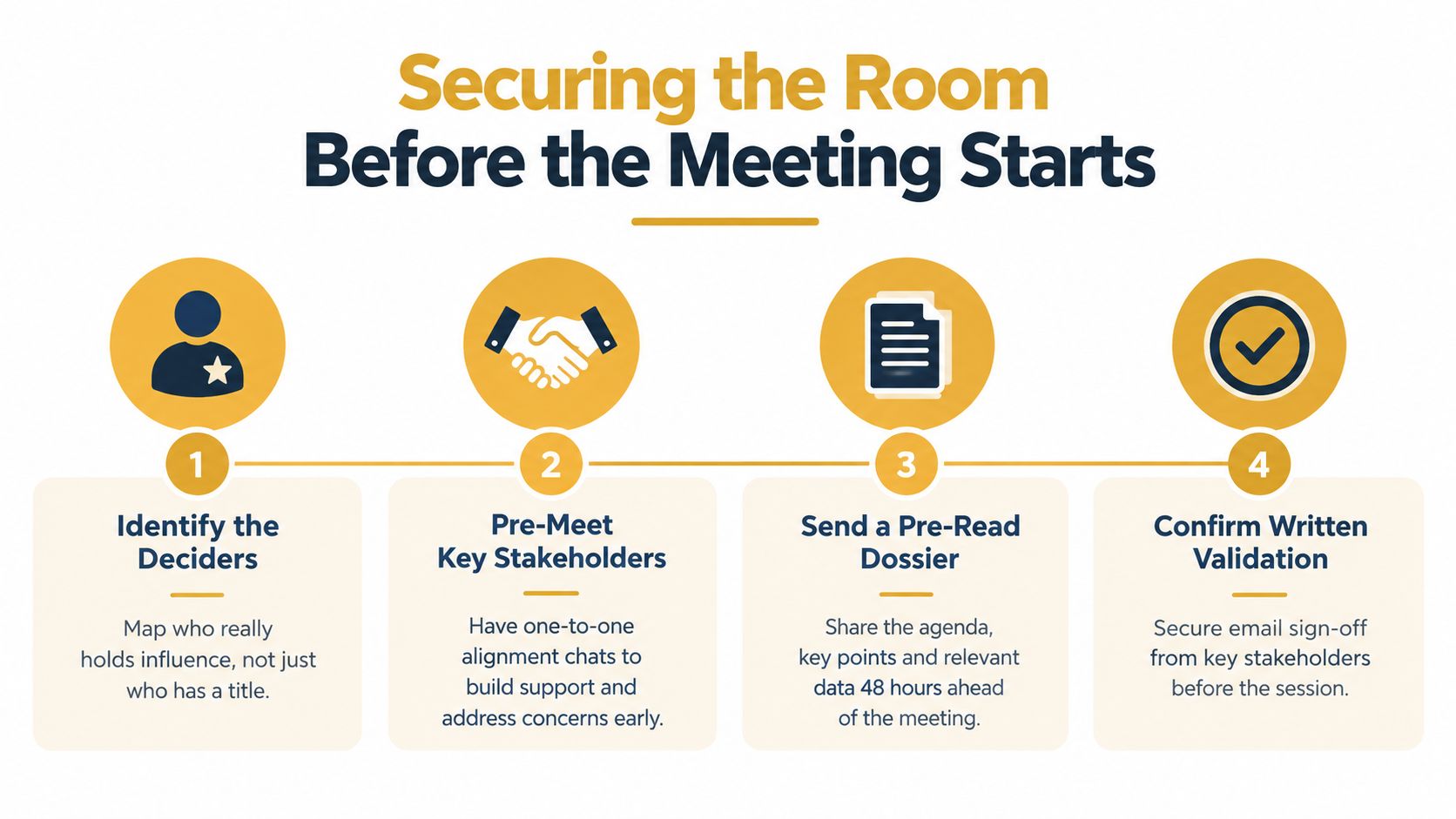
A proposal can lose support before anyone enters the conference room. In hierarchical French organizations, senior stakeholders may shape their position through private conversations, while the formal meeting tests, refines, or validates a view that has already received internal attention. French business culture guidance describes this pre-meeting influence and the value of preparing senior stakeholders before the discussion.
Find out who matters before you present. A polished argument delivered to an unprepared decision-maker can still meet resistance.
Build the schedule around French working norms
Arrange important meetings at least two weeks in advance and avoid the customary 12:00 to 14:00 lunch period, then confirm the appointment shortly before the meeting, as described in French business etiquette advice on punctuality. These choices signal respect for working patterns and give senior participants time to assess the issue.
Make the invitation purposeful. Include:
- The meeting objective.
- The names and roles of participants.
- A detailed agenda.
- The decision or response you need.
- Any documents participants should review beforehand.
“Let's discuss the partnership” leaves the recipient to guess what preparation means. A stronger invitation names the proposal, the commercial issue, the alternatives under consideration, and the outcome required from the senior stakeholder. It also gives participants a clear basis for discussing the matter privately before the meeting.
Use the 5'7 rule without turning it into a superstition
The informal 5'7 rule describes arriving no more than five minutes early and no more than seven minutes late. It is not a legal standard. It reflects a practical expectation: arriving extremely early can create an awkward wait, while obvious lateness may appear disrespectful. The same French business etiquette advice on punctuality also discusses advance agendas, confirmation, and face-to-face contact for important discussions.
Arrive ready to contribute. In person, allow time to organize your materials and rehearse the opening. Online, test the platform, verify your audio, and join close to the scheduled start rather than appearing casually far in advance.
Pre-brief the people who will influence the decision. Ask the senior stakeholder about concerns, internal constraints, and the recommendation they could support. This preparation is not manipulation. It prevents the formal meeting from becoming the first serious examination of your proposal.
A phone or video call requires the same discipline as an in-person discussion. French telephone etiquette guidance supports a formal opening, clear identification, and deliberate turn-taking. Remote access changes the channel, not the expectation that every participant arrives prepared.
Adapting Your Register for Modern and Hybrid Teams
The safest mistake in a French business meeting is usually starting too formally and adjusting later. The riskier mistake is assuming that a young company, an English-speaking team, or a video call has erased hierarchy altogether.
Company type, seniority, city, and team composition all affect the right register. Traditional companies may continue to use formal titles and business cards, while startup environments can become informal quickly. Business cards remain common in more traditional organizations, but they're less universal in technology and startup settings, as French workplace culture guidance explains.
Meeting Norms by Company Type
| Environment | Punctuality & Format | Language Register | Decision Making |
|---|---|---|---|
| Traditional corporation | Arrive prepared for a formal, agenda-led session | Start with vous, titles, and surnames | Senior leaders often shape or validate the outcome |
| Paris startup | Keep the meeting focused, but expect a more fluid rhythm | Begin professionally, then mirror the team's level of familiarity | Discussion may be more collaborative, though founders or executives can retain clear authority |
| Multinational office | Confirm the working language and meeting protocol in advance | Use clear professional French, or agreed English, without mixing registers carelessly | Responsibility may be distributed across countries and functions |
| Hybrid international team | Make turn-taking and decisions explicit on video | Use formal openings and concise language, especially with mixed seniority | Written confirmation becomes essential when participants interpret silence differently |
Decide when to use vous or tu
Default to vous when meeting someone for the first time, addressing a senior person, speaking across organizations, or working in a mixed-rank group. Switch to tu when the other person invites it or when the team clearly operates that way. Don't assume that age, startup culture, or first-name introductions automatically authorize the change.
A useful phrase is:
- Nous pouvons nous tutoyer si vous le souhaitez.
We can use tu if you'd like.
That wording gives the other person control and avoids forcing an artificial level of intimacy.
Make hybrid meetings more deliberate
Video meetings remove physical cues that normally help participants read status and turn-taking. Open by naming the objective, confirming the order of discussion, and explaining how people should intervene. If several participants speak English, decide whether key decisions will be summarized in French, English, or both.
French meeting phrase guidance highlights the value of direct openings, structured participation, and careful language. In practice, say who has the floor, pause after each major point, and invite questions rather than waiting for overlapping interruptions.
In a hybrid meeting, clarity is a form of courtesy. State who decides, what needs discussion, and what will be confirmed afterward.
The goal isn't to imitate a traditional French boardroom in every setting. It's to preserve respect, structure, and accountability while adapting your tone to the team in front of you.
Commanding the Conversation with Precise Phrasing
Confidence in a French business meeting doesn't require elaborate vocabulary. It requires reliable phrases that let you enter the discussion, organize your reasoning, and disagree without losing control of your tone. French professional communication tends to reward precision and a logical progression of ideas, so short structural expressions often carry more authority than improvised fluency.
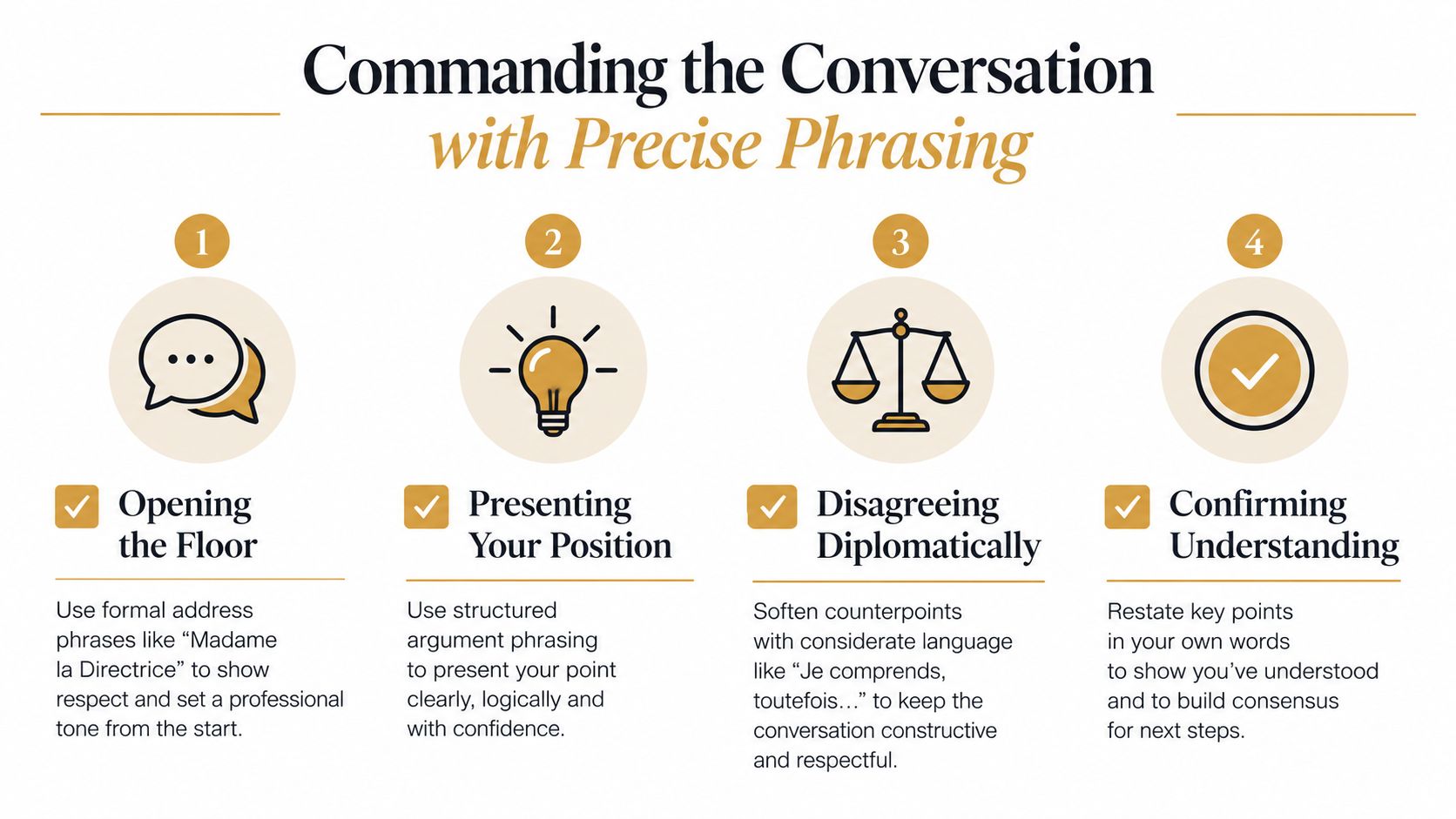
Open the floor with control
Begin by acknowledging the room and stating the purpose:
- Bonjour à tous. Merci d'être présents aujourd'hui.
Good morning everyone. Thank you for being here today. - L'objectif de cette réunion est de clarifier les prochaines étapes.
The objective of this meeting is to clarify the next steps. - Si vous le voulez bien, nous pouvons commencer.
If you agree, we can begin. - Le premier point à l'ordre du jour concerne…
The first agenda item concerns…
Address senior figures with care. Madame la Directrice or Monsieur le Directeur can be appropriate in a formal setting, while Madame or Monsieur followed by a surname maintains distance without sounding theatrical.
Enter, redirect, and challenge
Don't wait for a perfect pause if the discussion is moving away from your objective. Use a respectful marker before making your point:
- Excusez-moi de vous interrompre, mais j'aimerais préciser un élément.
Excuse me for interrupting, but I'd like to clarify a point. - Si vous permettez, j'aimerais ajouter quelque chose.
If you allow me, I'd like to add something. - Revenons à notre objectif principal.
Let's return to our main objective. - Afin d'avancer, concentrons-nous sur la solution suivante.
To move forward, let's focus on the following solution.
For disagreement, avoid a blunt Vous avez tort. It attacks the person before the argument has been examined. Use a phrase that recognizes the other position and then creates room for your counterpoint:
Je comprends votre point de vue, toutefois…
I understand your point of view, however…
Continue with a specific reason, not a vague objection. For example, Je comprends votre point de vue, toutefois cette option présente un risque opérationnel important gives the room something concrete to evaluate.
Close by converting discussion into action
A meeting can feel productive while leaving everyone with a different interpretation. Before the chair concludes, summarize:
- Si je résume, nous sommes d'accord sur les points suivants…
If I may summarize, we agree on the following points. - Nous avons convenu que…
We agreed that… - Chacun sera responsable de…
Each person will be responsible for… - Je vous remercie pour votre temps et vos contributions.
Thank you for your time and contributions.
These phrases don't make you sound stiff. They make your contribution easy to follow, which is especially valuable when several languages and levels of seniority are present.
Locking in Agreements with the Perfect Follow-Up
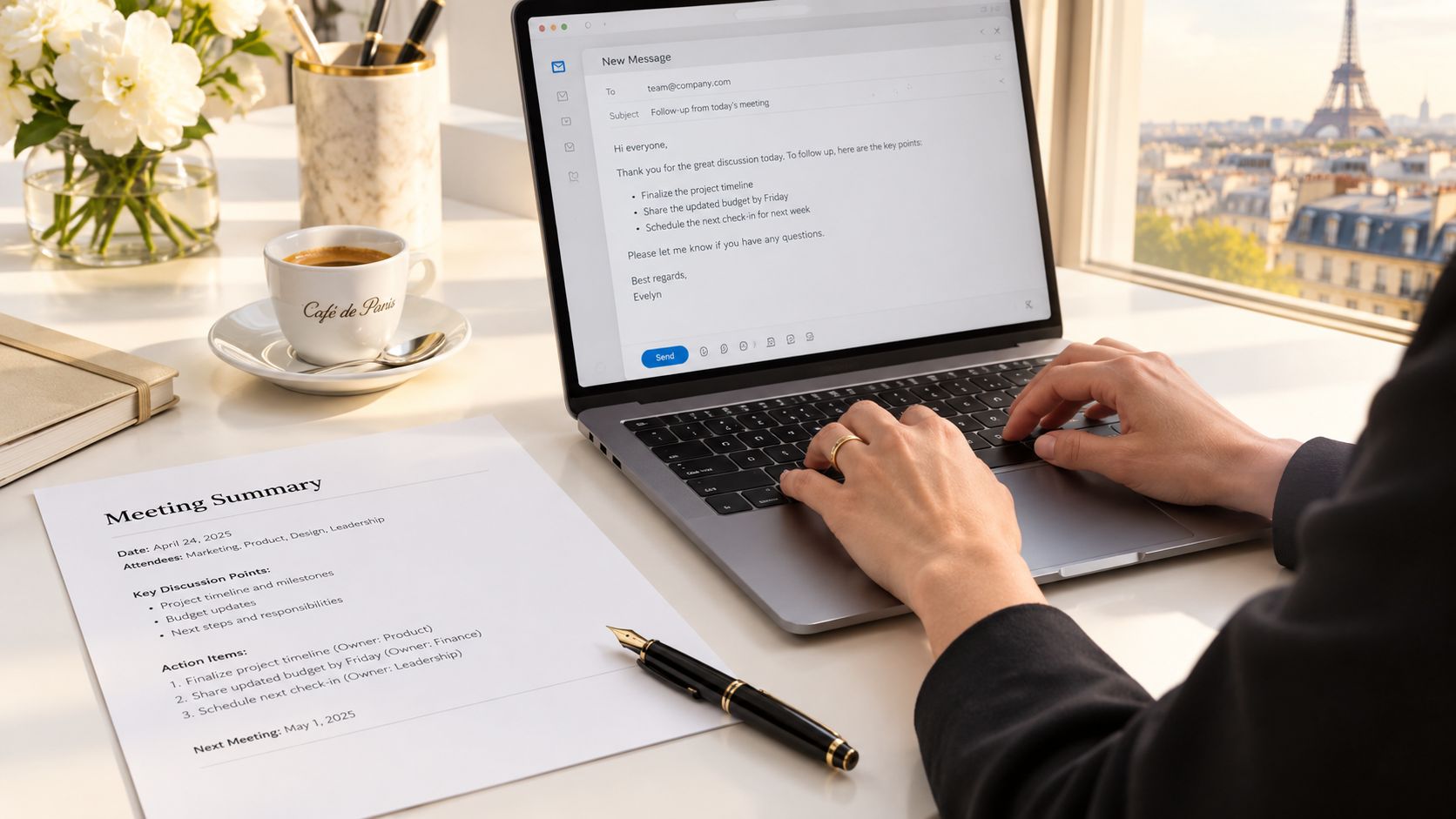
Leaving the room without a written summary creates avoidable ambiguity. In a hierarchical organization, a verbal indication of support may still depend on internal review, a senior approval, or a later clarification of scope. Your follow-up email should therefore distinguish between confirmed decisions, open questions, owners, and next actions.
A concise written record protects the relationship because it prevents both sides from relying on memory. It also gives senior stakeholders a document they can forward internally without reconstructing the entire conversation.
Structure the message around decisions
Use a subject line that identifies the meeting and its purpose. Open with appreciation, then move quickly to the record:
Bonjour Madame Dupont,
Je vous remercie pour notre échange de ce matin. Comme convenu, je résume ci-dessous les décisions et prochaines étapes.
Organize the body into clear sections:
- Points agreed: State only what participants confirmed.
- Outstanding questions: Identify issues that still require analysis or approval.
- Responsibilities: Name the person or team accountable for each action.
- Timing: Record the agreed timing without implying a commitment that wasn't made.
- Next contact: Specify who will follow up and what the next interaction will address.
Don't write “everyone agreed to proceed” if the room only agreed to review a revised proposal. Precision builds trust. It also gives your counterpart a simple way to correct the record without feeling publicly challenged.
Keep the French formal but human
Use vous unless the relationship has clearly changed. Avoid translated English formulas that sound too intimate or too abrupt. A professional close might be:
Je reste à votre disposition pour toute précision complémentaire.
Je vous prie d'agréer, Madame, l'expression de mes salutations distinguées.
For a warmer established relationship, you can use:
Bien cordialement,
Je vous remercie encore pour cet échange.
The right choice depends on the relationship and company culture. French business writing support can help you rehearse messages for negotiation, internal reporting, and executive correspondence rather than relying on literal translation.
Ask for written correction
End with a low-friction invitation:
Je vous remercie de me signaler toute correction ou précision nécessaire.
That sentence does two jobs. It shows respect for the other party's authority over the record, and it creates a clear opportunity to resolve disagreement before the next meeting.
Choosing the Right Coaching for Executive Fluency
A language app can help you recognize vocabulary. It won't recreate the pressure of a senior stakeholder pausing after your proposal, a colleague interrupting in fast French, or a negotiation shifting from formal vous to a more familiar register. Executive fluency develops when you practice the situations in which your authority is tested.
The strongest option for a high-stakes French business meeting is usually scenario-based coaching. You bring the agenda, presentation, email, negotiation, or difficult conversation. A coach challenges your assumptions, corrects your phrasing, and helps you sound like yourself in French rather than like someone reciting a textbook.
Compare coaching options by the outcome you need
Self-study works well for building a base of vocabulary and reviewing expressions between sessions. Group classes can provide discussion practice and exposure to different accents. Private coaching becomes more relevant when you need confidential rehearsal, industry-specific terminology, or feedback on executive presence.
Evaluate a program against practical criteria:
- Scenario alignment: Can you rehearse your actual board presentation, client negotiation, or internal review?
- Register control: Will the instructor explain when to use vous, tu, titles, direct disagreement, or softer phrasing?
- Industry vocabulary: Can lessons reflect finance, law, technology, diplomacy, healthcare, or your own field?
- Remote flexibility: Can you maintain a consistent schedule across time zones?
- Feedback quality: Will the coach address pacing, interruptions, structure, and tone, not just grammar?
- Written communication: Does practice include agendas, follow-up emails, and decision summaries?
Choose measurable preparation over vague confidence
A useful coaching plan should produce observable capabilities. You might aim to open a meeting without notes, summarize a decision accurately, handle a challenge from a senior colleague, or redirect a discussion that has drifted. Those objectives are more useful than a general promise to “speak better French.”
Elite French Tutoring offers customized private lessons online and in person, including corporate and professional communication, with programs shaped around a learner's objectives, current level, and learning style. Its published information states that it has helped thousands of clients since 2012, including CEOs, Manhattan's District Attorney, UN mission staff, and Ivy League professors, and that every engagement begins with a free 20-minute consultation. French for business programs are one option to compare with other specialist coaching services.
Selection test: Ask a prospective coach to explain how they would prepare you for one real meeting. If the answer stays at vocabulary and grammar, the program may not address the decision-making pressure in the room.
Before your next French business meeting, choose one live scenario and book a consultation with a coach who can role-play it with you. Bring the actual agenda, your speaking notes, and a recent follow-up email, then compare the program's feedback, scheduling, and industry fit before committing to lessons.