You're stuck between French pride and French panic. You can read short articles, but the moment a novel asks for irony, moral nuance, or historical context, your confidence drops. That's exactly where the right French classic novels become useful, not as museum pieces, but as training tools that build the kind of language you need for exams, meetings, and serious conversation. I've seen learners use them to move from “I can follow French” to “I can discuss French well,” which is a very different skill.
The trap is choosing books only by fame. A better strategy is to choose by reading payoff, difficulty, and conversation value. Some classics give you dense vocabulary for professional French, some sharpen your speaking with philosophical debate, and some are the best way to build reading confidence without getting overwhelmed.
If you're aiming for fluent, practical French, the right novel can do more than entertain. It can give you phrases for negotiation, vocabulary for moral argument, and the cultural references that make French conversations feel natural instead of rehearsed. That's why we use classics in tutoring, not as decoration, but as a structured route toward stronger reading, listening, and speaking.
Table of Contents
- 1. Les Misérables by Victor Hugo, Penguin Classics Edition, The Unabridged Gateway to French Literature
- 2. Madame Bovary by Gustave Flaubert, Dover Classics Edition, Psychological Depth for Advanced Learners
- 3. The Stranger by Albert Camus, Penguin Classics Edition, Existential Clarity for Intermediate Readers
- 4. Notre-Dame de Paris by Victor Hugo, Penguin Classics Edition, Architectural Beauty Meets Dramatic French
- 5. The Red and the Black by Stendhal, Penguin Classics Edition, Ambitious Social Climbing and Psychological Manipulation
- 6. The Charterhouse of Parma by Stendhal, Dover Classics, Italian Renaissance Setting, French Psychological Depth
- 7. The Three Musketeers by Alexandre Dumas, Dover Thrift Edition, Accessible Adventure for Beginners Wanting Classic Status
- 8. Guide, Using French Literary Classics to Accelerate Professional Fluency
- 9. Edition Comparison Summary for Recommended Classics
- 10. Reading Plan for Busy Professionals, Timelines and Session Structures
- French Classics: 10-Item Comparison of Novels, Editions & Guides
- Turn Your Reading Into Fluent Conversation
1. Les Misérables by Victor Hugo, Penguin Classics Edition, The Unabridged Gateway to French Literature
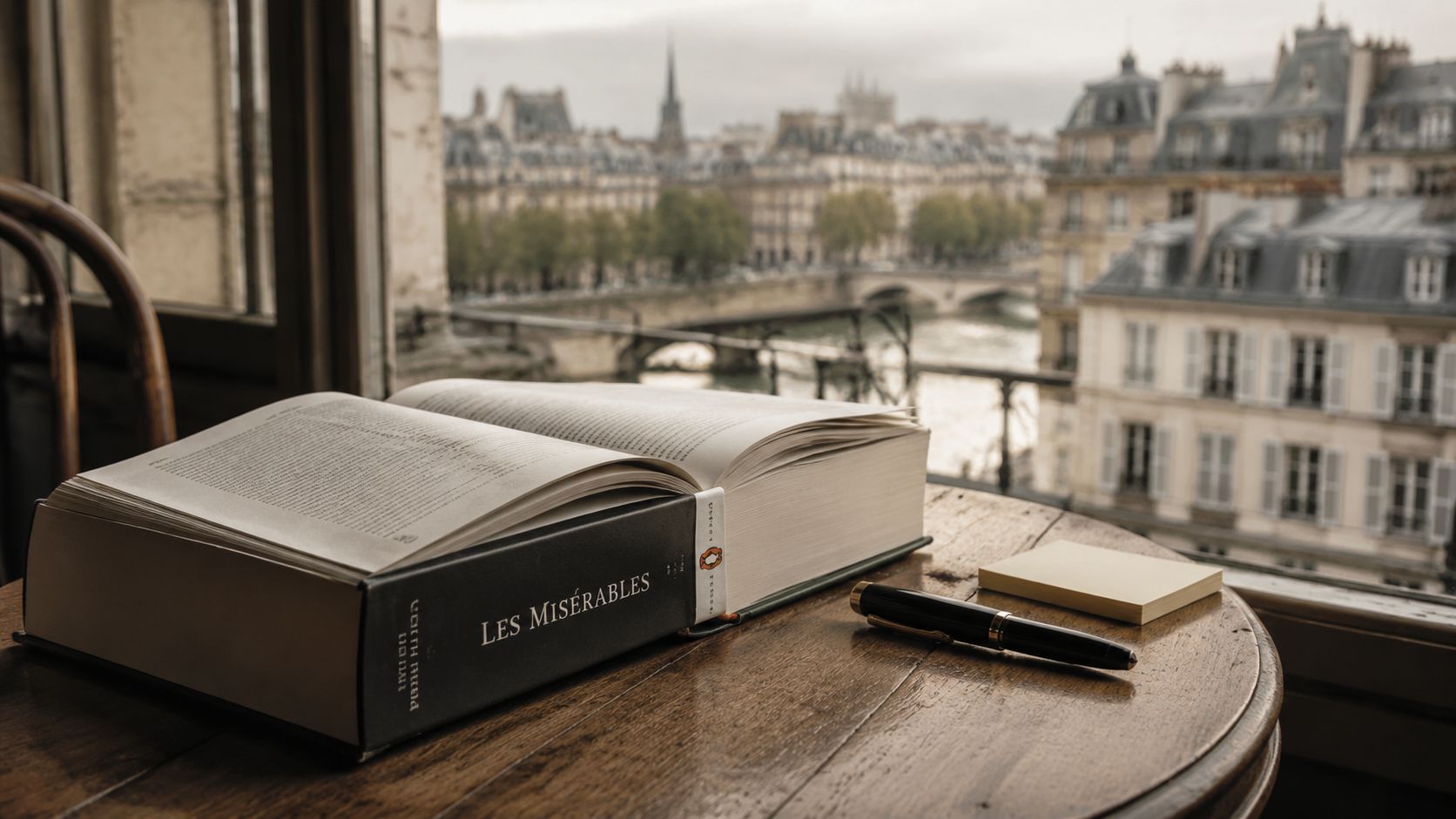
If a learner wants one novel that feels like a serious French achievement, Les Misérables is hard to beat. The unabridged Penguin Classics translation by Christine Donougher gives you the full sweep of Hugo's moral world, and that matters because the book rewards stamina, not speed. For readers preparing for senior roles in French-speaking environments, this is the kind of text that builds the vocabulary of justice, redemption, social responsibility, and emotionally precise argument.
A student of mine, a UN diplomat preparing for a Paris posting, used discussions of the novel to bond with French colleagues and show real cultural range. Another, a Manhattan corporate executive, built more confidence discussing the novel's social themes in French before board meetings. In both cases, the book became a conversation engine, not just a reading assignment.
Practical rule: If Book I feels slow, begin with Book II, Cosette, then circle back. That keeps momentum high without losing the book's emotional spine.
The dialogue is a gift for learners. Hugo uses interruptions, punctuation, and sudden shifts in tone to reveal character, so the page becomes a lesson in spoken French as well as literary French. I always tell students to keep a notebook for phrases around guilt, sacrifice, and moral conflict, because those ideas show up constantly in advanced conversation.
For extra support, listen on commutes, then read the same section at home. That dual-input method helps the rhythm settle in. If you want to tie the novel to historical context, use the French Revolution reading pathway as a companion resource while you work through the social and political background.
2. Madame Bovary by Gustave Flaubert, Dover Classics Edition, Psychological Depth for Advanced Learners
The appeal of Madame Bovary is precision. Flaubert's prose is exact, controlled, and emotionally sharp, which makes the novel especially useful for learners who already speak comfortably but want better writing and more nuanced speaking. The Dover Classics edition in Mildred Marmur's translation is compact enough to feel manageable, yet rich enough to reward close reading.
I like this book for B2 and C1 learners because it shows how French handles desire, disappointment, and social self-presentation. One corporate expatriate relocating to Lyon read it to understand provincial aspiration, and that subtle cultural knowledge made a real difference in workplace conversations. A DELF B2 candidate also used Emma's emotional language to strengthen oral production, especially when answering questions about identity and frustration.
How to read it well
Flaubert's style is easiest to miss if you rush. Pause every few pages and ask where the narration slips into Emma's mind, because free indirect discourse is one of the novel's most useful features for advanced learners. That structure teaches you how French can sound both objective and intimate at the same time.
Read with a notebook tracking Emma's changing emotional states. French often uses different vocabulary for wishfulness, boredom, vanity, and dissatisfaction, and those differences matter in real conversation.
Discuss the ending with your tutor in French. The moral questions are strong enough to generate real discussion, but the language stays grounded in daily life, money, marriage, and status. If you want to push your vocabulary further, pair the novel with the French vocabulary improvement guide, especially if you're trying to move from “good” to “precise.”
3. The Stranger by Albert Camus, Penguin Classics Edition, Existential Clarity for Intermediate Readers
The Stranger is one of the smartest picks for an intermediate reader who wants serious French without a heavy page count. The Penguin Classics edition in Matthew Ward's translation stays lean at 123 pages, and that compactness is part of the appeal. The prose is sparse, modern, and highly concentrated, which makes it ideal for readers preparing for oral exams or for anyone who wants to discuss philosophical themes without getting buried in syntax.
An investment banker I worked with used Camus while preparing for Geneva postings. He needed French that could support thoughtful conversation with Swiss colleagues, and Camus gave him a clean vocabulary for ethics, detachment, and social judgment. A high school student also moved from an English study version to the French original with tutoring support, then earned top exam marks. The novel works because it's short enough to finish, but deep enough to revisit.
What to focus on
Part I asks for patience, especially if you're used to more conventional plotting. Part II moves faster and gives you more dialogue, which is where many learners start to feel the payoff. Keep a vocabulary list for Meursault's emotional language, including what he doesn't say, because that silence is part of the book's meaning.
Compare the trial speeches to real French news coverage of courtroom language if you want to hear how rhetoric works outside fiction. Then bring one discussion question to your tutor, such as why Meursault doesn't care, because that opens ethical language, not just literary commentary.
Spend extra time on the final page. It's the part students often rush, but it's also where Camus' style becomes clearest.
4. Notre-Dame de Paris by Victor Hugo, Penguin Classics Edition, Architectural Beauty Meets Dramatic French
When a learner loves Paris, Notre-Dame de Paris often becomes the right classic to buy first. The Penguin Classics edition translated by John Sturrock offers 550 pages of gothic drama, architecture, and emotionally charged dialogue. It gives you a very different Hugo from Les Misérables, more visual, more atmospheric, and especially useful for readers who want French that connects literature to city life.
An architecture student relocating to Paris read it before arrival and could immediately discuss historical architecture with professors. A parent at Lycée Français used it alongside a teenager and ended up helping with school assignments in French. That's the kind of practical value I look for, a book that supports both cultural confidence and family conversation.
Why it works for learners
The descriptions of Notre-Dame and Paris are memorable, so the novel helps with location vocabulary and spatial language. Keep a running list of place descriptions and compare them later if you visit the city or watch a virtual tour. That simple habit turns reading into lived reference.
Read the emotional scenes aloud. Hugo gives you strong contrasts between beauty and suffering, and those contrasts train pronunciation, pacing, and expressive range. You also start to notice French cultural values around difference, disability, and social rejection, which makes discussion with a tutor much more interesting.
The best payoff comes when you ask not only what Hugo describes, but why he insists on those contrasts. That question builds real interpretive French.
If you care about Parisian culture, art history, and dramatic prose, this one belongs near the top of your list.
5. The Red and the Black by Stendhal, Penguin Classics Edition, Ambitious Social Climbing and Psychological Manipulation
The Red and the Black is the best choice for learners who want French that feels socially sharp. Stendhal's novel is about ambition, performance, and the tension between authenticity and calculation, which makes it especially useful for professionals navigating status-heavy environments. The Penguin Classics edition, in Margaret R.B. Shaw's revised translation, is substantial enough to give you depth without the sprawl of Hugo.
A McKinsey consultant preparing for Paris used Julien's maneuvering to think more clearly about corporate hierarchy. A UN negotiator found the book useful for understanding French attitudes toward strategy versus sincerity. A diplomat's spouse studying courtship and social expectations also found it helpful for smoother integration into French social life. Those are real-world uses, not literary ornaments.
The reading angle that matters
Track Julien's emotional fluctuations. That gives you vocabulary for internal conflict and self-justification, which comes up constantly in advanced conversation and writing. Then mark the places where he is performing versus feeling something. Stendhal is brilliant at that split, and French learners benefit from seeing how social language hides or reveals intention.
Practical rule: Study the “crystallization” passage more than once. It's central to Stendhal's idea of falling in love, and it gives you one of the best windows into French psychological vocabulary.
This is also a book for nuance. In tutoring, I like to ask whether Julien deserves sympathy or condemnation, because the answer is never simple. That conversation pushes students toward more mature French, the kind that can handle ambiguity without collapsing into clichés.
6. The Charterhouse of Parma by Stendhal, Dover Classics, Italian Renaissance Setting, French Psychological Depth
The Charterhouse of Parma gives you something many learners need, a novel with plot momentum and psychological depth at the same time. The Dover Classics edition, in Margaret R.B. Shaw's translation, is a strong fit for advanced-intermediate readers who want to stay engaged without sacrificing literary seriousness. Because the action moves through post-Napoleonic Italy, the book also helps readers working across French and Italian professional settings.
An EU professional rotating between French and Italian offices used it to reference shared history in meetings. An INSEAD applicant studied it to sharpen how she spoke about ambition and career philosophy. A diplomat preparing for a Milan posting combined it with Stendhal's diaries to gain more cultural depth. That combination of story and context makes the novel unusually practical.
How to keep your footing
This book has many minor characters, so a character map helps a lot. Without one, readers can lose the thread and miss the emotional movement that gives the novel its power. I also recommend comparing Fabrizio to Julien, because the contrast reveals a lot about Stendhal's view of authenticity, desire, and self-making.
The prison section deserves close attention. It gives you a dense, useful block of emotional vocabulary, and it's one of the places where students notice how French can carry tension without over-explaining it. Discuss the ending with your tutor too, especially if you've already read The Red and the Black. The comparison creates a productive discussion about how Stendhal treats ambition in different settings.
For learners who want a classic that feels intellectually serious but still readable, this is a strong buy.
7. The Three Musketeers by Alexandre Dumas, Dover Thrift Edition, Accessible Adventure for Beginners Wanting Classic Status
If someone wants a first French classic novel that doesn't feel punishing, The Three Musketeers is the sensible choice. The Dover Thrift edition, translated by William Barrow, is only 256 pages and moves quickly enough to keep upper-beginner and lower-intermediate readers engaged. It's dialogue-heavy, action-driven, and built around loyalty, wit, and honor.
A parent at Lycée Français read it alongside a 10-year-old to support schoolwork and practice conversation. A beginner adult learner used it as a confidence-builder after six months of lessons. A teenager at UNIS used it for supplemental reading to build reading stamina. That range tells you something important, the novel meets learners where they are.
Why it works so well
Read the action scenes aloud. Dumas gives you clear, lively exchanges that help with dialogue delivery and rhythm. That matters because many learners can parse written French but sound flat when they speak. This book gives you the energy of spoken language without requiring the density of Hugo or Flaubert.
Track the four friendships, especially d'Artagnan and the three musketeers. That relationship structure is easy to follow and gives you a chance to talk about loyalty, masculinity, and French ideas of honor. Those are useful themes for family discussions, classroom conversation, and beginner tutoring sessions.
A good first classic should build confidence before it demands sophistication. Dumas does that better than most books on the shelf.
If your goal is to start a serious reading habit in French, this is often the safest and most enjoyable entry point.
8. Guide, Using French Literary Classics to Accelerate Professional Fluency
The best reading plan is the one that supports your actual French goals. If you need better boardroom language, Les Misérables and The Red and the Black build nuance around ethics, hierarchy, and social judgment. If you're preparing for DELF or DALF, The Stranger and Madame Bovary are especially effective because they sharpen interpretation, summary, and spoken analysis.
I usually tell clients to treat a classic like a conversation partner. Don't just read it once and move on. Return to selected passages, underline phrases worth reusing, and pick one topic per tutoring session, such as justice, ambition, beauty, or alienation.
A corporate client who dedicated two or three sessions each month to literary analysis told us the conversations translated directly into more confident professional speech. Exam candidates also do well when they combine a short philosophical novel with guided speaking practice, because the reading gives them ideas and the tutoring turns those ideas into fluent output.
What to build into your routine
- Use audiobooks during commutes. Dual-input learning makes the language feel more natural.
- Keep one notebook for idioms and rhetorical patterns. Vocabulary turns into reusable speech here.
- Choose a single discussion angle per session. Justice, status, love, or power is enough.
- Start with books that fit your stamina. A short book you finish beats a long book you abandon.
For a more structured approach, I'd pair literary reading with the online French literature courses that let you discuss these books with real feedback, not just private notes in the margin.
9. Edition Comparison Summary for Recommended Classics
Picking the right edition matters more than many learners expect. Penguin Classics tends to be the better fit when you want readability and literary credibility, especially for Hugo and Camus. Dover Classics and Dover Thrift are often better when budget, portability, or lower-stakes reading matters more.
If you're buying for a serious self-study plan, I'd think in terms of use case. Choose Penguin when you want a polished reading experience and a translation that feels classroom-safe. Choose Dover when you want value and a book you don't mind annotating heavily.
Best fit by reader type
- Penguin editions for learners who want a cleaner, more polished reading journey.
- Dover editions for readers who want affordability and a practical study copy.
- Kindle or searchable editions if you know you'll look up vocabulary often.
- Audiobook pairings if your goal is pronunciation, rhythm, and passive exposure.
I've found that learners often do best when they stop trying to find the “perfect” edition and instead choose the one they'll finish. If the translation feels too stiff, reading slows down. If the print layout is convenient, consistency improves. That's usually the difference between a beautiful plan and a habit.
10. Reading Plan for Busy Professionals, Timelines and Session Structures
Busy professionals don't need more theory. They need a reading plan they can keep. I recommend three 30-minute reading blocks each week plus one 30- to 60-minute tutoring session, because that rhythm is enough to build momentum without crowding out work or family life.
An executive I worked with finished The Stranger over two weekends, then used two tutor sessions to prepare discussion points for a business dinner. A parent balanced The Three Musketeers with a child's reading schedule over three to four weeks, and the family discussions in French became a genuine win. In both cases, the plan worked because the book had a clear end point and a speaking goal.
A practical structure
Start with the audiobook on your commute, then read the same section at home. That keeps pronunciation, meaning, and memory moving together. After each block, write one discussion prompt, not five, because too many prompts dilute the focus.
Practical rule: Each book needs one speaking goal. For Camus, discuss Meursault's ethics. For Hugo, explain social critique. For Flaubert, talk about aspiration and disappointment.
If you want more structure around pacing and accountability, the structured French study plan is the right companion to a classic-reading project. It helps you keep the book tied to a measurable routine instead of letting it drift into a vague “someday I'll finish it” task.
The point is not to read every page perfectly. The point is to turn each reading block into speaking material you can use.
French Classics: 10-Item Comparison of Novels, Editions & Guides
| Item | 🔄 Implementation complexity | ⚡ Time / Resource commitment | ⭐ Expected outcomes | 📊 Ideal use cases | 💡 Key advantages / tips |
|---|---|---|---|---|---|
| Les Misérables, Penguin Classics (Donougher, 2015) | Very high, dense, multi-perspective narrative requiring sustained effort | Very long, ~1,463 pp; 3–4 months reading; 28+ hr audiobook | ⭐⭐⭐⭐⭐ Deep advanced vocabulary, historical & cultural fluency, rich dialogue comprehension | Senior/professional prep (diplomacy, corporate Paris postings), immersive literary analysis | Use footnotes and audiobook in tandem; start with Book II if pacing stalls; keep a phrase notebook |
| Madame Bovary, Dover Classics (Marmur, 2002) | High, linguistically demanding (free indirect discourse, complex sentences) | Moderate, 368 pp; 4–6 weeks with focused study | ⭐⭐⭐⭐ Improved B2/C1 writing & speaking; mastery of psychological registers | DELF B2 prep, advanced learners focused on stylistic/psychological language | Pause every 10 pages to spot interior monologue; track Emma's emotional shifts |
| The Stranger (L'Étranger), Penguin Classics (Ward, 1988) | Low–Moderate, short and stylistically spare but philosophically dense | Short, 123 pp; 1–2 weekends or 2–4 tutoring sessions | ⭐⭐⭐⭐ Precision in vocabulary, persuasive/trial rhetoric, conversational philosophy | Busy professionals prepping DELF or philosophical discussion topics | Read aloud and re-read final pages; compare trial passages to real legal rhetoric |
| Notre-Dame de Paris, Penguin Classics (Sturrock, 2002) | Moderate, vivid prose with architectural digressions | Medium, 550 pp; 6–8 weeks | ⭐⭐⭐⭐ Strong architectural/art vocabulary and emotionally charged dialogue | Architecture/art-history students, Paris relocation, cultural attachés | Keep a location/architecture list; pair reading with virtual tours; read dialogues aloud |
| The Red and the Black, Penguin Classics (Shaw, 2002) | High, psychological depth and political context; complex social dynamics | Medium–Long, 506 pp; 8–10 weeks | ⭐⭐⭐⭐ Insight into ambition, social maneuvering, advanced interpersonal vocabulary | Consultants, negotiators, professionals studying social strategy | Track Julien's performance vs. feeling; study the "crystallization" love passage |
| The Charterhouse of Parma, Dover Classics (Shaw) | Moderate, action-driven but many shifting relationships | Medium–Long, 464 pp; ~8–9 weeks | ⭐⭐⭐⭐ Combines adventurous momentum with psychological vocabulary | EU professionals, applicants seeking cultural breadth across France/Italy | Maintain a character map; compare Fabrizio and Julien to explore authenticity |
| The Three Musketeers, Dover Thrift (Barrow) | Low, action-forward, dialogue-heavy, accessible style | Short, 256 pp; 3–4 weeks | ⭐⭐⭐ Rapid confidence-building; conversational practice via frequent dialogue | Upper-beginners/low-intermediate learners, family reading with children | Read action scenes aloud; track camaraderie to study French values of honor |
| Guide: Using French Literary Classics to Accelerate Professional Fluency | Low, structured synthesis of methods and pairings | Variable, integrates with chosen book timelines and 1–3 monthly tutors | ⭐⭐⭐⭐ Faster retention through combined reading/listening/tutoring approach | Learners selecting books to meet professional or exam goals | Use dual-input (audio + text), keep an idiom notebook, set one topic per tutor session |
| Edition Comparison Summary for Recommended Classics | Low, compact reference to editions & formats | Minimal, quick consult for purchase decisions | ⭐⭐⭐ Informed edition choice balancing fidelity, budget, and study needs | Buyers choosing translation/format (Penguin vs Dover vs Folio) | Prefer Kindle for searchable text; consider audiobooks for dual-input |
| Reading Plan for Busy Professionals: Timelines & Session Structures | Low–Moderate, practical scheduling framework to implement study | Optimized, short/medium/long timelines matched to book length; 3×30min/week + 1 tutor | ⭐⭐⭐⭐ Measurable progress with limited hours; consistent speaking goals | Busy executives, parents, professionals with limited study time | Allocate 3×30min weekly + 30–60min tutor; use commute audiobooks and set one speaking goal per book |
Turn Your Reading Into Fluent Conversation
Choosing one of these French classic novels is a strong first step if you want deeper reading ability and more confident French overall. The right book gives you vocabulary, syntax, and cultural knowledge, but progress starts when you speak about what you've read. That's where the language becomes yours instead of staying on the page.
If you're using classics to prepare for a move, an exam, or a more demanding professional role, don't leave the process to chance. Pick the novel that matches your level and your goal, then build a speaking routine around it. A short book can still create a big jump if you discuss it well, and a long book can become manageable when it's broken into clear sessions.
I've seen this work for diplomats, executives, parents, and exam candidates because the method is simple. Read in small blocks, listen while you commute, keep a notebook of reusable expressions, and talk through the themes with someone who knows how to push your French forward. That combination turns literature into practical fluency.
If you want help choosing the best classic for your level, book a free 20-minute consultation with Elite French Tutoring. We'll match you with the right novel, shape a reading plan around your schedule, and help you turn every chapter into real speaking progress.