Skip to content
You've landed in Lyon, your hotel is across town, and the café server has just asked a question you don't understand. You know how to smile, point, and say “merci,” but you can't order the coffee you wanted or explain that you have a train to catch. That moment is exactly why French for good trip preparation should be built around your itinerary, not a random list of memorized phrases.
I recommend choosing the right lesson format first, then narrowing your vocabulary to the situations you'll encounter. Add pronunciation drills and realistic role-play, and you'll arrive with a practical speaking system instead of fragile, last-minute recall.
Table of Contents
- Getting Started with Your Travel French Journey
- Choosing Your French Lesson Format
- Building Your Travel Phrase List
- Mastering French Pronunciation for Travel
- Practicing Realistic Role-Play Scenarios
- Crafting Your Itinerary Focused Study Plan
- Bringing It All Together
Getting Started with Your Travel French Journey
A week in Lyon might include hotel check-in, café orders, market visits, train departures, and conversations with people who don't automatically switch to English. You don't need perfect French for those moments, but you do need a small set of phrases that you can retrieve quickly and pronounce clearly.
I prepare travelers around four decisions:
- Select the lesson format. Choose private in-person tutoring, online one-to-one lessons, or a group class based on your schedule, budget, and need for personal feedback.
- Build a situation-based phrase list. Prioritize greetings, food, transport, accommodation, and help rather than collecting disconnected vocabulary.
- Train pronunciation early. A phrase you recognize on a page is not useful if a server or ticket agent can't understand it.
- Practice interactions, not just words. Role-play teaches you how to respond when the conversation moves beyond your prepared sentence.
The scale of French makes structured preparation especially practical. Official French government materials report 396 million French speakers and 170 million learners by 2026, which reinforces the value of learning a living language through guided use rather than cramming isolated expressions. (French-language figures from the Organisation internationale de la Francophonie)
Practical rule: Buy lessons that rehearse your actual trip. A traveler heading to Marseille needs different practice from someone attending meetings in Paris and hiking in the Alps.
Start with your itinerary. Mark every point where you'll need to ask, answer, order, confirm, or recover from confusion. Those moments become your curriculum.
Choosing Your French Lesson Format
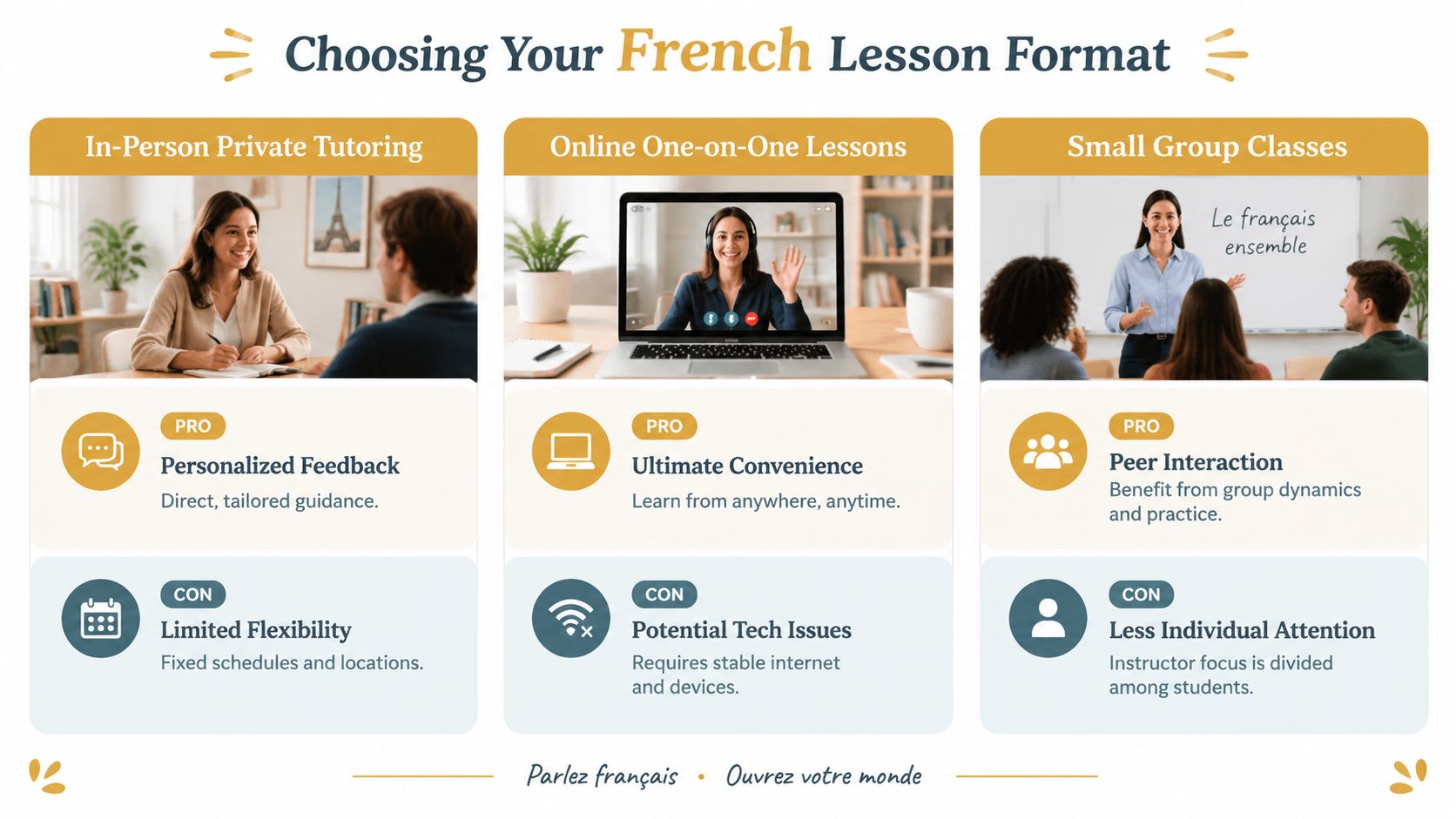
Your learning environment affects how quickly you can turn preparation into usable speech. I wouldn't choose a class because it's labeled “French for travel.” I'd compare the teacher's feedback, the scheduling demands, and whether the lessons can follow your route.
A 2026 pricing guide lists in-person private tutoring at $30–$125 per hour, online private tutoring at $15–$60 per hour, and language-school private lessons at $40–$125 per hour. (2026 French tutor cost ranges) Those ranges make format a genuine buying decision, especially when your departure date is close.
Compare Lesson Formats
| Format | Price Range | Flexibility | Ideal Traveler |
|---|---|---|---|
| In-person private tutoring | $30–$200 per hour | Lower, because location and schedule must align | Travelers who want direct, personalized correction |
| Online one-on-one lessons | $15–$150 per hour | High, with lessons from a convenient location | Busy professionals, remote learners, and travelers with limited preparation time |
| Small group or language-school lessons | $40–$125 per hour for private school lessons | Depends on the school timetable | Travelers who enjoy peer interaction and a structured classroom |
In-person tutoring gives you immediate correction and a strong sense of accountability, but fixed locations can be difficult before a busy trip. Online lessons usually offer the cleanest logistical fit, provided you have a reliable device and connection. Group learning can create useful listening practice, although the instructor's attention is divided.
I once recommended online lessons to a business traveler whose calendar changed constantly. He needed practice for hotel conversations, introductions, and meeting logistics, but commuting to a tutor would have consumed the little time he had. Online sessions let us adjust the focus around his schedule and rehearse the exact situations he expected to face. For a closer look at selection criteria, compare these online French lesson options.
Choose in-person tutoring if you value physical accountability and live nearby. Choose online private lessons if your itinerary or work schedule is unpredictable. Choose a group course if you want a classroom rhythm and can accept less individualized speaking time.
Building Your Travel Phrase List
Don't begin with a giant vocabulary document. Begin with the moments that can create friction.
For a Paris stay, you might need to greet a hotel receptionist, ask whether a table is available, order in a busy café, find a Metro entrance, and clarify a museum reservation. In a smaller town, you may rely more heavily on polite openings, shop questions, directions, and explanations when the other person speaks quickly.
Organize Phrases by Outcome
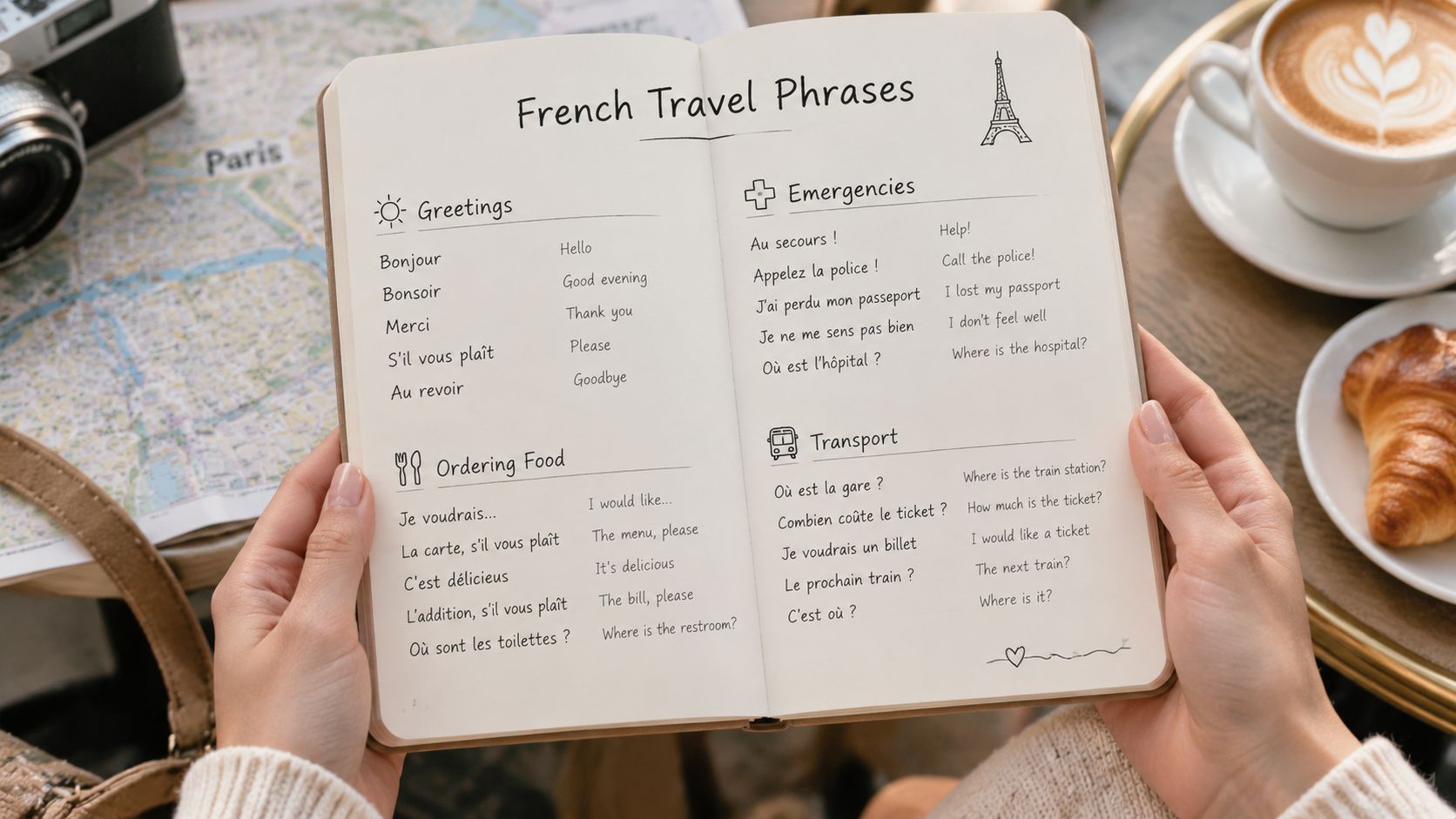
I group travel phrases into four practical folders:
- Opening an interaction: “Bonjour,” “Bonsoir,” “S'il vous plaît,” and “Merci.” In France, a polite greeting is the doorway to the conversation, not decoration.
- Getting food and drinks: Practice ordering, asking about ingredients, requesting the bill, and stating preferences. Rehearse the complete exchange, not only the name of a dish.
- Moving around: Prepare questions for platforms, tickets, directions, delays, and connections. Include a recovery phrase such as “Pouvez-vous répéter, s'il vous plaît ?”
- Handling problems: Learn how to say that you need help, have lost something, feel unwell, or don't understand.
I prefer a compact shortlist of 50–75 outcome-driven phrases over an enormous phrase bank. That range is a planning target, not a guarantee of mastery. Divide the list by context, write one realistic example beside each expression, and review the phrases aloud while looking at a map of your route.
“Bon voyage” deserves a place in that list, but use it accurately. The phrase combines bon, meaning “good,” with voyage, meaning “journey,” and etymology sources trace its use to the late 15th century, making it a durable travel expression in both French and English. (Etymology of “bon voyage”)
It's the standard French send-off for someone leaving on a trip. It isn't what you say to greet someone who has arrived, and it shouldn't replace every travel-related expression. Use bonne route for a road journey, bon trajet for a shorter trip or commute, and bonnes vacances when you're wishing someone an enjoyable holiday rather than focusing on the journey itself. (Usage guidance for “bon voyage”)
For a ready-made starting point, use this practical guide to common French phrases for travelers, then remove anything your itinerary doesn't require.
Here's a useful listening exercise for phrase selection. Play a short travel dialogue, pause before the response, and say your answer aloud instead of translating.
Mastering French Pronunciation for Travel
Travelers often blame vocabulary when the primary obstacle is pronunciation. You may know the right words, but a misplaced vowel, an overpronounced final consonant, or an English-style rhythm can make a simple order difficult to understand.
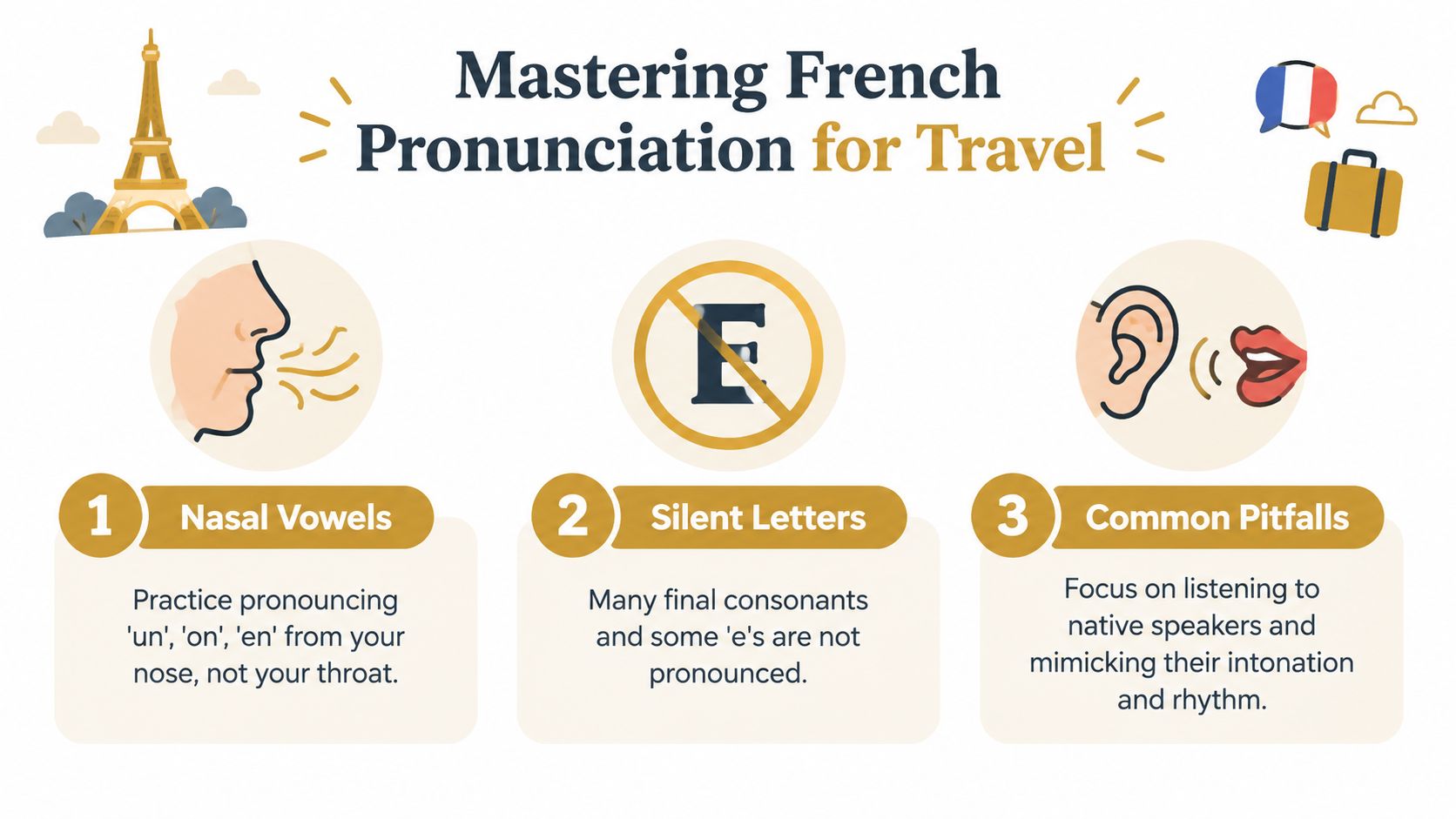
Start with listening. Choose a native-speaker recording, listen to one short sentence, and copy its pace and melody. Record yourself on your phone, compare the two versions, and repeat until your version sounds less like a word-by-word translation.
Work on the Sounds That Matter
Nasal vowels need special attention. In words containing sounds such as un, on, and en, air resonates through the nose rather than producing a fully separate “n” sound. Practice slowly, then place the sound inside a useful phrase.
Silent letters can make written French deceptive. Many final consonants and some final e sounds aren't pronounced, so don't read every letter as you would in English. Learn the pronunciation of each travel phrase as a complete unit.
The French r doesn't need to be perfect before your trip. Keep the back of your tongue raised gently, avoid forcing the sound, and practice it in short words such as route and restaurant. A relaxed approximation is more useful than tense, repeated throat scraping.
Use a Short Feedback Loop
Take one phrase, listen, repeat, record, and revise. For “un café noisette,” focus first on clear vowels and natural rhythm, then work on the more unfamiliar sounds. Tools such as phone recordings and audio playback provide immediate self-checking, while a tutor can identify the specific sound you're missing.
Don't spend your entire study session reading pronunciation rules. Use them to correct a phrase you need at a hotel, café, or station. For targeted guidance, review this resource on French pronunciation for English speakers.
Practicing Realistic Role-Play Scenarios
One of my students used to freeze at Paris Metro entrances. He knew basic direction words, but when someone answered quickly, he lost the thread and stopped speaking. We practiced guided role-play built around his actual route, and after three guided role-play sessions, he could ask for directions, confirm the line, and request repetition without abandoning the exchange.
The improvement came from rehearsing recovery, not from memorizing more nouns. I had him practice the same conversation with changing details so he learned to listen for meaning rather than wait for one exact sentence.
Three Scenarios to Rehearse
Hotel check-in: Start with “Bonjour, j'ai une réservation au nom de…” Then practice confirming the room, asking about breakfast, checking the departure time, and explaining a problem. Your partner should occasionally ask an unexpected follow-up so you learn to pause and clarify.
Café ordering: Begin with a greeting, order a drink or meal, ask about an ingredient, and finish by requesting the bill. Practice both a seated order and a quick counter exchange. In a busy café, concise and polite language works better than a long explanation.
Asking for help: Set up a missed train, a wrong street, or a lost bag. Use “Excusez-moi,” explain the problem in simple terms, and ask the listener to repeat or speak more slowly. Your practice partner should answer in different ways, because real conversations rarely follow a script.
Role-play rule: Change one detail every round. Keep the structure familiar, but make the destination, time, item, or problem unpredictable.
Crafting Your Itinerary Focused Study Plan
A useful study calendar follows your trip in sequence. If you're spending time in Marseille, attending business meetings in Lyon, and hiking in the Alps, don't give every lesson the same vocabulary. Match each study block to the first conversations you'll need after landing.
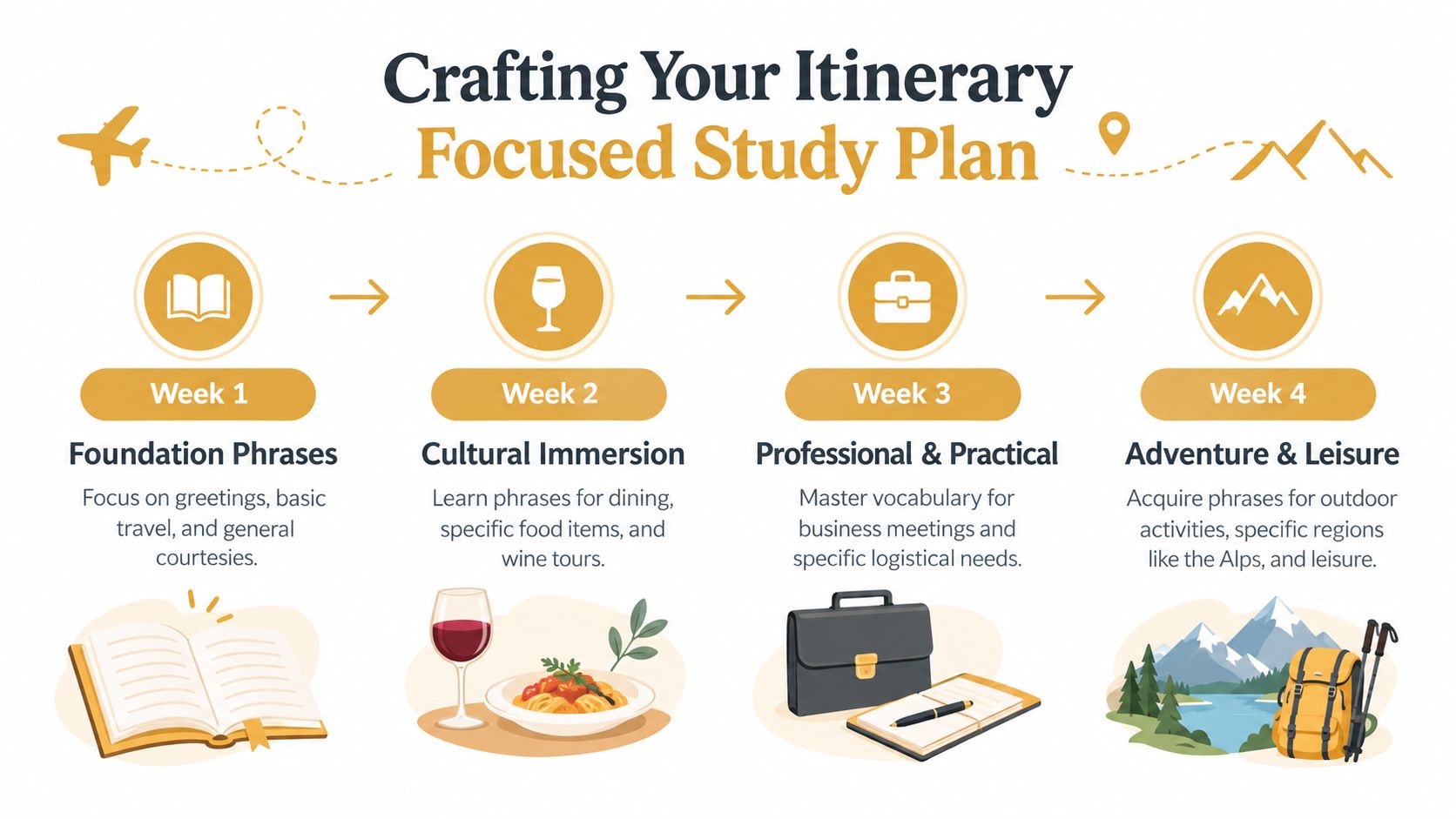
Use this four-week structure as a template, then move the topics around your actual departure date.
Match Each Week to Your Route
- Week one, foundation: Practice greetings, introductions, basic requests, numbers, courtesy phrases, and repair language such as asking someone to repeat themselves.
- Week two, dining and immersion: Rehearse restaurant orders, market questions, food preferences, café language, and any wine-tour vocabulary relevant to your plans.
- Week three, professional and practical needs: Prepare introductions, meeting logistics, schedules, addresses, transport questions, and the phrases required for your work commitments.
- Week four, adventure and leisure: Add the language for mountain activities, weather, equipment, directions, and the specific places you'll visit in the Alps.
Don't treat the calendar as four identical blocks. Use earlier weeks for frequent short reviews, reserve later sessions for role-play, and keep travel days light. On a weekend free day, walk through your itinerary mentally and say the phrases connected to each stop.
A personalized structured French study plan can help when your route includes competing priorities, such as family travel, professional meetings, and outdoor activities. The right plan should leave you able to act, not merely recognize vocabulary.
Bringing It All Together
Good French for good trip preparation is practical by design. Choose lessons that fit your schedule, build phrases around your itinerary, sharpen the sounds that cause misunderstandings, and rehearse the conversations most likely to happen.
If you want guidance before booking, Elite French Tutoring offers a free 20-minute consultation to discuss your objectives, current level, and learning preferences. Book that consultation to compare a focused private lesson plan with other options and prepare for the specific cafés, trains, meetings, and destinations on your route.
Book your free 20-minute consultation with Elite French Tutoring and bring your itinerary to the conversation. You'll leave with a clearer recommendation on lesson format, phrase priorities, and the practice schedule that best fits your trip.