
You've read the questions, the recording starts, and the French seems to arrive as one continuous blur. You recognize individual words, but you miss the contrast that changes the answer, the speaker's position, and the detail the question tests. By the time you recover, the audio has moved on.
That experience is common among candidates who have spent months “listening to French” without training for how the exam delivers information. Effective preparation is more precise. You need a target CEFR level, a clear picture of your exam format, timed drills, and an error log that shows whether your weakness is speed, vocabulary, accents, distractors, or note-taking.
The practical question isn't how to prepare for French listening exam tasks. It's how to measure the skill each week so that your next practice session addresses the problem that is costing you marks.
Table of Contents
- The Moment the Audio Starts and Nothing Lands
- What Your Specific French Listening Test Actually Looks Like
- The Four Listening Skills That Decide Your Score
- Picking the Right Weekly Schedule for Your Timeframe
- A Real Score Jump and the Drills Behind It
- Self-Study vs Tutor Support and How to Decide
- Test Day Execution and What to Do Next
The Moment the Audio Starts and Nothing Lands
The candidate is sitting in the second section of a DELF B2 listening paper. The first play was difficult, but still felt recoverable. Then the second play finishes, and the questions remain blank. The cursor blinks on the page. An invigilator walks behind the desk. Every footstep makes the remaining time feel shorter.
The problem wasn't that the candidate had never heard French at that level. The problem was that they hadn't trained themselves to catch the structure of spoken French under pressure. Words such as cependant, en revanche, and d'ailleurs passed by unnoticed, even though they signaled where the speaker was changing direction or adding a qualification.
At that point, guessing feels like the only option. That freeze is usually a preparation problem rather than a permanent French-level problem, and preparation can target it directly.
Practical rule: If you can't explain why an answer was wrong, your next drill should diagnose the error, not add another hour of passive listening.
A measurable plan starts with your target level. The Council of Europe CEFR self-assessment grid defines six levels, A1, A2, B1, B2, C1, and C2, with listening descriptors that clarify the expected comprehension demand. At B1, learners should understand the main points of clear standard speech on familiar matters. At B2, they should follow the main ideas of more complex speech in a standard dialect. At C2, they should understand virtually any spoken language at natural speed.
That distinction changes your study choices. A B1 learner needs reliable recognition of the main message and familiar details. A B2 or DALF candidate needs faster processing, more complex structure, and stronger control when the speaker qualifies or reverses an idea.
The rest of this guide focuses on four exam formats, four high-value listening skills, three preparation schedules, and one worked student example. The purpose is to prevent the exact moment when the second play ends and you realize you've already lost the passage.
What Your Specific French Listening Test Actually Looks Like
Before choosing audio, identify the test you're taking. A DELF B1 candidate, a DELF B2 candidate, and someone taking TEF Canada may all search for “French listening practice,” but their pacing decisions are different. DALF C1 candidates also face longer, more demanding material, although the precise question count and score details should be confirmed in the official candidate materials for the session.
| Exam & Level | Audio Length | Plays per Item | Number of Questions | Score Weight | Key Characteristic |
|---|---|---|---|---|---|
| DELF B1 | About 25 minutes | Each of three recordings is played twice | Not specified in the verified format summary | 25 marks | Audio runs continuously, so you answer while listening |
| DELF B2 | About 30 minutes | Short broadcast once, longer recording twice | Not specified in the verified format summary | 5–7 marks for the short broadcast, 18–20 marks for the longer recording | Radio-style broadcast plus a longer recording |
| TEF Canada | 40 minutes | Once | 60 questions | Maximum 360 points | Four sections, no negative marking |
| DALF C1 | Confirm the current official format | Confirm the current official format | Confirm the current official format | Listening is one of four exam components | Long passages can require sustained note-taking |
The DELF B1 listening format lasts about 25 minutes, uses three recordings played twice, and carries 25 marks. The audio runs without pauses, so you can't wait for a clarification or rely on a stop-start approach.
For DELF B2, the published B2 listening breakdown describes a section of approximately 30 minutes. A short radio-style broadcast lasts 2–3 minutes, plays once, and is worth 5–7 marks. A longer recording lasts about 6 minutes, plays twice, and is worth 18–20 marks. That makes first-play orientation especially important for the short item and detailed confirmation important for the longer one.
TEF Canada requires a different rhythm. The TEF Canada listening guide specifies 40 minutes, 60 questions, four sections, a maximum score of 360 points, and one play per recording. It also states that there's no negative marking, so leaving questions blank is generally less useful than making an informed selection.
DALF C1 shouldn't be treated as an extended DELF B2 worksheet. It tests advanced comprehension across formats such as interviews, classes, conferences, and media, and candidates often need to retain the thread of a long monologue. Use official materials to confirm the current timing and scoring details before building a mock schedule.
If you're preparing specifically for B2, the DELF B2 exam preparation guide can help you align practice with that level. Identify your exam in the table before choosing a schedule, because the number of plays, pacing pressure, and note-taking demands determine what your drills should look like.
The Four Listening Skills That Decide Your Score
Listening practice becomes more useful when you isolate the behavior that failed. In my experience, candidates often know enough French to understand a recording after reading its transcript, but they lose marks because they don't process structure quickly enough during the first pass.
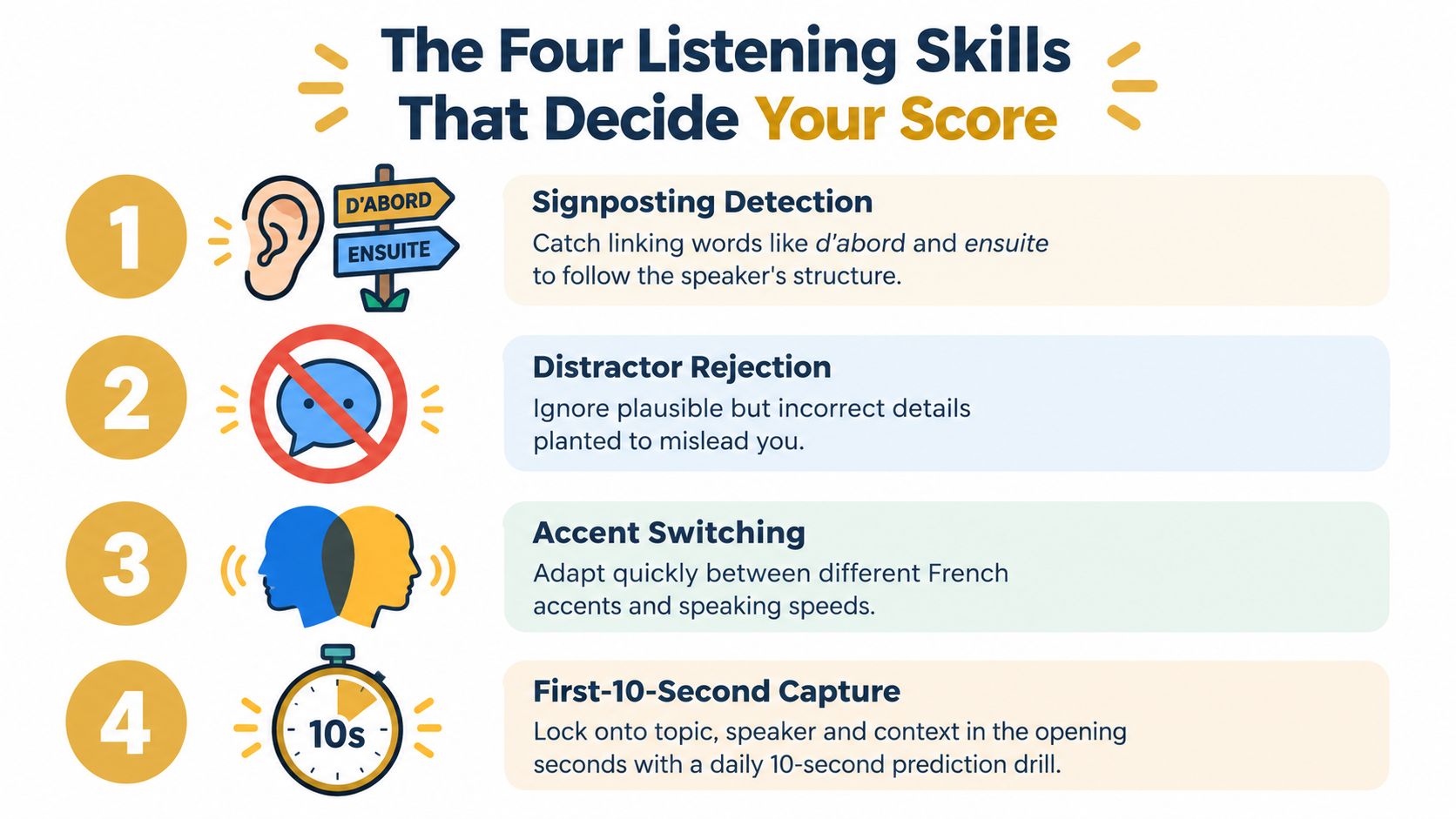
Signposting detection
Train your ear to notice transitions before you worry about every noun. Take a short extract and write down only the linking words, such as cependant, en revanche, and d'ailleurs. Don't transcribe the whole passage. Your task is to mark the speaker's route, for example, claim, contrast, example, conclusion.
Then answer the questions and check whether the correct option followed one of those transitions. This drill is particularly useful for DELF B2 and DALF work, where a speaker may introduce an idea and then qualify it seconds later.
Distractor rejection
Use a report from TV5Monde's French-learning resources and create a true-or-false sheet with details that sound plausible. Include two statements that contradict the recording in subtle ways, such as changing the speaker, time, cause, or degree of certainty.
The aim isn't to recognize vocabulary. It's to reject an answer because the audio disproves it. Keep a note of the trap type: repeated wording, reversed meaning, wrong speaker, or detail mentioned only as background.
Accent switching
Rotate your material rather than listening to one comfortable speaker. A practical 15-minute daily rotation can move from standard hexagonal French to Quebec radio and then to a West African francophone podcast. The point is not to master every regional variety. It's to reduce the delay between hearing an unfamiliar pronunciation and identifying the meaning.
You can supplement this rotation with the French podcast listening resource and choose short clips that match your target level.
First-10-second capture
Play a recording and stop it after 10 seconds. Write three predictions: the topic, the speaker's stance, and the likely question type. Resume the audio and compare your predictions with what happened.
This drill develops early orientation, which matters most when an item plays once, especially in TEF Canada and the short DELF B2 broadcast. It also gives you a concrete way to prioritize tonight's work. If your notes consistently miss the topic, train opening-context capture. If you identify the topic but miss the speaker's position, train stance and signposting.
Picking the Right Weekly Schedule for Your Timeframe
Your exam date should determine the ratio between diagnosis, focused repair, and simulation. A candidate sitting the exam in two weeks can't spend every session building broad vocabulary. Someone with three months has time to improve automatic recognition before adding full exam pressure.
Use the same five blocks in every schedule:
- Diagnostic: Complete a timed sample and record the error type.
- Targeted listening: Work on one weakness, such as signposting or accent switching.
- Transcription: Write selected sentences, then compare them with the transcript.
- Shadowing: Repeat immediately after the speaker to build processing and rhythm.
- Review: Update an error log and retest the same skill.
Choose material that resembles your exam. Use RFI Journal en français facile for B1 work, Arte Journal for B2, TEF sample banks for Canada-bound candidates, and France Inter podcasts for DALF preparation. Don't use every source in every session. The closer the audio is to your target format and level, the easier it is to interpret the checkpoint.
| Week / Focus | 2-Week Sprint, 90 min/day | 1-Month Build, 60 min/day | 3-Month Deep Prep, 35 min/day |
|---|---|---|---|
| Week 1 or opening phase | Timed diagnostic, then targeted drills every day | Diagnostic plus rotation through all five blocks | Baseline diagnostic, gradual accent and speed exposure |
| Middle phase | Alternate one-play drills with exam-format recordings | Two focused skills per week, with transcription and shadowing | Build automatic recognition before adding heavier timing pressure |
| Final phase | Full timed mock, error repair, then another realistic simulation | Weekly mini-mock and progressively stricter timing | Add regular timed sections during the final part of preparation |
| Checkpoint | Record exact errors after each session | Compare weekly accuracy and timing notes | Track whether the same error category is shrinking |
| Best fit | Exam in roughly two weeks and a stable baseline | Exam in about a month with regular study time | Exam several months away or a level that needs gradual development |
For the sprint, spend the first part of each session diagnosing and the final part simulating. You're trading breadth for immediacy, so don't chase every unfamiliar word.
The one-month build gives you more room to revisit mistakes. Keep one day for a timed sample, then use the remaining sessions to repair the dominant error before retesting it.
The deep-prep schedule is gentler but only works if you keep the routine consistent. With 35 minutes a day, short transcription and shadowing blocks are more valuable than occasional long listening sessions that never receive feedback.
A Real Score Jump and the Drills Behind It
One TEF Canada candidate I worked with moved from NCLC 5 to NCLC 7 in ten weeks, with listening comprehension rising from 248 to 357. Those are the candidate's recorded results, not a promise that every learner will make the same jump. The useful part is the process, because each drill addressed a specific failure rather than adding general exposure.
The weekly routine included five components:
- An 8-minute daily RFI “savate d'écoute” drill, focused on extracting the main point and key details.
- A weekly transcription of two 90-second Arte clips, followed by comparison with the transcript.
- Alternating shadowing between a Parisian speaker and a Québécois speaker.
- A timed 25-question mini-mock every Saturday.
- A Sunday error log divided into three buckets: missed meaning, missed detail, and timing or attention failure.
The candidate studied in short, repeatable blocks rather than relying on a single long session. A typical week included daily listening and shadowing, one transcription session, the Saturday mini-mock, and Sunday review. The schedule made it clear whether the score problem came from comprehension or from failing to answer quickly enough.
The decisive change was not listening to more audio. It was naming the exact reason each answer failed.
The candidate's work also shows why a structured French test study approach needs a feedback loop. A transcript can reveal a vocabulary gap, but it won't automatically show that you ignored a contrast marker or selected a distractor because it repeated wording from the recording.
Use the same method with your own results. After every mock, write the missed question, the relevant audio phrase, the error category, and the drill that will test that category again. If the same bucket appears repeatedly, it deserves the next week's priority.
Self-Study vs Tutor Support and How to Decide
Self-study works well when you can diagnose your own mistakes accurately. It becomes less efficient when every missed answer gets labeled “I need more vocabulary,” even though the issue is speed, inference, or distractor handling.
A tutor-led program adds external diagnosis and accountability. That can matter when you're preparing for a demanding target, working with unfamiliar accents, or trying to correct a plateau before the exam date. The trade-off is cost and scheduling, while self-study offers flexibility but requires stronger self-management.
| Factor | Self-Study | Tutor-Led Program | Hybrid, Recommended |
|---|---|---|---|
| Cost | Lower direct cost | Higher direct cost | Controlled, because most practice remains independent |
| Feedback speed | Depends on transcripts and answer keys | Immediate, personalized correction | Daily self-check plus scheduled expert review |
| Plateau-breaking | Difficult if you misdiagnose the issue | Tutor can identify recurring patterns | Tutor retunes the next practice cycle |
| Accent exposure | You must choose and rotate sources | Tutor can curate contrasting material | Independent rotation with targeted tutor recommendations |
| Accountability | Self-managed | Built into scheduled lessons | Weekly review keeps the routine active |
Self-study is the sensible choice when you have a strong B1 or higher baseline, a flexible timetable, and enough confidence to separate a vocabulary gap from a processing problem. It also suits learners who can complete timed work without avoiding the uncomfortable sections.
Tutor support becomes more valuable when you've reached a CEFR ceiling, are aiming for NCLC 7 or higher on TEF Canada, are preparing for DALF, or have less than eight weeks before the exam. Those situations leave less room for repeated unproductive practice.
A hybrid plan usually gives the best balance. Handle the daily listening volume yourself, then use a weekly 45-minute diagnostic to review the error log, analyze one recording, and retune the next seven days. A tutor shouldn't replace your independent exposure. The tutor should make that exposure more precise.
A practical allocation is 70% solo drills, 20% tutor feedback, and 10% full mock work. It keeps the learner responsible for repetition while reserving expert time for decisions that are hard to make alone. French tutor support for exam preparation is one option for learners who want that kind of individualized review.
Test Day Execution and What to Do Next
Test-day performance depends on reducing avoidable decisions. Prepare the night before, warm up without exhausting yourself, and follow the format instead of improvising when the recording begins.
The night before
- Pack documents: Set out identification, admission materials, pens, and anything the test center permits.
- Prepare audio access: If you use a phone for the morning warm-up, preload the chosen podcast rather than searching while tired.
- Set two alarms: Put one away from the bed so you have to stand up to turn it off.
- Stop new material: Don't introduce unfamiliar grammar or a difficult podcast late at night. Review your error categories instead.
The morning
Eat a light breakfast that you know sits well. Use a 10-minute French podcast warm-up, but choose a familiar speaker and listen for topic and structure rather than trying to learn new expressions.
Arrive 30 minutes early so registration, seating, and instructions don't consume the attention you need for listening. Once inside, read the questions before the audio starts whenever the format allows it. Mark likely topic words and predict what kind of detail each question may require.
During the recording
On the first listen, stay calm and capture the speaker, topic, direction, and attitude. Don't chase one missed word. For sections with a second play, use the second pass to confirm details and eliminate distractors, rather than restarting your understanding from zero.
For TEF Canada, where each recording plays once and wrong answers aren't negatively marked, keep moving and select an answer rather than surrendering time to one question. For DELF formats, use the available second play strategically and write while listening when the audio runs continuously.
Your post-exam diagnostic
Write down the following while the experience is fresh:
- Score breakdown: Record the total and each section result when available.
- Error pattern: Separate missed main ideas, missed details, distractors, accent problems, and timing failures.
- Timing issue: Note where you stopped reading, writing, or checking answers.
- Next action: Decide whether to resit, change format, add targeted tutoring, or continue self-study.
- Threshold review: If any section is below 60%, treat it as a priority for a new study cycle rather than assuming the overall result tells the full story.
Candidates who want help interpreting that diagnostic can request a free 20-minute consultation with Elite French Tutoring to discuss objectives, current level, and the next preparation route. Bring your error log, not just your score, so the review can focus on the drills most likely to change your performance.
If your exam date is approaching, start with one timed sample today, record every error by type, and choose the schedule that matches your remaining preparation window. For personalized guidance, compare online and in-person French lesson options and book a free consultation with Elite French Tutoring to build a listening plan around your exact exam format.