Skip to content

Your child has been studying French for months, yet one timed paper comes back covered in corrections. Then an oral practice begins, and the confident classroom speaker suddenly pauses, translates in their head, and loses the thread. That moment is common because the IB French exam tests several different abilities, not just vocabulary recall.
I've helped families make this stage more manageable by turning the exam into practical decisions. Which level matches the student's profile? Which component is costing marks? When does a textbook help, and when is targeted tutoring a better use of the budget? The answers below connect exam mechanics with those choices, so preparation becomes focused rather than frantic.
Table of Contents
- When the IB French Exam Suddenly Feels Real
- Choosing the Right IB French Level for Your Student
- How the IB French Exam Is Actually Structured
- What a 7 Looks Like in the IB French Oral
- Your 8 Week IB French Study Plan
- Resources and Tutoring Options Compared
- A Real Student Story From 4 to 7
- Your Next Move Toward a 7 in IB French
When the IB French Exam Suddenly Feels Real
Maya's mother first became concerned after a practice evening at home. Maya, a Grade 11 student, had spent weeks making vocabulary cards and revising verb tables. Her first writing paper still contained tense shifts, missing agreements, and sentences that answered the topic only indirectly.
The oral simulation was more revealing. Maya could describe the image, but she spoke in short bursts, repeated familiar adjectives, and struggled when the teacher asked a follow-up question. Her parent had assumed the problem was a lack of vocabulary. In fact, the larger issue was that Maya hadn't practised retrieving language while thinking, listening, and responding at the same time.
That distinction matters because Language B combines productive skills, such as writing and speaking, with receptive skills, such as reading and listening. Official guidance describes an assessment model with external written work and an internally assessed oral component, so a student who prepares only through flashcards is leaving important skills untrained. The IB's French Language B guidance sets out this broader framework.
Practical rule: Choose preparation activities by the mark-producing skill they train, not by how comfortable they feel.
Every family I work with eventually faces three decisions:
- Level: Is ab initio, SL, or HL realistic for the student's current ability and diploma goals?
- Method: Does the student need daily listening, timed writing, oral rehearsal, or a mixture?
- Support: Would independent resources be enough, or would an IB-experienced tutor provide feedback the student can't generate alone?
The IB ecosystem is large and multilingual. The May 2025 Diploma Programme session included 202,103 students and 758,858 student-subject entries across 211 first languages, with French among the higher-volume language subjects, including 5,552 students in one French category and 1,161 in another in the bulletin. The official May 2025 statistical bulletin places French in that global assessment context.
The useful response to pressure isn't buying every revision resource. It's identifying the gap early, then paying for help only where feedback changes the student's next attempt.
Choosing the Right IB French Level for Your Student
Level selection should begin with evidence, not prestige. A student who reads quickly, handles abstract ideas, and writes accurately may be ready for HL. A student with solid classroom French but slower reading and fragile grammar may perform more strongly at SL. Ab initio suits a genuine beginner pathway, but it still requires consistent work across writing, comprehension, and speaking.
Start with four questions:
- How much prior French study does the student have? Classroom years alone don't tell us enough. Ask whether the student can understand connected speech and produce paragraphs without translating every sentence.
- How quickly can they read? Timed comprehension exposes students who know individual words but can't process a whole passage efficiently.
- Can they discuss ideas beyond personal preferences? HL raises the demand for interpretation and more sustained discussion, including a literature-based element.
- What does the overall diploma need? A higher level is only useful if the student can maintain it without damaging performance in other subjects.
The CEFR level guide for French proficiency can help families describe ability more precisely than saying a student is “good” or “weak” at French.
IB French Level Comparison
| Factor | Ab Initio | SL | HL |
|---|---|---|---|
| Starting profile | Little or no previous experience | Prior experience with developing independence | Stronger control, range, and confidence |
| Main challenge | Building core language quickly | Balancing accuracy with comprehension | Sustaining complexity, analysis, and interaction |
| Speaking demand | Structured oral performance | More developed spontaneous communication | More demanding discussion, including literature-related work |
| Writing decision | Focus on clear, appropriate communication | Build reliable text-type control | Manage greater sophistication without sacrificing accuracy |
| Best choice when | The course matches the student's starting point | A strong, realistic diploma result is the priority | The student already handles abstract language comfortably |
| Tutoring priority | Foundations and confidence | Listening, writing, and oral feedback | Analysis, precision, and live discussion |
University recognition shouldn't be treated as a reason to select HL automatically. Universities generally care about the complete academic profile, and a stable SL result may serve a student better than an ambitious HL choice that repeatedly produces weak predicted grades.
I ask families to compare the student's current work with the level's actual demands. If the student can express ideas but makes frequent tense and agreement errors, we need a plan to repair accuracy before chasing phrases. If grammar is acceptable but comprehension collapses under time pressure, the level decision should include a listening and reading diagnostic.
How the IB French Exam Is Actually Structured
Families often budget tutoring time for “French” as though every session improves every component equally. It doesn't. The assessment separates writing, reading, listening, and speaking, and each skill needs its own practice loop.
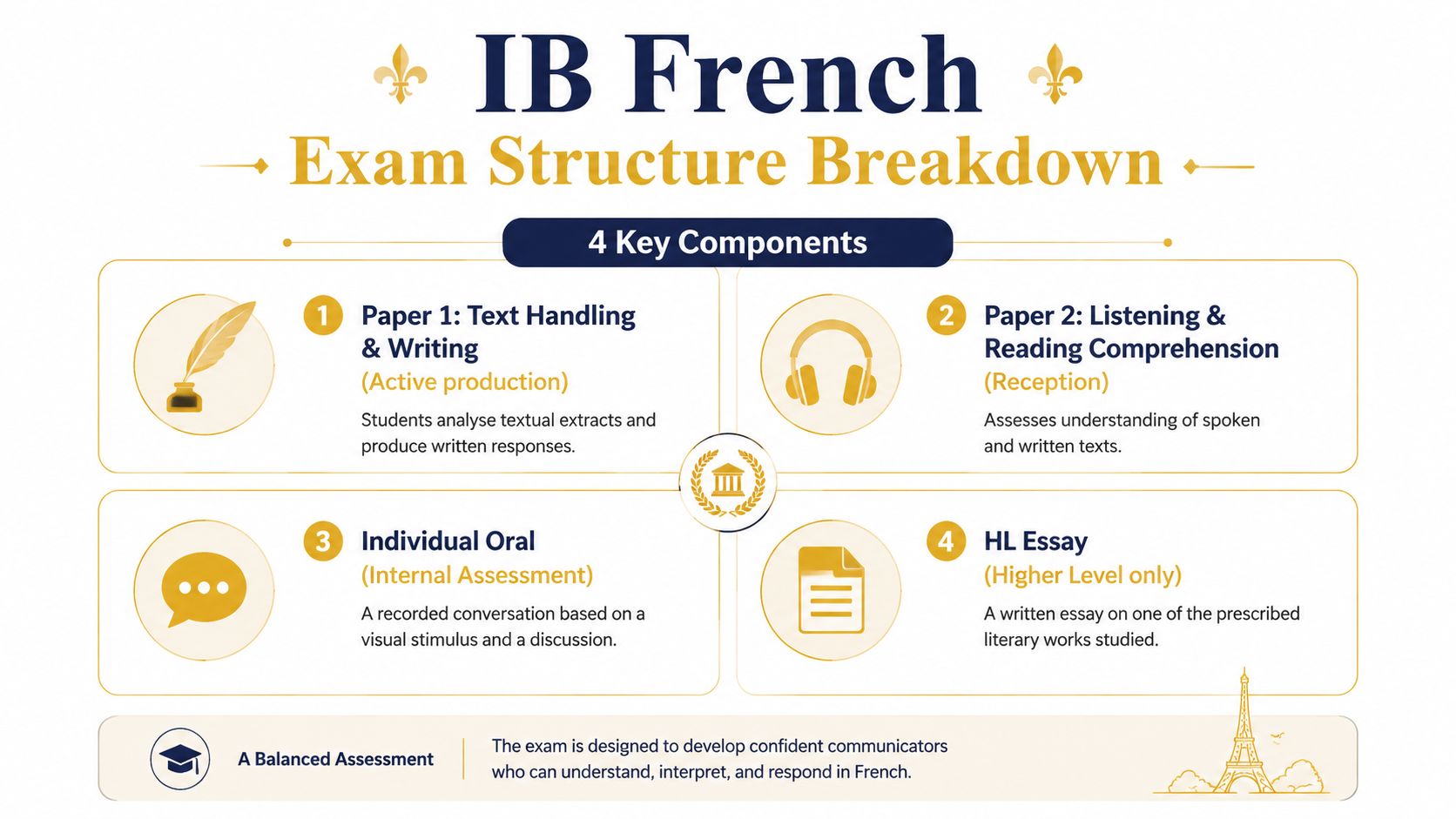
The official Language B outline assigns 75% to external assessment. Paper 1, the productive writing paper, represents 25%, while Paper 2, covering receptive listening and reading skills, represents 25% in the cited outline. The individual oral makes up the remaining 25% and is marked out of 30. The Language B assessment outline provides those component weightings.
What each component demands
Paper 1 asks students to produce a written response from a choice of tasks. The challenge isn't inserting impressive connectors. Students must identify the purpose, audience, and register, then develop a clear response while controlling grammar.
Paper 2 tests reception. Reading allows the student to revisit language on the page, while listening moves forward and demands rapid recognition. A capable writer may still lose marks here because written vocabulary knowledge doesn't automatically transfer to authentic-speed audio.
The individual oral assesses spoken production and interaction. Students need to describe or analyse the stimulus, develop a message, and respond naturally to questions rather than deliver a memorised speech.
HL work adds a literature-based discussion component, increasing the need for analysis and flexible responses. The IB French class structure resource is useful when a family wants to compare classroom support with the specific exam skills being assessed.
The oral format also varies by level. Ab initio generally provides about 15 minutes of preparation and 7 to 10 minutes of speaking, within a 22 to 25 minute total window. SL and HL generally provide 15 to 20 minutes of preparation and 12 to 15 minutes of speaking, within a 27 to 30 minute total. HL's literature discussion means the student must move from stimulus work to analysis and then live follow-up under pressure. This French B exam overview outlines those format differences.
I usually advise students to diagnose before purchasing more material. Complete one timed writing task, one reading and listening exercise, and one recorded oral. The pattern of errors will show whether the next investment should be a listening subscription, writing marking, or specialist oral coaching.
What a 7 Looks Like in the IB French Oral
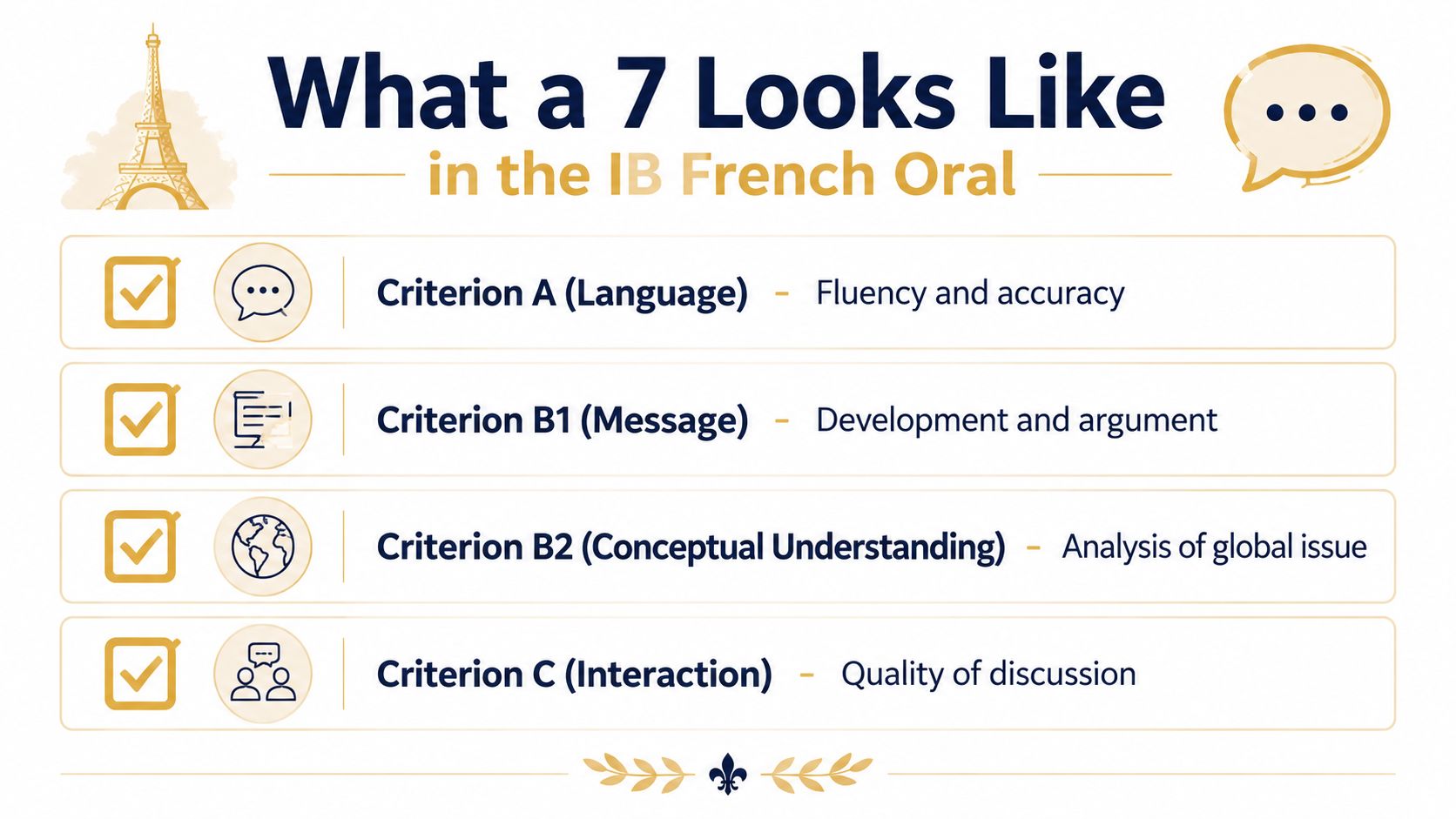
A strong oral isn't a memorised monologue delivered without interruption. The individual oral is scored out of 30 marks across four criteria: Criterion A, Language, is worth 12 marks; Criterion B1, Message through the visual stimulus, is worth 6; Criterion B2, Message through conversation, is worth 6; and Criterion C, Interactive skills, is worth 6. The oral assessment breakdown explains that weighting.
Criterion A and language control
A student may sound fluent but still lose marks through repeated tense errors, weak agreement, or narrow vocabulary. Consider this student-style answer:
Dans cette image, les personnes travaillent ensemble. Ils sont dans une communauté et c'est important parce que les jeunes doivent aider les autres. Hier, ils ont organisé une activité et maintenant ils vont faire beaucoup de choses pour améliorer la société.
The message is understandable, but les personnes followed by ils creates an agreement problem, and the language remains general. A stronger response would use accurate structures and more specific vocabulary, such as participation, responsibility, access, or inclusion, only when those ideas connect to the stimulus.
Criteria B1 and B2
For the visual stimulus, the student must develop a relevant message, not recite background knowledge. Description should lead to interpretation. At HL, the student also needs to connect the stimulus to a global issue and sustain analysis rather than naming a social problem.
Students often prepare too much unrelated cultural information. The examiner is assessing how effectively the student responds to the stimulus and develops the required message, not how many facts they can remember.
Criterion C and interaction
The conversation rewards listening as much as speaking. A student who gives polished prepared answers but ignores the question may sound fluent while demonstrating weak interaction. Practise answering in three moves: acknowledge the question, give a direct response, and extend it with a reason, example, or contrast.
For home practice, listen for these signs:
- Language: Are errors occasional, or do they repeatedly obscure meaning?
- Message: Does the student develop ideas, or only describe visible details?
- Analysis: Can they explain why the issue matters?
- Interaction: Do they answer the actual follow-up question without restarting a memorised paragraph?
A useful oral coach should record performances, mark each criterion separately, and identify one change for the next recording. Advanced French conversation lessons can be relevant when the student's main weakness is spontaneous response rather than basic grammar.
The oral is internally assessed by the teacher and externally moderated after recording, so preparation needs to reflect both live performance and careful evidence of the student's level. This 2026 oral guide describes the typical 12 to 15 minute oral format and moderation process.
Your 8 Week IB French Study Plan
An eight-week plan works best when every session produces something reviewable. I'd allocate roughly 5 to 7 hours per week, adjusted around the student's other IB subjects, and keep a single error log for grammar, vocabulary, comprehension, and interaction.
Weeks 1 and 2 build the diagnostic
Week 1, identities: Complete a timed Paper 1 task, a reading and listening sample, and a recorded oral. Don't correct everything immediately. First, identify the repeated problems that affect marks.
Week 2, experiences: Review past tenses, agreement, pronouns, and useful opinion structures. Write a 200-word Paper 2 draft on an experiences-related prompt, then revise it using the assessment criteria. For listening, use a short segment from RFI Journal en français facile, listen for the overall meaning, replay for details, and check a transcript where available.
The structured French study plan can give families a wider framework, but the diagnostic should still be personal. A schedule only helps when it responds to the student's actual errors.
Weeks 3 to 5 target written marks
Week 3, human ingenuity: Complete a timed Paper 1 unseen text analysis or writing task, depending on the course requirements. Focus on purpose, register, and paragraph development rather than decorative vocabulary.
Week 4, social organization: Drill the subjunctive in useful contexts, then write another timed response. Ask a teacher or tutor to mark errors by category. “Grammar” is too broad to guide improvement. “Past-tense selection in narratives” is actionable.
Week 5, sharing the planet: Rewrite a previous Paper 1 response under timed conditions. Compare the original and revised versions. The student should be able to explain which changes improved clarity, accuracy, or relevance.
Weeks 6 to 8 prepare performance
Week 6, identities and global issues for HL: Record an oral mock and practise follow-up questions. The student should answer without reading a script, while still using a clear structure.
Week 7, experiences: Complete a listening dictation from RFI and review every missed phrase. Then conduct a second oral recording, focusing on one rubric criterion that remained weak.
Week 8, sharing the planet: Sit a full past paper under timed conditions. Review it with the official criteria, not just the raw result, and list the final priorities for the remaining preparation period.
Two habits deserve protection throughout: weekly speaking practice and one full past paper every fortnight. They reveal problems that vocabulary revision can hide.
Resources and Tutoring Options Compared
Families don't need the most expensive preparation package. They need the right combination of input, structured practice, and feedback. Free resources can supply listening exposure, but they rarely tell a student why a response missed marks. Premium platforms may provide more organised material, but they still require the student to use it consistently.
| Option | Typical Cost | Best For | Key Limitation |
|---|---|---|---|
| RFI Journal en français facile and TV5Monde | Free | Building regular listening and vocabulary exposure | Limited personalised correction |
| IB past papers through the OCC | Free or school-access dependent | Timing and exam familiarity | Students may misjudge their own answers |
| Oxford IB Diploma Programme French B textbook | Paid textbook | Following a structured course and practising task types | Doesn't replace live speaking feedback |
| IB vocabulary lists and Quizlet decks | Free or low-cost | Retrieval practice and thematic review | Memorisation alone won't build interaction |
| InThinking or Stimmt | Paid subscription or course resource | Guided exam preparation and broader practice | Quality depends on how actively the student uses it |
| One-Exam marking services | Paid per marking arrangement | Students who need written correction | Usually narrower than ongoing coaching |
| Small online group | Varies by provider | Accountability and shared practice | Less individual speaking time |
| One-to-one online IB tutor | Varies by provider | Targeted oral, writing, and diagnostic feedback | Requires regular scheduling and independent follow-through |
| In-person private tutor | Varies by provider | Students who work better face to face | Geography can restrict choice and flexibility |
Matching support to the actual gap
Choose free listening resources when the student avoids audio practice. Choose a textbook when work lacks sequence. Choose marking when the student writes regularly but can't identify recurring errors.
Tutoring quality matters most for the oral because students need an informed listener who can interrupt the cycle of memorisation and vague feedback. A tutor should be able to mark the criteria separately, explain why an answer sits at its current level, and create a better version without writing the student's response for them.
A blended approach often makes practical sense: authentic listening input at home, one dependable textbook, and individual online sessions during the final preparation period. Elite French Tutoring offers private online and in-person French lessons, including customised support for students and families, so it's one option to compare with school provision, group courses, and independent study.
Before paying, ask for a sample correction or diagnostic conversation. You're looking for precise comments such as “your answer is relevant, but the second idea isn't developed,” not general praise or a promise of a particular grade.
A Real Student Story From 4 to 7
Maya entered Year 12 at an international school in Singapore with a predicted 4 in French B SL. Her vocabulary had noticeable gaps, her past tenses were unreliable, and she panicked during the individual oral whenever the teacher moved beyond the first prepared question.
We built an eight-week plan around the weaknesses rather than adding more general revision. Maya had two private sessions each week focused on the oral criteria, a daily 15-minute listening habit using RFI, and timed Paper 1 rewrites every Saturday. Her tutor recorded each oral, separated language accuracy from message and interaction, and selected one priority for the next attempt.
The first turning point came when Maya produced a clean individual oral recording without restarting after every hesitation. She still made errors, but she developed the stimulus instead of listing details. The second came during listening practice. She stopped translating each sentence in her head and began recognising familiar phrases as complete units.
Her Saturday writing routine produced a quieter improvement. On the first attempts, she often spent too long deciding what to say and finished without reaching her target word count. After practising outlines and timed paragraphs, she completed a Paper 1 response within the required conditions and reached the target word count without filling space with repetition.
Maya ultimately achieved a 7 in IB French B SL. That result supported her university applications, but the more useful lesson was the process. She didn't become fluent overnight. She practised the exact behaviours the assessment rewarded, reviewed recorded evidence, and used tutoring for feedback she couldn't reliably provide herself.
Your Next Move Toward a 7 in IB French
Use three decisions this week. Each one should produce a clear deliverable, so preparation doesn't remain a vague promise.
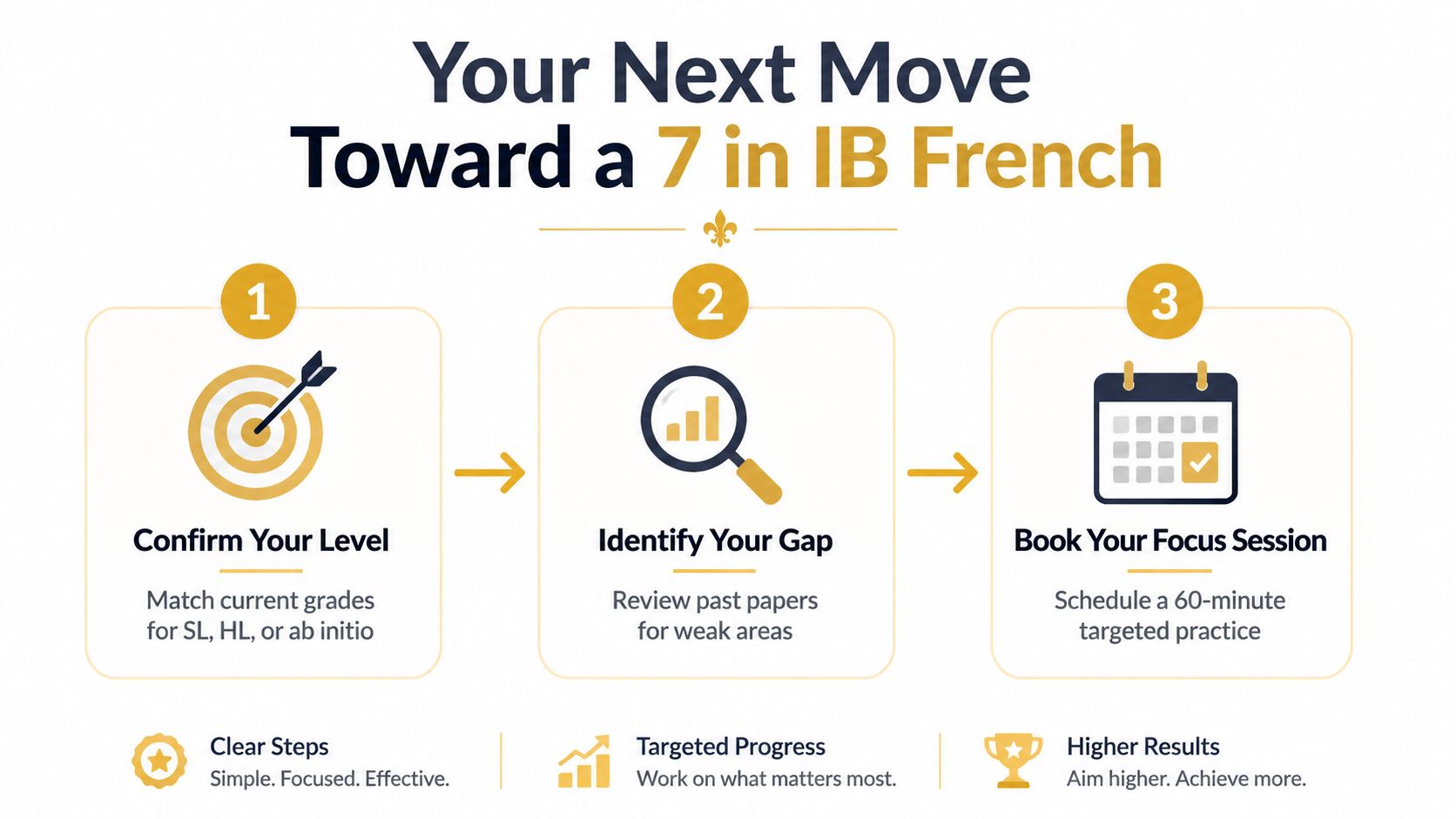
Confirm the level
By Friday, compare the student's current grades, timed writing, reading speed, oral confidence, and tolerance for written workload. Discuss university requirements, but don't choose HL for prestige if the student's present trajectory suggests SL would protect the wider diploma.
Identify the gap
By Sunday, complete one timed past paper and one recorded oral. Use the official assessment criteria to label the weakness. Is it language control, stimulus development, listening accuracy, written organisation, or interaction? A diagnosis turns “I'm bad at French” into a decision about where the next hour should go.
Book the right support
Match the format to the problem. Independent study can work for a disciplined student who needs vocabulary and listening input. A group course can add accountability. A private IB French tutor is more suitable when the student needs repeated oral practice, detailed Paper 1 correction, or help adapting responses under pressure.
Parents often wait for the next report before acting, but a timed diagnostic can reveal the problem earlier. Students also benefit from knowing exactly what the tutor will review, which rubric criterion will be targeted, and what they'll practise between sessions.
If your child is unsure about level choice or keeps losing marks in the oral and Paper 1, book a free 20-minute consultation with Elite French Tutoring to discuss the diagnostic evidence, compare online or in-person options, and decide whether targeted IB French support fits your family's schedule.