

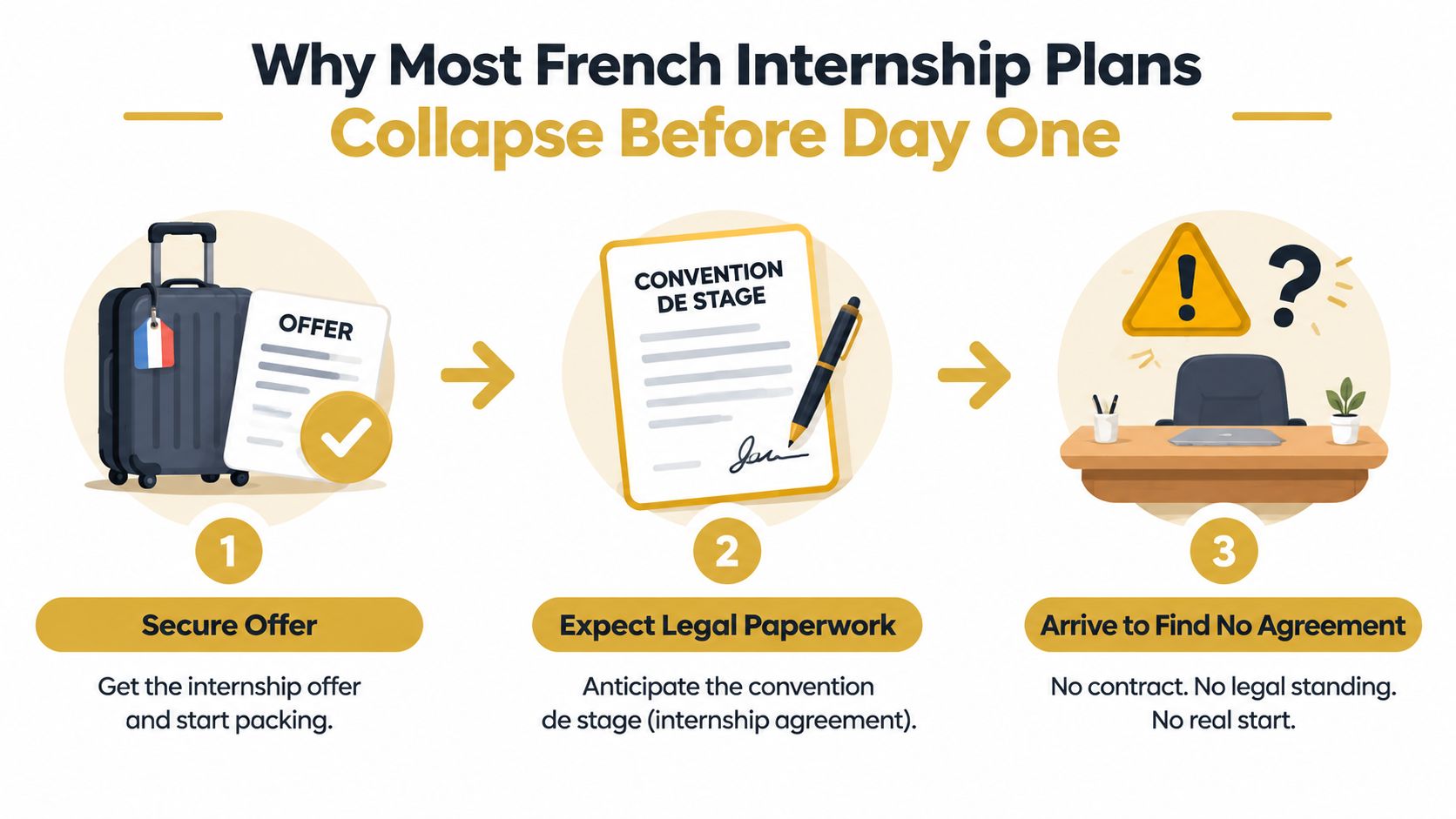
You can have the offer, the Paris address, and the dream title on the email. If the convention de stage is missing, your internship in France can still be dead on arrival. That's the trap many miss, because they treat the search like a résumé problem when it's really a compliance problem first.
I've seen the same story repeat: a student signs with a glamorous host company, books housing, and only later learns the placement can't legally start because the paperwork never left HR. France does not run internships as casual work experience. It runs them as a regulated training pathway, with the company, the school, and the intern each holding a piece of the approval chain, and with hard limits on duration and pay under the Cherpion Law and later caps on internship volume Eurofound's summary of France's strengthened internship regulation.
The smart way to approach internships in France is to stop thinking in terms of “apply, interview, accept” and start thinking in terms of legal eligibility, search channels, and visa viability. If you get those three right, the job search becomes simpler. If you get them wrong, even a strong offer can collapse under paperwork, timing, or stipend confusion.
Table of Contents
- Why Most French Internship Plans Collapse Before Day One
- Eligibility, the Convention de Stage, and the Pay Rules You Must Know
- Where to Actually Find Internships in France That Convert
- CV, Cover Letter, and Email Templates That French Recruiters Expect
- Visa and Work-Permit Reality for Non-EU Applicants
- Best Sectors and Cities to Target in 2026
- How French Tutoring Lifts Your Odds and Your 90-Day Action Plan
Why Most French Internship Plans Collapse Before Day One
A Master's student lands a polished offer from a Paris luxury house. She clears the interview, buys a train ticket, and starts looking for a flat. Then HR admits the school never issued a convention de stage, so she can't legally begin. That's the failure pattern, and it happens because people assume the offer itself is enough.
The three places plans break
The first mistake is ignoring the convention de stage, the tripartite agreement signed by the student, the host company, and the educational institution. French guidance treats that document as the backbone of the placement, not a formality. The second mistake is misunderstanding duration, especially the 6-month ceiling that is commonly expressed as 924 hours of actual presence in official internship documentation official convention materials.
The third mistake is treating the stipend as optional after the first month. It isn't. Once the internship crosses the legal threshold, compensation rules kick in, and the practical payroll logic matters as much as the offer letter service-public internship guidance.
Practical rule: if the school office hasn't approved the placement in writing, the internship isn't ready, no matter how enthusiastic the recruiter sounds.
France also controls internship volume at the company level. Firms with 20 or more employees cannot use interns for more than 15% of their workforce, while firms with fewer than 20 employees are capped at three interns Eurofound. That tells you exactly what kind of market you're dealing with. This is a regulated training system first, a recruiting market second.
What this means for your search
The bottleneck isn't “Can I get attention?” It's “Can the host company and the school finish the legal chain on time?” That's why I push clients to verify the paperwork path before they fall in love with the brand name.
If you want the tactical version of the process, keep reading with the legal map in mind, because the rest of the playbook is built around the things generic guides skip until it's too late.
Eligibility, the Convention de Stage, and the Pay Rules You Must Know
A French internship fails fast when people treat it like a normal job offer. The legal chain comes first: school, host company, and intern must all be bound by the convention de stage. If you are an international applicant, the placement also has to fit your residence status and student situation, so check the immigration side before you sign anything service-public guidance for foreign interns.
The legal pillars that matter
Start with the agreement itself. It is a three-party educational placement, not an offer letter and not a freelance contract with nicer branding. Then check duration. Official guidance sets the threshold at more than 44 days or more than 308 hours of actual presence, and the internship cannot exceed 6 months, which the convention materials express as 924 hours service-public internship rules, official convention materials.
Pay is the next trap. Once the placement crosses the threshold, the host owes a mandatory gratification, not a salary. In 2026, the legal floor is €4.50 per hour because the hourly social-security ceiling rises to €30 from €29 Business France guidance, service-public 2026 update. That works out to about €660 to €693 a month on a standard full-time month calculation derived from that hourly floor. Below the threshold, payment is optional.
Do not stop at the phrase “paid internship.” Check whether the placement crosses the legal threshold, whether the hours are consecutive or cumulative, and whether the host is counting actual presence correctly.
Internship Pay Triggers in France 2026
| Internship Duration | Compensation Required? | Monthly Gross Amount | Calculation Basis |
|---|---|---|---|
| Below the legal threshold | No, optional | Not fixed by law | Host discretion |
| Above the legal threshold | Yes, mandatory | About €660 to €693 in 2026 | Legal floor of €4.50/hour and standard full-time month calculation |
The biggest mistake is retroactive paperwork. If a company says it can “issue the convention later,” stop the process until the school approves it. The second mistake is classification abuse, where a host tries to treat the intern as a freelancer to sidestep the internship rules. That is a compliance failure, plain and simple.
Send the offer to your school's service des stages before you accept. That is the fastest way to avoid a legal mess you cannot fix after arrival.
Where to Actually Find Internships in France That Convert
Spraying applications across every platform they can find, then wondering why the replies feel dead, is a bad search strategy. In France, the better approach is a 60/30/10 mix, where most of your effort goes into warm channels, not mass-market listings.
The channels that deserve your time
University career services should be your first stop. Career Center, JobTeaser, and school-specific alumni portals usually produce better conversations because the company already trusts the institution. Aggregators like Indeed France, Welcome to the Jungle, and LinkedIn are still useful for reach, but they're noisy. Sector boards such as L'Étudiant, AEF Info for public-affairs roles, and ChooseYourBoss for tech are stronger when you already know your lane.
Direct-company career pages are underrated. Small and mid-sized French employers often post fewer roles publicly, which means they're also less flooded. That's where a targeted message can beat a generic apply button. You'll also do better if you work the carnet de réseau reality, because relationships still secure roles the algorithms never surface.
Here's the comparison I give clients:
| Channel | Best For | Response Quality | Best Use |
|---|---|---|---|
| University career services | Warm leads | High | Start here |
| Aggregators | Volume | Mixed | Fill the pipeline |
| Sector boards | Targeted fit | Better than broad job boards | Narrow by industry |
| Direct company pages | Hidden openings | Often strong | Focus on smaller firms and niche teams |
I've found that alumni intros and referrals tend to convert much more reliably than cold applications, while broad aggregators usually need far more volume to get movement. That's why I tell students to send three informational coffee requests per week, keep a live tracker, and prioritize small-to-mid companies that don't have polished internship funnels.
If you want a practical job-opportunities overview alongside this search strategy, see this work opportunities guide for France.
CV, Cover Letter, and Email Templates That French Recruiters Expect
French recruiters don't want a bloated autobiography. They want a tight one-page CV, a focused lettre de motivation, and a short email that shows you understand the company you're contacting. If your application reads like a generic Anglo-American template, it feels lazy fast.
What the documents should look like
For the CV, keep it clean, direct, and readable. A photo is still common in France, but the rule is consistency and clarity, not decoration. Put the company name in the cover letter with precision, because French recruiters notice when you paste a generic template and forget to change the employer.
For the letter, stay within one page. Open with the role, name the company, connect your profile to the mission, and close with a proper formule de politesse. “I am a fast learner” doesn't carry much weight on its own. Replace it with concrete evidence, action verbs, and actual outcomes.
A short candidature spontanée email should look like this:
Subject line: Candidature pour un stage en [domaine], [votre prénom nom]
Body:
Bonjour [Madame/Monsieur Nom],
Je vous contacte au sujet d'un stage en [domaine] chez [nom exact de l'entreprise]. Mon parcours en [formation] m'a permis de développer [compétence concrète]. Je serais ravi(e) de pouvoir contribuer à [activité, projet, service].
Vous trouverez ci-joint mon CV et ma lettre de motivation.
Cordialement,
[Prénom Nom]
[Téléphone]
[Email]
Use pièce jointe correctly, and make the file names obvious. Recruiters and assistants skim quickly, and a sloppy email lands in the wrong pile.
If your French is shaky, don't hide behind vague English phrases. Write shorter sentences, use stronger verbs, and let the structure do the work.
If you want a deeper model for the letter itself, compare your draft with this French cover letter guide. It's the fastest way to see whether your wording sounds native enough to survive a French inbox.
Visa and Work-Permit Reality for Non-EU Applicants
Non-EU applicants cannot treat the visa as an afterthought. The internship has to fit the school file, the host company's timing, and the visa route at the same time. If one piece is off, the offer may be valid on paper and useless in practice.
The pathway that works
For longer stays, the internship should be tied to an academic program and attached to the convention de stage in the long-stay visa process. The residence-resource requirement also matters, and the official guidance points to a monthly threshold around €615. Plan for that paperwork early, because the visa file is where many good offers stall.
Shorter internships can fit under visa-waiver rules in some cases, but nationality, duration, and academic status decide the outcome. The key point is simple, the internship is not treated like ordinary student work. Official guidance also says internships do not count toward the 964-hour annual student-work limit in the relevant contexts.
| Pathway | Max Duration | Key Documents | Processing Risk |
|---|---|---|---|
| Short academic internship | Short stay | Convention de stage, school approval, identity and travel papers | Moderate if timing is tight |
| Long-stay student route | Longer stay | Visa application file, convention de stage, proof of housing, resources | Higher because the file must align |
| Residence-permit adjustment after arrival | Depends on status | Current permit, school enrollment, host agreement | Moderate, but only if eligibility is clean |
A recent official update also points to a draft 2026 reform that would move internships closer to employment-contract logic from 2027. The direction is clear, more formalization, not less.
The documents that derail non-EU files are usually boring ones. Missing housing proof, mismatched school dates, and a convention that is not fully integrated into the visa packet cause most of the damage.
If you want a practical check on the process, use this work visas in France guide.
Best Sectors and Cities to Target in 2026
Not every sector is equally friendly to interns, and not every city fits every profile. If you chase prestige first, you usually end up with more friction. If you match the sector to the city and your degree level, you get a cleaner shot.
The strongest city-sector pairs
Paris La Défense is the obvious target for finance and consulting. If you're going after structured internship pipelines, that's where you'll find the most familiar corporate logic. Paris 1st to 8th arrondissements and Lyon are stronger for luxury and fashion, where brand name and polish matter more than raw technical depth.
Toulouse makes sense for aerospace and AI, especially if your profile leans technical or engineering-heavy. The Côte d'Azur is better for hospitality and events, where seasonal pressure and client-facing work shape the internship structure. Strasbourg and Brussels-adjacent programs fit EU public affairs, policy, and institutional work.
Here's the cleanest way to understand it:
- Finance and consulting: choose Paris if you want formal processes and corporate internship conventions.
- Luxury and fashion: choose Paris or Lyon if your portfolio and French presentation are strong.
- Tech and engineering: target Toulouse and selected Paris teams if you want more technical substance.
- Hospitality and events: focus on the Riviera if you can handle fast-paced service environments.
- Public affairs: look at Strasbourg first, then nearby EU-linked pathways.
A lot of weak advice tells you to apply everywhere. I don't recommend that. Apply where your degree level matches the internship structure, because the wrong fit usually ends in vague feedback or an offer that never gets through school approval.
Structured companies usually handle the convention de stage cleanly. Ad-hoc employers often don't. That difference matters more than the logo on the offer letter.
How French Tutoring Lifts Your Odds and Your 90-Day Action Plan
French language ability isn't a nice extra. It shapes whether you get the interview, whether you survive the interview, and whether you can function on day one. In Paris especially, employers often expect at least B1 or B2-level practical ability in real workplace settings, even when the role looks partly English-facing.
Where language changes the outcome
Recruiters notice hesitation immediately. A candidate who can explain a project in plain French usually beats a candidate with a stronger résumé but weaker spoken delivery. Written French matters too, because cover letters, follow-up emails, and school paperwork all expose the same weakness if you've been relying on translation apps.
A tutoring plan should map onto your internship timeline, not sit outside it. Here's the schedule I'd use:
- Weeks 1 to 4, eligibility and audit. Check your paperwork, review your actual French level, and identify the gaps in spoken and written delivery.
- Weeks 5 to 10, parallel applications. Translate and localize your CV, draft your letter, and practice answering role-specific questions in French.
- Weeks 11 to 12, interview prep. Run mock entretien sessions, focus on pronunciation, and drill concise answers.
- Weeks 13 onward, visa lodging and arrival logistics. Practice practical French for housing, HR, and daily office life.
The right tutoring intervention changes by phase. Early on, I'd prioritize letter review. Midway, I'd use mock interviews. Right before departure, I'd switch to telephone French drills and workplace scenarios.
The goal isn't perfect French. The goal is enough fluency to stop language from becoming the reason a good internship dies.
If you're deciding whether private French support is worth it for this process, read our guide to whether a French tutor is worth the investment. And if you want a quick diagnostic, book a focused session so we can pressure-test your CV, interview answers, and internship plan before you commit to the wrong offer.
If you're serious about internships in France, don't wait until an offer lands to check the legal side. Book a free 20-minute consultation with Elite French Tutoring, and we'll help you tighten your French, review your application materials, and build a plan that fits the convention de stage, the visa file, and the role you actually want.