Skip to content

If you're chasing work opportunities in France with the idea that fluent French is the only way in, you're aiming at the problem backwards. The barrier isn't perfection, it's knowing where English is accepted, where French is required, and which regions are hiring instead of just looking attractive on paper.
Most generic advice blurs those lines and wastes your time. I don't. The candidates who move fastest are the ones who stop applying everywhere and start targeting the right sectors, the right contracts, and the right geography with a blunt strategy.
Table of Contents
- Where English Actually Works in the French Job Market
- The Scale of Opportunity in France Right Now
- Top Hiring Sectors and Where the Real Shortages Are
- Navigating Visas and Work Permits Successfully
- Job Search Strategies That Actually Work in France
- Regional Opportunities Beyond Paris
- Why Language Preparation Is Your Highest-ROI Investment
Where English Actually Works in the French Job Market
You do not need perfect French to get hired in France, but you do need to stop pretending every “English-speaking job” listing is equally real. English can work at hiring time in international companies, some tech teams, and roles where the day-to-day work happens mostly with internal colleagues. It breaks down quickly in public-facing jobs, regulated environments, and apprenticeship pathways where local paperwork, supervisors, or clients expect French from day one.

The language line that matters
Independent guidance on expat hiring in France keeps coming back to the same point, a good command of French is generally required even when opportunities exist. That matters because the threshold isn't just about your résumé language, it's about how much of the job is exposed to customers, public institutions, or local compliance rules. The labor market is also highly regulated, which means recruiters often screen for language fit earlier than candidates expect, especially outside multinational offices. See the broader hiring context in the expat job market guide for France.
Practical rule: if the role needs you to explain, negotiate, sell, schedule, or solve problems with French clients, assume French is required unless the employer says otherwise in writing.
Where English can be enough
English is most realistic in international companies, software and data teams, and some corporate roles where the working language is already English. It can also be enough when the job is tied to export markets, multinational stakeholders, or a very technical function with limited external contact. That said, even in these environments, French usually becomes the difference between surviving and advancing.
Here's the filter I use with candidates. If the job ad is in English, the team page is bilingual, and the recruiter responds in English without hesitation, the role is probably worth pursuing. If the ad is translated awkwardly, the employer's website is French-first, and the interview process suddenly shifts into French, treat that as a warning, not a hurdle to “push through.”
Where French is not optional
French is functionally required in public-facing jobs, healthcare, education, apprenticeships, and most regulated sectors. It's also the safer assumption for operational roles where written instructions, shift handovers, and local compliance matter. People lose time when they treat these as “maybe English-friendly” opportunities. They usually aren't.
For readers comparing options, this is the simplest decision rule. If you want speed, aim for international teams or technical roles. If you want broader access and a stronger long-term career path, invest in French before you apply.
The Scale of Opportunity in France Right Now
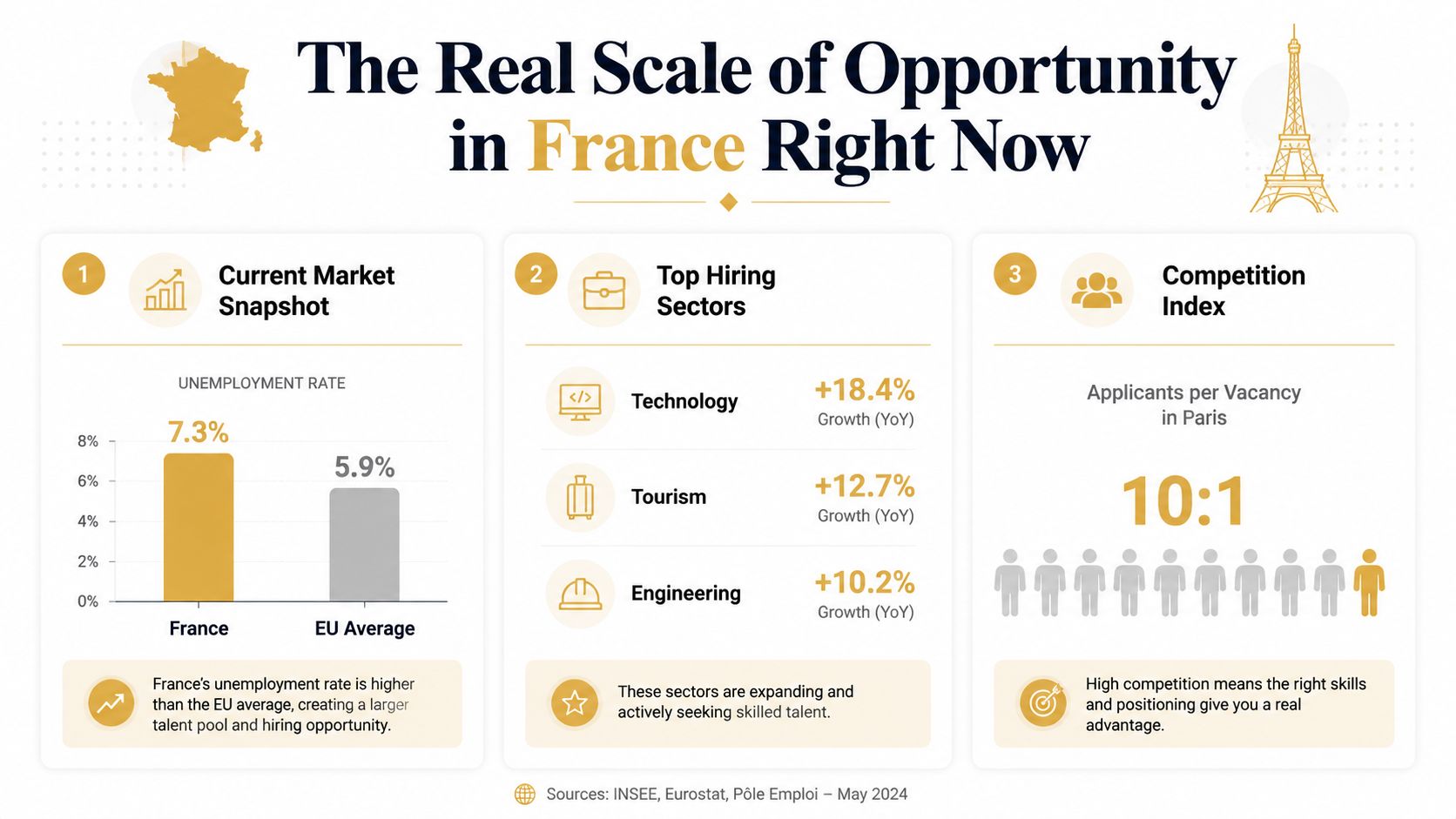
France's labour market still offers openings, but anyone treating it as easy is already making a mistake. In 2025, the employment rate for people aged 15 to 64 reached 69.3%, the highest level since 1975, while the activity rate rose to 75.1%. Unemployment also moved up slightly to 7.7%, though it remained 2.7 points below its 2015 peak. The message is straightforward. There is momentum in the market, but access is uneven across skill levels and sectors. INSEE labour market data for 2025
Why the headline numbers matter
Those numbers matter because they tell you how to search. France is open, but it does not hand out easy wins. With part-time work at 17.7% and underemployment at 4.4% in the same 2025 report, you need to judge whether a role gives you real stability, not just a quick entry point. Many candidates accept work that sits below their skill level because they apply too broadly or move before they have a clear target.
Remote work is now part of normal hiring. 19.7% of employees worked remotely in 2025, which means flexible arrangements are no longer reserved for a narrow slice of digital employers. If you want remote or hybrid work in France, build that into your search from the start. Do not assume it will appear later by accident. INSEE labour market data for 2025
The hiring pipeline is still large
France Travail reported 2.4 million new job offers in the first quarter of 2026, and its national database showed 9,293,980 offers published over the previous 12 months. That is a large pipeline, and it matters because openings keep getting replenished across the economy. France's private-sector vacancy rate was 2.2% in the fourth quarter of 2025, which points to the same conclusion. Demand is real, but access is uneven. See the national offer database at France Travail's job-offer statistics portal
The practical takeaway is simple. If you bring the right skills and the right language profile, France offers meaningful work opportunities. If you send applications everywhere without a target, competition will catch up fast.
Top Hiring Sectors and Where the Real Shortages Are
The biggest mistake job seekers make in France is obsessing over glamorous office roles while ignoring the sectors where employers struggle to hire. EU labour-market data point to shortage occupations in science and engineering associate professionals, building and related trades workers, and metal and machinery trades workers. That's not the polished narrative most expats want to hear, but it's the one that gets people hired faster.
| Sector | Shortage Level | Growth Projection | English Accessibility |
|---|---|---|---|
| Science and engineering associate professions | High shortage | Stable demand, especially for technical profiles | Medium, stronger in international firms |
| Building and related trades | High shortage | Steady demand from local projects and maintenance work | Low to medium |
| Metal and machinery trades | High shortage | Persistent demand for hands-on technical roles | Low |
| Human health and social work | High vacancy pressure | Strong demand in care-related services | Low |
| Education | High vacancy pressure | Ongoing need for qualified staff | Low |
| Arts, entertainment, recreation | High vacancy pressure | Role availability varies by employer and venue | Medium, but uneven |
| Public administration | High vacancy pressure | Structured demand, often local and formal | Low |
| Administrative and support services | High vacancy pressure | Broad need across firms and institutions | Medium |
| ICT services | Strong growth projection | Leading employment growth through 2030 | Medium to high in international teams |
| Accommodation and food services | Strong growth projection | Continued job creation through 2030 | Low to medium |
| Health and social care | Strong growth projection | Continued job creation through 2030 | Low |
Recent EU labour-market profiles for France show the highest-shortage groups and the highest vacancy-rate sectors, which is exactly why generic “apply in tech or healthcare” advice misses the point. For 2024, France's highest-shortage occupational groups included science and engineering associate professionals, building and related trades workers, and metal/machinery trades workers, while the highest vacancy rates were in human health and social work, education, arts/entertainment/recreation, public administration, and administrative/support services. The more useful strategy is to target the exact role family, not the vague industry label. EURES labour market information for France
Where international candidates have the best odds
If you're coming in from abroad, ICT services is the cleanest medium-term bet because Cedefop projects it to lead employment growth in France through 2030. That projection is followed by accommodation and food services, then health and social care. For candidates, that means the smartest search isn't always “best-paid office job.” Sometimes it's the sector where the shortage is persistent and the employer is willing to move faster. Cedefop France profile
Why I push shortage occupations over generic job boards
Generic job boards are fine for browsing. They are not a strategy. If you have a technical background, look at shortage occupations first. If you're retraining, look at temporary channels, employer-direct outreach, and apprenticeship paths before you spend weeks mass-applying to bilingual corporate roles that don't need you.
A student I worked with, a data analyst from outside the EU, stopped chasing broad “international jobs in Paris” listings and focused on employer-direct outreach in tech and support roles with real hiring pressure. She got interviews faster once she rewrote her CV around deployable skills, not titles, and once she accepted that some openings were English-friendly only at the first stage. That shift saved her months.
Navigating Visas and Work Permits Successfully
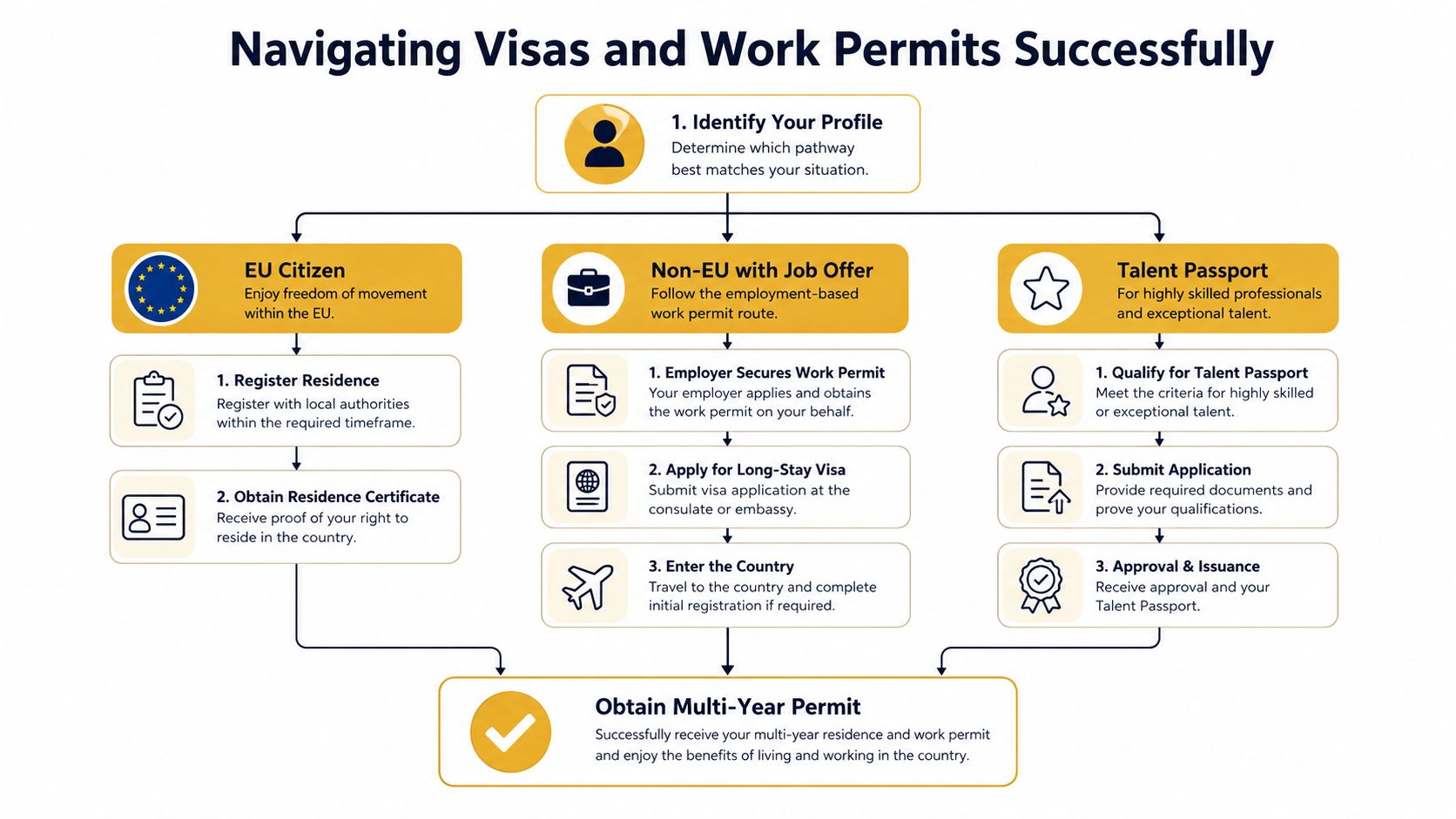
Visa problems get messy when people apply before they know which route fits them. Start with your profile, not with random forms. If you're an EU citizen, the path is much simpler. If you're non-EU, your job offer, study status, or professional profile determines the permit route you should pursue.
Pick the right route first
The Talent Passport is the route to watch if you're a highly skilled professional, because it's built for profiles that employers want to retain. Students often have a different advantage, since a student visa can include work authorization under the right conditions. Remote workers and digital nomads need to be careful here, because “working from France” and “working in France under a French permit” are not the same legal question. If your plan is tied to a relocation or an international employer, use the work visa guidance for France before you lock in a move.
What to get right before you apply
You need clean documents, a matched job description, and a permit path that fits your actual work arrangement. The most common mistake I see is candidates treating the visa as an afterthought, then discovering their employer can't support the category they picked. Another common error is assuming a remote arrangement gives them broad freedom to work any way they want. It doesn't.
Keep the employer and the permit aligned. If those two don't match, delays follow.
Business France reported that its 2025 foreign investment projects created or maintained 47,734 jobs across 1,878 international investment projects in France. That matters because multinational employers, relocation teams, and inward investment clusters often have more predictable mobility processes than small local firms. If you're targeting a transfer or an internationally backed role, focus on companies with a real mobility structure, not just a French office address. Trade.gov's France market opportunities guide
A fast decision framework
Use this before you submit anything.
- EU citizen: apply directly for jobs, then formalize residency steps after arrival.
- Non-EU with an offer: verify whether the employer is responsible for work authorization.
- Student profile: confirm the work allowance attached to the visa.
- Highly skilled candidate: test the Talent Passport route early.
- Remote worker: check the legal basis for your stay before you assume flexibility.
If you want a smoother relocation, start your permit planning before serious interviews begin. That's where strong candidates separate themselves from hopeful applicants.
Job Search Strategies That Actually Work in France
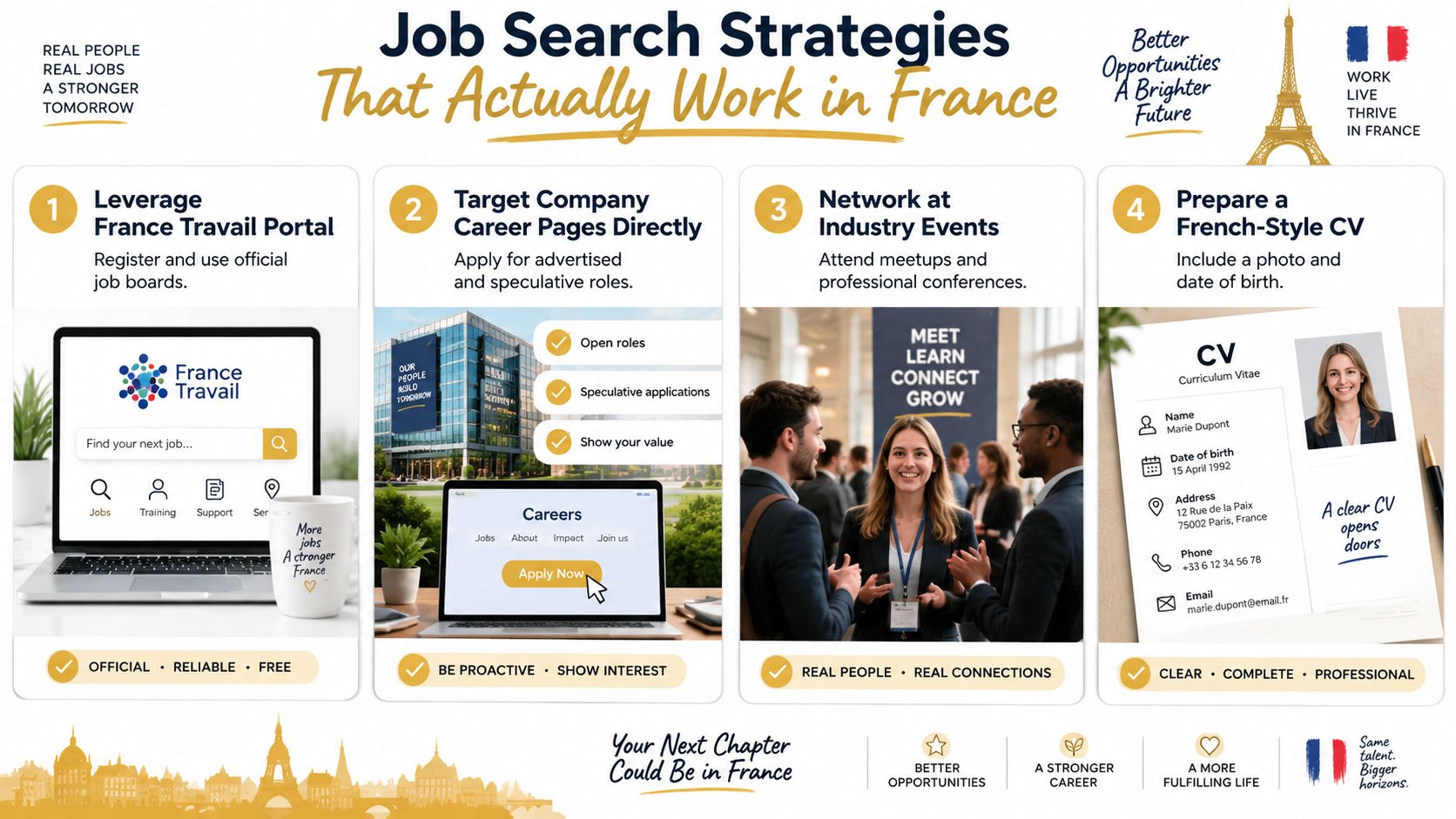
France rewards candidates who use the channels French employers trust. France Travail, company career pages, and direct outreach matter more than endless scrolling on global job boards because the market still runs on local rules and local habits. The people who get traction are the ones who apply like insiders, not tourists.
The channels I'd use first
France Travail is the obvious starting point because it reflects the domestic labour market, not just the expat bubble. Company websites matter just as much, especially for roles where hiring managers want proof that you've taken the time to understand the business. Ministry apprenticeship portals are worth a look too, because they expose paths that don't show up cleanly on English-language boards.
The hiring volume is large enough to make this worthwhile. France Travail reported 2.4 million new job offers in the first quarter of 2026, and 9,293,980 offers over the previous 12 months. That's a lot of motion, but the winning move is still selective targeting. France Travail's offer database
How to search like a French candidate
I tell professionals to reverse the usual order. Don't start with the job title, start with the locality and the skill cluster. Business France's labour-market tools emphasize that local demand can be analyzed by the most sought-after occupations and the skills most present or in demand in a locality, and that's the logic to follow. If you're serious, map demand region by region before you submit ten weak applications.
Your CV also needs to look French enough to pass the first glance. That means a tighter summary, more concrete role descriptions, and a format that doesn't waste space. If you're in a client-facing or office role, a polished French telephone manner matters too, which is why French telephone etiquette guidance is worth reviewing before interviews.
A simple example that works
One candidate I coached had solid marketing experience but kept applying to “English-speaking jobs in Paris” with no response. We narrowed her search to international firms, rewrote her CV around outcomes instead of duties, and pushed her to contact hiring managers directly after applications. The response rate changed because the approach changed.
My rule: if the job is hard to find, stop searching harder and start searching smarter.
That's how you work the French market. Not with volume, with precision.
Regional Opportunities Beyond Paris
Paris gets the attention, but the smartest job search in France often starts elsewhere. Hiring pressure is uneven, and that gives you an edge if you're willing to look outside the obvious destination. In OECD data, Corsica faced the most severe regional labour shortages, with 103% more vacancies per unemployed person than France as a whole, which is a blunt reminder that location changes your odds. OECD France country note
Think in clusters, not stereotypes
The wrong way to choose a region is by reputation alone. The right way is to match the region to the sector. Tech candidates should look for places with a strong digital employer base, trades workers should look for regions where infrastructure and construction activity keep labor demand tight, and healthcare candidates should map care shortages before they move. This is also where study-abroad pathways in France can matter, because students often build their first local network in a city that later becomes a job base.
France's job-vacancy series stood at 258.20 thousand in October 2025, which confirms that openings are spread across the country rather than locked to one city. That number isn't a promise that every region is equal. It's a signal that you can and should compare places based on the role families they need. Trading Economics France job vacancies
Where to think beyond the capital
If you want better odds, stop treating Paris as the default. Smaller markets can be less saturated, and that often means a stronger fit for candidates with hands-on skills or sector-specific experience. It also means a better chance of trading prestige for practical access, which is usually the right trade when you're relocating.
For global professionals, this matters because regional labor demand is not evenly distributed. The best move is to build a shortlist of cities or regions based on occupation, language fit, and mobility, then search there with discipline instead of drifting from one popular listing to the next.
Why Language Preparation Is Your Highest-ROI Investment
French is the highest-return investment you can make if you're serious about working here. English can get you through a shortlist of roles, but French changes how employers judge you, how interviews feel, and how fast you can function once you're hired. It also gives you access to the parts of the market that stay closed to English-only candidates.
What basic French actually buys you
Basic French helps before the interview, not just during it. It shows effort, reduces friction in admin-heavy processes, and makes recruiters more comfortable putting you forward for roles that involve local communication. In practical terms, that means you move from “possible candidate” to “serious candidate” much faster.
Professional French is different from conversational French. You can order a coffee, chat with coworkers, and still freeze in a contract discussion or a performance review if you haven't practiced the right vocabulary. That's why I push candidates to train for workplace situations, not just travel phrases. If you want business-facing support, start with French for business training.
Why I'd invest before the move
Language prep is the one thing that improves both your job search and your daily life. You'll handle interviews better, read contracts more confidently, and handle the regulated side of the market with fewer mistakes. That saves time, lowers stress, and makes your transition feel less temporary and more real.
A client of ours, a senior project manager relocating for a French employer, went from avoiding phone calls to handling recruiter screenings in French with confidence because she trained the exact phrases she needed for her sector. That's the kind of progress that changes an application from stalled to active.
The smartest next step
Book a free consultation with Elite French Tutoring and we'll assess your current level, your target role, and the French you need for interviews and work. If you're comparing options, ask for a plan built around your schedule and your sector, not a generic class. That's the fastest way to turn French from a blocker into an advantage.
If you're ready to move from browsing to acting, compare your target roles, choose the region that fits your profile, and invest in French before you send the next application. Start with a free consultation from Elite French Tutoring, then build a job search plan around the roles where you can win, not just the ones that look good online.