Skip to content

You've narrowed your French ski holiday to three offers. A self-catered week in La Clusaz costs €950, a half-board Val Thorens package is €2,400, and a group chalet in Les 2 Alpes comes to €1,600. All three sound plausible until you add airport transfers, lift passes, equipment, lessons, food, and the risk of losing half a ski day to poor logistics.
The resort name alone won't settle the decision. Your travel dates, airport, accommodation setup, lift-pass domain, and confidence speaking French will shape the trip just as much. I've booked enough Alpine holidays to know that a cheaper package can become expensive after transfers, while a premium resort can make sense if you'll use its full linked terrain every day.
French skiing is a major market, with about 250 alpine resorts across six massifs and roughly 54.8 million skier-days in the 2024/25 season, placing France second worldwide behind the United States and ahead of Austria (French ski resorts' 2024/25 results). That scale gives you plenty of choice, but it also makes poor matching costly.
I use four decision levers: region choice, travel logistics, pass pricing, and language preparation. Tackle them separately and the shortlist becomes much easier.
Table of Contents
- When Choosing a Ski France Trip Starts to Feel Overwhelming
- The Six French Ski Massifs and Who Each One Suits
- Comparing Lift Pass Prices Across Major Ski France Resorts
- Getting There, Staying There, and Skiing There
- How Lift Pass Pricing Actually Works for Families and Budgets
- French Phrases That Make a Ski France Day Smoother
- Booking Your Ski France Trip With Confidence
When Choosing a Ski France Trip Starts to Feel Overwhelming
Three packages can look reasonable until you test them against the people travelling. La Clusaz gives you control over food costs, Val Thorens offers high-altitude skiing with half-board convenience, and Les 2 Alpes suits a group that wants chalet space and shared evenings. The right choice depends on how much your group can tolerate transfers, queues, cooking, and language friction.
Start with the dates and airport, not the resort's reputation. A cheaper week during a school holiday can mean crowded transfers, fewer lesson slots, and less choice of accommodation. Paying more for a well-connected resort often makes sense for beginners, children, or non-skiers who need shops, meeting points, and services close by.
The dates change the value
French ski demand varies sharply through the winter. Atout France's winter observatory reported average winter 2025 occupancy of around 83%, with international visitors up only 0.3%, while INSEE recorded a 2.3% decline in collective mountain lodging stays compared with winter 2024. The market was mixed rather than uniformly strong. The Southern Alps, Pyrenees, and Jura recorded modest gains, while the Northern Alps dipped slightly.
Use that distinction when comparing a package with an independent booking. School-holiday weeks require earlier reservations and leave little room to change plans. January and March usually give you more accommodation and transfer options to compare, but check snow conditions and opening schedules before paying.
French makes small tasks faster
Fluent French is unnecessary. Practical French is useful for collecting a lift pass, registering for ski school, describing a rental requirement, and ordering food. Staff in major resorts often speak English, but opening with “Bonjour” and using a clear, prepared sentence makes a busy counter easier to handle.
Prepare a short spoken script for your actual trip instead of studying general grammar. A personalized French travel itinerary lesson can cover your resort, children's needs, and booking vocabulary.
My booking rule: choose around your group's tolerance for transfers, queues, cooking, and language friction, then compare resorts.
Separate the decisions. Set the dates, choose the region and airport, price the lift pass, and prepare the phrases you will need. That process produces a better trip than choosing a famous resort first.
The Six French Ski Massifs and Who Each One Suits
France's six ski massifs suit different trips. Resort scale, snow reliability, access, atmosphere, terrain, and price vary sharply. Choose the massif around your group first, then compare individual resorts and booking routes.
| French Ski Massifs at a Glance | Representative Resorts | Best For | Closest Airport |
|---|---|---|---|
| Northern Alps | La Clusaz, Courchevel | Families, intermediates, advanced skiers, variety | Geneva, Lyon, Chambéry |
| Southern Alps | Les 2 Alpes, Serre Chevalier | Sunnier trips, mixed abilities, value seekers | Lyon, Grenoble |
| Pyrenees | Saint-Lary, Font-Romeu | Lower-crowd trips, scenery, families | Toulouse, Tarbes |
| Jura | Les Rousses, Métabief | Beginners, cross-country skiers, short breaks | Geneva, Lyon |
| Vosges | La Bresse, Gérardmer | Low-budget weekends and first snow trips | Strasbourg, Basel |
| Massif Central | Super-Besse, Le Lioran | Distinctive volcanic scenery and budget travel | Clermont-Ferrand, Lyon |
Northern Alps
Choose the Northern Alps for mixed ability levels, broad resort choice, and extensive lift networks. La Clusaz fits families and intermediates who want a traditional village. Courchevel suits high-end travelers and strong skiers prepared to pay for a premium base and a large linked area. Geneva is the practical gateway for many Haute-Savoie and Savoie resorts, while Lyon and Chambéry can work better for eastern or southern approaches.
The region has France's deepest concentration of ski infrastructure. France has roughly 3,518 to 3,650 ski lifts and related uphill systems, a scale that helps explain why major resorts can handle heavy winter traffic (French winter tourism facts). Book early for school holidays, especially if you need a family room, private transfer, or a specific ski-school schedule.
Southern Alps
The Southern Alps are my value choice when sunshine, space, and a less polished resort feel matter more than prestige. Les 2 Alpes suits intermediates and groups wanting a lively base. Serre Chevalier gives families and confident intermediates varied skiing without the same premium positioning as the biggest Northern Alpine names. Lyon and Grenoble are the useful airports, depending on the resort and transfer timetable.
Choose this massif when you want more room for your budget, not when your priority is the largest connected domain.
Pyrenees
Pick the Pyrenees for dramatic scenery, quieter slopes, and a slower resort rhythm. Saint-Lary is a sensible family choice. Font-Romeu works well for beginners and mixed groups who prefer a less intimidating setting. Toulouse and Tarbes are the main air gateways. I would choose this massif over a famous Alpine resort when crowding and total trip cost matter more than maximum linked terrain.
Jura
The Jura is well suited to beginners, cross-country skiers, and short breaks. Les Rousses and Métabief provide a gentler introduction than a huge Alpine domain, with less pressure to fill a full week. Geneva or Lyon usually makes the most sense, depending on your arrival point and final resort.
Vosges
La Bresse and Gérardmer suit travelers planning a low-budget weekend or a first experience on snow. Strasbourg and Basel can provide practical access. Do not book the Vosges expecting an Alpine-scale holiday. Choose it for affordability, simple logistics, and a shorter commitment.
Massif Central
Super-Besse and Le Lioran offer distinctive volcanic mountain scenery and straightforward budget options. Clermont-Ferrand is the natural gateway, with Lyon another possibility for some itineraries. This massif suits families and first-time skiers who value atmosphere over extensive linked skiing. If Courchevel remains on your shortlist, use this Courchevel French travel guide to check whether its higher prices and larger ski area match your group.
Comparing Lift Pass Prices Across Major Ski France Resorts
Lift-pass prices show what you are buying: a local village area or a premium linked domain. For 2026/27, published rates list La Clusaz at about €201 for six days, Courchevel at €374, Paradiski at €401, and Les 3 Vallées at €421. Check the current season's rate card before booking, because prices and ski-area access can change by season and sales channel.
The requested 2025/26 comparison works best as a planning guide rather than a fixed quote.
| Resort | Pass Domain | 6-Day Adult Price (€) | Resort Class |
|---|---|---|---|
| La Clusaz | La Clusaz local area | About 201 | Value village domain |
| Courchevel | Courchevel local area | About 374 | Premium resort |
| Paradiski | La Plagne and Les Arcs | 401 | Large linked domain |
| Les 3 Vallées | Courchevel, Méribel, Les Menuires, Val Thorens and linked areas | 421 | Premium super-domain |
The higher price is not a guarantee of better pistes. It pays for more interconnected terrain, higher-altitude options, and the ability to ski across several resort sectors. Strong intermediates and advanced skiers can use that access every day. Beginners repeating nursery slopes, or families whose children spend much of the day in lessons, usually cannot.
Spend on coverage only when you'll use coverage. A large-domain pass is poor value if your group stays near one village.
My recommendation is simple. Buy a local pass for a budget trip or first ski holiday. Choose a linked mid-range area when intermediates want variety without the top price. Pay for a premium domain only when extensive terrain is central to the trip and everyone can ski enough to justify it. Check French ski trip costs and the La Clusaz lift-pass comparison before confirming your resort and pass.
Getting There, Staying There, and Skiing There
A French ski trip becomes stressful when travelers book the resort before confirming the transfer. I lock the airport first, then calculate how much of the arrival and departure day will disappear on the road.
Geneva is the strongest all-round gateway for many Northern Alps trips, especially Chamonix, Paradiski, and Les 3 Vallées. Lyon works well for several Southern and Savoie routes, including Les 2 Alpes and La Plagne. Bourg-Saint-Maurice is an important rail point for some Savoie itineraries, followed by a taxi or resort transfer.
| Ski France Logistics at a Glance | Geneva Gateway | Lyon Gateway |
|---|---|---|
| Best regional fit | Haute-Savoie and Northern Alps | Southern Alps and Savoie routes |
| Useful for | Chamonix, Paradiski, Les 3 Vallées | Les 2 Alpes, La Plagne, Tignes |
| Transfer style | Bus, private transfer, shared shuttle | Train connections, taxi, shared transfer |
| Main advantage | Broad flight choice and established ski transfers | Good access for selected Alpine corridors |
| Booking priority | Reserve weekend peak transfers early | Match train times to the final resort connection |
Pick accommodation by workload
Catered chalets are the easiest choice for groups that want dinner, breakfast, and après-ski conversation handled. Self-catered apartments in Val Thorens or Les Menuires give families and budget-conscious groups more control over food costs and schedules. Family-run hotels in mid-massif resorts such as La Clusaz offer a more personal stay, though you'll have less kitchen flexibility.
I'd avoid paying for half-board if your group plans long lunches, late après, or flexible ski-school days. Conversely, self-catering loses its advantage when nobody wants to shop, cook, or wash up after skiing.
Reserve services before arrival
For peak weeks, book ski school roughly 8 to 10 weeks ahead. ESF and ESI operate across major resorts, while smaller independent schools can be a better fit for advanced skiers seeking focused coaching. Confirm the lesson meeting point, language, ability grouping, and cancellation terms rather than choosing solely by brand.
Renting in the valley is often cheaper than renting beside the lifts. Slope-side shops can still be worth the extra cost for first-day beginners, families with young children, or anyone arriving late and prioritizing speed.
Driving from the Channel ports is feasible, but it adds a full day each way. I'd choose the car only when you need it for a large group, substantial equipment, or a resort poorly served by public transfers. If you're combining skiing with a wider France itinerary, review the practical planning ideas in this Paris France vacation guide, then keep the mountain segment operationally simple.
How Lift Pass Pricing Actually Works for Families and Budgets
Families often compare accommodation first and treat lift passes as a fixed cost. That's backwards. The pass can become one of the largest controllable expenses, especially when a group doesn't need a full linked domain.
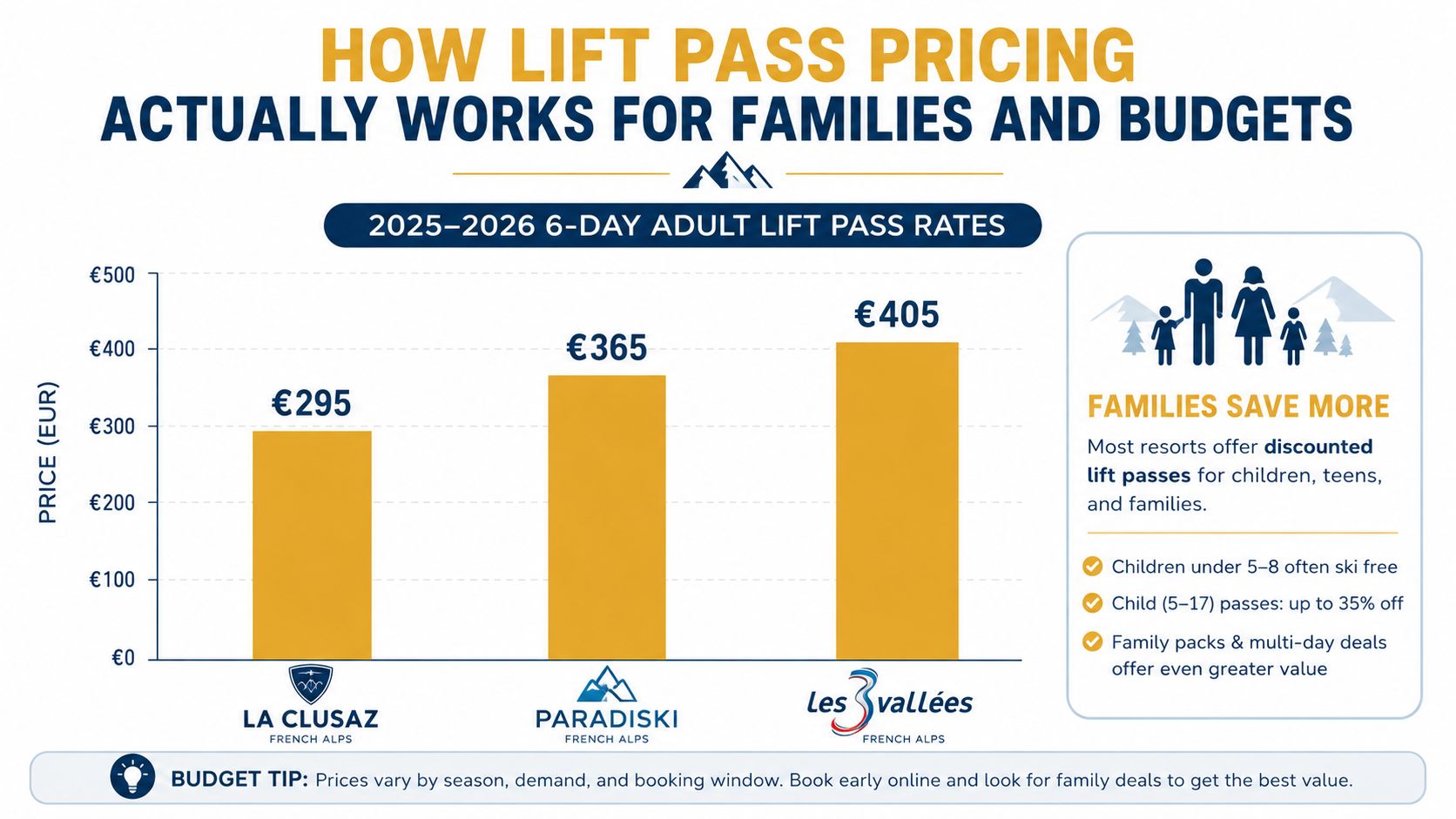
Published examples show the spread clearly. A six-day adult pass is about €201 at La Clusaz, €401 for Paradiski, and €421 for Les 3 Vallées, while a published Courchevel figure is €374 for six days (published French resort pass prices, French ski trip cost comparison). Check the exact season, domain, and purchase conditions before paying, because a local pass and a linked-area pass are different products.
La Plagne provides a useful family example. Its published one-day adult pass is €56, while the child and senior pass is €45 for ages 5 to 12 and 65 to 74. Children under 5 can receive free access at La Plagne and Paradiski under the published conditions (La Plagne ski passes).
Where families save
The first saving is choosing the right domain. If children spend most of the week in lessons, a local area pass may be enough. If two adults want to explore while children ski with instructors, calculate whether separate domain choices cost less than buying every traveler the biggest pass.
Check age bands carefully. Senior concessions often begin at 65, but the upper age band and proof requirements vary. Under-five access is commonly conditional on a paying adult and may still require a pass or card issued at the ticket office.
Timing and checkout matter
Some resorts attach booking conditions or small fees. Grand Massif states that a pass must be purchased for every booking at a cost of €2, and resorts may offer online discounts or advance rates (Grand Massif package rates). Read the final checkout screen, not only the headline price.
Family buying rule: price each person by age, ski area, and number of actual ski days before selecting a six-day package.
French Phrases That Make a Ski France Day Smoother
You don't need conversational fluency to improve a ski day. You need the phrases that solve problems at the exact moment a queue is forming, a child is late for class, or your pass won't open the gate.
The pronunciation notes below are deliberately approximate. Speak slowly, keep the polite opening, and show the booking confirmation if a staff member needs more detail.
Tickets and ski school
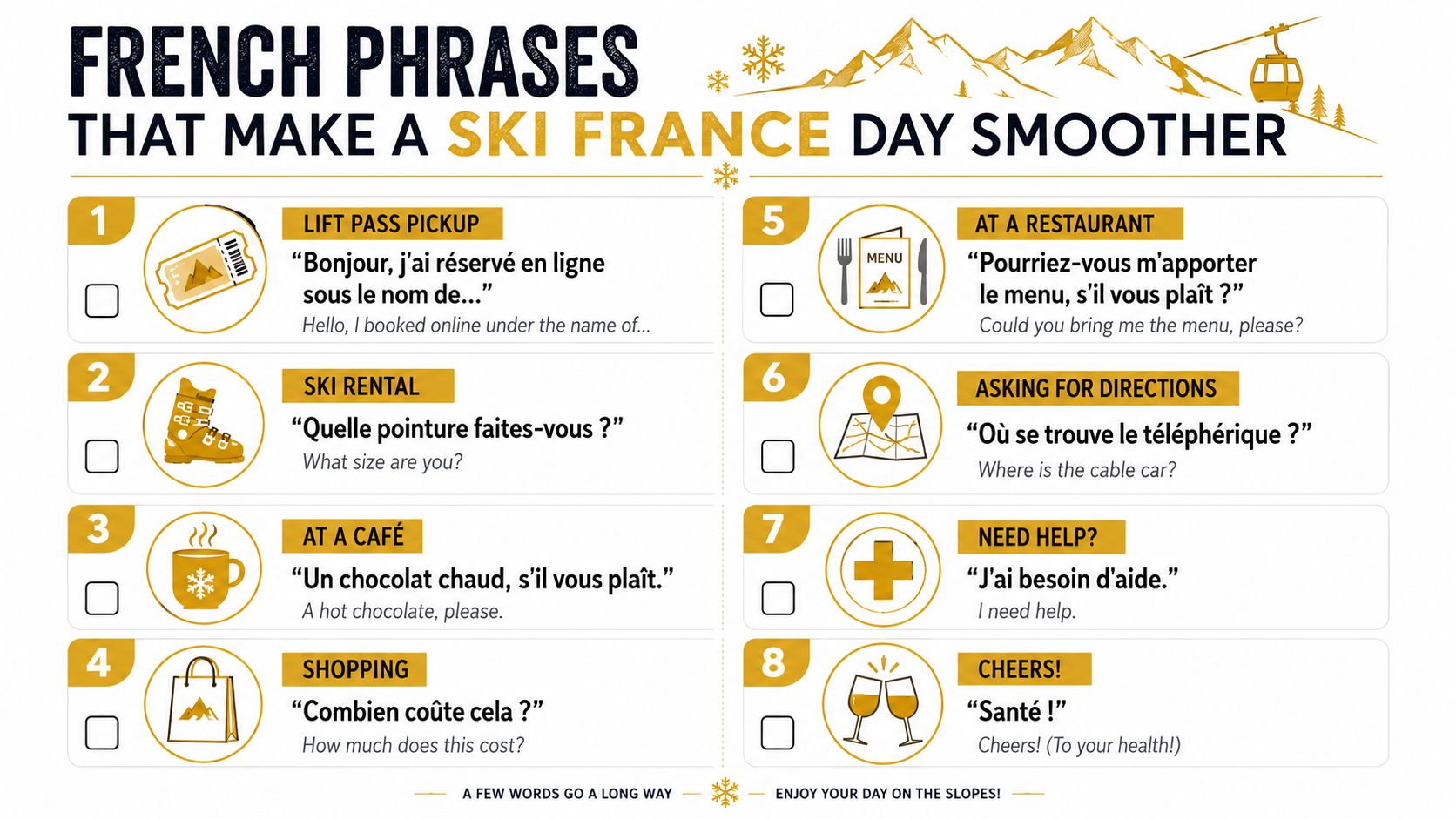
- Lift-pass pickup: “Bonjour, j'ai réservé en ligne sous le nom de…” Say bon-zhoor, zhay ray-zair-vay on leen soh luh nom duh. Use it at the collection desk.
- Deposit question: “Est-ce que la caution est par carte?” Say ess kuh lah koh-see-on ay par kart. Ask whether the deposit is charged by card.
- Pass problem: “Mon forfait ne marche pas.” Say mon for-fay nuh marsh pah. Use this immediately at a gate or ticket office.
- Reloading: “Je voudrais recharger ma carte.” Say zhuh voo-dray ruh-shar-zhay mah kart. This helps when adding access to an existing card.
- Child's ability: “Mon enfant est débutant complet.” Say mon on-fon ay day-boo-tan kom-play. Tell the school your child is a complete beginner.
- Lesson time: “À quelle heure est le cours?” Say ah kel ur ay luh koor. Confirm the class time before walking away.
- Meeting point: “Où est le point de rencontre des cours enfants?” Say oo ay luh pwan duh ron-kon-truh day koor on-fon. This prevents a rushed first morning.
A practical French phrases for travelers guide can help you rehearse these aloud rather than recognizing them only on paper.
On the mountain and in the shop
- Finding beginners' terrain: “Comment puis-je rejoindre le secteur débutants?” Say koh-mon pwee-zhuh ruh-zhwan-druh luh sek-tur day-boo-tan. Ask before taking the wrong lift.
- Checking a piste: “Cette piste est-elle ouverte?” Say set peest ay-tel oo-vert. Confirm closure before committing to a route.
- Finding lunch: “Excusez-moi, je cherche le restaurant d'altitude.” Say ex-koo-zay mwah, zhuh shersh luh res-toh-ron dal-tee-tood. Use it with a map or lift operator.
- Rental request: “Je voudrais louer des skis, niveau intermédiaire, pointure 27.” Say zhuh voo-dray loo-ay day skee, nee-vo an-ter-may-dyair, pwan-toor vingt-set. Give ability and boot size clearly.
Après-ski and medical help
- Ordering: “Une bière pression, s'il vous plaît.” Say oon byair press-yon, seel voo play.
- Paying: “L'addition, s'il vous plaît.” Say lah-dee-syon, seel voo play.
- Fondue price: “C'est combien la fondue pour deux?” Say say kom-byen lah fon-doo poor duh.
- Medical assistance: “Où est le médecin?” Say oo ay luh med-san.
- Pain: “J'ai mal au genou.” Say zhay mal oh zhuh-noo. Say it plainly if your knee hurts.
Booking Your Ski France Trip With Confidence
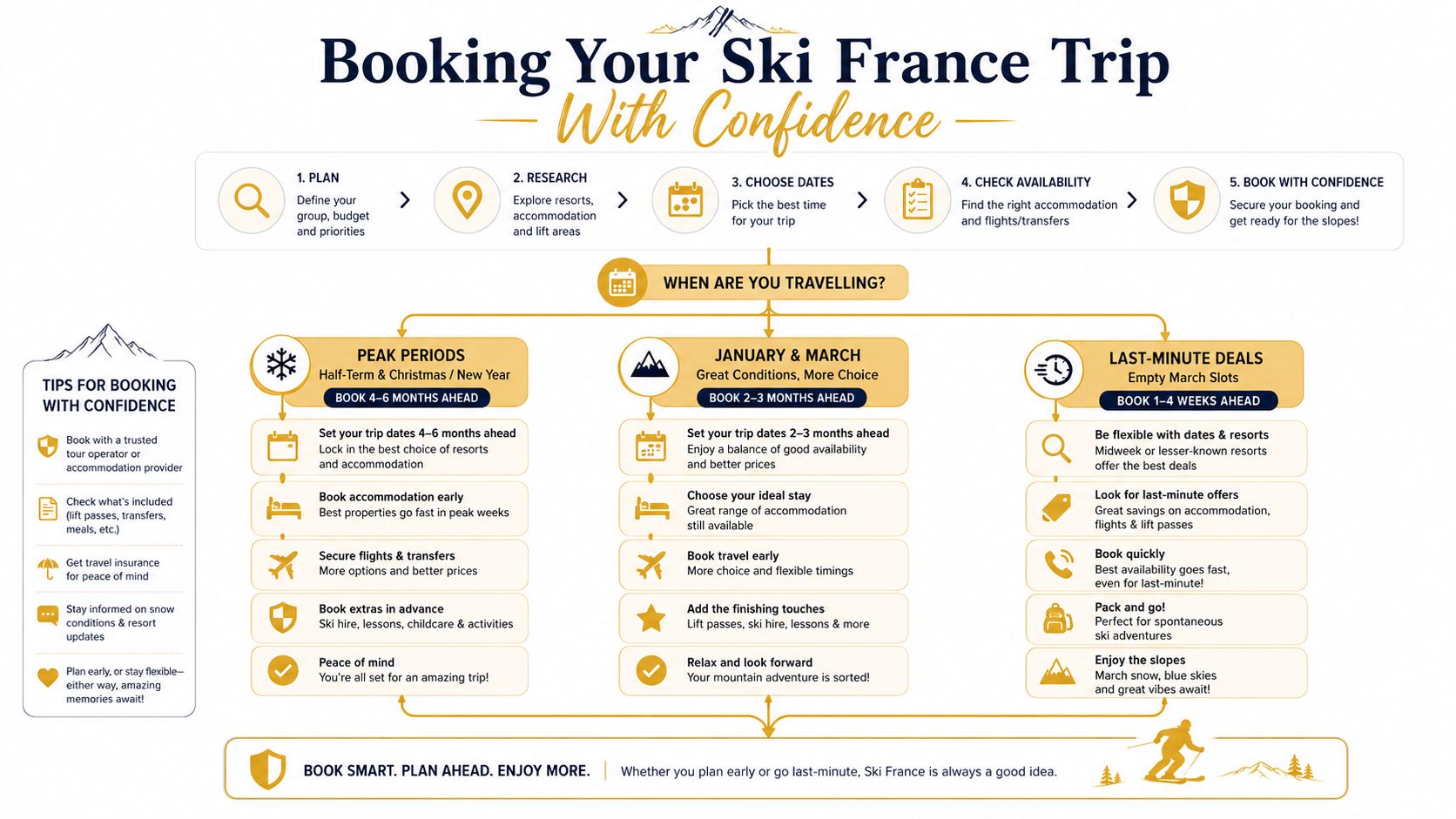
The cleanest booking sequence starts with dates, not a resort brochure. For Christmas and half-term, I'd start 4 to 6 months ahead. January and March trips generally allow planning 2 to 3 months ahead, while a last-minute March slot can work when you're deliberately looking for empty availability.
Lock the gateway before the resort
Compare Geneva, Lyon, Grenoble, and Chambéry against the accommodation you want. A long transfer reduces usable ski time on arrival and departure days, so I won't approve a resort shortlist until the airport and transfer route are clear.
Then match the massif to the group. Beginners and families may prefer La Clusaz, the Jura, or a quieter Pyrenean resort. Intermediates seeking variety can look toward Paradiski, Les 2 Alpes, or the Northern Alps. Advanced skiers can justify a large linked domain or a resort with stronger access to challenging terrain.
Book the cost centers in order
- Accommodation: Book directly through the tourist office or use a chalet operator when a group package includes meals and services.
- Lift passes: Reserve online at least 7 days ahead when the resort offers an advance rate, and verify whether the pass covers the local area or a linked domain.
- Equipment: Choose a specific rental shop and reserve fitting time. Valley shops can reduce cost, while slope-side stores save time for beginners.
- Lessons: Pre-book ESF, ESI, or an independent instructor, especially for peak weeks. Popular classes fill well before arrival.
- Language: Spend 2 to 3 hours practicing skier-specific phrases before departure. Rehearse them aloud, including names, dates, ages, and boot sizes.
The language step is small but practical. You'll handle ticket desks, ski-school questions, rental fittings, restaurant orders, and minor problems with less stress.
If you want structured preparation, Elite French Tutoring offers private online and in-person lessons that can be customized to a Courchevel itinerary, family needs, or a professional schedule. A free consultation is available if you'd like to compare a focused travel-French plan with self-study.
My final recommendation is simple: choose the dates, gateway, and group needs first, then buy the resort. Once you've matched the massif, pass domain, accommodation, and language preparation to the people traveling, ski France becomes a straightforward purchase rather than an expensive guess.
Book your resort and transfer shortlist now, then schedule a focused French travel lesson before you leave. You'll arrive ready to collect your passes, register for lessons, rent equipment, and enjoy the mountain without letting avoidable language problems take over the first day.