Skip to content

Quebec is often described as the easy, affordable French option. That advice is outdated. If you're serious about study abroad in Quebec, you need to think like an applicant competing for a shrinking number of places, not like a tourist picking a semester destination.
Quebec has grown into a major international study market, with more than 60,000 international students choosing the province each year, and the long-term enrollment trend shows why families keep looking there. But the province has also shifted hard into capacity control, tighter budgeting rules, and stronger French expectations, so the old “apply late and figure it out later” strategy is a bad bet now.
Table of Contents
- Why Quebec Is Harder to Get Into Than You Think
- Choosing the Right Program and Institution
- Navigating the CAQ and Study Permit Process
- Budgeting for Your Quebec Education
- Why French Preparation Is Your Secret Weapon
- Arrival Logistics and Settling Into Quebec Life
- Post-Study Work and Immigration Pathways
Why Quebec Is Harder to Get Into Than You Think
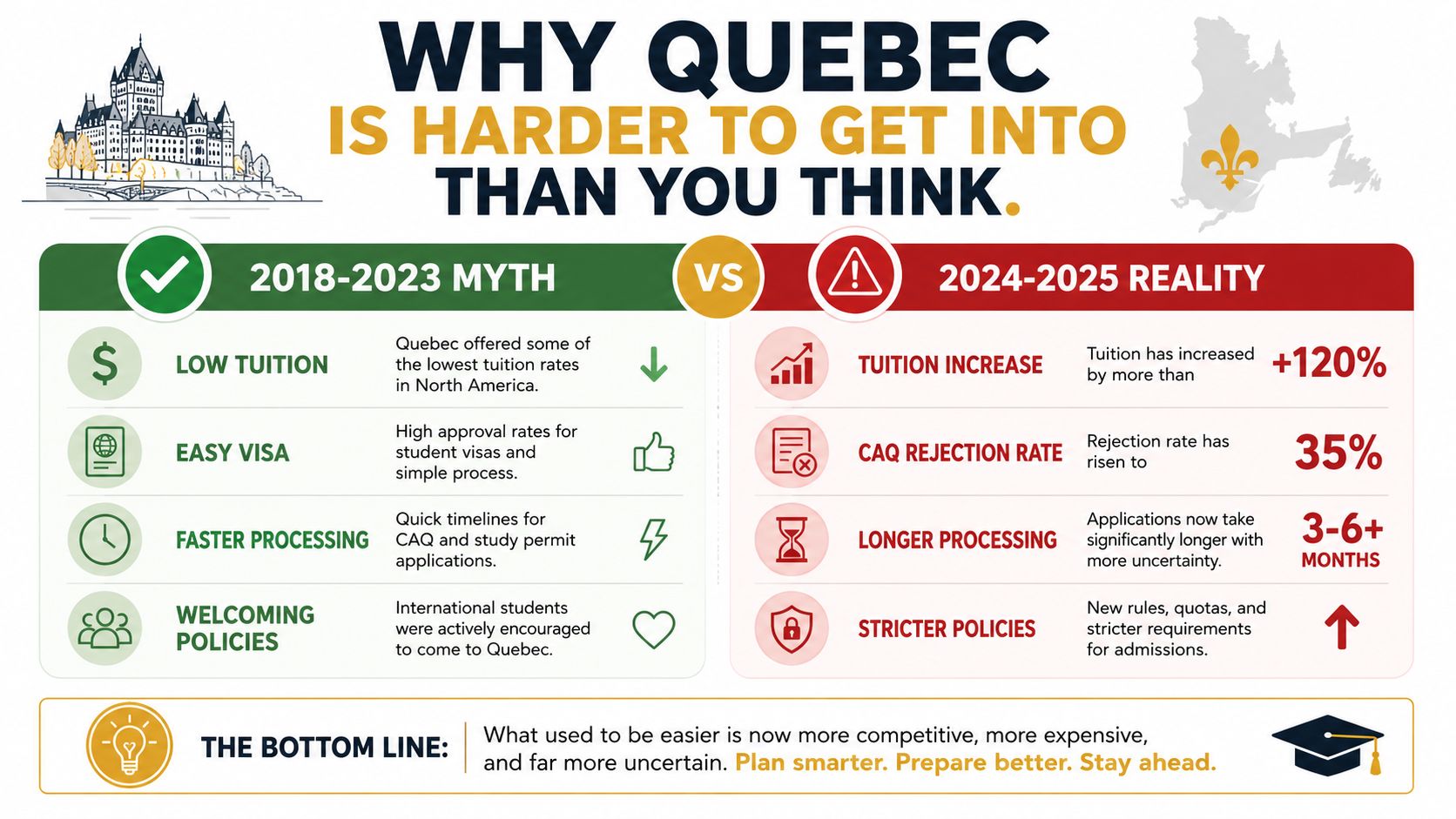
The biggest mistake I see is treating Quebec like an easy backup plan. It isn't. Quebec has shifted from expansion to control, and that changes the whole application strategy, from timing to funding to French preparation.
In February 2025, Quebec announced caps of 63,299 international applications for university programs, 32,261 for vocational training, and 29,200 for college programs, for a total of 124,760 acceptance certificates, about a 20% decrease from 2024. Government reporting also showed that Quebec had nearly 615,000 non-permanent residents as of October 1, 2024, including about 129,000 international students, or 21% of that population. That is active crowd control, not an open pipeline. Quebec's 2025 to 2026 international student caps
What the new reality means for your file
If you wait to gather documents until after admission, you are already behind. Quebec-bound applications need to be complete the first time, because incomplete proof of funds, weak study rationale, or sloppy document sequencing can lead to refusal.
Practical rule: Treat Quebec as a first-choice destination only if you can move early, prove your finances cleanly, and show real French intent.
The funding bar is higher now too. Quebec raised its minimum financial capacity requirement effective January 1, 2026, to CAD 24,617 for one person, replacing the previous lower thresholds of CAD 7,756 for a minor and CAD 15,508 for an adult. Quebec's 2026 financial requirement change
My advice
Stop asking whether Quebec is “affordable” in the abstract. Ask whether the applicant can handle a more selective intake environment and a stricter money test. Quebec is still attractive, but it now rewards applicants who prepare like professionals. If you want to pursue study abroad in Quebec, build your file early, budget conservatively, and do not assume a French-speaking province is administratively easier than the rest of Canada.
Choosing the Right Program and Institution
Quebec gives you three real pathways, not one. Universities, CEGEPs, and vocational training centers each serve a different student profile, and choosing the wrong one can waste time, money, and permit energy. The right decision depends on your academic record, your French level, and what you want after graduation.
Universities like McGill, Université de Montréal, Concordia, Laval, and UQAM make sense if you're aiming for degree-level academic study and want the widest range of program options. CEGEPs are their own Quebec system, and they matter a lot more than most international families realize. Vocational training is the practical route for students who want targeted career preparation instead of a long academic track.
Here's the comparison I use with families before they send a single application.
| Pathway | Duration | Annual Tuition Range (CAD) | Language of Instruction | Best For |
|---|---|---|---|---|
| University | Varies by degree | Varies by program and institution | English, French, or both | Students pursuing bachelor's, master's, or doctoral study |
| CEGEP | Varies by program | CAD 7,575, CAD 9,805, or CAD 11,740 per full-time session, depending on program category Cost and financial assistance | Mostly French, some English options | Students who want Quebec's pre-university or technical college route |
| Vocational training | Varies by program | Varies by institution and program | Mostly French | Career-focused students seeking direct job skills |
How I would choose
If your French is weak and your long-term goal is a recognized degree, university is usually the cleaner starting point. If you want a more structured, often more practical route into Quebec's education system, CEGEP can be the smarter move, but only if you're ready for the language and culture of the system. Vocational training makes sense when the career path is clear and you want speed over prestige.
The tuition structure also matters. Quebec college tuition is not one flat figure, and that's exactly why budget planning gets messy when families assume all programs cost the same. I prefer applicants compare the exact program cost before they fall in love with a school.
If you want to strengthen your French before committing to a program, I'd start with a structured option like online French courses in Canada. That's especially useful if you're comparing English-taught universities with French-heavy CEGEP or vocational options.
Don't pick the institution first and the language plan later. In Quebec, those two decisions are tied together.
Navigating the CAQ and Study Permit Process
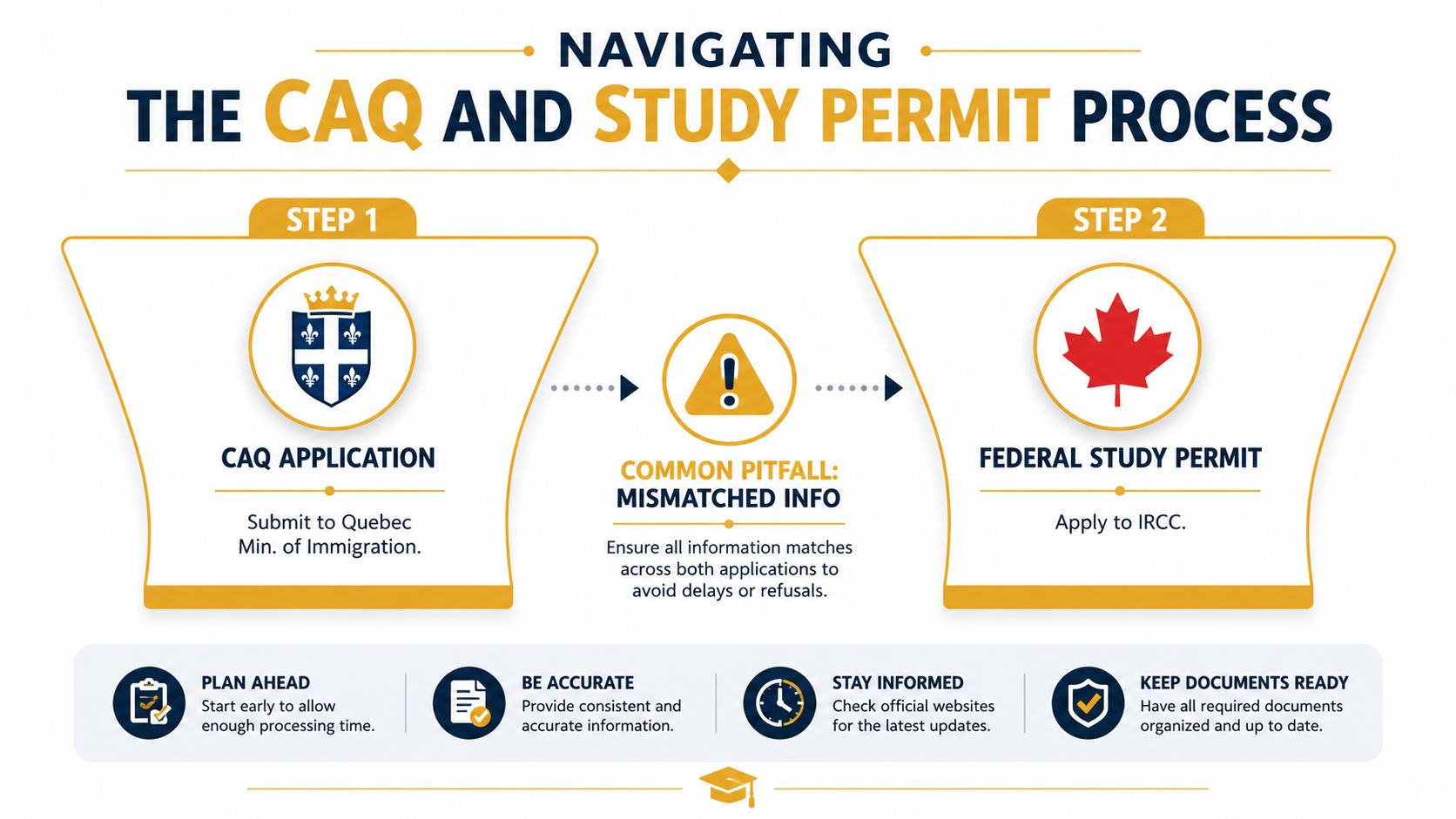
Quebec's process is stricter than many families expect. For a program lasting more than six months, you need a two-stage process, and the order is fixed. First comes admission to a designated learning institution, then the CAQ, then the federal study permit application. Quebec's authorization process
The sequence I recommend
- Secure admission first. The acceptance letter is the trigger for the next step.
- Apply for the CAQ immediately. Quebec says to submit as soon as the admission letter arrives, and the CAQ attestation should follow right after you receive the CAQ letter.
- Wait for the CAQ issuance. Do not send the federal permit file early.
- Submit the federal study permit application to IRCC. The CAQ is the provincial document required for Quebec-bound study permits.
The most common mistake is inconsistency. A different program title, a date mismatch, or weak financial evidence can slow the file down for no good reason.
Why preparation matters more here
IRCC data has shown weaker outcomes for Quebec-bound students than for the rest of Canada. In 2021, approval was 41% for students destined for Quebec versus 62% for the rest of Canada. A later dashboard showed 56% of processed applications approved and 43% refused overall across Canada in 2022, which is a blunt reminder that complete files matter. IRCC Quebec student approval data
My rule: If a document can be translated, notarized, or clarified before submission, do it. Do not give an officer a reason to pause.
If your CAQ timing gets messy, do not improvise. Check every field against your admission letter, your passport, and your financial evidence, then resubmit only when the file is consistent. Quebec is unforgiving when documents contradict each other, especially now that capacity is tighter.
Budgeting for Your Quebec Education
Quebec budgeting used to be loose. That no longer works. The province's financial threshold changed on January 1, 2026, so your budget has to match the new standard, not last year's assumptions.
For one person, Quebec's minimum financial capacity requirement is now CAD 24,617. Treat that as a hard gate, not a rough target. It sits on top of tuition, housing, transport, insurance, and basic living costs. Quebec financial requirement update
Where the money really goes
Tuition changes sharply by institution type. Quebec college tuition for international students can be CAD 7,575, CAD 9,805, or CAD 11,740 per full-time session depending on the program category, so there is no safe province-wide number. Quebec college costs
For domestic students, Statistics Canada projects Quebec undergraduate tuition at CAD 3,963 and graduate tuition at CAD 4,307 for 2025/2026. That gap is why Quebec still looks relatively affordable, even though international fees are a different calculation. Statistics Canada tuition projection
What I tell families to budget for
Use the exact school and program rate first. Do not start with a province-wide average.
Build around the CAD 24,617 threshold next, then add tuition. Housing comes after that, and Montreal is not the same as a smaller Quebec town. Monthly costs move fast once rent, transit, and day-to-day spending are added together. Insurance is easy to underestimate until the bill arrives.
Scholarships and bursaries can help, but never budget on aid you have not already secured. If you expect to work part-time, treat that income as support, not the base of the file. Immigration officers want proof that you can pay your way before any earnings begin.
French study costs, application fees, and moving expenses also belong in the budget. Families who plan only for tuition usually end up scrambling later.
Why French Preparation Is Your Secret Weapon
If you're hoping to study in Quebec and “just get by in English,” you're underestimating the province. English can carry you in some lectures, especially at bilingual universities, but it won't do the heavy lifting for housing, internships, workplace communication, or basic bureaucracy.
Quebec's language environment is getting stricter, not looser. The province's newer workplace language rules require many businesses to communicate with workers in French and set a French-language target for most workplaces by 2025, which means the market around students is also moving toward stronger French use. On top of that, Quebec's post-study pathways now include explicit French benchmarks, including oral French level 7 and written French level 5 for the Diplômés du Québec stream, plus oral French level 7 for temporary foreign workers, measured on Quebec's own scale rather than the federal CLB/NCLC scale. French-language benchmarks in Quebec immigration
Why I push French early
A student who studies French before arrival gets more choices. They can handle landlord calls, register for services, speak up in class, and move faster when a placement or internship appears. The student who arrives with classroom-only French usually spends the first months reacting instead of progressing.
That's why I'd rather see a family invest in French before departure than spend money cleaning up avoidable stress after arrival. One option is French language certification support, especially if the student is aiming for a concrete benchmark instead of casual conversation.
What good preparation looks like
- Structured tutoring: Useful when the student needs accountability and targeted correction.
- Immersion practice: Helps with listening speed and everyday conversation.
- Exam preparation: Necessary for students who need DELF or DALF-style proof of competence.
- Daily-use French: The primary goal is comfort with forms, landlords, classmates, and part-time work, not just test scores.
French is not a side project in Quebec. It's a competitive advantage, and it gets more valuable as policy gets stricter. The families who treat French as an admissions and settlement tool usually make better decisions than the ones who treat it like a nice extra.
Arrival Logistics and Settling Into Quebec Life
A student's first month in Quebec can go well or badly depending on what happens before the flight. I've seen students arrive with their permit approved but no real housing plan, and that's when stress gets expensive fast. Quebec life is manageable, but you need to arrive organized.
One student I worked with, Sara, moved to Montreal for college after we tightened her French prep and cleaned up her paperwork. She found a lease before arrival, opened her bank account during her first week, and joined a student association by the end of the month. That combination made a real difference, because she had people to ask when she needed help with transit, course registration, and her first part-time job search.
What to do the moment you land
Start with housing, then banking, then phone service. Don't reverse that order. If you wait to solve the basics after classes begin, every small task turns into a delay.
Practical rule: In Quebec, the student who has housing and a communication plan in place before arrival starts school with a real advantage.
The rest is straightforward, but it has to be done early. If you need local French support while settling in Montreal, private French classes in Montreal can help bridge the gap between classroom French and daily-life French, especially for errands and first-week conversations.
A few things students usually underestimate
- Winter readiness: Quebec winter is not a minor inconvenience, it shapes your daily routine.
- Administrative pace: Paperwork and scheduling move on local timelines, not student timelines.
- Social life: Joining clubs and associations matters more than most students expect.
- Transport: Learn the transit system early and use it consistently.
The students who settle best are the ones who act like adults from day one. They don't wait for somebody else to translate every task for them, and they don't assume their first week will feel like a vacation. They build routine quickly, and Quebec responds well to that.
Post-Study Work and Immigration Pathways
Quebec's post-study route only works if you plan it before graduation. Families often focus on admission and tuition, then discover that the bottleneck is what happens after the diploma. The province now ties study, work, and immigration together more tightly, so the student's next move has to be mapped in advance.
The usual path is straightforward: finish the program, apply for the Post-Graduation Work Permit if eligible, gain Quebec work experience, then choose between a Quebec route such as PEQ or a federal route such as Express Entry. In practice, PEQ rewards students who can move quickly into qualified work and assemble clean documents early. Federal files can work too, but they demand a strong profile and a realistic score target, not wishful thinking. For students who still need proof of French before they graduate, DELF B2 exam preparation should be part of the plan, not an afterthought.
How I frame the decision
A student with solid French and a clear work plan has real options in Quebec. A student who waits until the end to fix language, documents, and job strategy usually ends up with a thin file and fewer choices.
Timing matters. The post-graduation work permit is the bridge, not the destination. Once a student starts working in Quebec, the file has to move toward permanent residence without delay, because work experience, job classification, and document quality all shape the next step.
Build flexibility into the plan
I advise families to keep two pathways alive from day one. One should be Quebec-specific, the other federal, because eligibility can shift depending on the student's program, work history, and how quickly they secure a skilled position. PEQ is the more direct route for the right candidate, while federal processing can suit students with a stronger overall profile and enough points to stay competitive.
If Quebec is the target, treat post-graduation work as the start of the immigration file, not a separate phase.
That mindset saves time and prevents bad decisions. Students who organize their employment records, keep their status clean, and prepare their immigration documents early are in a far better position than those who improvise after graduation.