Skip to content

If you're deciding whether to move, hire, or accept an offer in Quebec, a common mistake is simple. They treat work in Quebec like a normal Canadian move with a French accent. It isn't. Two rules now shape the whole decision, the 2025 francization expansion and the new French trigger for temporary foreign workers after three years, and both of them change hiring, LMIA filings, and even whether a relocation still makes sense.
The labour market is still large and active. Québec added 79,000 jobs in 2025, a 1.7% increase, bringing total employment to about 4,645,000 jobs according to Job Bank's snapshot, and the province was still above 4.6 million jobs in mid-2026, with 4,592,200 jobs in May 2026 and 4,607,200 in July 2026 while unemployment stayed in the mid-5% range (Job Bank Québec labour market snapshot). That's the scale you're dealing with. Québec is big, busy, and still hiring, but the rules around language and authorization are tighter than many expect.
The core question isn't whether there are jobs. It's whether you can legally take one, keep it, and stay compliant while you do it. If you're a professional, family mover, student, or employer, I'd read this as a decision guide, not a theory lesson.
Table of Contents
- Who Can Actually Work in Quebec Right Now
- Comparing Permits and the Quebec Skilled Worker Path
- French Requirements Workers and Employers Must Know
- Credential Recognition and Licensing for Professionals
- Pay, Overtime, and Quebec Employment Standards
- A Real Success Story From Arrival to Employment
- Your Next Steps, Documents, and Timelines
Who Can Actually Work in Quebec Right Now
You're probably weighing a Montreal offer against Toronto, or you've got a Quebec employer saying, “We can hire you, but we need the paperwork sorted.” That's the right moment to slow down and separate legal work status from job interest. Quebec's labour market remains large and relatively stable, but the practical path you choose matters more here than in many other provinces.
The first filter is status, not talent
Some people can work without a permit. That includes Canadian citizens, permanent residents, and certain other categories allowed under immigration rules. If you're in Quebec as a student, you still need to check whether your study conditions allow work, because not every student status gives blanket work rights. Asylum claimants with valid documents may also have work authorization depending on their situation.
Practical rule: don't start with the job title. Start with the document that lets you legally do the job.
If you're not already authorized, the three realistic paths are straightforward. First, an employer-specific temporary work permit backed by an LMIA or an LMIA-exempt route. Second, an LMIA-exempt category like an intra-company transfer or a trade-agreement professional. Third, a permanent path through Quebec's selection system, which still matters for people who want to settle, not just work temporarily.
Match the path to the real-life situation
A confirmed employer offer points you toward a closed permit. A cross-border manager or specialist often fits an LMIA-exempt stream. A person who wants to build a life in Quebec, not just hold a contract, should look hard at permanent residence routes.
| Status | Work Authorized? | Notes |
|---|---|---|
| Canadian citizen | Yes | Can work freely in Quebec |
| Permanent resident | Yes | Can work freely in Quebec |
| Certain students | Sometimes | Depends on study status and work conditions |
| Asylum claimant with valid documents | Sometimes | Depends on the file and documents |
| Temporary worker with valid permit | Yes | Must follow permit conditions |
If you're comparing whether Quebec is the right move for study plus work, I'd also look at study options and relocation support in Quebec before you commit to a city, because the school choice often shapes the work path later.
Comparing Permits and the Quebec Skilled Worker Path
The common question people ask here is the wrong one. They ask, “Which permit is easiest?” I ask, “Which route fits your employer, your French level, and your long-term plan?” Quebec uses a two-step system, Quebec selects, Canada admits, so the provincial choice and the federal permit aren't the same thing. That split is where many relocations stall.
Temporary work, Quebec selection, and permanent residence are different bets
A CAQ-backed temporary work permit suits you if you already have a specific job offer and need to start work under an employer-linked arrangement. LMIA-exempt streams are better for intra-company transferees and certain professionals under trade agreements, because they avoid the LMIA process. The Quebec Skilled Worker Program is the route for experienced workers who want to build a permanent life in the province and can wait for selection and federal admissibility.
| Path | Processing Time | Validity | Job Offer Required? | French Requirement | Best For |
|---|---|---|---|---|---|
| Employer-specific temporary permit | Varies by file | Linked to job contract | Yes | Depends on stream | People with a confirmed Quebec role |
| LMIA-exempt work permit | Varies by category | Tied to assignment | Often yes, but not always | Depends on category | Intra-company transfers, trade-agreement professionals |
| Quebec Skilled Worker Program | Longer-term process | Permanent selection route | No | Strong French helps a lot | Workers planning to settle |
The biggest trade-off is this, and most newcomers miss it. A job offer is not required for Quebec selection under the skilled worker route, but French ability and Quebec-linked education or experience now carry serious weight in practical outcomes. If your profile is strong but your French is weak, you can still apply, but you're building on a shaky base.
Who should choose what
If you've got a solid offer and need to move quickly, take the permit route. If you're a manager or specialist on assignment, use the LMIA-exempt stream if you qualify. If you're already settled enough to think long term, pursue Quebec selection and build around it instead of treating the job offer as the whole story.
For readers comparing language preparation alongside the permit route, I'd use French certification support for career moves as a planning reference, because the documents and the language proof tend to rise or fall together.
French Requirements Workers and Employers Must Know
The two rules people get wrong are easy to confuse because they hit at different levels. One is for employers, one is for workers. Together, they've changed how work in Quebec gets approved, renewed, and managed in day-to-day operations.
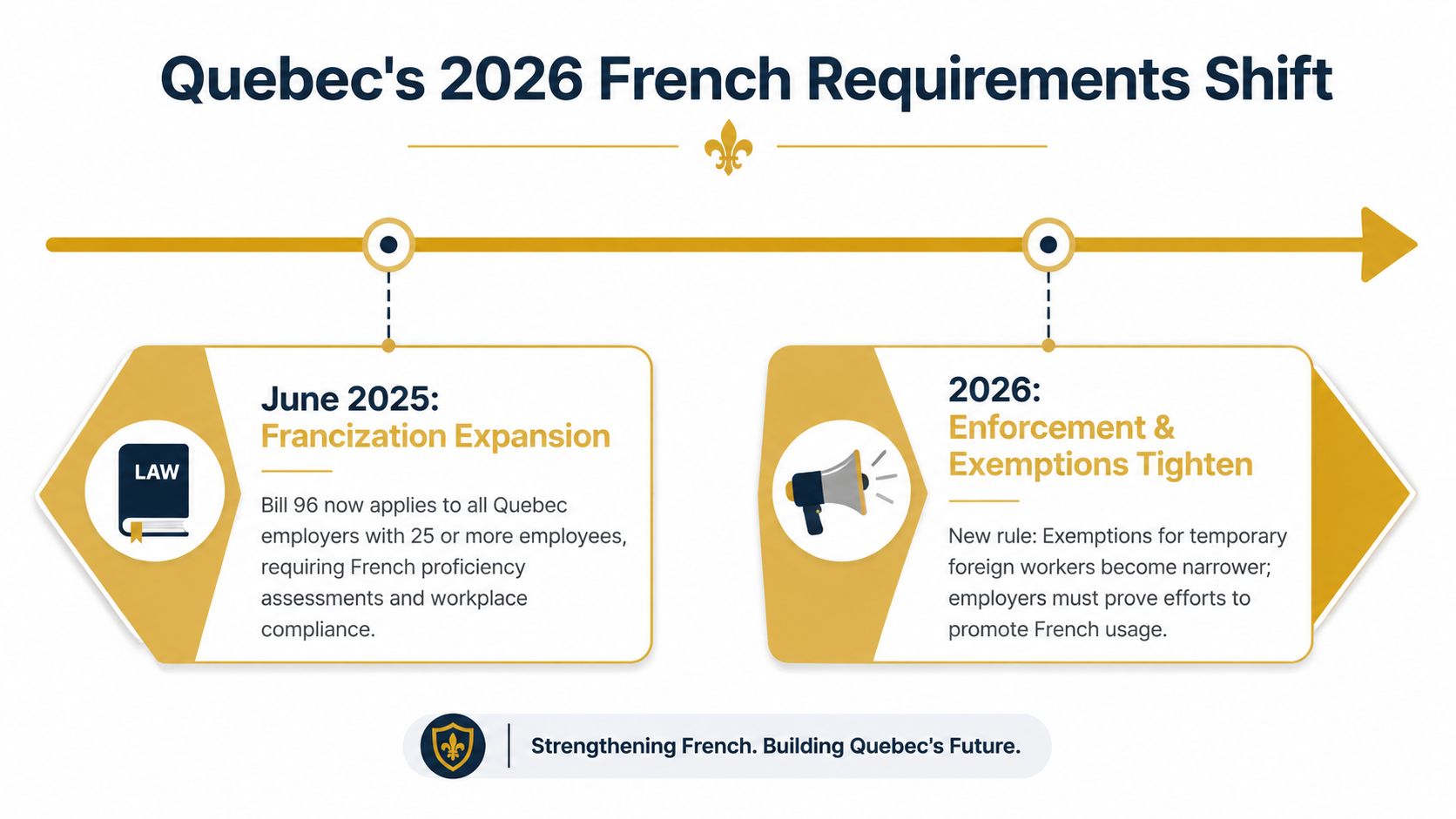
Employers with 25 or more staff now live under francization pressure
Under Quebec's language regime, businesses with 25 employees or more are now subject to francization requirements, and employers with 25 to 49 staff must register with the language authority and assess their linguistic situation (DLA Piper's 2025 Quebec language update). That means French-capable processes aren't cosmetic. They affect job postings, internal communications, policies, and documentation. If you're hiring in Quebec and you're not preparing French materials early, you're already behind.
Temporary foreign workers face a separate oral French trigger
For certain temporary foreign workers, the new issue is renewal, not arrival. Quebec's 2026 update tied to federal work-permit processing says the rule applies only after three years in Quebec, and the worker must show NCLC level 4 oral French. The French requirement applies to the oral side, not the written component, and it starts from the first permit issuance. Some workers are exempt, including agricultural foreign workers, people working for a foreign state's political office, and international employees of Quebec-recognized international non-governmental organizations (Quebec temporary foreign worker program exemptions).
If French is part of your long-term plan, don't wait for the renewal date. Waiting makes the renewal feel like a crisis instead of a process.
What this means in real hiring
French is now a hiring filter, not a nice-to-have. Employers need francization documentation ready, and workers who expect to stay beyond the first permit cycle need to treat oral French as a renewal requirement, not a future bonus. If you're hiring or moving, the cheapest insurance is early language training, not last-minute scrambling.
For employers building a workplace plan, French for business support in Quebec is the kind of preparation that avoids a lot of preventable friction later.
Credential Recognition and Licensing for Professionals
If you're in a regulated profession, the job offer alone doesn't get you across the finish line. Quebec cares about recognition, then licensing, then language, and that order matters. A competent engineer, nurse, or accountant can still be delayed if the file is incomplete or the French piece is ignored.
General recognition and regulated licensing are not the same thing
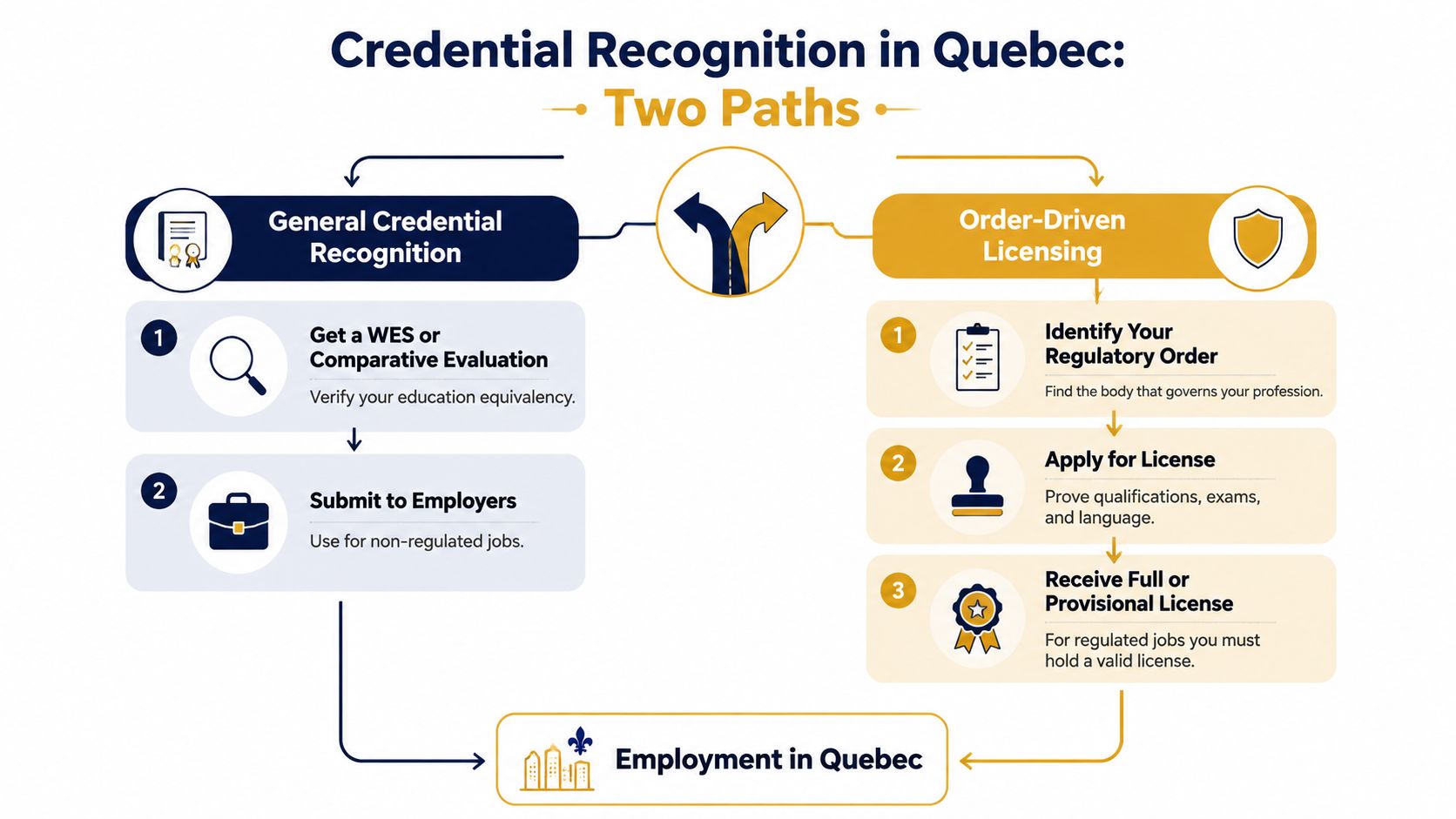
General credential recognition is the easier lane. People often use tools like WES or provincial comparative evaluations to show how their degree stacks up. That helps for non-regulated jobs, where the employer just wants proof that your education is credible.
Regulated professions are different. OIQ for engineering, OIIQ for nursing, and CPA Quebec for accounting can all require their own review, language proof, supervised practice, and exam steps. You don't get to skip the regulatory order because your resume looks strong.
| Stage | General Recognition | Regulated Profession |
|---|---|---|
| Education review | WES or comparative evaluation | Order-specific file review |
| Language evidence | Helpful | Often required |
| Practicum or bridging | Usually not required | Common |
| Exam | Usually not required | Often required |
| Outcome | Employer-ready profile | License or provisional license |
The delays are usually administrative, not technical
The slowest files are often the ones with missing transcripts, sealed documents, or old school records that take forever to retrieve. The other trap is language. Many candidates have excellent technical English, but the oral French required in interviews, practicums, and supervision settings is a different test entirely.
A focused 12 to 16 week French plan can line up well with licensing steps because it gives you enough time to build oral confidence before the order interview or supervised placement. That's the part people underestimate. They think their degree is the hard part, but in Quebec, the conversation is often the primary gate.
My advice: don't wait until the order asks for French proof. By then, you're already reacting instead of controlling the timeline.
If you're in a regulated field and need oral confidence for interviews or supervised practice, French for medical professionals is the kind of targeted preparation that closes the gap fast.
Pay, Overtime, and Quebec Employment Standards
A lot of newcomers compare offers by salary alone and miss the part that changes take-home value. Quebec's employment standards affect how much you keep, how overtime is paid, and what your employer must give you in writing. If you've worked elsewhere in Canada, don't assume the same payroll rules apply here.
The first surprise is the 40-hour threshold
Quebec's labour framework uses 40 hours as the default overtime threshold, and hours beyond that must be paid at 1.5 times the regular hourly wage (CNESST labour standards). That matters even when a workplace has a shorter regular schedule, because overtime is still calculated against the province-wide standard workweek. Payroll teams need to track hours carefully or they'll misclassify premium pay.
Vacation and work location can change the offer
Workers with less than 3 years of service are typically entitled to 2 weeks of annual leave and 4% vacation pay, while workers with 3 years or more get 3 weeks and 6% vacation pay (TCW Global Quebec summary). Under Quebec labour standards, an employee is considered to work in Quebec if they report to a Quebec establishment, or if they don't report to an establishment but are paid from a Quebec base (LégisQuébec labour standards). That's the rule remote workers miss.
| Topic | What Most Newcomers Expect | What Quebec Actually Requires |
|---|---|---|
| Overtime | Paid only after employer-specific thresholds | Time and a half after 40 hours in the standard week |
| Vacation | Similar across Canada | 2 weeks and 4% at lower seniority, 3 weeks and 6% after 3 years |
| Remote work location | Home country or employer location decides rules | Where the work is performed, or the Quebec pay base, can trigger Quebec standards |
| Offer details | Verbal promises are enough | New hires should get written employment terms and CNESST-related information |
The bottom line is simple. If the work is performed in Quebec, or you're paid through a Quebec establishment, assume Quebec labour standards matter. If payroll gets that wrong on day one, the correction usually costs more later.
A Real Success Story From Arrival to Employment
Andrea landed in Montreal from Colombia with a closed work permit, no French, and a clear goal. She didn't arrive pretending the system was easy. She arrived with paperwork, nerves, and a willingness to do the boring parts early. That's usually what separates people who settle from people who stall.
Her first move was to submit her Arrima profile in week two. By week six, her employer-specific work permit was issued, which gave her legal stability and let her focus on the next bottleneck, not the last one. She started intensive French tutoring four mornings a week and moved from NCLC 3 to NCLC 5 in five months, which made everyday workplace communication less fragile.
The middle of her year was all about alignment. She entered a supervised engineering practicum with a Quebec firm in month eight, which fit the licensing and language track from the earlier section. By month twelve, she signed a full-time contract. The final stretch wasn't glamorous, but it was decisive. Her overtime during crunch weeks was paid correctly under Quebec standards, which mattered because those extra hours were part of how she proved she could function in the local work culture.
Here's the video that many professionals I've coached end up identifying with, because it captures the emotional side of arrival better than a checklist ever will.
Andrea's story works because every milestone matched a rule. The permit, the francization trigger, the licensing path, and the labour standards all lined up. That's the lesson for anyone trying to work in Quebec in 2026. Success doesn't come from one perfect application. It comes from sequencing the right steps before pressure hits.
Your Next Steps, Documents, and Timelines
If you're serious about Quebec, stop treating the move as one application. It's a sequence. The people who do well are the ones who respect the sequence and get the documents ready before the clock starts making decisions for them.
Your 12-week countdown as an individual
Weeks 1 to 2, confirm the path. Decide whether you're applying as a temporary worker, an LMIA-exempt candidate, or a permanent selection applicant. If you need licensure, identify the regulatory order immediately. If you're waiting to see whether a French threshold will apply later, don't wait to start language prep.
Weeks 3 to 4, gather the file. Pull your passport, transcripts, reference letters, and any credential evaluations. If you need a job offer to proceed, secure it now. If your role needs a CAQ or employer-specific support, make sure the employer understands what form must be filed.
Weeks 5 to 6, lock language and medicals. Book French tutoring if you're anywhere near the renewal zone or a regulated role. If a medical exam is required for your stream, schedule it early instead of letting it delay the permit file.
Weeks 7 to 8, submit the permit package. Complete biometrics, confirm the CAQ or employer offer details, and make sure no field is blank. The most common failures I see are incomplete credential evaluations and missing employer attestations.
Weeks 9 to 12, prepare arrival. Once you're approved, plan for RAMQ, a social insurance number, housing, and payroll setup. If your three-year French clock will eventually apply, don't let arrival become the point where language planning stops.
Practical rule: if a document matters for approval, assume it matters twice, once for the application and once for the renewal.
Your 12-week countdown as an employer
Weeks 1 to 4, check compliance and budget. Confirm whether your team falls under the francization threshold and prepare the documentation now, not later. If you need to hire a foreign worker, determine whether the role needs an LMIA or fits an LMIA-exempt category.
Weeks 5 to 8, recruit and screen. Post the job, screen candidates, and make sure the employment letter is detailed enough to support the permit file. Don't wait to clean up the French-language side of your internal communications.
Weeks 9 to 10, file the work authorization. Submit the offer of employment or LMIA-related paperwork. If you're in the francization category, keep your compliance documents organized because delays here can slow the whole hire.
Weeks 11 to 12, onboard properly. Set up payroll, orientation, and French-language support. A new hire who understands the workplace in both languages is easier to retain and far less likely to hit avoidable compliance friction.
For direct planning, use the official employer and worker resources from IRCC, Québec immigration information, and CNESST workplace standards. If you want to pressure-test your French against real Quebec job descriptions before you file anything, book a free 20-minute French consultation with Elite French Tutoring and get a clean read on whether your language level is ready for the role you want.