Skip to content

Dozens of “best universities in Paris” lists rank institutions without asking the question that matters most: what do you want to study, and in which language can you study it successfully? A globally recognized name won't make a French-taught seminar manageable if your academic French isn't ready.
I advise students to shortlist by goal first. The seven universities below stand out for different priorities, from broad research and engineering to humanities, law, health, and public affairs. I'll also point out the practical trade-offs: some campuses sit outside central Paris, program language varies by degree, and tuition policies can differ even among public institutions.
For international students, language of instruction may decide the shortlist. English-taught options exist, especially at graduate level, but “international” doesn't automatically mean that lectures, administration, internships, or daily student life operate in English. French preparation may involve DELF or DALF certification, but conversational practice matters too, particularly when you need to participate in seminars and manage everyday tasks.
Use the profiles to identify your strongest matches, then check the exact program's admissions route, teaching language, and fees for your year of entry. If you're applying for 2026, start preparing early enough to build both the documentation and the French skills your chosen course requires.
Table of Contents
- 1. Université PSL
- 2. Institut Polytechnique de Paris
- 3. Sorbonne Université
- 4. Université Paris-Saclay
- 5. Université Paris 1 Panthéon-Sorbonne
- 6. Université Paris Cité
- 7. Sciences Po
- Top 7 Universities in Paris: Comparison Table
- Your Next Steps Toward Studying in Paris
1. Université PSL
Are you aiming for research across more than one discipline? Put Université PSL on your shortlist. Its collegiate structure brings together specialized institutions, including École normale supérieure, Mines Paris, Dauphine, and the Paris Observatory, while each school keeps its own academic focus.
PSL ranked 42nd worldwide in the 2025 Times Higher Education World University Rankings. Student-count figures vary across PSL's published materials, so I'd focus less on the headline total and more on the degree level and research community that fit your plans.
Match the school to the program
PSL spans science, engineering, arts, humanities, economics, and management. English-taught options are more common at graduate level; undergraduate teaching may require stronger French. Admissions criteria also vary by constituent school, so check the specific program's entry requirements and language of instruction before you apply.
For a research-focused master's or doctorate, compare faculty research and course content first. Then map out language preparation: if your program requires French, build DELF or DALF study into your application timeline and add conversational practice for seminars and daily life.
Best for: students seeking research depth or a specialized academic setting. Trade-off: school-by-school admissions and language rules, plus fewer undergraduate options taught in English. To weigh the wider move, read this guide to studying abroad in Paris. Explore programs on the Université PSL website.
2. Institut Polytechnique de Paris
If engineering, computing, or mathematics is your priority, put Institut Polytechnique de Paris on your shortlist. It brings together six selective schools: École Polytechnique, ENSTA, École nationale des ponts et chaussées, ENSAE Paris, Télécom Paris, and Télécom SudParis. Each school sets its own programs and admissions requirements, so choose a degree before comparing entry routes.
Plan for a specialized application
IP Paris is especially suited to technical and quantitative study. Program language varies by school and degree, with French, English, and mixed-language options. Check the exact course page and admissions criteria early, particularly if you are applying to a French-taught program.
I recommend building French for the classroom, not just daily conversation. Technical vocabulary, lecture comprehension, and group-project communication all matter. If your course requires a French qualification, confirm the accepted DELF or DALF level with the program and schedule exam preparation before application deadlines. Add regular conversation practice so you can use that knowledge in seminars and on campus.
The main campus is in Palaiseau, south of central Paris. Factor the commute and housing location into your choice, especially if you expect to travel into the city often.
Best for: engineering, computing, mathematics, data science, and other quantitative fields. Trade-off: admission is selective, the main campus is outside central Paris, and fees vary by school and program. Compare requirements and costs on the Institut Polytechnique de Paris website.
3. Sorbonne Université
Sorbonne Université suits students who want to build expertise within a broad public university, especially in humanities, science, engineering, or medicine. Its three faculties cover Arts and Humanities, Science and Engineering, and Medicine. English-taught master's programs include options in physics and computer science. Undergraduate degrees are taught in French, so plan on demonstrating academic French if you're applying for a bachelor's.
Prepare for the language and budget requirements
For French-taught programs, check the admissions page for the accepted language certificates and the level required at application or enrollment. DELF or DALF preparation can help you build the academic reading and writing skills humanities courses demand. Science students also need to understand lectures and communicate clearly in labs and group work. Pair exam preparation with conversational French practice, so you're ready for daily campus life as well as formal assessment.
For 2026–2027, standard public-university registration fees are €178 for a licence, €255 for a master's, and €398 for a doctorate. Differentiated fees for non-French students are €2,902 for a licence and €3,950 for a master's. Exemptions or university policies may change the amount due; the CVEC is a separate €105 charge (government guidance on 2026–2027 registration fees and CVEC).
Best for: students seeking breadth in humanities, languages, science, engineering, or medicine. Trade-off: bachelor's study requires strong French, and admissions vary by faculty. For practical advice on preparing to study in France, consider your language timeline alongside program deadlines. Check the Sorbonne Université website for course-specific requirements.
4. Université Paris-Saclay
Choose Université Paris-Saclay if research performance and STEM depth lead your priorities. The university's ecosystem spans campuses in the southern Paris region, including Orsay and Saclay, and its academic strengths include science, engineering, health, technology, and mathematics. It also offers programs in areas such as law, economics, and humanities, so it isn't limited to laboratory-based study.
Paris-Saclay ranked 13th worldwide in the 2025 Academic Ranking of World Universities, first in France and first in continental Europe. It also ranked 64th in the 2025 Times Higher Education ranking. The institution reports five Nobel laureates, 11 Fields Medalists, and 24 highly cited researchers (Paris-Saclay's 2025 ARWU announcement).
Compare campus, course, and fee together
These research indicators make Paris-Saclay a compelling choice for students who want a research-intensive environment, especially in STEM. They don't measure every part of student experience, however. I'd still compare teaching format, supervisor access, student support, and the day-to-day realities of your intended program.
Some master's programs are taught in English, but English-only undergraduate study isn't available. Campuses are spread across the region, so check the exact teaching location before deciding where to live. For 2025–2026, Paris-Saclay listed national registration fees of €178 for bachelor-level study, €254 for master-level study, and €397 for doctoral study. Eligible non-EU students subject to differentiated fees could receive a partial exemption bringing registration costs into line with domestic fees (Paris-Saclay tuition and fee policy).
Best for: STEM, research-led graduate study, and students who value a major research ecosystem. Trade-off: campuses sit outside central Paris, English-language undergraduate study isn't available, and fees can depend on program and exemption status. If you need a formal language credential, compare French certification preparation options with your program's stated requirements. Start with the Université Paris-Saclay website.
5. Université Paris 1 Panthéon-Sorbonne
Choose Université Paris 1 Panthéon-Sorbonne for law, economics, political science, history, or art history. Its public-university programs span arts and humanities, law and political science, and economics and management. Several teaching sites are in central Paris, but check your program's location before choosing housing.
Paris 1 ranked 42nd in Europe in the 2025 Times Higher Education European University Rankings, as noted earlier. Some international-track options are available, including in economics. For many courses, though, you'll need strong French to read dense material, write essays, and contribute to class discussions.
Understand the fee rules before you apply
If you're a non-EU applicant, check Paris 1's fee policy for your intended enrollment year. The university says it will partially apply differentiated fees for 2026–2027. Exemptions depend on factors such as citizenship, residency, degree type, and exchange status. Students enrolled in 2025–2026 remain exempt through the end of their current degree level (Paris 1's differentiated-fee rules).
Confirm your eligibility and budget for any separate charges before accepting an offer. For French-taught law or social-science programs, build academic French into your preparation: conversational practice helps with everyday life, while essay writing and argumentation need focused work. If you need a formal qualification, schedule DELF or DALF preparation early enough to meet the program's application deadline.
Best for: law, economics, political science, and humanities. Trade-off: many courses demand strong French, teaching sites vary, and non-EU fees depend on your circumstances. Compare course-level requirements on the Université Paris 1 Panthéon-Sorbonne website.
6. Université Paris Cité
For health and life sciences, Université Paris Cité is my first choice among Paris's broad, research-focused universities. Its programs also span humanities and social sciences, with some English-taught options and international joint degrees. Teaching locations vary by program, so check the campus before choosing where to live.
Paris Cité offers international students practical support through its Welcome Desk and Be Our Guest platform. Start your language check early: an English-taught program may still involve French in daily administration, internships, or group work.
Check the application route early
If you're applying from abroad for the first year of an undergraduate licence, you generally need to use the Preliminary Admission Request (DAP). Applicants entering a later year usually apply through Campus France's Études en France process if they live in one of the participating countries. Check the university's international admission procedures to confirm the route for your degree and country.
For French-taught study, match your preparation to the course's stated language requirement. DELF or DALF preparation can build academic French toward certification; conversation practice helps you take part in class and handle everyday interactions. Plan for both.
Best for: health, life sciences, and multidisciplinary research. Trade-off: admissions routes, French requirements, fees, and campus locations vary by program. Compare options on the Université Paris Cité website.
7. Sciences Po
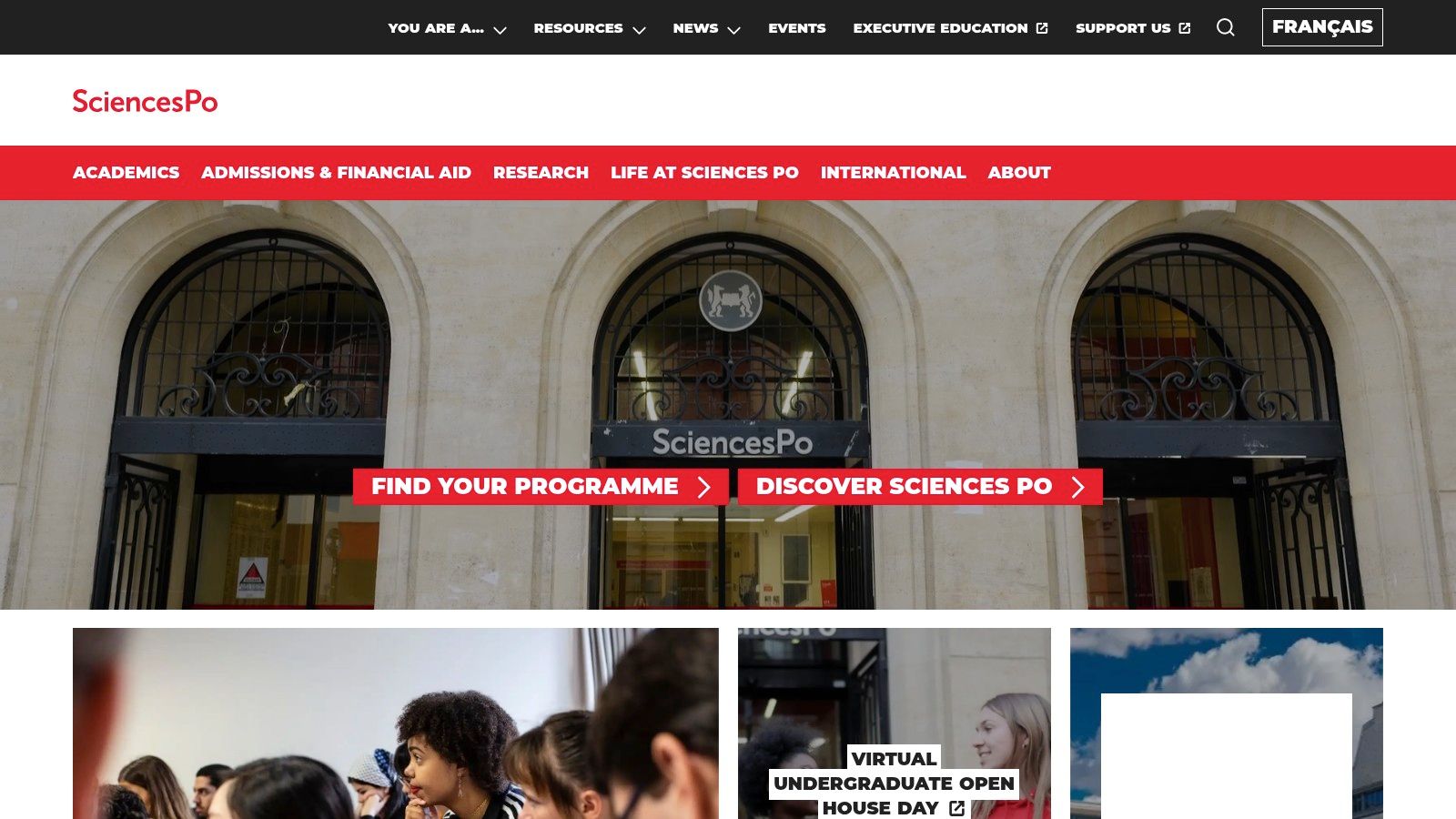
If you're aiming for public affairs, political science, international relations, or policy work, Sciences Po is the clearest specialist choice in this group. Its Paris campus is in Saint-Germain-des-Prés, and the institution also has campuses elsewhere in France. It offers graduate degrees, dual degrees, exchange programs, and executive education, with many graduate dual-degree programs taught in English.
Sciences Po's graduate-outcomes data show that nine in ten graduates who enter the labor market are employed, and 98% of employed graduates find work within five months. The institution also reports that 57% secure a position before graduation, around 30% begin their careers abroad, and 73% of graduates employed 30 months after graduation hold permanent contracts (Sciences Po graduate outcomes).
Prepare for the work beyond the classroom
A strong language plan should cover more than conversation. If you're targeting policy or international careers, practice structured writing, formal presentations, interviews, administrative French, and terminology in your intended sector. English-taught graduate study can reduce the French requirement inside the classroom, but French may still matter for internships, networking, and daily life.
Admissions are selective, and applicants need to use the route appropriate to their educational background. Tuition can also be high for many non-European students, although need-based aid and tuition waivers are available to eligible students. Confirm the current fee rules and aid criteria with the institution before you make a budget.
Best for: public affairs, diplomacy, international relations, NGOs, and policy-focused study. Trade-off: selective admissions, potentially high tuition, and a need to prepare for both academic and professional communication. For focused practice, online university French classes can support your study goals. Find admissions information on the Sciences Po website.
Top 7 Universities in Paris: Comparison Table
Compare these universities by academic goal, admissions demands, and the French you'll need in practice. I'd treat the table as a shortlist, not a ranking: the programs and entry requirements vary by school and degree, and the 2027 QS figures aren't included here.
| University | Best fit | Admissions and study reality | French-language preparation |
|---|---|---|---|
| Université PSL | Research across disciplines | Selective; requirements differ among constituent schools. English-taught options are more common at master's level. | Check the target program's language rules. For French-taught study, prepare for the required level and certification, such as DELF or DALF. |
| Institut Polytechnique de Paris | Engineering, mathematics, computing, and data science | Highly selective; strong technical or quantitative preparation is expected. Programs and fees vary by school, and the campus is in Palaiseau. | Confirm whether your program is taught in English or French. Conversational French can help with daily life and campus integration. |
| Sorbonne Université | Humanities, science, engineering, and medicine | Entry requirements depend on the faculty and program. French is generally needed for undergraduate study; English-taught master's options are available. | Start DELF or DALF preparation early if your course requires French proof. Build speaking practice alongside exam preparation. |
| Université Paris-Saclay | STEM, health, and research-led study | Requirements and fees are program-specific, and campuses are spread across the southern Paris region. Some master's programs are taught in English. | Verify the language of instruction and accepted proof for your degree. Plan French study around the program's stated requirement. |
| Université Paris 1 Panthéon-Sorbonne | Law, economics, political science, and humanities | Programs span multiple sites, and many require substantial French. Some international tracks are available; non-EU fees may exceed standard rates. | French ability matters for many courses. Use DELF or DALF preparation for certification and conversation practice for seminars and administration. |
| Université Paris Cité | Health, life sciences, and multidisciplinary study | Requirements, language rules, and fees vary by course. International-student support and joint degrees are available. | Check the language requirements for your specific program. Add conversational practice if you'll study, work, or manage daily tasks in French. |
| Sciences Po | Public affairs, international relations, and policy | Selective; the application route depends on your educational background. Tuition can be high for many non-European students, with aid and waivers available to eligible applicants. | English-taught graduate study does not remove the value of French for internships, networking, and daily life. Prepare for both formal communication and conversation. |
Your Next Steps Toward Studying in Paris
I'd make your decision in this order: academic fit first, language fit second, and budget and campus logistics alongside both. PSL and Paris-Saclay make sense for research-driven study; Institut Polytechnique de Paris is the focused choice for engineering and quantitative fields. Sorbonne Université offers broad academic coverage, Paris 1 fits law and humanities, Paris Cité brings together health and multidisciplinary study, and Sciences Po is the specialist option for public affairs.
Use the university profiles above as a shortlist, not a substitute for checking program details. QS ranking figures for 2027 aren't included here because the verified information available for this guide doesn't establish those figures. An overall ranking can't tell you whether a specific degree matches your preparation, language level, or career plan.
I also won't invent a student success story or present an unverified example as real. The practical route is to check the target program's accepted French proof and required level, then build a preparation plan around it. DELF or DALF work can support certification goals; conversational practice can help you speak up in seminars, handle university administration, and prepare for interviews. They serve different needs, so plan for both if your program and future work require them.
Make your shortlist actionable
- Choose two or three universities by academic goal. Compare the actual degrees and campuses, not just the institutional names.
- Verify language requirements program by program. Ask whether the course is taught in French, English, or both, and what proof of French is required.
- Map the application route and deadlines for your 2026 intake. At Paris Cité, for example, first-year undergraduate applicants from abroad use DAP; later-entry applicants may use Études en France depending on their country.
- Check tuition for your degree and applicant status. Standard public fees, differentiated rates, exemptions, and institutional waivers can vary.
- Start French preparation early. Build exam skills if you need DELF or DALF, and practice conversational French for real interactions you'll have on campus.
If you're weighing which French preparation fits your application, book a free 20-minute consultation with Elite French Tutoring. We can assess your current level and help you plan DELF/DALF preparation or conversational French around your university timeline.