Skip to content

You've accepted a French job offer, but you still can't book the flight with confidence. Your employer may be ready to hire you, yet your work authorization, contract, French level, payroll setup, and first legal working day remain unresolved. That gap between getting hired and being allowed to start is where many international professionals lose time.
I've guided expats, diplomats, and globally mobile professionals through this process, and my advice is direct: treat work in France as three connected decisions, not a visa application followed by a job search. Your residence status, profession, language readiness, and employment contract must support one another from the beginning.
France has a mature labor market, strict working-time rules, and a workplace culture that can feel unfamiliar even to experienced professionals. In 2025, 69.3% of people aged 15 to 64 were employed, the average unemployment rate was 7.7%, and 19.7% of employees worked remotely, according to INSEE's labor market data. The country's activity rate also reached 75.1%, its highest level since 1975. Those conditions create opportunity, but they also make preparation essential.
Table of Contents
- Three Decisions You Face Before You Move
- Which Work Permit Matches Your Profile
- The French Labor Market in Real Numbers
- CVs, Cover Letters, and Interviews the French Way
- How Much French You Actually Need and How to Build It
- Employment Contracts, Pay, and Working Time Rules
- Remote Work, Telework, and the Legal Wrinkle
- Your 90-Day Plan and How We Can Help
Three Decisions You Face Before You Move
A senior software engineer in California, a hospital nurse in Canada, and a doctoral candidate in India may all say, “I want to work in France.” Their immigration paths, job searches, and first months at work can be completely different.
The engineer may have a multinational employer ready to transfer them to Paris. The nurse may need recognition of professional qualifications and stronger French before a hospital can employ them. The doctoral candidate may qualify for a researcher status connected to a hosting agreement rather than a standard employee route.
Before you compare visa forms, decide which version of the move you're making.
Decide how long France is part of your plan
A temporary assignment, a multi-year relocation, and permanent settlement aren't interchangeable. An intra-company transfer may suit someone moving for a defined corporate assignment, while a long-term employee route may make more sense for a person joining a French employer directly. A researcher, entrepreneur, or highly qualified employee may have a status designed around their professional profile rather than a generic employment contract.
This choice affects more than immigration. It influences tax planning, family arrangements, housing, social protection, and whether your employer must establish a French payroll relationship.
Identify what your profession allows
Your occupation may be regulated, in shortage, or difficult to sponsor. Healthcare, legal services, teaching, and certain technical professions can require qualification recognition or professional registration before you can perform the job. A French employer may support your authorization, but an offer alone doesn't erase professional requirements.
Ask who must carry the administrative burden. If the employer sponsors the role, expect the company to provide documents and participate in the authorization process. If you're applying independently as a founder, researcher, or qualified professional, your dossier must prove why your profile fits that category.
Test the language reality before accepting the offer
An English-speaking vacancy doesn't guarantee an English-speaking workplace. Your team may conduct technical meetings in English while using French for administration, informal conversations, clients, suppliers, and internal coordination.
My rule for candidates: if you can't explain your work history, handle a disagreement, and make a polite request in French, you're not yet ready for the full workplace.
These three forks narrow your legal and practical options downstream. Make them before you spend money on relocation.
Which Work Permit Matches Your Profile
The right French work permit depends on the relationship between your role, salary, employer, and professional activity. European Union, European Economic Area, and Swiss citizens generally start from a different baseline because they benefit from applicable mobility rights, while non-European professionals need to match their situation to an authorization category.
Several routes appear similar from outside France, but they serve different candidates.
| Permit | Eligibility Trigger | Typical Processing |
|---|---|---|
| Passeport Talent | Skilled employment, executive responsibility, international profile, or another qualifying talent category. The 2026 Talent–Qualified Employee threshold is €39,582 gross per year, according to the 2026 permit threshold coverage | Depends on the category and administration |
| Salarié or employee permit | A French employment contract supported by the sponsoring employer and reviewed through the relevant labor administration | Depends on employer documents and authorization review |
| Seasonal work permit | Seasonal employment, commonly in agriculture, hospitality, or tourism, with work limited to the permitted period | Depends on the seasonal contract and authorization |
| Intra-company transfer, ICT | A multinational employer moves an employee to a French entity or assignment | Depends on the group structure and transfer file |
The Passeport Talent is usually the first route I examine for senior technology hires, executives, researchers, and other highly qualified professionals. The EU Blue Card is a separate skilled route, with a 2026 threshold of €59,373 gross per year, as reported in the same French permit threshold update. Don't assume a high salary automatically guarantees approval. The role, qualifications, contract, and category must align.
The standard salarié route suits rank-and-file hires whose French employer is prepared to sponsor them. It's practical, but the employer has a central role, so you should confirm sponsorship before accepting an offer.
Seasonal authorization works for time-limited agriculture and hospitality roles. It isn't a substitute for a long-term employment status. ICT is the natural comparison for multinational transferees because the move begins inside an existing corporate structure.
Academics should also examine the researcher card, while founders may need an entrepreneur or business-creation route. I recommend using a specialized French work visa assessment alongside qualified immigration advice, especially when your employer uses several entities or your contract combines employment with international duties.
The question you need to answer is simple: Will your employer sponsor you, does your salary clear the relevant threshold, or do you qualify through your professional merit?
The French Labor Market in Real Numbers
A strong profile can still stall in France if language readiness, workplace expectations, and work authorization are treated as separate afterthoughts. The official figures show 69.3% employment among people aged 15 to 64, an average unemployment rate of 7.7%, remote work for 19.7% of employees, and an activity rate of 75.1%, according to INSEE.
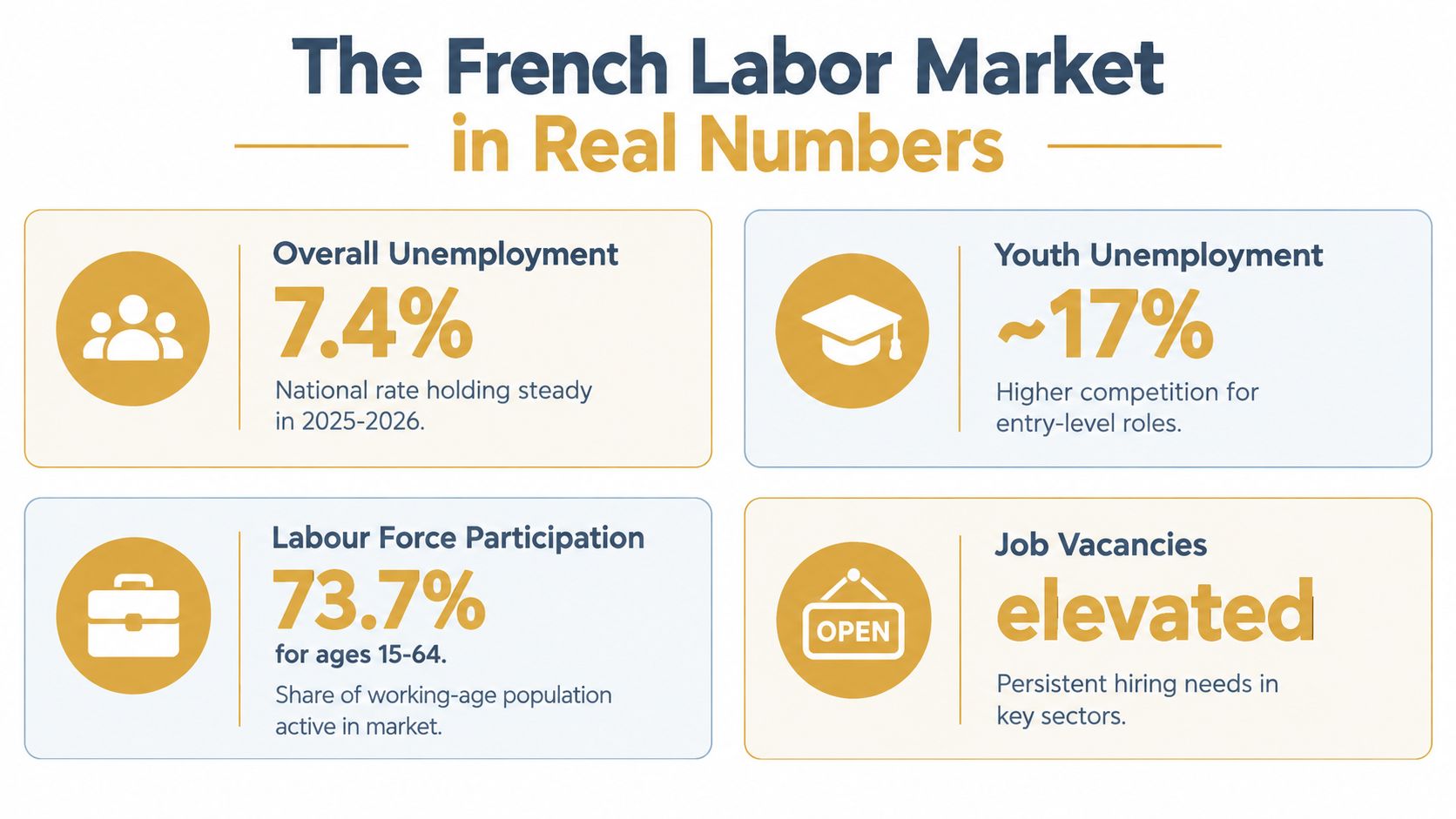
These figures describe a broad, established workforce, not a market waiting for every international applicant. Employers do hire from abroad when candidates offer scarce technical knowledge, multilingual ability, research credentials, or experience managing cross-border operations. Your advantage must be specific enough for an employer to justify the extra hiring and administrative work.
Where international candidates tend to compete best
English-language roles appear most often in multinational companies, technology firms, research environments, and teams operating across borders. Paris remains the largest international hub. Lyon and other regional centers can offer strong opportunities, depending on the sector and the employer's working language.
The remote-work figure also changes how you assess location. Hybrid arrangements may reduce the need to live beside a central Paris office, while regional employers may still expect regular on-site attendance. Confirm the schedule, office location, and permitted worksite before accepting an offer.
Remote eligibility does not authorize work from France for a foreign employer. Immigration status, tax residence, payroll, and social-security obligations remain separate questions. Check those conditions before you move, not after your first remote workday.
Why job searches take longer for foreign applicants
Your application may pass through several checks. A recruiter assesses fit, the employer confirms that sponsorship is workable, and an administration may review authorization. Regulated professions can add qualification recognition and language requirements.
Use a targeted search:
- Choose employers carefully: Prioritize companies with international teams and experience hiring non-European professionals.
- Match the role to your status: Avoid jobs whose salary or qualification profile cannot support your likely permit.
- Treat French as a hiring asset: Intermediate French can improve collaboration after you reach the shortlist.
- Prepare administrative answers: State your nationality, residence, authorization needs, and availability clearly.
For a role-by-role search strategy, compare work opportunities in France with your profession, location, and sponsorship requirements.
CVs, Cover Letters, and Interviews the French Way
French recruitment rewards precision. Your CV should tell a recruiter quickly what you studied, where you worked, what you can do, and why your profile fits the role.
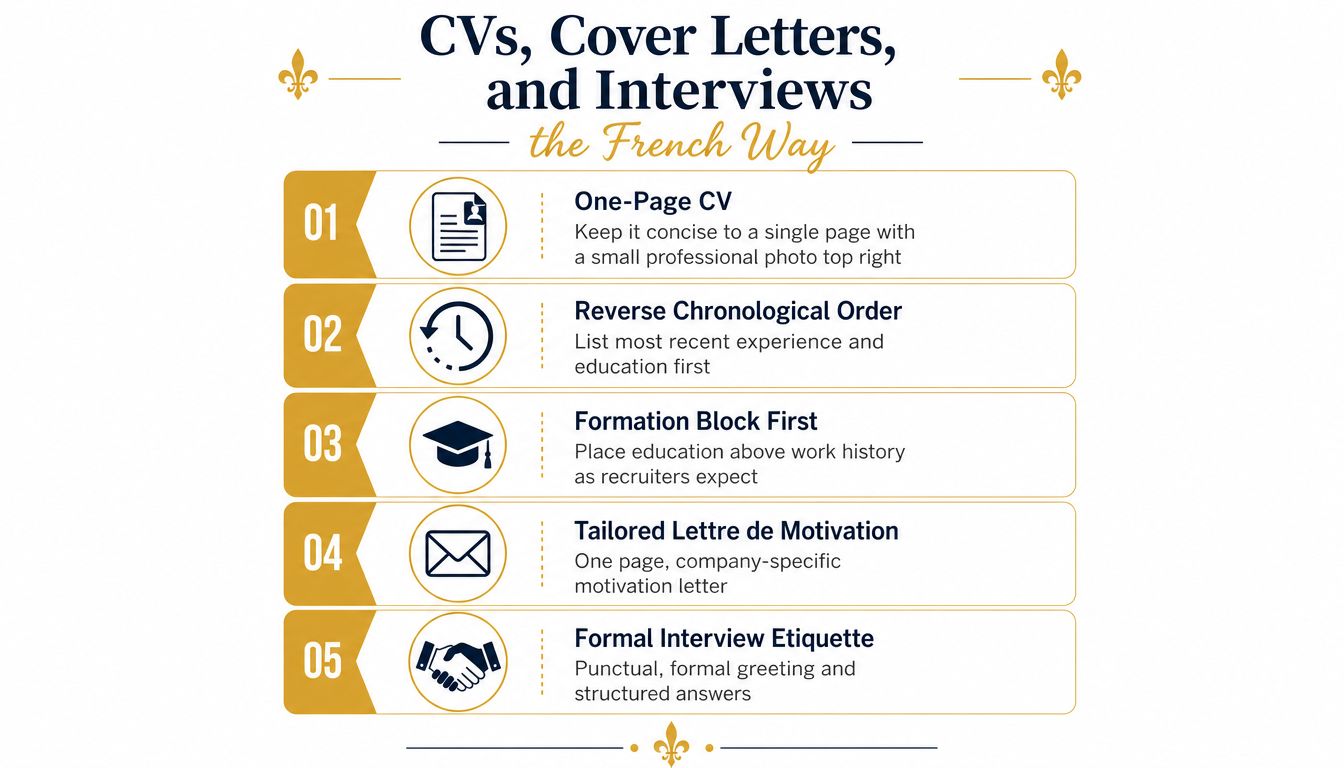
For many candidates, a one-page CV remains the safest format. A small professional photo is common, though you should use judgment for international employers. Put experience in reverse chronological order and create a clear Formation block, particularly if your degree or technical training is central to the role.
Don't submit an unadapted English résumé and expect the recruiter to translate your career logic. Translate the job title where appropriate, clarify equivalent qualifications, and explain achievements in terms a French hiring manager can evaluate.
The cover letter still carries weight
A lettre de motivation should answer two questions directly: why this position and why this company. Avoid a generic paragraph about passion, excellence, or international ambition. Connect one specific part of your background to one identifiable business need.
Corporate applications usually work best as tracked PDF submissions through the employer's recruiting system. Smaller firms may still appreciate a more personal approach, but handwritten applications are not the default for every employer. Ask a local contact or recruiter which format fits the company before sending something unusual.
Leave hobbies off unless they help demonstrate genuine team fit, leadership, discipline, or a relevant interest. Your professional evidence should occupy the limited space first.
Interviews reward structure and composure
French interviews can be formal at the start. Use Madame or Monsieur until the interviewer invites a more familiar form of address. Arrive prepared to discuss not only your technical work but also how you'll operate within French workplace conventions.
Structured behavioral answers work well. Use a STAR-style sequence, situation, task, action, and result, without forcing every answer into a rigid formula. Salary is commonly discussed seriously once the employer is moving toward an offer, not necessarily during the first screening call.
Interview standard: answer the question asked, give evidence, and show that you understand how the team communicates.
Review French business culture before interviews, especially if you're unfamiliar with formal greetings, hierarchy, meeting rhythm, or disagreement in professional settings.
How Much French You Actually Need and How to Build It
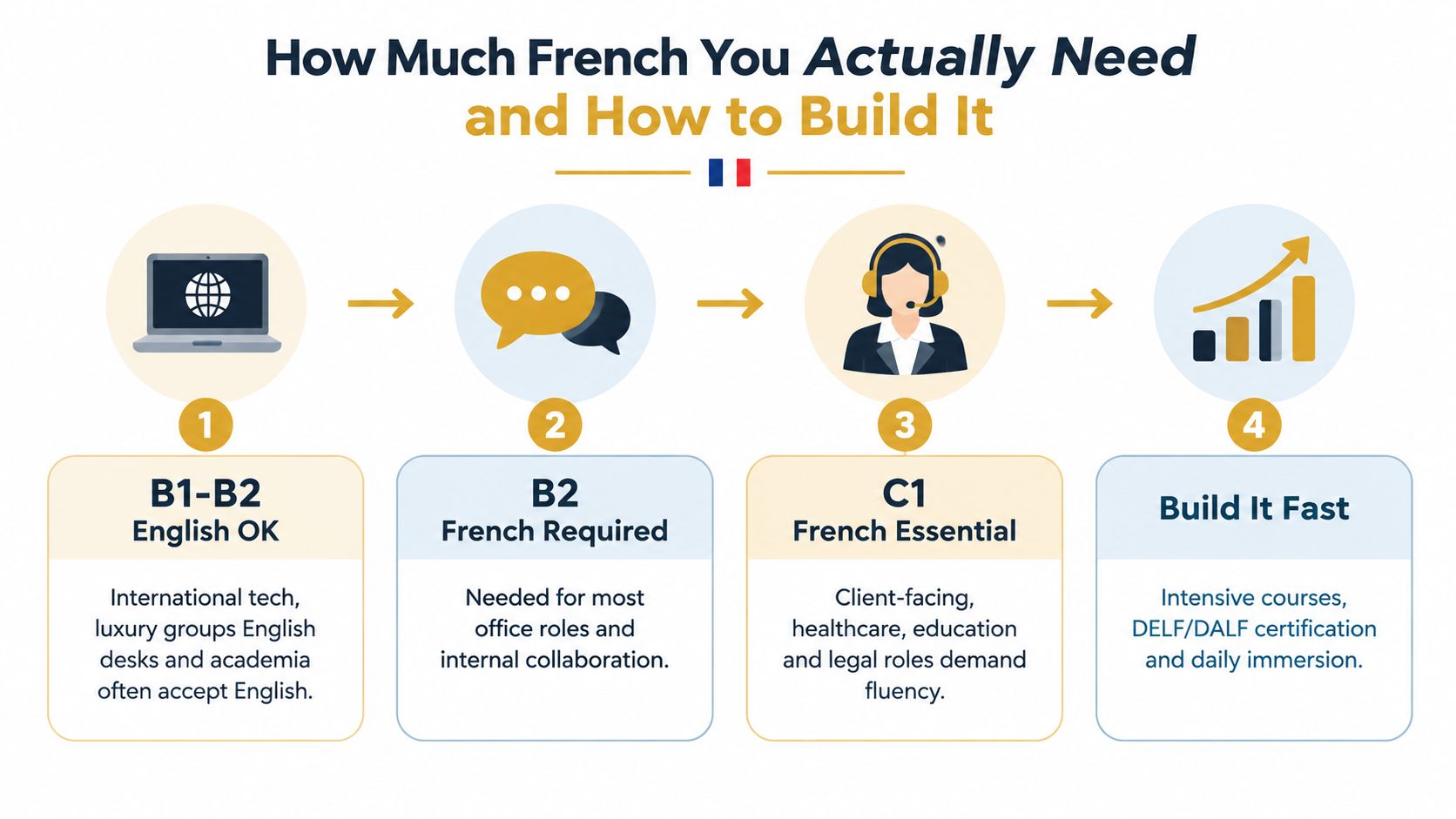
The right French level depends on the job, not your relocation ambition. An international technology company may accept English for technical work, while a French-speaking manager, customer, regulator, patient, or supplier may expect you to operate in French from your first week.
International tech firms, English-speaking desks at luxury groups, and academic environments can sometimes work with English and developing French. Client-facing roles, healthcare, public administration, and many small and medium-sized companies usually demand stronger French, including sector vocabulary.
Use a practical progression
If you're starting at A0, reaching B1 can require roughly six months at five to seven hours per week, based on the preparation framework used for this relocation plan. Moving from B1 to B2 often takes another four to six months, while B2 to C1 can require three to six months of immersion or structured tutoring. These are planning ranges, not guarantees, and your current exposure, consistency, and professional goals will change the result.
At work, grammar is only one piece. You need to follow fast speech, interrupt politely, write a clear email, participate in meetings, and understand what colleagues imply rather than say directly.
Build workplace French, not only classroom French
A useful program combines:
- Spaced repetition: Learn role-specific vocabulary and review it consistently.
- Conversation practice: Rehearse introductions, updates, disagreement, and requests.
- Professional simulations: Practice interviews, phone calls, presentations, and written reports.
- Feedback on real materials: Rewrite emails, review meeting language, and improve explanations of your experience.
DELF B2, DALF C1, or TCF may help when an employer, university, or authority requests evidence. Don't book an exam to collect a certificate. Choose the test that matches your actual application requirement.
For a personalized route, French certification preparation can help you connect exam work with the French you'll use in your role. Elite French Tutoring is one option for customized online or in-person lessons focused on professional communication, interviews, meetings, and workplace vocabulary.
Employment Contracts, Pay, and Working Time Rules
You receive a French job offer, yet the contract still determines whether the role is stable, renewable, and compatible with your authorization. A CDI is an open-ended contract. A CDD ends on a set date and is allowed only for defined situations, with renewal limits set by law or the applicable collective agreement.
Read the contract before you sign. It should state the job, location, remuneration, working time, applicable collective agreement, trial period, and termination conditions. If you need work authorization, confirm that these terms match the documents submitted with your application. Getting hired and being legally cleared to start are separate steps.
| Element | Standard Rule | Notes for Foreign Workers |
|---|---|---|
| Contract type | CDI is open-ended. CDD is fixed-term and restricted to permitted situations | Confirm that the contract supports the residence and work route |
| Statutory working time | Full-time work is based on 35 hours per week, 151.67 hours per month, and 1,607 hours per year, according to Service-Public | Your schedule may include RTT or an agreement that organizes working time differently |
| Overtime | Hours beyond the legal working-time framework can be overtime | Check premiums and annual limits against the contract and collective agreement |
| Wage floor | The 2026 SMIC is €12.31 gross per hour, or about €1,867 gross per month on a 35-hour contract, according to French employment-law guidance | A collective agreement may set a higher minimum for your classification |
| CDI trial period | A CDI trial period isn't mandatory, and its maximum legal length is 2 months, according to Service-Public | Check the written clause before signing |
Working time is a planning issue
The 35-hour framework sets the legal baseline, not a universal daily departure time. Collective agreements, senior-executive classifications, RTT arrangements, and overtime provisions determine how your schedule operates in practice.
Daily working time generally cannot exceed 10 hours. One week cannot exceed 48 hours, and the average across 12 consecutive weeks cannot exceed 44 hours. Review the specific maximum-duration rules before accepting a schedule. Hours beyond the annual framework count as overtime, and where no company agreement changes the limit, the annual overtime cap is 220 hours, according to the official overtime guidance.
The first 8 overtime hours are generally paid at 25% above the normal rate, while later overtime is generally paid at 50% above the normal rate, subject to the applicable agreement and legal rules. Check whether your collective agreement sets different terms before relying on the default rates.
Your payslip will show social-security deductions, unemployment-related contributions, and CSG contributions. Before comparing offers, ask the employer to explain gross pay, net pay before tax, withholding, benefits, and any RTT arrangement. That comparison often exposes a less attractive offer that looks better on gross salary alone.
Remote Work, Telework, and the Legal Wrinkle
Working from your apartment in France doesn't make French obligations disappear. Physical presence matters, even when your employer, bank account, clients, and laptop are located elsewhere.
France doesn't offer a dedicated digital nomad visa as a standalone category, and recent guidance warns that remote work on a long-stay visitor visa is prohibited. Employer-focused guidance on remote work and French authorization also highlights the central question many candidates miss: what residence status makes the work legal?
Formalize the arrangement
Regular telework is typically recorded through a collective agreement, employer charter, or written agreement. That document should address:
- Approved locations: Identify where you may work and whether travel between countries is allowed.
- Equipment and security: Clarify devices, data protection, confidentiality, and incident reporting.
- Expenses: Confirm how electricity, connectivity, workspace, and equipment costs are handled.
- Accidents and health: Establish how workplace incidents and health-and-safety duties are managed.
- Reversibility: Define when the employer can require a return to the office.
Current French guidance states that the social-security-exempt telework allowance is a relatively small flat amount per day, with monthly caps that vary according to whether an agreement exists. Don't assume a reimbursement policy from your home country will satisfy French payroll treatment. The operational details matter.
Foreign employers need a real compliance review
A durable connection to France can raise questions about payroll registration, social security, individual tax, corporate presence, permanent-establishment risk, data protection, and transfer pricing. A foreign employer may use an employer of record, but that changes cost and control without removing the need to understand the arrangement.
Managers should also align schedules, rest periods, the right to disconnect, monitoring practices, and health-and-safety responsibilities with French requirements. An official work-authorization procedure for foreign hires confirms that employer procedures remain active, not a one-time formality.
Before the first French workday: obtain written advice from French employment, payroll, and tax specialists if you'll travel frequently, manage a French team, or work from a client site.
Your 90-Day Plan and How We Can Help
A successful relocation starts before the offer becomes urgent. I recommend dividing the process into three phases, with a compliance folder that follows you from application to arrival.
Days 1 to 30
Confirm the likely permit route and identify whether the employer will sponsor. Shortlist roles that match your qualifications, salary profile, and language level. Adapt your CV, begin role-specific French study, and build a realistic relocation budget covering the visa process, housing, transport, deposits, professional services, and family needs.
Start collecting documents immediately. Diplomas, civil-status records, employment letters, translations, and apostilles can determine whether your intended start date is realistic.
Days 31 to 60
Move from broad research to targeted applications. Contact recruiters who regularly handle international placements, attend relevant professional events, and ask prospective employers how they handle authorization and payroll.
Use this period for interview rehearsal in both languages. Prepare a concise explanation of your experience, your reason for moving, your authorization needs, and the workplace situations you'll handle in French. Verify the employer's legal entity, work location, contract type, and expected schedule before you treat an offer as final.
Days 61 to 90
Once you have an offer, complete work authorization before you assume you can begin. Check that the contract, salary, location, working time, collective agreement, and permit file agree with one another. Then organize payroll, social protection, housing, banking, insurance, and registration tasks.
Keep a digital compliance folder containing:
- Identity documents: Passport copies and residence documentation.
- Qualifications: Diplomas, equivalence records, certifications, and translations.
- Address evidence: Housing documents and proof of residence.
- Employment records: Offer letters, signed contracts, amendments, and payslips.
- Tax and social records: Relevant declarations, registration evidence, and adviser correspondence.
Build delays into your plan. Permit review, apostilles, employer eligibility, and family documents can all affect the legal start date.
Language preparation shouldn't stop when you land. Continue with meetings, client communication, email tone, and workplace vocabulary. A tutor can diagnose the level your sector requires and rehearse the precise conversations that slow you down.
If you're preparing for a French job search or relocation, book a free 20-minute consultation with Elite French Tutoring to discuss your current level, target role, and professional communication goals. Pair language preparation with qualified immigration, payroll, and tax advice, and you'll arrive ready to work rather than still trying to make the arrangement legal.